How Ustad Bismillah Khan Made a Ceremonial Instrument Eternal
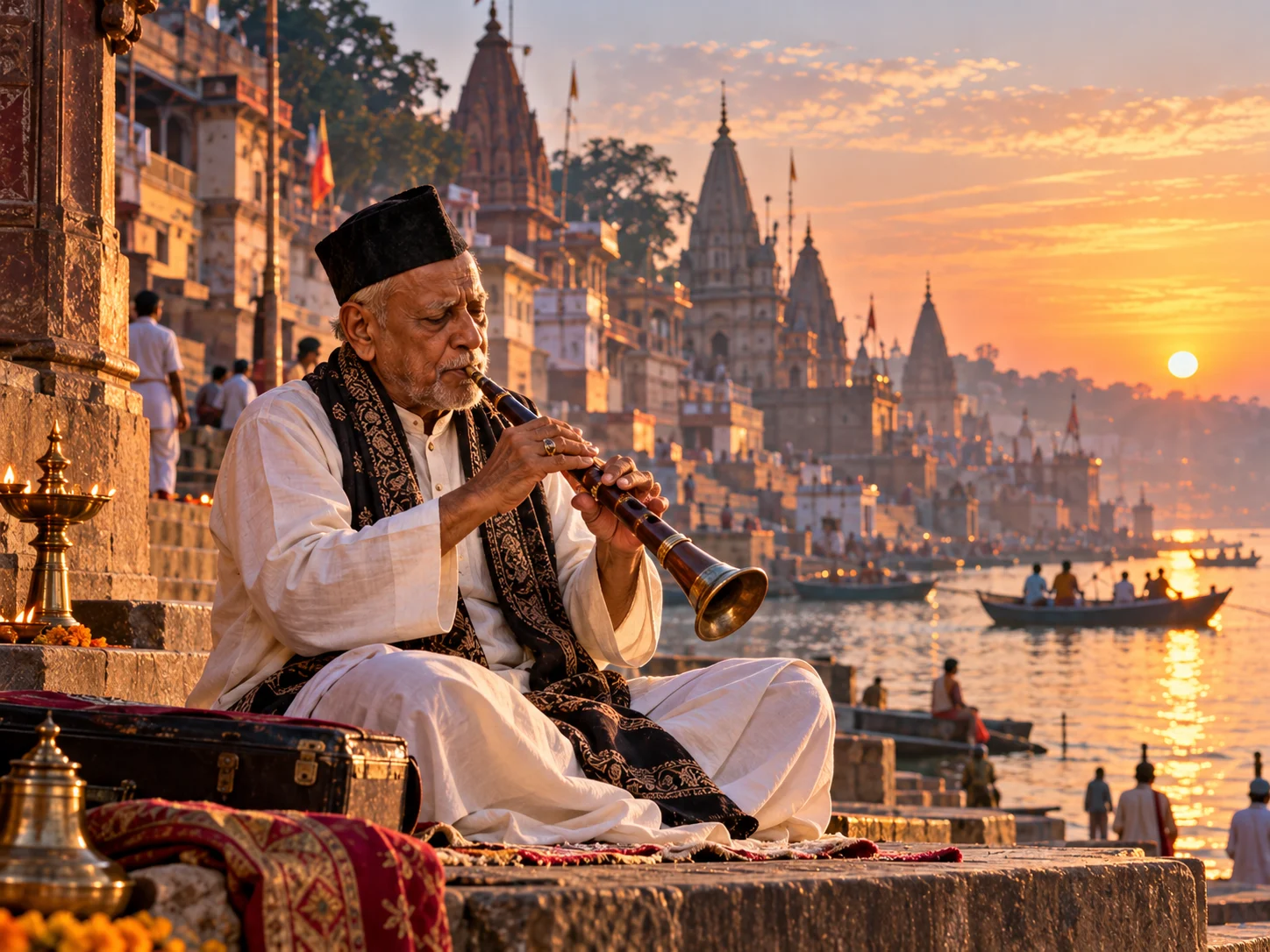
Every morning for most of his ninety years, Ustad Bismillah Khan walked to the Vishwanath Temple on the banks of the Ganga in Varanasi and played his Shehnai for the goddess. He was a Muslim man playing devotional music for a Hindu deity in one of Hinduism’s most sacred cities, and he saw absolutely nothing remarkable about this. The Shehnai, he said, was his prayer. Saraswati was the goddess of music. The Ganga was the river that understood everything. These were simply the facts of his life, and he lived inside them with a completeness and a joy that made him one of the most beloved musicians India has ever produced. His story is not only the story of a man and his instrument. It is the story of what music can be when a human being gives their entire life to it without reservation.
Born into a Tradition
Bismillah Khan was born on 21 March 1916 in Dumraon, a small princely state in Bihar, into a family whose relationship with music was not a hobby or a profession but an identity so completely assumed that separating the family from its music would have been like separating a river from its current. His grandfather, Rasool Bux Khan, had been a court musician to the Maharaja of Dumraon. His father, Paigambar Bux Khan, was also a musician of the royal court. The household he was born into was one in which music was the first language, in which the Shehnai was as present as furniture, and in which the question of what a child would do with his life was answered before it was asked.
He was named Qamruddin at birth. The name Bismillah, which means in the name of God in Arabic, came to him later, reportedly because his grandfather, hearing the infant cry for the first time, declared that the sound was as auspicious as saying Bismillah, the opening word of the Quran. Whether the story is precisely accurate or has been shaped by the affectionate mythology that accumulates around great lives, it has the quality of truth. The name suited him. Everything he did for ninety years began, in the most literal sense, with devotion.
When he was around six years old, his family sent him to Varanasi to live with his maternal uncle, Ali Bux Khan, who was a Shehnai player at the Vishwanath Temple. This move, made for practical reasons of musical education and family connection, shaped everything that followed. Varanasi did not simply become Bismillah Khan’s home. It became his spiritual anatomy.
Hemis Festival: Sacred Cham Dances That Offer Liberation in Ladakh
The Education of a River
Varanasi, called Kashi in its ancient name and Banaras in its colloquial one, is one of the oldest continuously inhabited cities in the world. It sits on the western bank of the Ganga at a point where the river curves in a way that faces the rising sun, and the ghats that descend to the water have received the prayers, the cremations, the rituals, and the daily ablutions of Hindu devotion for at least three thousand years. The city is simultaneously the most spiritually concentrated and the most viscerally alive place in India, a combination that makes it impossible to inhabit neutrally. Varanasi demands a response from everyone who lives within it.
Bismillah Khan’s response was the Shehnai.
Under the tutelage of Ali Bux Khan at the Vishwanath Temple, he learned not only the technical vocabulary of the instrument but the specific quality of listening that the temple environment demanded. Playing at a temple is different from playing at a concert. The audience at a temple is not evaluating performance. It is engaged in its own devotional practice, and the music’s function is to deepen that practice rather than to display the musician’s skill. This understanding, absorbed through years of daily temple playing before he was old enough to have formed any self-consciousness about it, became the foundation of everything he later did on the concert stage.
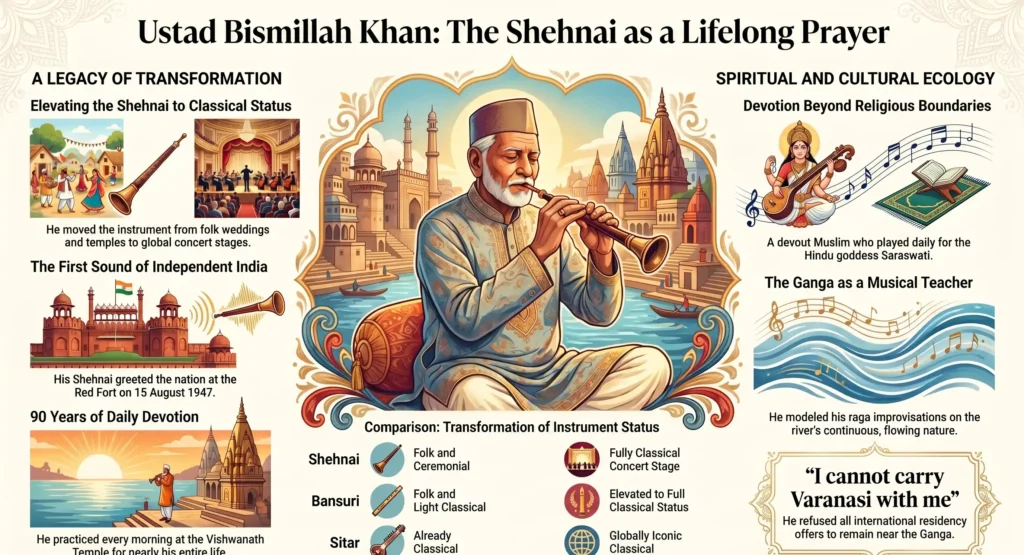
He practised with a discipline that his students and contemporaries described consistently as something beyond ordinary human capacity. He rose before dawn. He played at the temple. He practised through the morning. He sat with the river. The Ganga was not metaphorical in his life. He listened to it. He described the river’s sound as a teacher, specifically its quality of continuous flow, of finding a path through every obstacle without losing its essential nature, as the model for what improvisation in raga should aspire to be.
How Mirabai Left the Palace and Found Her God
From Ceremony to Immortality
The Shehnai is not a gentle instrument. It is made of wood and metal, played through a double reed, and its sound in untrained hands is harsh, insistent, and penetrating in the way that ceremonial instruments must be to carry across open courtyards and temple grounds. For most of its history in the Indian subcontinent, the Shehnai lived in exactly these contexts, at weddings, at temple rituals, at the auspicious moments of community life where its sound was required not for its beauty but for its volume and its ceremonial power.
Nobody who heard Bismillah Khan play would describe the Shehnai as harsh. What he did to the instrument, over nine decades of daily practice and performance, was something that cannot be entirely explained through technical analysis, though the technical dimensions of his mastery were extraordinary. He found inside the Shehnai a quality of longing, a particular kind of lyrical ache, that had perhaps always been latent in the instrument but had never been fully drawn out because no one had ever listened to it with the depth of attention and love that he brought to it every single morning of his life.
In the taxonomy of Indian classical music as it was understood in the early twentieth century, instruments were arranged in an informal but powerful hierarchy. At the top sat the instruments of the concert stage, the sitar, the sarod, the tabla, the sarangi. The Shehnai was not among them. It was a mangal vadya, an auspicious instrument, played at weddings and temple rituals, valued for its social function rather than its musical depth. Its practitioners were respected craftsmen of sound, but they were not considered classical artists in the sense that a sitar player was considered a classical artist.
Bismillah Khan changed this not through argument or advocacy but through the simple, devastating method of playing the Shehnai so magnificently, in concert after concert, raga after raga, that the existing hierarchy had no intellectually honest way to exclude him from its highest levels. The All India Radio sessions he recorded from the 1930s onward, the concerts at the Harballabh Sangeet Sammelan in Jalandhar, the performances at the ITC Sangeet Research Academy events, and above all the international concerts in the United States, Europe, Canada, and Japan through the 1960s and 1970s, each added another layer to the argument that the Shehnai in the right hands was not a ceremonial instrument but a vehicle of classical music of the highest order.
The Muslim Who Prayed to the Goddess
The spiritual centre of Bismillah Khan’s life was a relationship that defied easy categorisation and that he himself never felt any need to explain or defend. He was a devout Muslim who observed the five daily prayers of Islam throughout his life. He was also a man who played his Shehnai every morning at the Vishwanath Temple as an act of devotion to Goddess Saraswati, who sat on the banks of the Ganga and felt the river as a living spiritual presence, and who described his music not as a performance but as an offering.
In a country where religious identity has become increasingly hard-edged and politically charged, Bismillah Khan’s spiritual life was a standing rebuke to the idea that faith must be exclusive. He did not experience any contradiction between his Islamic practice and his devotion to Saraswati. He experienced them as expressions of the same fundamental impulse, the human being’s reaching toward the divine through the most complete engagement of which they are capable.
His explanation, when asked about this, was characteristically simple. Music is the language God understands best. The goddess of music is Saraswati. When I play for her, I am playing for God. What is the confusion? There was no confusion in him. The confusion existed only in the minds of those who needed religious boundaries to be more rigid than music allows them to be. This quality of spiritual inclusivity was rooted in Varanasi’s specific cultural and spiritual ecology, where the boundaries between traditions have always been more porous than religious orthodoxy in any direction would prefer.
Ancient Agricultural Myths That Shape the Magh Bihu Harvest Festival
The Sound of a Nation’s First Morning
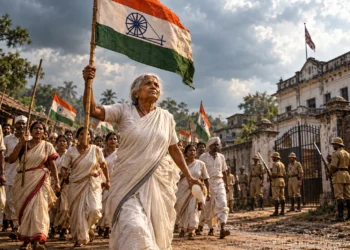
On 15 August 1947, the night before India’s formal independence, when Jawaharlal Nehru delivered his Tryst with Destiny speech at the stroke of midnight, the formal documents of India’s freedom were being prepared at the Red Fort. When the sun rose on independent India the following morning, the first sound that greeted the nation at the Red Fort in New Delhi was the Shehnai of Bismillah Khan.
This was not a casual choice of programming. The selection of Bismillah Khan to play at India’s first Independence Day celebration was a deliberate cultural and political statement about the kind of nation that India intended to be. A Muslim musician from Bihar, playing a classical instrument on the ramparts of a Mughal fort, welcoming the dawn of a Hindu-majority secular democratic republic with a morning raga, was an image so precisely calibrated to the ideals of the new nation that it could almost have been designed as a symbol.
Bismillah Khan was thirty-one years old. He would go on to play at every Republic Day celebration for years afterward, and the association between his Shehnai and the nation’s most solemn public occasions became so established that in many Indian minds the sound of the Shehnai and the feeling of patriotic devotion became genuinely intertwined. He was invited to perform internationally soon after, and the concerts in Europe and North America through the 1950s and 1960s introduced the Shehnai to audiences that had never encountered the instrument. The critical reception was consistently extraordinary. Western music critics who heard him perform wrote with the particular bewilderment of people encountering something their existing vocabulary cannot quite contain, reaching for words like ecstatic and transcendent and finding them insufficient but necessary.
The Man Who Would Not Leave
Throughout his career, Bismillah Khan received offers that would have made any other musician’s decision straightforward. He was invited to take up residency positions in the United States, in Canada, in several European countries. He was offered teaching positions at major international music institutions. He was presented with opportunities for a level of international celebrity and financial comfort that his life in Varanasi, which was never wealthy and was sometimes genuinely difficult, could not provide.
He declined all of them. The reason was always the same, expressed with the same gentle, absolute clarity every time it was asked. Where is the Ganga? Where is the Vishwanath Temple? Where are the ghats? I cannot carry Varanasi with me. So I must stay in Varanasi. This was not false modesty or performative humility. It was a precise statement of a spiritual reality. His music was not separable from the place that had formed it. The morning ragas he played at the temple were not simply exercises in a classical tradition. They were a specific conversation between a specific man and a specific river and a specific goddess in a specific city.
The depth of this attachment was expressed most movingly in the interviews he gave in the final years of his life, when he spoke with increasing sorrow about the changes he was witnessing in Varanasi and in India more broadly. He was troubled by what he perceived as a hardening of communal boundaries, a diminishing of the easy, daily pluralism that had been the unremarkable texture of his Varanasi childhood. He wept in several documented interviews, not for himself but for a way of being Indian that he feared was being lost.
How Goa’s Shigmo Festival Carries Myths Older Than Its Own Name
What a Raga Holds
To appreciate what Bismillah Khan did with the Shehnai, it helps to understand what a raga is and what it demands of the musician who plays it seriously. A raga is not a scale, though it has a specific set of notes. It is not a melody, though it generates melodies. It is closer to a personality, a specific emotional and spiritual territory that a musician enters and explores through improvisation within defined parameters. Each raga has a time of day or night at which it is meant to be performed, a season, an emotional quality, and a set of associations drawn from centuries of musical practice and poetic tradition.
When Bismillah Khan played Raga Bhairav at dawn, he was not simply performing a morning raga. He was entering a specific spiritual geography that the tradition had mapped with great precision, the grey-blue light of early morning, the first birds, the particular quality of silence before the city wakes, the particular quality of longing that the soul experiences in the moment between sleep and full wakefulness. The raga was a container for these specific experiences, and his Shehnai was the instrument through which he inhabited the container completely.
His improvisations were described by fellow musicians and critics as having a quality of inevitability, as if each phrase he played was the only phrase that could logically follow the previous one, even though the improvisation was being created in real time and could not have been predicted by anyone including the musician himself. This quality of inevitability in improvisation is the mark of a musician who has internalised the grammar of the raga so completely that their musical thought and the raga’s logic have become the same thing. His Shehnai playing possessed a quality of prayer that was independent of any specific religious content, a quality that the music itself generated through the completeness of the musician’s engagement with it.
The Legacy That Lives in Air
Ustad Bismillah Khan died on 21 August 2006, in Varanasi, the city he had refused to leave. He was ninety years old, and he had been playing the Shehnai almost every day of those ninety years. He was buried in the Fatemaan graveyard in Varanasi, close to the city he had loved so completely and so specifically that leaving it had never been a genuine option.
The obituaries that followed his death were extraordinary in their geographic range and their emotional register. They came from classical music communities in India, from the South Asian diaspora in North America and the United Kingdom, from world music critics in France and Germany and Japan, from political figures and from ordinary people who had never attended a classical concert but who felt, without quite being able to say why, that something irreplaceable had left the world.
He was awarded the Bharat Ratna in 2001, India’s highest civilian honour, becoming one of the few classical musicians to receive it. The citation from the Government of India acknowledged his contribution to Indian music and culture in terms that were, for official language, unusually personal in their warmth. But the most complete recognition came not from the state but from the world of music itself, where the Shehnai had been transformed from a folk instrument into a classical one, and where the name Bismillah Khan is spoken with the reverence usually reserved for figures who have fundamentally altered the landscape of their art.
He spent ninety years doing one thing. He played the Shehnai. He played it at the temple before the city woke. He played it on stages in Delhi and Bombay and New York and Paris. He played it on the banks of the Ganga when no one was listening except the river. He played it at the Red Fort on the morning India became free. He played it when he was six years old and just beginning, and he played it when he was ninety and coming to the end.
He played it as a Muslim man who loved a Hindu goddess. He played it as a Bihari who belonged completely to Varanasi. He played it as a classical musician who started with an instrument that nobody took seriously. He played it as an Indian who believed, with every note and every breath, that music was the most honest language available to a human being who wanted to reach toward something larger than themselves. The debates about religious identity and national culture that swirled around him throughout his life never touched the essential quality of what he did when he played. When the Shehnai sounded, the categories dissolved. There was only the music, and the longing inside the music, and the river outside the window, and the goddess at the temple, and the morning raga meeting the dawn.
Rukmini Devi Arundale and the Rebirth of Bharatanatyam
If you think you have remembered everything about this topic take this QUIZ
Results


#1. In which small princely state in Bihar was Ustad Bismillah Khan born in the year 1916?
#2. What was the original full name given to Ustad Bismillah Khan at his birth before his grandfather named him Bismillah?
#3. Under which maternal uncle did Bismillah Khan train as a young child after moving to the ancient city of Varanasi?
#4. Before Ustad Bismillah Khan single-handedly elevated it to the classical concert stage, what category of instrument was the Shehnai primarily considered?
#5. At which sacred landmark temple on the banks of the Ganga did Bismillah Khan perform every morning as an offering to Goddess Saraswati?
#6. On which monumental historical day did Ustad Bismillah Khan perform live at the Red Fort in New Delhi, making his Shehnai the sound of the nation’s first free morning?
#7. Why did Ustad Bismillah Khan repeatedly decline highly lucrative and prestigious international residency offers from the United States and Europe?
#8. Which premier national honor, representing India’s highest civilian award, was bestowed upon Ustad Bismillah Khan in the year 2001?
Why is Ustad Bismillah Khan considered the greatest Shehnai player in Indian history?
Ustad Bismillah Khan is considered the greatest Shehnai player in Indian history because he single-handedly transformed the instrument from a folk and ceremonial instrument into a vehicle of classical concert music of the highest order. Through decades of daily practice, temple performance at the Vishwanath Temple in Varanasi, and concert performances across India and internationally, he demonstrated that the Shehnai was capable of expressing the full emotional and spiritual range of Hindustani classical music. His Bharat Ratna in 2001 and the Sangeet Natak Akademi Award in 1956 were institutional confirmations of an artistic supremacy that his recordings make self-evident.
How did Bismillah Khan’s Muslim faith coexist with his devotion to Hindu traditions?
Bismillah Khan was a devout Muslim who observed the five daily prayers of Islam throughout his life and simultaneously maintained a deep devotional relationship with Goddess Saraswati and the Ganga at Varanasi. He did not experience these as contradictory. His explanation was characteristically direct: music is the language God understands best, Saraswati is the goddess of music, and playing for her is playing for God. This spiritual inclusivity was rooted in the specific cultural ecology of Varanasi, where Sufi and Hindu devotional traditions have coexisted and influenced each other for centuries.
What was the significance of his performance at India’s first Independence Day in 1947?
Bismillah Khan’s Shehnai performance at the Red Fort in New Delhi on 15 August 1947 was the sound that greeted independent India’s first morning. The selection of a Muslim musician from Bihar to play a classical instrument on the ramparts of a Mughal fort at the dawn of a secular democratic republic was a deliberate cultural statement about the kind of nation India intended to be. The association between his Shehnai and India’s most solemn national occasions became so established that for many Indians the sound of the Shehnai and the feeling of patriotic devotion became genuinely intertwined.
Why did Bismillah Khan refuse to leave Varanasi despite international offers?
Bismillah Khan declined multiple offers of international residency and institutional positions because he understood that his music was inseparable from the specific geography that had formed it, the Vishwanath Temple, the Ganga, the ghats, and the particular quality of spiritual life that Varanasi sustained. He stated consistently that he could not carry Varanasi with him and therefore had to remain within it. This was not false humility but a precise understanding of the relationship between a musician’s spiritual formation and the place that provides it.
What is the Shehnai and how did Bismillah Khan change its status in Indian music?
The Shehnai is a double-reed wind instrument made of wood and metal, traditionally used in India for ceremonial and auspicious occasions including weddings, temple rituals, and public celebrations. Before Bismillah Khan’s career, it was classified as a mangal vadya, an auspicious folk instrument, rather than a classical concert instrument. Through the sustained excellence of his concert performances across several decades, his All India Radio recordings, his international performances, and the institutional recognition he received culminating in the Bharat Ratna, Bismillah Khan elevated the Shehnai to full classical status, making it an instrument whose practitioners can now aspire to the highest levels of the Hindustani classical music tradition.
Sources & References
Bismillah Khan’s transformation of the Shehnai from ceremonial to classical instrument — Through decades of daily temple practice, All India Radio recordings, and concert performances across India and internationally, Bismillah Khan elevated the Shehnai from its status as a mangal vadya (auspicious ceremonial instrument) to recognition as a vehicle of classical Hindustani music capable of the highest artistic expression.
The Dumraon gharana tradition and hereditary court musician background — Bismillah Khan was born into the Dumraon gharana, a family tradition of court musicians serving the Maharaja of Dumraon, and this hereditary musical background provided the foundation for his later artistic development under his maternal uncle Ali Bux Khan at the Vishwanath Temple in Varanasi.
Varanasi’s spiritual ecology and its influence on musical formation — The specific geography of Varanasi, the Ganga river, the Vishwanath Temple, and the city’s distinctive spiritual pluralism directly shaped Bismillah Khan’s musical and devotional practice, providing the irreplaceable setting that he understood to be inseparable from his artistic identity.
Bismillah Khan’s spiritual inclusivity as Muslim devotee of Hindu traditions — The central paradox of Bismillah Khan’s life was his identity as a devout Muslim who observed Islamic prayers and simultaneously maintained a profound daily devotion to Goddess Saraswati and the sacred river Ganga, experiencing no contradiction between these forms of faith rooted in Varanasi’s centuries-old tradition of religious syncretism.
The 1947 Independence Day performance and its cultural significance — Bismillah Khan’s Shehnai performance at the Red Fort at dawn on 15 August 1947 was the sound that greeted independent India’s first morning, a deliberate cultural statement about the secular, pluralistic nation India intended to be, with his music becoming inextricably linked to India’s patriotic identity.