How a nine-year-old inherited his father’s equipment and ended up rebuilding the sound of Indian film music
R.K. Shekhar died on 30 September 1976, at forty-two, of Bright’s disease. He left a widow, four children and a room full of musical equipment.
Shekhar had spent twelve years in Malayalam cinema as a composer, conductor and arranger, credited on more than a hundred films. He was the man who took a music director’s tune off the harmonium, wrote out the orchestra’s parts, kept the instruments ready and rehearsed the players until the take. He had also bought a keyboard, early, and his second child used to watch him find sounds on it.
After he died the family lived on the rent from that equipment. Other composers hired the dead man’s instruments by the day. His son was nine.
The gear went out to work every morning. Before long the boy went out with it.
The boy in the orchestra
He had started piano at four and had spent his childhood in a house where recording sessions happened. At eleven he joined Ilaiyaraaja’s troupe as a keyboard player, which is a working musician’s job, not a prodigy’s exhibition.
He was enrolled at Padma Seshadri Bala Bhavan in Madras and could not keep up with it. Sessions ran at the hours school did, and he missed classes and failed examinations. The sessions paid and the school did not, so the sessions won.
What formal training he got came later and from a distance, with a scholarship to Trinity College of Music in London and a degree in Western classical music.
The Eternal Legacy of Charaka Samhita Medicine
Rajinikanth Life Story From Bus Conductor to Icon
Three hundred jingles
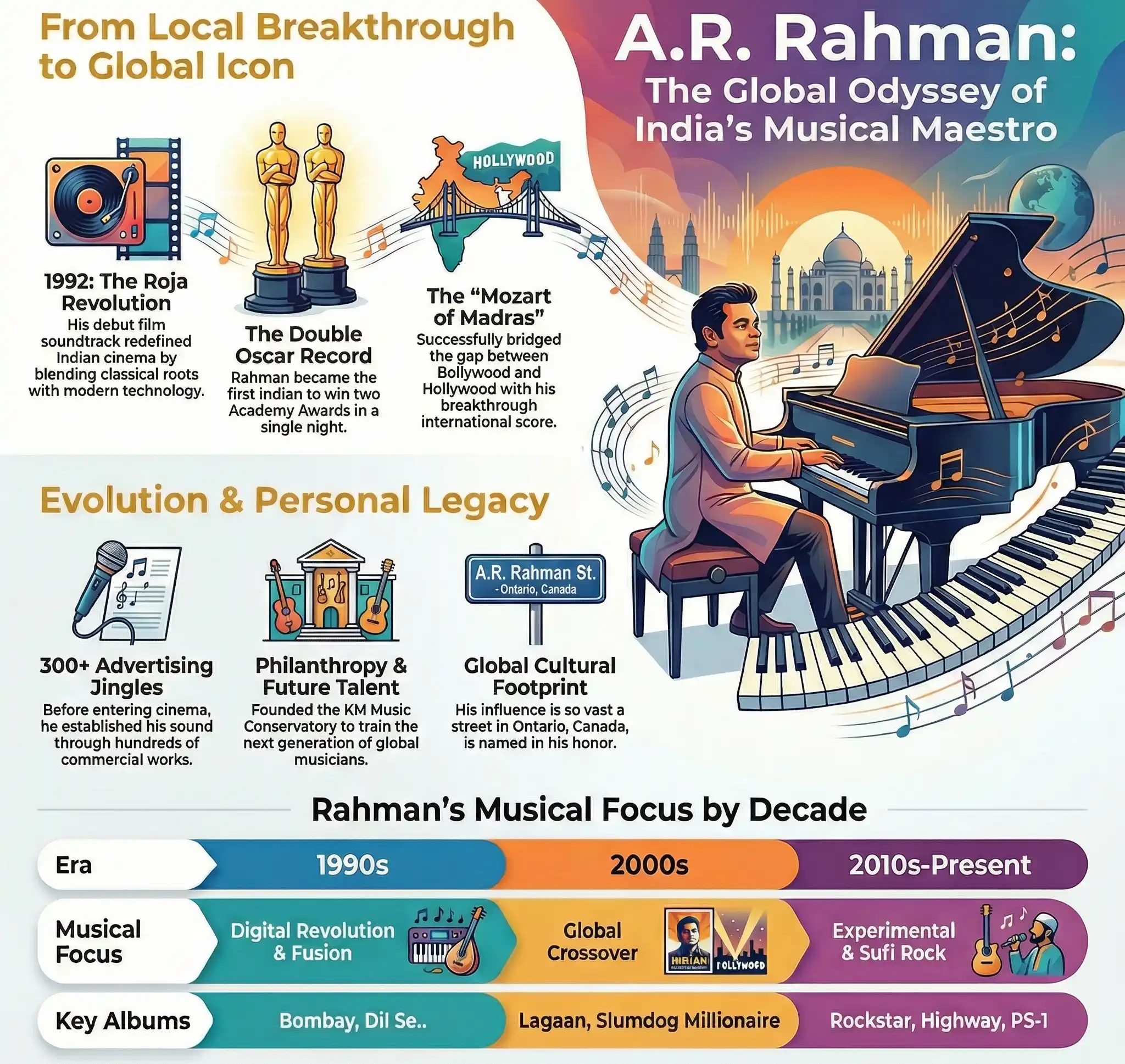
Through the 1980s he wrote advertising music, some three hundred jingles by the usual count, including the Leo Coffee spot that people in Madras could hum. Thirty seconds at a time is a hard school. It teaches a composer to get a whole idea across before the listener can look away, which is most of what a film song has to do too.
In 1989, after years of illness and money trouble in the family, they turned to Sufi Islam. Dileep Kumar became Allah Rakha Rahman. His mother Kasthuri became Kareema Begum. He has kept the devotional side of it close to the work ever since, and much of his music is built on it.
The studio behind the house
Then he did the thing his childhood had been pointing at. He built a studio, Panchathan Record Inn, in the backyard of the family house, and filled it with equipment that belonged to him.
That is a technical fact with a large consequence. A composer with his own room does not book a hall of session players by the day or work to somebody else’s clock. He can layer a track alone, at three in the morning, and keep going until it is right.
Mani Ratnam heard his jingle work and gave him Roja in 1992. The score won the National Film Award for best music direction, for a first film, and the sound of it was audibly made by one person with machines rather than by a room of musicians reading parts.
His father hired out instruments by the day. His son built a room the machines never had to leave.
Surgical Precision in Ancient Kashi: The Vision of Sushruta
What changed in the room
The Indian film score had meant a large session orchestra and a short list of playback voices. Within a few years of Roja the default had moved: smaller ensembles, programmed layers, months of studio time instead of days, and singers pulled in from outside the film circuit because a voice could now be found and used rather than booked by seniority.
The run that followed is the one everyone knows. Rangeela in 1995, Bombay, Dil Se.., Taal, Lagaan, and later Rockstar and Ponniyin Selvan. Six National Film Awards. The Padma Shri in 2000 and the Padma Bhushan in 2010.
2009
Slumdog Millionaire took him two Academy Awards in a single night, for the score and for the song, a Golden Globe, a BAFTA and two Grammy Awards the following year. The song was Jai Ho, written by Gulzar, who did not go to the ceremony.
The Oscars are the part of the story that gets told. They are also the least surprising part of it, given that he had been doing the work since he was eleven.
Kareema
In 2008 he opened the KM Music Conservatory in Chennai and named it after his mother. It teaches Western and Indian classical music, formally, to students who want the training he had to assemble on the job while keeping a household going. He married Saira Banu in 1995; the couple announced their separation in 2024.
He failed his examinations carrying his father’s instruments to other men’s recordings. He owns the studio now, and the school is named for the woman who kept the instruments.
Honoring the 50 Year Rishi Kapoor Legacy in Cinema
The Infinite Mind and Mathematical Poetry of Bhaskara II
If you think you have remembered everything about this topic take this QUIZ
Results


#1. What was A.R. Rahman’s birth name before he adopted his current name?
#2. Which 1992 film marked A.R. Rahman’s debut as a music composer?
#3. For which film did A.R. Rahman win two Academy Awards (Oscars) in a single night?
#4. A street has been named “Allah-Rakha Rahman St” in his honor in which city?
#5. Before entering the film industry, what was A.R. Rahman’s primary work?
#6. What is the name of the music conservatory founded by A.R. Rahman?
#7. As a teenager, A.R. Rahman played the keyboard for a band called “Roots” with which childhood friend?
#8. A.R. Rahman won a National Film Award for Best Music Direction for his very first film. Which film was it?
What was A.R. Rahman’s first movie?
His debut film as a composer was the Tamil classic Roja (1992), directed by Mani Ratnam.
How many Oscars has A.R. Rahman won?
He has won two Academy Awards, both for the film Slumdog Millionaire (2009).
What is A.R. Rahman’s real name?
He was born A.S. Dileep Kumar. He changed his name to Allah Rakha Rahman after converting to Islam.
Does A.R. Rahman have a music school?
Yes, he founded the KM Music Conservatory in Chennai to provide world-class musical training to Indian students.
Who is A.R. Rahman’s wife?
He is married to Saira Banu.
Read More: https://curiousindian.in/madhuri-dixit-may-1967-present/
Sources & References
Encyclopaedia Britannica (“A.R. Rahman”) — his early career, the Roja score and the international work that followed.
Scroll.in, excerpt from Kamini Mathai, A.R. Rahman: The Musical Storm — R.K. Shekhar’s career as arranger and conductor and the family’s circumstances after his death.
Academy of Motion Picture Arts and Sciences (81st Academy Awards) — the 2009 awards for best original score and best original song.
Padma Awards portal, Government of India — the Padma Shri of 2000 and the Padma Bhushan of 2010.
Author


Exploring the Soul of Bharat through History, Science, Culture, and its Diversity
Our Mission
Curious Indian is a definitive knowledge portal dedicated to chronicling the events, personalities, and cultural shifts that defined the Indian subcontinent. From the ancient Vedic Period to the complexities of 21st-century politics, our goal is to provide deep-dive analysis that inspires.
Editorial Standards & E-E-A-T
Every article published under our brand undergoes a rigorous fact-checking process. We prioritize primary historical records, academic citations, and credible archives to ensure our readers receive accurate, high-authority information.
Historical Integrity Directly sourcing from ASI archives and academic journals.Topical Authority Comprehensive clustering of Indian Science, Biographies, and Wars.Managed by Paripurna Datta and TEAM | Dedicated to the Knowledge of India.