How a Forgotten Hillside in Tripura Holds a Thousand Years of Devotion in Stone
Walk through the forest in North Tripura, and at a certain moment the trees open up. The jungle parts. And there, carved directly into the hillside, you encounter faces—enormous, patient faces, looking out across a landscape that has been growing quietly around them for over a thousand years. These are not small sculptures you examine in a museum. They are not contained in galleries or protected by glass. They are a hillside that has been transformed into art, a mountain that became sacred, a permanent statement about what it means to believe in something so deeply that you are willing to carve it into rock for eternity. Unakoti is not a famous site. Most of India has never heard of it. But the faces that wait there have been waiting longer than most religions have existed, carved during the early medieval period, lost to the mainstream historical narrative, and now—slowly—being rediscovered.
Bagha Jatin: German Plot That Shook Colonial India 1915
The Hillside Opens: The Stone Faces Appear
There is no grand entrance at Unakoti. No ticket booth. No souvenir shops scaled to the expectations of pilgrims. You walk through the forest—the air thick and green, the sounds of the jungle surrounding you—and then, almost without warning, the hill opens up. The vertical rock face is suddenly there, and carved into it are faces. Not painted. Not outlined. Carved directly into the living rock, as if the stone had been patient enough to allow human hands to reshape it, to turn it into an expression of faith.
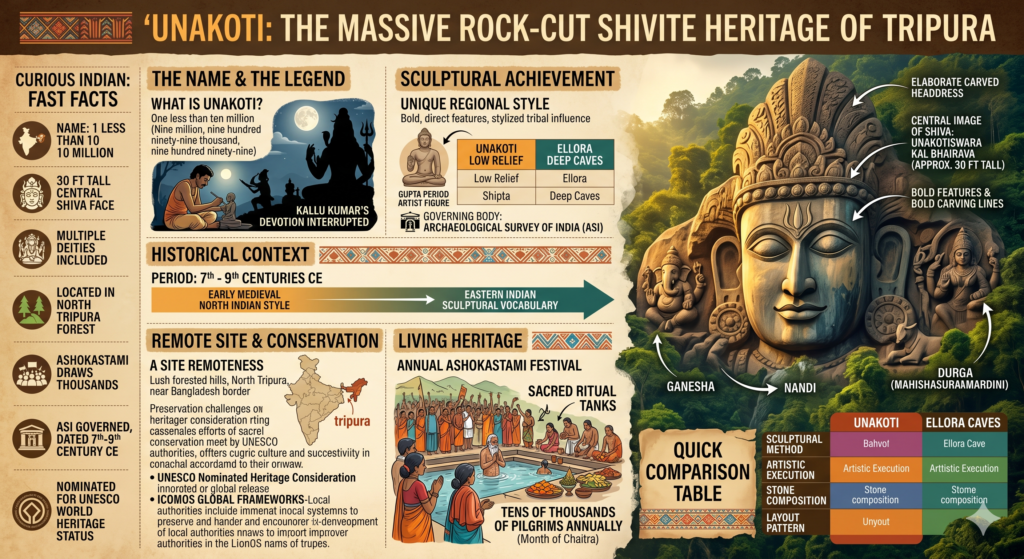
The largest of these faces is the central image of Shiva, known as Unakotiswara Kal Bhairava. It rises approximately thirty feet from the ground. To stand at the base of this face and look up is not the experience of viewing a sculpture. It is the experience of standing at the foot of a cliff, looking at something so large that it dominates your perception of scale. The face is flanked by two smaller figures and topped by an elaborate carved headdress. The proportions are exaggerated in the way that all monumental sculpture exaggerates proportion—not for close examination, but for viewing from a distance, for commanding attention across space and time.
Surrounding this central image are other carved figures: images of Ganesha, of Nandi, of Durga in her Mahishasuramardini form, of Vishnu and various attendant figures. The site is not a single work but an entire complex, a hillside that has been transformed into a temple carved from the rock itself. Near the base are water tanks, still used by pilgrims for ritual bathing, evidence that what was carved here over a thousand years ago still functions as it was intended to function.
The Legend: A Devotion That Never Quite Finished
The Cosmic Geometry Behind the Sun Temple Wheels of Konark
The name Unakoti means something precise in Bengali and in Kokborok, the local Tripuri language: one less than a koti. A koti is ten million. So the name translates, literally, to nine million nine hundred and ninety-nine thousand nine hundred and ninety-nine—one short of ten million. The name itself is a legend embedded in language, a mathematical impossibility that became a place.
The story attached to the site involves a sculptor named Kallu Kumar, a devoted follower of Shiva. In the legend, Kallu Kumar accompanies Shiva on a journey toward Kashi. Shiva makes him an offer: if Kallu Kumar can carve one koti images of the gods overnight, he will be allowed to travel with Shiva to Kashi. Kallu works through the entire night with extraordinary devotion, his hands moving across the stone, creating image after image. But when dawn comes, he has completed one less than a koti. One less. Shiva departs without him, heading to Kashi, leaving Kallu Kumar behind at the site.
In some versions of the legend, Kallu Kumar himself becomes stone, turned into an image alongside his unfinished work. In other tellings, he remains as a guardian, a presence watching over what he was not quite able to complete. What makes this legend unusual is that it frames the entire site as an act of devotion interrupted rather than concluded. There is something poignant about this. The site is not presented as a triumph but as an almost-triumph, as an effort that came close but did not quite reach completion. This gives the entire place a particular emotional texture—a sense of something still in motion despite the stillness of stone.
The Sculptural Achievement: A Regional Voice in Stone
The sculptures at Unakoti reflect a tradition rooted in the early medieval art of Bengal and the broader eastern Indian sculptural vocabulary. The site has been dated to approximately the 7th to 9th centuries CE, placing it in the early medieval period of Indian history. The style of carving is distinctive. The faces have a particular boldness that distinguishes them from the smoother, more refined figures of earlier periods. There is a directness to the carving, a power in the features that feels deliberately monumental rather than delicately refined.
The Archaeological Survey of India, which governs the site, has documented that the carvings belong to multiple phases of activity. This means that the hillside was not worked on in a single burst of construction but over an extended period. Different hands, possibly spanning different centuries, contributed to what visitors see today. The site evolved as a sacred place, with successive generations of sculptors and artisans adding to it, refining it, shaping it according to their own understanding of how to express devotion in stone.
The primary subject matter is Shaivite—devoted to Shiva—reflecting the religious tradition that dominated the region during the medieval period. But the surrounding figures show a broader religious and cultural sensibility. This was not a site created in isolation. It was part of a living religious landscape, connected to other sacred sites, influenced by regional artistic traditions, shaped by the spiritual needs of communities who came here to worship.
How the Kailasa Temple Was Carved From a Single Mountain
The Site That the World Forgot
Part of what makes Unakoti remarkable is simply how unknown it is. India has an extraordinary density of ancient sacred sites, and the competition for attention among them is fierce. Sites in Rajasthan, Tamil Nadu, Odisha and Maharashtra have benefited from better connectivity, stronger tourism infrastructure, and longer histories of scholarly documentation. Mainstream Indian culture has turned its attention toward certain sites repeatedly, building them up into symbols of national identity.
Northeast India, despite containing several sites of equal or greater historical interest, has historically received far less attention from the mainstream Indian cultural establishment. Unakoti sits in North Tripura, a state that borders Bangladesh on three sides and connects to the rest of India through a narrow land corridor. Getting there requires intention. The journey is not casual. There are no package tours that include Unakoti as one stop on a larger circuit. The people who come are pilgrims who have sought the place out, researchers pursuing specific historical interests, and the occasional traveler who has heard something about the faces in the jungle and decided to see them.
This remoteness has had paradoxical effects on the site. On one hand, it has meant less erosion from heavy tourist footfall, less commercial pressure on the surrounding environment, and a preservation of the forested atmosphere that makes the experience of encountering the sculptures so unusual and moving. On the other hand, it has meant slower conservation work, limited documentation compared to more visited sites, and a persistent underrepresentation in the national conversation about India’s artistic heritage. Institutions working on Northeast Indian heritage are gradually expanding their documentation of sites like Unakoti, but much work remains to be done.
The Living Ritual: Ashokastami and the Pilgrimage
Once a year, the quiet of Unakoti is replaced by something entirely different. During Ashokastami, a festival held in the month of Chaitra according to the Hindu calendar—usually falling in March or April—tens of thousands of pilgrims make the journey through the forest to bathe in the sacred tanks at the base of the sculptures and offer prayers to Unakotiswara Kal Bhairava. The festival has been observed for centuries, representing a living thread of continuity that connects the site’s ancient origins to contemporary religious practice.
For those days, Unakoti becomes one of the most important pilgrimage destinations in Tripura, drawing devotees from across the state and from neighboring districts of Assam and Mizoram. The contrast between the empty hillside on an ordinary day—when you might be the only visitor, walking through silence and green—and the same hillside crowded with pilgrims during Ashokastami is itself instructive. It teaches something about how sacred geography works in India. A site does not need to be famous everywhere to be profoundly important somewhere. A place can be invisible to the world and still be the center of someone’s universe.
The pilgrims who come to Unakoti for Ashokastami are not tourists seeking cultural experiences. They are worshippers coming to a place they believe is sacred, to participate in rituals that have been performed here for generations, to connect themselves to something larger than themselves. When you witness this, you understand that Unakoti is not primarily a historical monument or an artistic achievement. It is a living place of faith.
The Push for the World to Notice
Ceremonial Preparation of Karah Parshad in Sikh Gurdwaras
In recent years, there have been sustained efforts to secure UNESCO World Heritage status for Unakoti. The nomination process involves detailed documentation of the site’s outstanding universal value, its integrity and authenticity, and the management frameworks in place to protect it. This is significant because UNESCO recognition would represent more than a trophy for Tripura. It would be a statement that Unakoti belongs in the company of the world’s greatest cultural treasures, that the faces carved into this hillside in North India are part of the human heritage that transcends national boundaries.
The Archaeological Survey of India has been working to strengthen the case for UNESCO recognition, addressing concerns about site management and long-term preservation planning. According to UNESCO’s own heritage criteria, outstanding universal value is not a function of how many tourists a site currently receives. It is a function of what the site represents in the story of human creativity and expression. By that measure, the rock cut faces of Unakoti have an exceptionally strong claim. They represent an extraordinary moment when human beings decided to make something so permanent, so large, so deliberate that time itself has had to accommodate it.
If Unakoti receives World Heritage status, it will be a moment of recognition not only for Tripura but for the broader acknowledgment of Northeast India’s place in the history of Indian art and civilization. It will be a statement that the faces looking out from that hillside deserve the same attention, the same protection, the same place in the global conversation about human heritage that has long been reserved for more famous sites.
The Faces Still Waiting
Unakoti does not announce itself. It does not compete for attention. The faces carved into the hillside have been waiting for a very long time—through the rise and fall of the kingdoms that built them, through centuries of monsoons, through the slow growth of the jungle around them and the equally slow growth of scholarly attention toward Northeast India. They have waited with the kind of patience that only stone can have.
What they represent is not simply a religious achievement, though it is certainly that. They represent the human impulse to make something so large and so permanent that time itself has to negotiate with it. A sculptor working by hand, carving into rock—this is an act that says something about who we are, about what we value, about what we are willing to sacrifice to create something that will outlast us. The legend of Kallu Kumar, the devotee who carved all night to reach a number he never quite achieved, left something more interesting than completion. He left evidence of effort on a scale that still commands attention over a thousand years later.
India has many sacred sites. Very few of them produce the specific sensation that Unakoti produces: the feeling of having stumbled onto something that the rest of the world has not yet caught up with, a place that has been waiting patiently for someone to notice it. That feeling will not last forever. Attention, once directed at a place like this, tends to arrive with both consequences and promise. For now, the faces look out over their forest in something very close to peace, waiting for the world to remember that they are there.
The Elephanta Trimurti and the Three Faces of an Infinite God
If you think you have remembered everything about this topic take this QUIZ
Where exactly is Unakoti located and how do you get there?
Unakoti is located in the Unakoti district of North Tripura, approximately 178 kilometers from Agartala, the state capital. The nearest town is Kailashahar. The site is accessible by road from Agartala, and the journey passes through the forested hills of Tripura. The closest railway station is Kumarghat, after which road transport is required to reach the site.
How old are the rock cut sculptures at Unakoti?
The sculptures are generally dated to between the 7th and 9th centuries CE, placing them in the early medieval period of Indian history. Archaeological Survey of India documentation suggests multiple phases of carving activity, meaning different figures may belong to different periods within that broad range.
Who carved the sculptures at Unakoti and why?
The historical identity of the sculptors is not known. Local tradition attributes the carvings to a devotee named Kallu Kumar, who attempted to carve one koti images of the gods overnight as a condition set by Shiva. Academically, the carvings are understood as the work of skilled artisans operating within the early medieval Shaivite tradition of eastern India, likely patronized by local rulers of the period.
What is the significance of the Ashokastami festival at Unakoti?
Ashokastami is an annual pilgrimage festival held during the Hindu month of Chaitra, usually falling in March or April. Tens of thousands of devotees travel to Unakoti to bathe in the sacred tanks at the base of the sculptures and offer prayers to Unakotiswara Kal Bhairava. It is one of the most important religious gatherings in Tripura and represents a living continuation of the site’s ancient sacred function.
Is Unakoti a UNESCO World Heritage Site?
Unakoti has been nominated for UNESCO World Heritage consideration but has not yet received formal inscription. Conservation and documentation efforts are ongoing, led by the Archaeological Survey of India, with the aim of strengthening the site’s case for recognition based on its outstanding universal value as a rock cut sculptural complex.
Sources & References
Unakoti rock cut sculptures as a Shaivite pilgrimage site in North Tripura with over 1,000 years of history dating from 7th to 9th centuries CE — Unakoti is a rock cut sculptural complex located in North Tripura featuring hundreds of figures carved directly into the hillside during the early medieval period (7th-9th centuries CE), dominated by a central face of Shiva (Unakotiswara Kal Bhairava) rising nearly 30 feet tall, representing one of the largest and most important Shaivite sacred sites in Northeast India.
The legend of Kallu Kumar and the origin story of Unakoti with the name meaning “one less than ten million” referring to an attempted devotional act — The name Unakoti means “one less than a koti” (ten million) in Bengali and Kokborok, based on the legendary story of a devotee sculptor named Kallu Kumar who attempted to carve one koti images of the gods overnight as commanded by Shiva, but succeeded in carving one less than a koti before dawn, with Shiva departing for Kashi and leaving Kallu at the site where his unfinished work became sacred.
Unakoti sculptural style as early medieval North Indian rock carving with distinctive bold features and monumental proportions designed for distant viewing — The sculptures at Unakoti reflect early medieval Bengali and eastern Indian sculptural traditions, featuring direct bold carving with exaggerated monumental proportions designed for viewing from distance rather than close examination, with multiple phases of carving activity documented by the Archaeological Survey of India suggesting development over an extended period.
The Ashokastami pilgrimage festival at Unakoti drawing tens of thousands of pilgrims annually during the Hindu month of Chaitra to perform ritual bathing and worship — Unakoti functions as a living pilgrimage site where tens of thousands of devotees gather annually during the Ashokastami festival held in the Hindu month of Chaitra (March-April) for ritual bathing in sacred tanks and prayers to Unakotiswara Kal Bhairava, representing a living continuation of the site’s ancient sacred function for centuries.
Unakoti’s nomination for UNESCO World Heritage status and efforts by the Archaeological Survey of India to document and preserve this understudied Northeast Indian site — Unakoti has been nominated for UNESCO World Heritage consideration based on its outstanding universal value as a rock cut sculptural complex, with the Archaeological Survey of India working to strengthen preservation and documentation efforts as part of broader initiatives to bring greater international recognition to Northeast India’s ancient cultural heritage.