Muzaffarpur jail, August 1908: an eighteen-year-old who had killed two innocent women wrote letters from his cell with a clarity that made the British officials uneasy. They were about to hang a boy who did not seem afraid
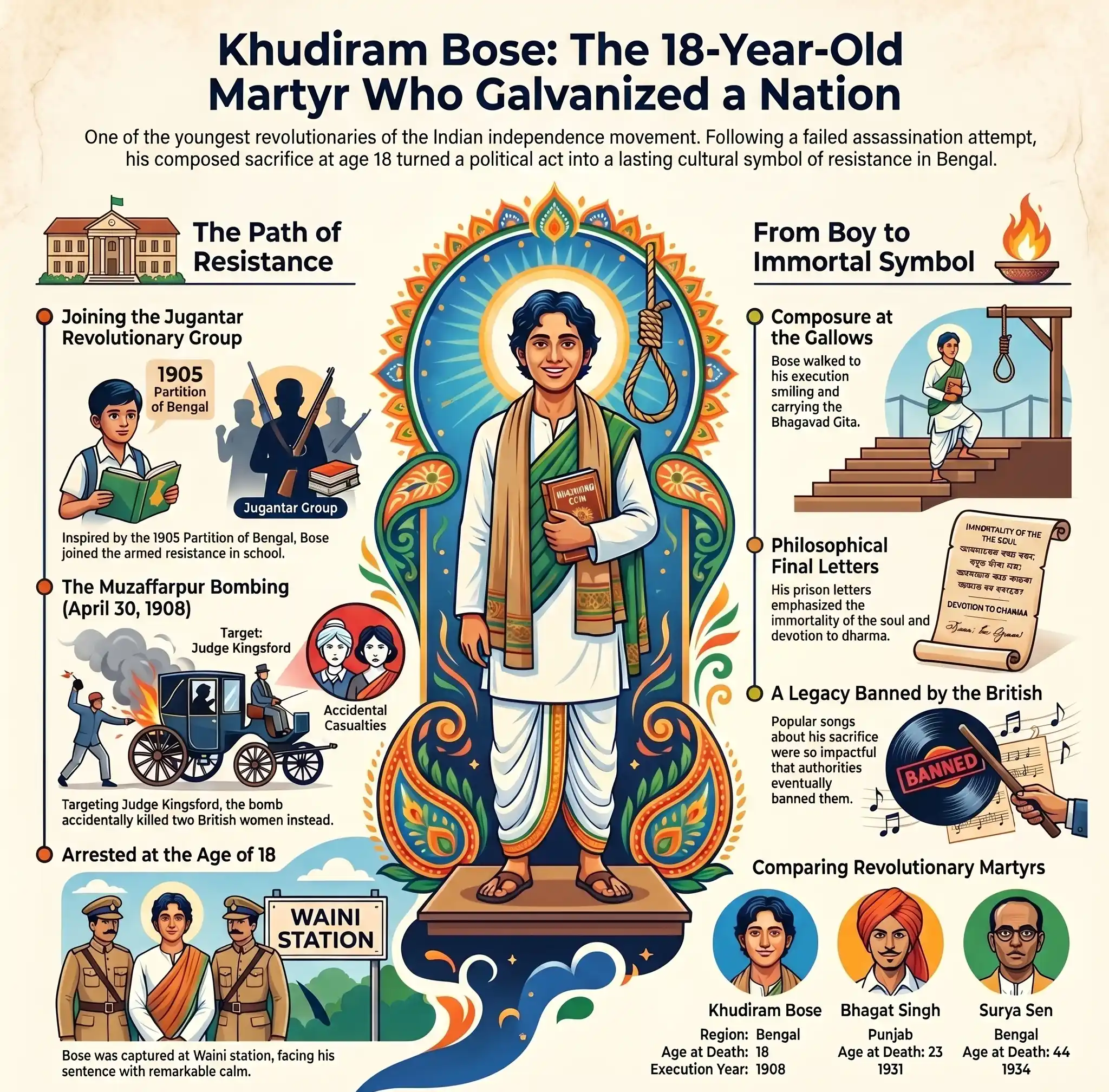
In the spring of 1908, a bomb was thrown at a carriage in Muzaffarpur. The target was a magistrate named Kingsford, hated for his cruelty to revolutionaries. But Kingsford was not in the carriage. Inside were the wife and daughter of a British barrister. Both were killed.
The boy who threw the bomb was Khudiram Bose. He was not yet eighteen.
The boy who had nothing to lose except everything
Vitthala Temple Musical Pillars When Stone Becomes Music
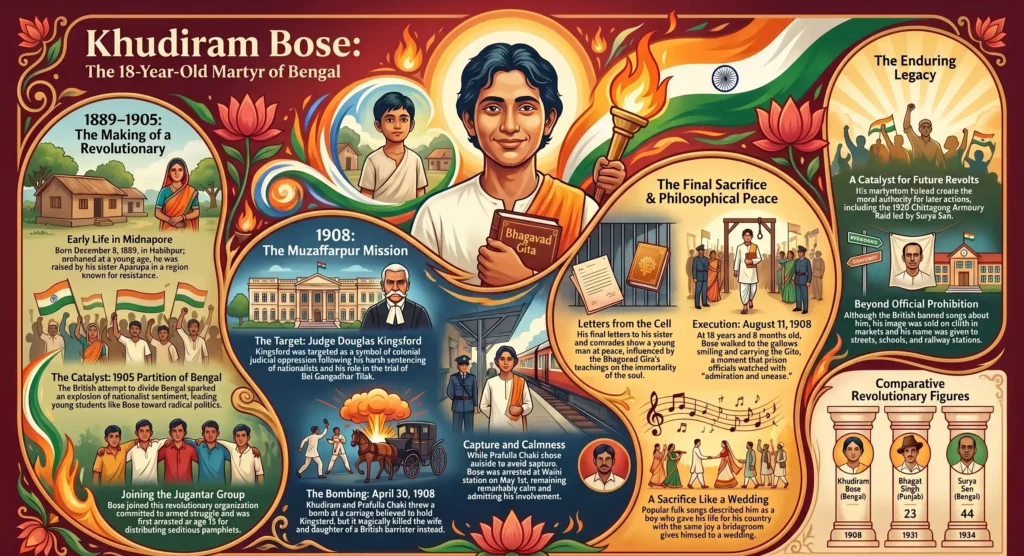
Khudiram had been an orphan since he was seven. He had lost his mother and father before he knew them, and grew up in his sister’s house. When he was old enough to think, the only thing that mattered was that his country was not his own.
He was fifteen when he first got arrested, for distributing pamphlets. He had heard Sri Aurobindo speak in Medinipur, and something in those words had changed him. The freedom struggle was not something that happened elsewhere, something that other people did. It was the only thing that mattered.
By eighteen, he was already a revolutionary. Not famous. Not celebrated. Just a boy who had decided that his life belonged to India.
When the bomb went wrong and killed two innocent women instead of the magistrate, he knew he had failed. He had wanted to strike at Kingsford. Instead, he had done harm to people who had never touched his country. Any of that should have broken him.
But the boy did not break. Instead, he waited to be captured. He waited for the trial. And when he knew the sentence was death, he asked for paper and pen.
A boy could be executed. But his letters could be remembered.
The letters
The letters he wrote from Muzaffarpur jail are unlike almost any other final words left by a condemned person. They are not desperate. They are not angry. They are not full of regret, though he knew he had caused innocent deaths. They are simply the letters of someone who had made a choice and was living with it.
To his sister, he wrote with a tenderness that must have unmade her. He did not ask for pity. He did not ask her to campaign for a reprieve or fight the sentence. He simply wrote to her as if he were going on a journey, and she was the person who mattered most to him. He told her not to grieve. He told her that this was what he had chosen to do with his life.
To his fellow revolutionaries, he wrote with a philosophical clarity that the prison officials found disturbing. He was not defiant in a theatrical way. He was not raging against the British or the system. He was simply explaining, as if to himself as much as to them, why a boy of eighteen would choose the noose over silence, why he would die rather than live.
The prison officials who reported on him noted his composure with a mixture of admiration and unease. He did not seem like a boy about to be hanged. He seemed like someone who had already made peace with what was coming.
The song they sang after he died
Before he died, Khudiram had written words that people would remember:
“Mother bid me farewell once, I will be back soon. Whole of India will watch me while I wear the noose smiling. Ten months and ten days from now I shall be born to my maternal aunt. If you don’t recognize me, look for the noose around my neck.”
After he died, people took those words and made them into a song. It spread through Bengal so quickly, and it moved people so deeply, that the British banned it from public performance. A song about a dead boy was dangerous to them.
On August 11, 1908, Khudiram walked to the gallows carrying the Bhagavad Gita. He was eighteen years and eight months old. He walked firmly. He smiled. He did not look like someone who was afraid.
Matangini Hazra: The Widow Who Walked Into Gunfire
The soul of Young Bengal
What his letters reveal is not ideology. It is a boy who had lost everything by age seven, and so had nothing left to be cautious with. A boy who believed his country mattered more than his own life, and could admit mistakes and still stand by what he believed.
This was the Young Bengal that Gandhi looked at with horror and concern. Young men and women who were willing to die. Not cruelly. Not vindictively. But with a clarity that suggested they believed something was more important than living.
That belief—not the violence, but the willingness to give everything, the philosophical calm about it, the tenderness they showed toward the people they loved even as they walked toward death—that was what terrified the British more than any bomb.
A boy could be executed. But his letters could be remembered. His song could be sung. His calmness in the face of the noose could inspire others.
And it did.
How Ramkinkar Baij Transformed Indian Sculpture Forever
If you think you have remembered everything about this topic take this QUIZ
Results


#1. In which district of Bengal was Khudiram Bose born?
#2. On what date was the Muzaffarpur bombing carried out by Khudiram Bose and Prafulla Chaki?
#3. Which revolutionary group was Khudiram Bose associated with?
#4. Who was the intended target of the Muzaffarpur bombing?
#5. At which railway station was Khudiram Bose arrested by the police?
#6. What sacred text did Khudiram Bose read in his cell and carry to the gallows?
#7. How did Khudiram Bose’s fellow revolutionary, Prafulla Chaki, die?
#8. At what age was Khudiram Bose executed by the British colonial government?
Who was Khudiram Bose and why is he significant in Indian history?
Khudiram Bose was a revolutionary from Midnapore district in Bengal who was executed by the British colonial government in 1908 at the age of eighteen. He is significant as one of the youngest martyrs of the Indian independence movement and as a defining figure of the revolutionary nationalist tradition in Bengal. His composure at the gallows and his final letters made him a powerful symbol of the willingness of young India to sacrifice everything for freedom.
What was the Muzaffarpur bombing and what were its consequences?
The Muzaffarpur bombing took place on 30 April 1908, when Khudiram and his fellow revolutionary Prafulla Chaki threw a bomb at a carriage they believed carried the colonial judge Kingsford. The bomb hit the wrong carriage and killed the wife and daughter of a British barrister. Prafulla Chaki shot himself the following day to avoid capture. Khudiram was arrested, tried and executed. The incident galvanized revolutionary nationalism in Bengal while also prompting serious debate within the movement about methods and targets.
What did Khudiram write in his final letters?
Khudiram’s final letters, written from his prison cell between his sentencing and his execution, addressed his sister Aparupa and fellow revolutionaries. They expressed his belief in the rightness of the independence cause, his engagement with the Bhagavad Gita’s teaching about the soul’s continuity beyond bodily death and his personal affection for those he was leaving behind. The letters reveal a philosophical clarity and emotional warmth that is remarkable given the circumstances in which they were written.
Why was Khudiram Bose targeting Judge Kingsford?
Douglas Kingsford was a colonial judge who had presided over the sedition trial of Bal Gangadhar Tilak and had delivered a verdict widely regarded in nationalist circles as unjust. He had also been responsible for harsh sentences against young Bengali nationalists in earlier cases. Revolutionary groups including Jugantar identified him as a symbol of colonial judicial oppression and decided to target him as an act of political resistance.
How is Khudiram Bose remembered in Bengal today?
Khudiram Bose is remembered across West Bengal through streets, schools, railway stations and institutions bearing his name. His image continues to be associated with the tradition of revolutionary sacrifice in Bengali nationalist culture. His execution date, 11 August, is observed in West Bengal. His story is taught in schools and his final letters and the songs composed about him after his death remain part of the living cultural memory of Bengal’s independence movement.
Gommateshwara Statue and the Philosophy of Inner Peace
Sources & References
Curious Indian, “The Final Letters of Khudiram Bose and Soul of Young Bengal” (2026) — his final letters to his sister and fellow revolutionaries, written from his prison cell, the philosophical clarity and personal warmth despite having caused the deaths of two innocent women, carrying the Bhagavad Gita to the gallows.
Wikipedia, “Khudiram Bose” — born December 3, 1889, died August 11, 1908 (aged 18 years, 8 months), member of Jugantar, attempted assassination of Kingsford with Prafulla Chaki, bombs killed wife and daughter of barrister Pringle Kennedy instead.
Wikiquote, “Kshudiram Bose” — the song “Mother bid me farewell once, I will be back soon. Whole of India will watch me while I wear the noose smiling.”
The Better India, “Khudiram Bose: The Boy Revolutionary Who Died With a Smile” (2018) — became a volunteer at 15, first arrest for distributing pamphlets, heard Sri Aurobindo speak in Medinipur, lost both parents by age seven.
“Mother and Sri Aurobindo” — April 30, 1908 bombing, execution August 11, 1908 at 6 a.m., walked to gallows firmly and cheerfully, Gandak river funeral.
Wikiquote, “Ekbar Biday De Ma Ghure Ashi” — the song written after his death, banned by British colonial authorities for public performance, it became one of the most popular songs of the independence movement.