Tamluk, 29 September 1942: a widow who had been told she was nobody walked into bullets carrying a flag and in that one walk, changed everything that came after
She was seventy-two years old, which meant she was supposed to be invisible.
Poor. A widow since she was eighteen. Born in a village with no school and no prospects. She had spent five decades doing what widows in her part of Bengal were supposed to do: work, stay quiet, take up as little space as possible. For most of her life, the British had hardly known her name.
But on the morning of September 29, 1942, thousands of people came looking for her.
Gommateshwara Statue and the Philosophy of Inner Peace
The movement had come to Tamluk
In August, Mahatma Gandhi had given his call: Quit India. Leave. Now. The British had no mandate here, he said, and they needed to go.
The call spread like fire. In September, young people in the Tamluk subdivision, in Midnapore district, started planning what to do. They organised into groups—the Vidyut Bahini, the lightning force—and they decided what they would do with their one chance. They would march on the police station and hoist the Indian flag. It was a direct challenge to colonial authority. The police could not allow it.
They needed leaders. And in Tamluk, when the young organisers thought of who could lead them, they thought of the old widow who had been walking the Swadeshi path since 1905. The woman everyone called Gandhi Buri. The old lady Gandhi.
The British had expected the crowd to scatter in fear.
She had walked in the salt march in 1930, worn khadi, been arrested and imprisoned. The British knew her name by now, though they had not troubled themselves with much worry until recently. She was just an old woman. How much trouble could she be?
The morning of the march
The leaders came to her and asked her to lead one of the five batches that would march on government buildings that day.
She was nearly blind. Her body was worn out from decades of work and hardship and age. There were younger, stronger people who could lead the procession. But they asked her, and she said yes.
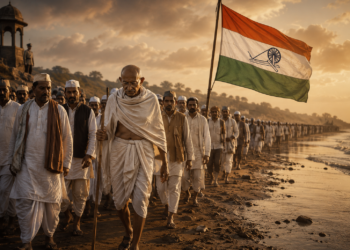
Nearly six thousand people gathered at dawn. Most of them were women: servants’ wives, peasant wives, widows, girls who had never been to school. They carried what they had: sticks, stones, their voices. Some carried a conch shell. Some carried Congress flags made of khadi.
Matangini Hazra stood at the front.
She was dressed in white—a widow’s colour, which was all she had ever been allowed to wear. She held the tricolour flag in one hand. In the other, she held a conch shell. Around her, the procession began to move toward the police station.
The walk
The distance was not far. But as they walked, the orders came: Section 144. Disperse. No processions. Halt.
The crowd did not stop.
When they reached the outskirts of the town, the police were waiting. Soldiers with bayonets. Officers with rifles. An order to disperse.
The people kept walking.
Matangini Hazra was at the front, and she did not slow her pace. The flag was raised. Ahead of her was the police station. Behind her were thousands of people who had been told all their lives that they had no right to be there, carrying no authority, speaking no language of power, and they had come anyway.
The police fired.
How Madam Bhikaiji Cama Unfurled India’s Flag in Germany
She was hit. A bullet struck her in the neck or shoulder. The people around her faltered. She did not. She kept walking forward, the flag held high.
“Don’t shoot at the crowd,” she called out to the police. “Shoot at me instead.”
They fired again.
A second bullet struck her, in the chest this time. She staggered but did not fall. She kept walking.
She kept walking, the flag held high.
The police fired a third time, and this shot struck her in the forehead. She fell where she stood, on the ground in front of the police station.
But the flag did not touch the ground.
In the moment she fell, the people around her surged forward and caught the flag before it could touch the earth. And even as she died—and eyewitness accounts say her last words were Vande Mataram, I bow to the Mother—the tricolour rose again, held by someone else’s hands.
What came after
The British had expected the crowd to scatter in fear. They had expected an old woman’s death to teach them a lesson. But something else happened instead.
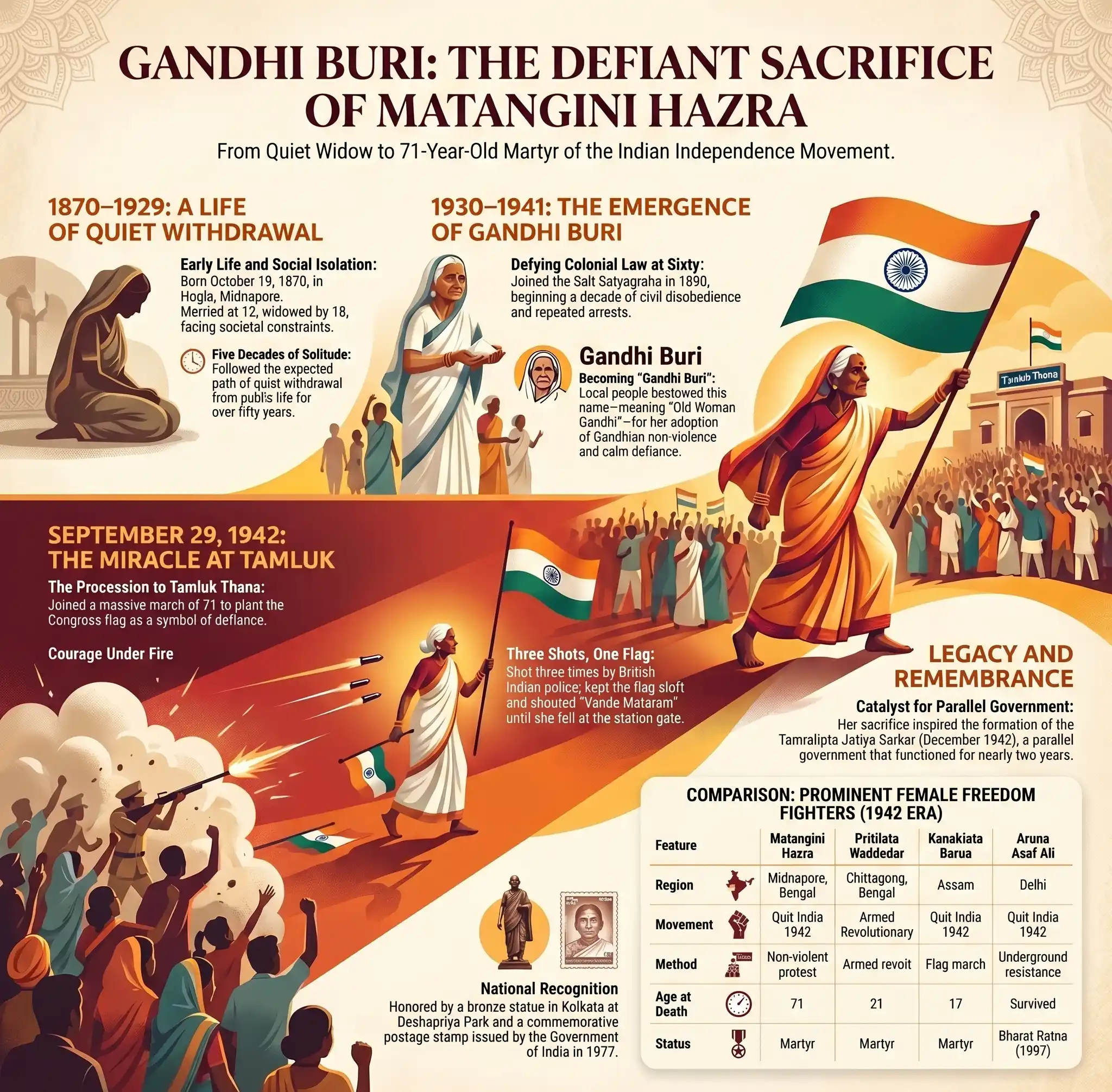
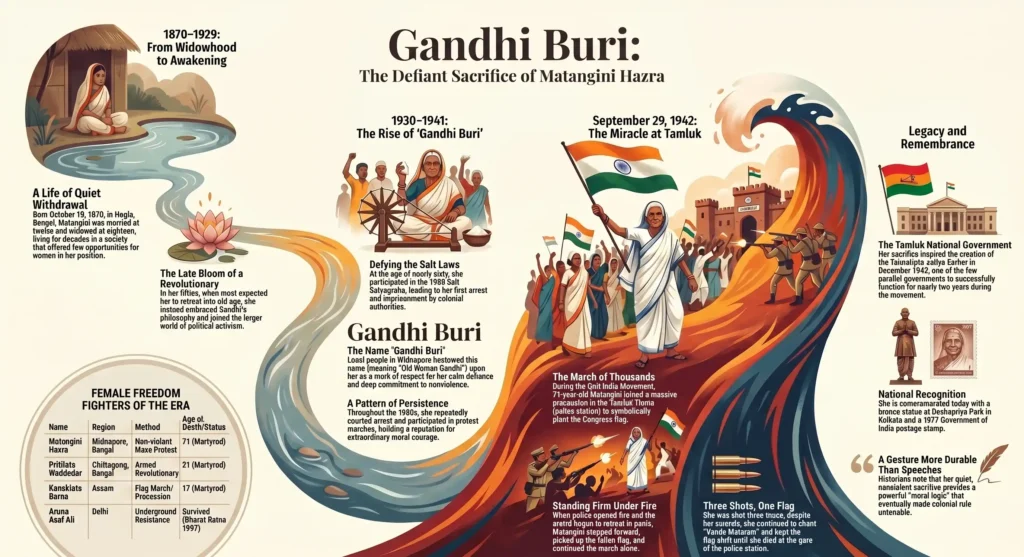
Her death did not end the movement. It strengthened it. The Vidyut Bahini grew. Other police stations were attacked. Young people found courage in her example. Within three months, in December 1942, the movement had coalesced into something more: the Tamralipta Jatiya Sarkar, a parallel national government, established across the Midnapore district. The first free government of independent India, they called it. Born out of the fire of September 29.
Matangini Hazra was the first Quit India martyr in Midnapore. The district that followed her bullet-riddled body into the police station became the first place in India where colonial rule was completely challenged and a national government rose in its place.
She had been told all her life that she was nobody. A poor widow with no education. No power. No right to anything. On the morning of September 29, she walked into history carrying a flag.
And when the bullets came, she did not let go.
The Powerful Feminist Anthems Hidden in the Songs of Lalon Fakir
If you think you have remembered everything about this topic take this QUIZ
Results


#1. In which village of Midnapore district was Matangini Hazra born?
#2. What nickname meaning “old woman Gandhi” was given to Matangini Hazra by the local people?
#3. In which year did Matangini Hazra first participate in the civil disobedience campaign known as the Salt Satyagraha?
#4. On what date was Matangini Hazra shot and killed by British Indian police while leading a march?
#5. How many times was Matangini Hazra shot by the police during the Tamluk Thana march?
#6. What parallel national government was established in Midnapore district in December 1942, partly inspired by the resistance shown at Tamluk?
#7. In Kolkata, at the crossing of which two locations can one find the bronze statue of Matangini Hazra holding the flag?
#8. In which year did the Government of India issue a commemorative postage stamp in honor of Matangini Hazra?
Who was Matangini Hazra and why is she called Gandhi Buri?
Matangini Hazra was a freedom fighter from Midnapore district in Bengal who participated in the civil disobedience campaigns of the 1930s and 1940s. She was called Gandhi Buri, meaning old woman Gandhi in Bengali, because of her deep commitment to Mahatma Gandhi’s philosophy of nonviolent resistance and her visible resemblance in spirit and method to Gandhi’s own approach to civil disobedience.u003cbru003e
What happened at Tamluk on 29 September 1942?
A large procession organized as part of the Quit India Movement marched toward the Tamluk police station with the intention of planting the Congress flag there. British Indian police opened fire on the marchers. Matangini Hazra, who was at the front of the march, picked up the flag when its carrier fell, continued walking toward the thana and was shot three times before dying at the gate of the police station.u003cbru003e
What was the Tamralipta Jatiya Sarkar?
The Tamralipta Jatiya Sarkar, also called the Tamluk National Government, was a parallel administrative government established in Midnapore district in December 1942 as part of the sustained Quit India resistance in the region. It functioned for nearly two years and was one of the only parallel governments established and maintained for an extended period during the Quit India Movement anywhere in Bengal.u003cbru003e
Why is Matangini Hazra not as widely known as other freedom fighters?
Her relative obscurity reflects a broader pattern in how women’s contributions to the Indian independence movement were recorded and commemorated. Women’s participation was systematically underrepresented in official histories. Regional figures without post-independence political careers received less sustained commemoration, and the quiet nature of Matangini’s sacrifice made it less visible in narratives that tended to favor dramatic or better-documented acts of resistance.u003cbru003e
Where can one learn more about Matangini Hazra today?
The Nehru Memorial Museum and Library in New Delhi holds archival materials related to the Quit India Movement including documentation of events in Midnapore district. A prominent statue of Matangini Hazra stands in Kolkata at the Rashbehari Avenue and Deshapriya Park crossing. The Government of India issued a commemorative postage stamp in her honor in 1977. Her story is also documented in several regional histories of the Bengal independence movement.
The Final Letters of Khudiram Bose and Soul of Young Bengal
Sources & References
Wikipedia, “Matangini Hazra” — born 19 October 1870, widowed at 18, age 72 or 73 on 29 September 1942, called Gandhi Buri, the march on Tamluk police station, shot three times, first Quit India martyr in Midnapore.
Wikipedia, “Tamralipta Jatiya Sarkar” — the parallel national government established in December 1942, inspired by the 29 September resistance; the Vidyut Bahini; her death hardening local resolve.
East India Story, “History of 29th September — Matangini Hazra” (2024) — leading six thousand volunteers, mostly women; the flag, the conch shell; the three shots.
The Indian Blog, “Who Was Matangini Hazra?” (2025) — the Salt March in 1930, her participation in Swadeshi, arrest and imprisonment, the chant of Vande Mataram as she died.
The Rise, “Matangini Hazra: Who Defied Britishers in Bengal” (2026) — her background, the widowhood at eighteen, the decades of quiet service, the 29 September march.
Dynamite News, “Gandhi Buri aka Matangini Hazra” (2026) — the three bullets, her keeping the flag raised, the chant of Vande Mataram.
Rita M Digital, “Matangini Hazra: An Indomitable Symbol” (2025) — the Quit India call of August 1942, Satish Samanta and Ajay Mukherjee as planners, the 6,000 protestors.