How Pandita Ramabai Pioneered a Fearless Crusade for Women’s Education and Welfare
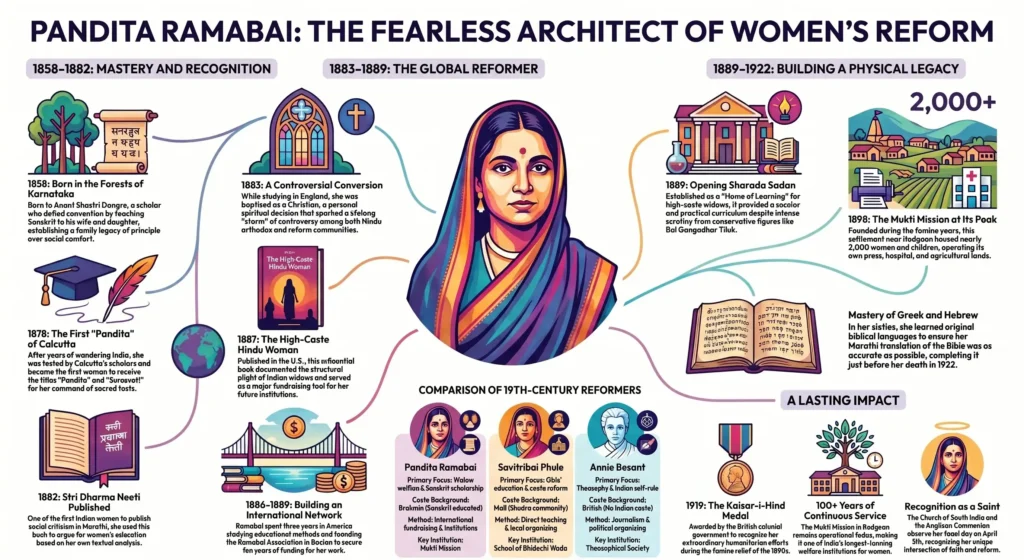
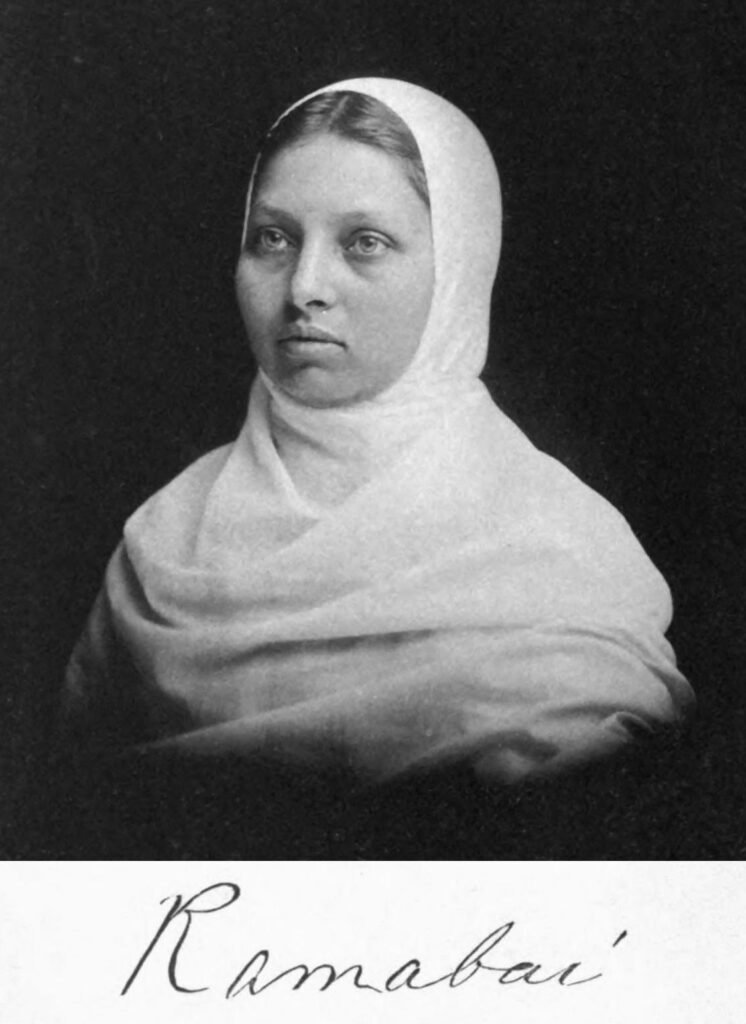
Pandita Ramabai earned the title of Pandita from the Sanskrit scholars of Calcutta at a time when no woman had ever stood before that assembly and been granted such recognition, and she earned it not as a courtesy but as an acknowledgment that she had mastered the texts they considered the highest measure of human intellectual achievement. She then used every ounce of the authority that title gave her to say, publicly and in writing, that the tradition whose texts she had mastered was treating its women with a cruelty so systematic and so thoroughly justified by the very texts she knew, that nothing short of a complete transformation in women’s access to education and economic independence would constitute an adequate response. Pandita Ramabai pioneered a fearless crusade for women’s education not from the margins of Indian intellectual life but from its center, armed with more Sanskrit than her critics and more courage than her admirers fully understood.
How Jyotiba Phule’s Satyashodhak Samaj Challenged Caste in Maharashtra
Related to article: The Pandita Who Built a Mission · Source: Wikimedia Commons · DesiBoy101 · CC BY 4.0
The Woman Who Knew More Sanskrit Than Her Critics
How Kamaladevi Chattopadhyay Saved India’s Artisan Heritage
The scholars of Calcutta did not know quite what to make of Ramabai when she appeared before them in 1878. She was twenty years old, she had walked across large parts of India with her father and then with her brother after her father’s death, and she had used those years of wandering to study Sanskrit with an intensity that had given her a command of the classical texts that most Brahmin men with formal scholarly training would have found difficult to match.
The scholars tested her. They asked her to recite from the Vedas, from the Upanishads, from the texts of Sanskrit grammar and rhetoric that constituted the highest measure of classical learning in the tradition they represented. She recited. They asked her to interpret. She interpreted. They granted her the title of Pandita, the title given to a master of Sanskrit learning, and they granted her the additional title of Sarasvati, the name of the goddess of learning. No woman had received these titles before her from this assembly.
Related to article: The Pandita Who Built a Mission · Source: Wikimedia Commons · DesiBoy101 · CC BY 4.0
What the scholars of Calcutta had perhaps not fully anticipated was that the woman they had just declared a master of the Sanskrit tradition was also a woman who had read that tradition carefully enough to understand, with a precision that no amount of respectful silence could blur, what it said about women and what the consequences of what it said were in the lives of the women around her. The title gave her a platform. She used the platform to say what she had read.
A Childhood Shaped by Principle
Ramabai was born on April 23, 1858, in Gangamul, a forested area in Karnataka, to a family whose own story was already unusual by the standards of nineteenth-century Hindu society. Her father, Anant Shastri Dongre, was a Sanskrit scholar of considerable accomplishment who had made the decision, extraordinary for his time and social position, to teach Sanskrit to his wife Lakshmibai. This decision had cost him the social acceptance of the orthodox community, which considered the education of women in the sacred language a violation of religious law, but Anant Shastri had concluded from his own reading of the texts that the prohibition had no adequate scriptural basis, and he was not a man who allowed social pressure to override his own careful reasoning.
He applied the same reasoning to his daughter. Ramabai grew up learning Sanskrit alongside her brothers, in a household that combined the rigors of classical learning with the material simplicity of a family that had chosen principle over social comfort. The family traveled extensively, moving between pilgrimage sites and scholarly communities, and the years of wandering that shaped Ramabai’s childhood gave her an unusually direct encounter with the diversity of Indian social and religious life.
Related to article: The Pandita Who Built a Mission · Source: Wikimedia Commons · Ramabai Sarasvati, Pandita, 1858-1922 · Public domain
The famine of the early 1870s destroyed the family. Anant Shastri, his wife, and one of Ramabai’s sisters died of starvation and illness within a short period, leaving Ramabai and her brother Srinivas alone, continuing the wandering life without the father whose scholarship had given it purpose and whose example had given both children the intellectual formation that would define everything they would later do.
The two siblings walked across India together, studying, reciting, engaging with scholars and religious communities, and arriving eventually at Calcutta, where the recognition that Ramabai received from the city’s Sanskrit scholars was the first formal acknowledgment that the education her father had given her had produced something that the tradition could not simply ignore.
The Widow and the Book
Thakkar Bapa’s Tribal Upliftment Work in Remote India
Related to article: The Pandita Who Built a Mission · Source: Wikimedia Commons · DesiBoy101 · CC BY 4.0
Ramabai’s brother Srinivas died in 1880. She married Bipin Behari Medhavi, a Bengali lawyer who was not a Brahmin, a choice that crossed caste lines in a way that the orthodox community of the time considered a serious violation of social and religious law. The marriage was brief and, by the available accounts, genuinely companionate. Bipin died in 1882, leaving Ramabai a widow with an infant daughter, Manoramabai, in precisely the social condition that she had already begun to write about, the condition of the Hindu widow in a society that had organized itself to make that condition as difficult and as punishing as possible.
She had already published Stri Dharma Neeti, a book on women’s moral conduct, in 1882, making her one of the first Indian women to publish a work of social criticism in Marathi. The book argued for women’s education and for the reform of the social conditions of widowhood from a position that was grounded in both classical textual authority and direct personal observation. She knew the texts that were used to justify the treatment of widows. She knew them better than most of the people who invoked them. And she knew, with the precision of someone who had spent years studying Sanskrit grammar and rhetoric, that the interpretation of those texts being used to condemn widows to lives of enforced misery was not the only interpretation available and was not the most careful one.
The related legal debate over women’s vulnerability in colonial India also shaped the Age of Consent Act of 1891.
A parallel Marathi critique of the gendered social order appeared in Tarabai Shinde’s 1882 critique.
The book attracted attention and controversy in equal measure. It also attracted the attention of the Deccan Education Society in Pune, which invited Ramabai to teach Sanskrit and Marathi, making her one of the first women to hold a teaching position at an institution of any standing in western India.
The book that would make her internationally known came five years later. The High-Caste Hindu Woman, published in English in 1887 after Ramabai had moved to England and then to the United States, was an account of the condition of upper-caste Hindu women, particularly widows, in nineteenth-century India, written with the authority of an insider and the analytical clarity of someone who had spent years thinking carefully about the structural conditions that produced what she was describing.
The book was read by audiences in Britain and America who had limited direct knowledge of Indian social conditions but who responded to the combination of specific, documented evidence with systematic argument that Ramabai brought to her account. It raised funds, built networks of support, and created an international audience for Ramabai’s reform work that would prove crucial to the institutional projects she was about to undertake.
The Conversion and the Storm
In 1883, while she was in England studying at the Cheltenham Ladies College in preparation for her eventual journey to the United States, Ramabai was baptized as a Christian. This decision was perhaps the single most controversial act of her public life, more controversial even than her marriage across caste lines, more controversial than her public criticism of Hindu orthodoxy’s treatment of women, because it was understood by the Hindu reform community, which had been her primary constituency and her primary support base, as a betrayal.
The response from figures like Justice Mahadev Govind Ranade, who had been among her supporters in Pune, was one of distress and disappointment. The response from the orthodox community was one of vindication, the sense that her criticism of Hindu social practice had always been motivated by an alien orientation and could now be dismissed on those grounds.
Ramabai’s own account of her conversion was carefully articulated and consistently maintained across the decades that followed. She had accepted Christianity not as a rejection of Indian identity or of the intellectual tradition she had been formed by but as a personal spiritual decision that she had arrived at through her own reading and her own reasoning. She also maintained, with considerable firmness, that her conversion did not change her commitment to the welfare of Indian women or her assessment of the social conditions that made that welfare so inadequately served by the existing order.
The storm of controversy did not slow her down. She had work to do and she went to do it.
The American Years and the Funding of a Vision
The Rationalist Awakening Sparked by Gopal Hari Deshmukh in Maharashtra
Ramabai spent three years in the United States, from 1886 to 1889, during which she lectured extensively, built networks of support among American Christian women’s organizations, and wrote The High-Caste Hindu Woman, which she used as both a fundraising tool and a public argument for the institutional work she was planning to undertake on her return to India.
The American audiences she addressed were moved by what she described and organized to support what she proposed. The Ramabai Association, founded in Boston in 1887, committed to funding a school for Hindu child widows in India for ten years, providing the financial foundation on which Sharada Sadan would be built.
She also studied American educational methods during these years, visiting schools and institutions with the careful attention of someone who was planning to build something similar and wanted to understand what worked and what did not. The practical orientation that characterized everything she did, the insistence on understanding a problem completely before designing a solution and on building institutions that could actually function rather than simply embodying a correct principle, was fully evident in the way she used her American years.
Her book My Testimony, written and revised over several years, documented her spiritual journey and the development of her thinking about the relationship between Christianity, Indian social reform, and the specific condition of Indian women. It is a document of unusual intellectual honesty, the account of a mind working through questions that had no easy answers and refusing to pretend that the difficulty was less than it was.
Sharada Sadan and What It Actually Did
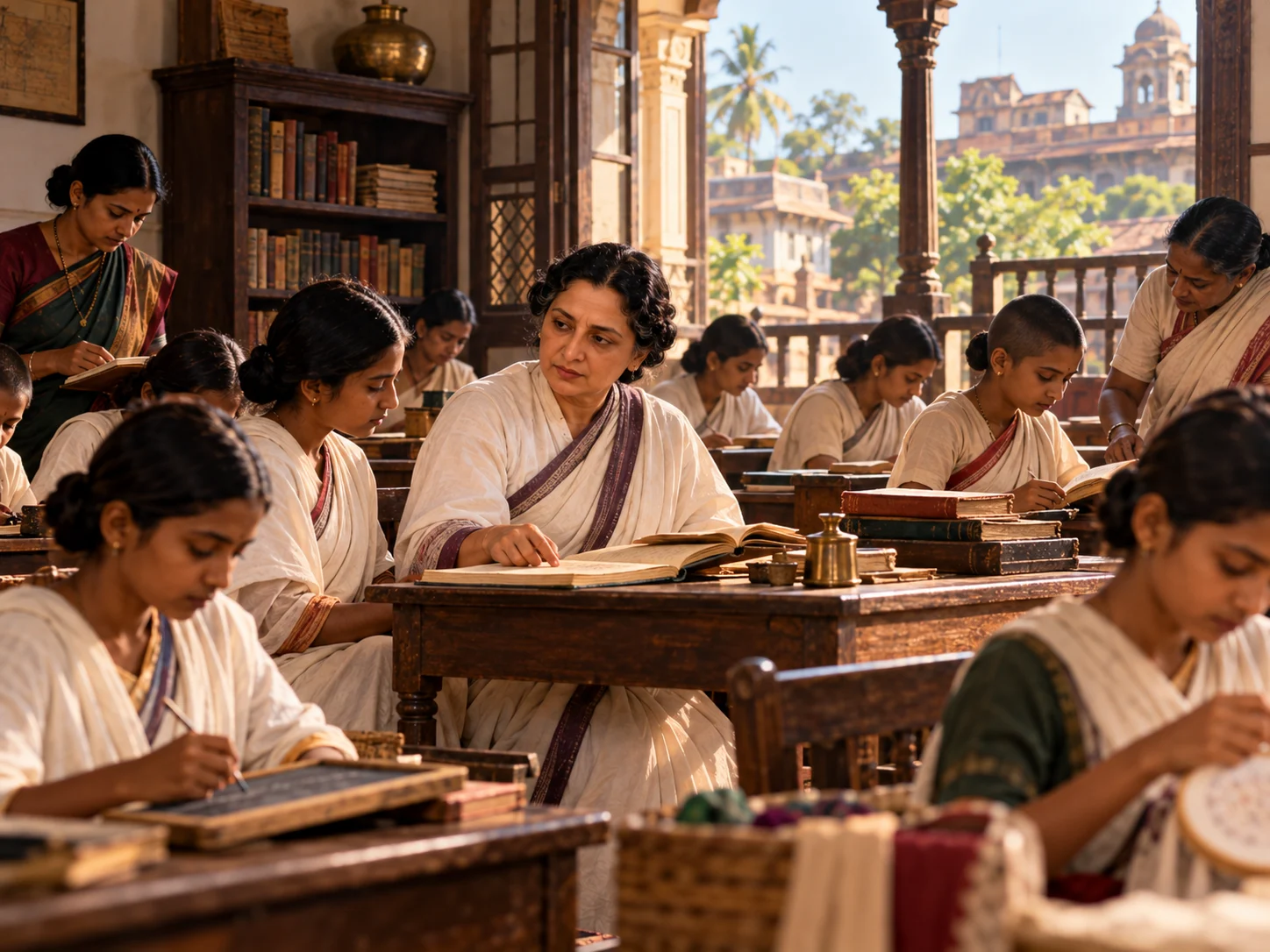
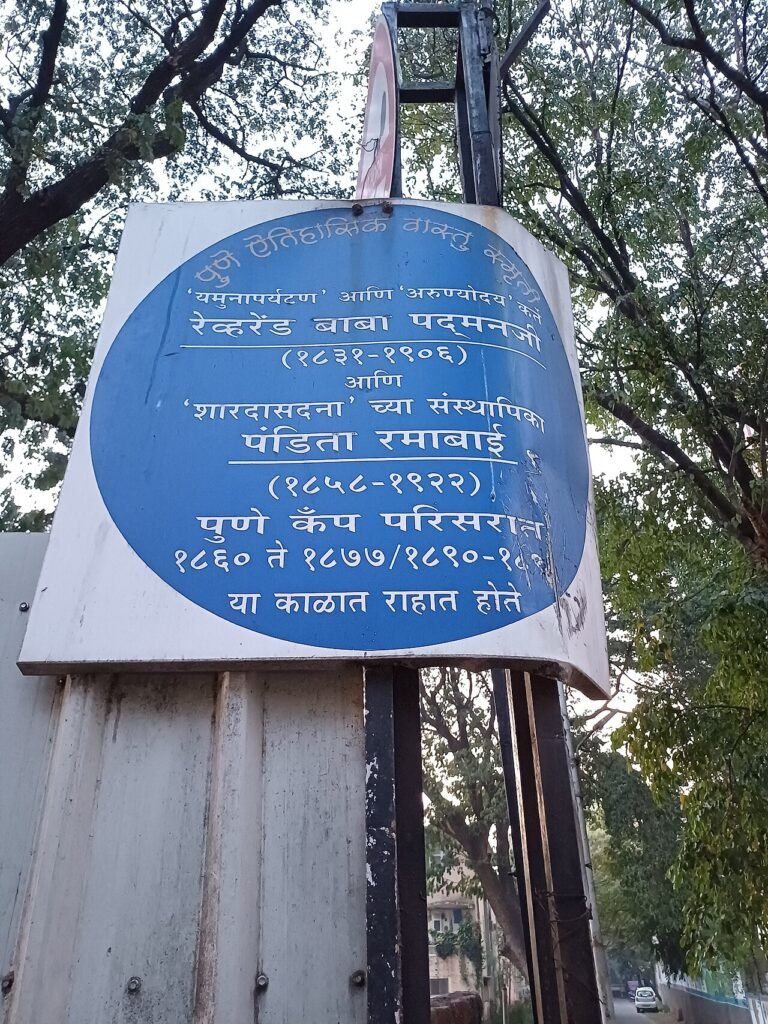
Ramabai returned to India in 1889 and opened Sharada Sadan, the Home of Learning, in Bombay before moving it to Pune, where it became the most significant institution for the education of high-caste Hindu widows that had yet existed in India.
The institution was deliberately and carefully designed to be acceptable to a Hindu community that was deeply suspicious of Ramabai’s Christian identity and deeply anxious about the possibility that the school was a vehicle for converting its students. Ramabai made explicit promises that no religious pressure would be placed on students, that the curriculum would be secular and practical, and that the institution would serve the educational needs of widows without requiring them to adopt any particular religious position.
She kept those promises, at considerable personal cost. When some of her students expressed interest in Christianity and eventually converted, the resulting controversy threatened to destroy the institution she had built. Bal Gangadhar Tilak, whose own position on social reform was considerably more conservative, used his newspaper Kesari to attack Sharada Sadan as a vehicle for Christian conversion and called for a boycott.
The attack was not entirely without foundation, since some students had indeed converted, but it was grossly disproportionate to the actual character of the institution, which was providing education, shelter, and economic training to women who had nowhere else to go. The controversy damaged Sharada Sadan’s reputation and reduced its student numbers in the short term, but the institution survived.
The Famine Years and the Mukti Mission
The famine years of the late 1890s gave Ramabai’s work a new and more urgent dimension. When the great famines of 1896 and 1897 swept across Maharashtra and the Deccan, producing an enormous population of displaced women and children, Ramabai moved with characteristic directness. She traveled into the famine-affected areas herself, arranged transportation for women and children who had been completely abandoned by every other form of social support, and brought them to an expanded settlement near Kedgaon, outside Pune, that became the Mukti Mission.
The Mukti Mission, which Ramabai established at Kedgaon in 1898, was at its peak a community of nearly two thousand women and children, most of them famine survivors and widows who had no other recourse. It was not simply a school or a shelter. It was an attempt to create, within the boundaries of a single community, the conditions of education, economic self-sufficiency, and human dignity that the society surrounding it denied its members.
The Mission ran its own printing press, staffed by women who had been trained to operate it. It had workshops for carpentry, weaving, and other practical skills. It ran an agricultural operation that the women themselves managed. It had a school that educated both the children in the community and the women who had arrived as adults without any prior access to formal education. It had medical facilities, a hospital, and a training program for nurses.
The scale of the undertaking was extraordinary, particularly given that Ramabai was funding it primarily through the American support networks she had built during her time in the United States and through her own relentless fundraising efforts. She was not working with government support or with the backing of a large institutional structure. She was working with the organizational intelligence of someone who had decided that a thing needed to exist and had figured out how to make it exist.
The printing press at Mukti Mission produced Ramabai’s Marathi translation of the Bible, a project she undertook in the final decade of her life and which required her to learn Greek and Hebrew so that she could work from the original texts rather than from existing English translations. She worked on this translation until the last weeks of her life, completing it shortly before her death on April 5, 1922.
The Legacy and the Continuing Mission
Ramabai died at Kedgaon on April 5, 1922, eleven days before what would have been her sixty-fourth birthday. She had outlived her daughter Manoramabai by less than a year, Manoramabai having died in 1921 after decades as her mother’s closest collaborator and the person who more than anyone else understood the full scope of what the Mission required to function.
The Mukti Mission continued after her death and continues today, more than a century later, operating schools and vocational training programs for women and children in Kedgaon, making it one of the longest continuously functioning institutions for women’s welfare established by an Indian reformer in the nineteenth century.
The title she had been given by the scholars of Calcutta, Pandita, the master of Sanskrit learning, was the most accurate single word that could be applied to her. She had mastered the tradition. She had read it with more care and more honesty than most of its defenders. She had used what she read to build the most rigorous possible argument for the transformation of the conditions it described. And she had then gone and built the institutions that gave that transformation a physical address.
That sequence—mastery, honesty, argument, institution—was the whole of what she did. It was enough to change the lives of thousands of women in her own lifetime and to establish a tradition of women’s education and welfare that the society around her was eventually, slowly, imperfectly, but genuinely compelled to take seriously.
The Fearless Crusade
Pandita Ramabai’s crusade for women’s education was fearless in the most literal sense. She was not unaware of the consequences of what she was doing. She had watched her father lose his social standing for teaching her mother Sanskrit. She had experienced the hostility of the scholarly establishment before it gave way to recognition. She had seen the reform community withdraw its support when her religious choices confounded their expectations. She had been attacked in the most influential Marathi newspaper of her time by one of the most powerful public figures of her era.
She continued. She opened Sharada Sadan and kept it open through the controversy. She traveled into famine-affected areas and brought thousands of women to Kedgaon and built a community around them that gave them what the society around them had refused to give. She learned two more languages in her sixties to do a translation she considered necessary. She did not slow down because the opposition was real and sustained and came from people whose opinions carried social weight.
The fearlessness was not the absence of feeling. It was the refusal to let feeling become the reason not to act. She was angry about what the Sanskrit texts said about women. She was grief-stricken by the deaths that had shaped her life. She was hurt by the withdrawal of support from people she had considered allies. She was all of these things and she continued anyway, because the work was more important than any of those responses and because the women at Kedgaon needed the work to continue more than Ramabai needed the comfort of stopping.
The Mukti Mission is still there. The women trained in its workshops, the children educated in its schools, the tradition of women’s welfare that it established in Kedgaon, these are the continuation of the argument that Pandita Ramabai made with her life. The argument has not been completed. But it is further along than it was when she began it, and that distance is her gift to everyone who has continued walking in the same direction.
How Syed Ahmad Khan Changed Muslim Education in India
If you think you have remembered everything about this topic take this QUIZ
Results


#1. In which year was Pandita Ramabai granted the titles of Pandita and Sarasvati by the scholars of Calcutta?
#2. Who was Pandita Ramabai’s father, a Sanskrit scholar who defied orthodox convention by teaching Sanskrit to his wife?
#3. Which book did Pandita Ramabai publish in Marathi in 1882 that addressed women’s moral conduct and social conditions?
#4. In which country was the Ramabai Association founded in 1887 to provide a financial foundation for her school?
#5. Which prominent public figure used his newspaper “Kesari” to attack Sharada Sadan as a vehicle for Christian conversion?
#6. In which year did Pandita Ramabai establish the Mukti Mission at Kedgaon to aid displaced women and famine survivors?
#7. Which two languages did Pandita Ramabai learn in her sixties to translate the Bible directly into Marathi?
#8. Which award was conferred upon Pandita Ramabai by the British colonial government in 1919 for her humanitarian work?
Who was Pandita Ramabai and what made her a significant historical figure?
Pandita Ramabai was a nineteenth-century Indian scholar and reformer born in 1858 who mastered Sanskrit, published works of social criticism, built institutions for women’s welfare, and conducted international fundraising campaigns that gave her work a reach unprecedented for an Indian woman of her era. She is significant because she combined intellectual authority in the classical tradition with fearless public advocacy for women’s education, building institutions that served thousands of women while making arguments that the reform community could not ignore.
What was Sharada Sadan and what did it offer to women?
Sharada Sadan, the Home of Learning, was a school for high-caste Hindu widows that Ramabai opened in Bombay in 1889 before relocating it to Pune. It offered education, vocational training, and a living environment to widows who had no other recourse, explicitly designed to be religiously neutral so that Hindu families would feel safe sending their daughters. It was the most significant institution of its kind in western India at the time of its founding and survived the controversies over religious conversion that threatened to close it in its early years.u003cbru003e
How did Pandita Ramabai fund her institutional work in India?
Ramabai funded her work primarily through the international networks she built during her three years in the United States between 1886 and 1889. The Ramabai Association, founded in Boston in 1887, committed to ten years of funding for her school. The High-Caste Hindu Woman, published during this period, served as both a fundraising tool and a public argument that generated support from American Christian women’s organizations. She continued fundraising through lectures, publications, and correspondence throughout her life, supplementing international donations with the income generated by the Mukti Mission’s own printing press and agricultural operations.u003cbru003e
What was the significance of Ramabai’s conversion to Christianity?
Her conversion to Christianity in 1883 was the most controversial act of her public life because it was understood by the Hindu reform community as a betrayal of the constituency that had supported her. It led to attacks from Bal Gangadhar Tilak and withdrawal of support from figures including Justice Ranade. Ramabai consistently maintained that her conversion was a personal spiritual decision that did not alter her commitment to the welfare of Indian women regardless of their religion. The controversy was real and damaging to her institutional work in the short term but did not ultimately prevent her from building the Mukti Mission into one of the largest women’s welfare institutions in India.
What is the legacy of the Mukti Mission today?
The Mukti Mission at Kedgaon, established by Ramabai in 1898, continues to operate more than a century after its founding, running schools, vocational training programs, and welfare services for women and children in the Pune district. Its continuous operation makes it one of the longest-lived institutions for women’s welfare established by any Indian reformer of the nineteenth century. The Church of South India and the Anglican Communion have recognized Ramabai as a saint, with her feast day on April 5, extending her institutional legacy into the domain of religious recognition across multiple Christian traditions.
Sources & References
Pandita Ramabai’s life and the title of Pandita — Born April 23, 1858 in Gangamul; died April 5, 1922 at Kedgaon. Granted the title of Pandita by Sanskrit scholars at Calcutta at age 20, the first woman to receive this recognition. Mastered Sanskrit, Marathi, Hindi, Bengali, English, Greek, and Hebrew over her lifetime.
Her father’s influence and family principle — Anant Shastri Dongre was a Sanskrit scholar who defied orthodox convention by teaching his wife and daughter Sanskrit, costing him social standing but establishing the family’s tradition of placing principle over social acceptance that Ramabai inherited and amplified throughout her life.
Early writings and institutional innovation — Published Stri Dharma Neeti (1882) and The High-Caste Hindu Woman (1887), which documented the condition of widows and raised funds through American networks. The Ramabai Association (founded Boston 1887) committed to funding her school, providing the foundation for Sharada Sadan (1889).
Sharada Sadan and the controversy — Opened the Home of Learning in Bombay then Pune for high-caste widows, explicitly designed to be religiously neutral. Survived a major controversy when Bal Gangadhar Tilak attacked it as a vehicle for Christian conversion, a charge that was partially founded but grossly disproportionate to the institution’s actual character.
The Mukti Mission and lasting legacy — Founded the Mukti Mission at Kedgaon in 1898 to serve famine survivors and widows, which grew to nearly 2,000 women and children at its peak with printing press, workshops, farm, hospital, and school. Learned Greek and Hebrew in her sixties to translate the Bible directly into Marathi. The Mission continues operating today, more than 100 years after her death, making it one of the longest continuously functioning institutions for women’s welfare established by an Indian reformer in the nineteenth century.