How a civilization that built nothing in stone survives entirely in the hymns of the Rigveda
The people of the Indus, we have seen, left behind a strange kind of puzzle: great cities we can walk right through, and not one single word we are able to read. We can see them perfectly, and yet we cannot hear them at all.
The people who came after them, in the age we call the Early Vedic period, are almost the exact opposite. They left us hardly anything to dig up: no grand cities, no palaces, no monuments, barely so much as a brick. And yet we can hear them, clearly, across three and a half thousand years. Because what these people left behind was not stone at all. It was words. This is the story of a whole world that survives not as ruins, but as a song.
A world kept alive in memory
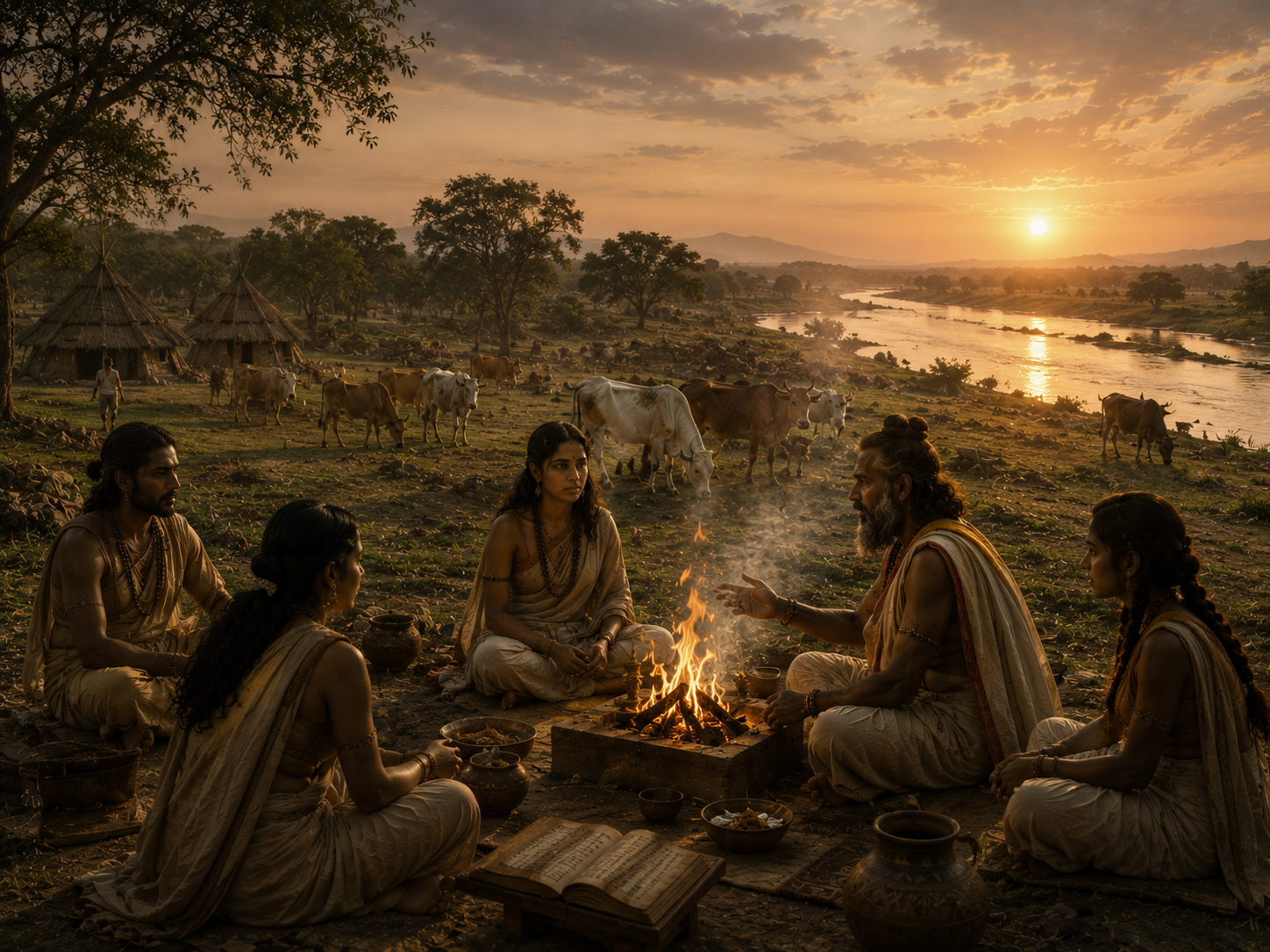
Around 1500 BCE, in the land of the seven rivers in India’s northwest, there lived a people of cattle-herders and poets. They did not write things down. Instead, they did something that still seems almost unbelievable.
They committed their most sacred words to memory, and then passed them on, mouth to ear, parent to child, teacher to student, generation after generation, for thousands of years, without ever letting a single syllable slip away. These words are the Rigveda, a vast collection of more than a thousand hymns to the gods.
For roughly three thousand years, the hymns of the Rigveda were never written down at all. They were held, perfectly, in human memory and passed along by voice alone.
They were recited so carefully, using such clever memory techniques, that the version chanted aloud today is believed to be very nearly the exact version chanted back when the pyramids of Egypt were still young. It is one of the most astonishing feats of memory in all of human history: a whole civilization, kept alive as pure sound. Where exactly these people came from, and how they were connected to the Indus folk before them, is something scholars still argue over, and we can happily leave that debate to them. What we can do, instead, is simply listen to what they left us.
Indus Valley Civilization: The Lost Urban Utopia
A world where wealth walked on four legs
And when we do listen, a vivid world springs to life. It was a simpler world than the great cities of the Indus, and a far more restless one. These were herders, forever moving with their animals, and at the very centre of their lives stood the cow.
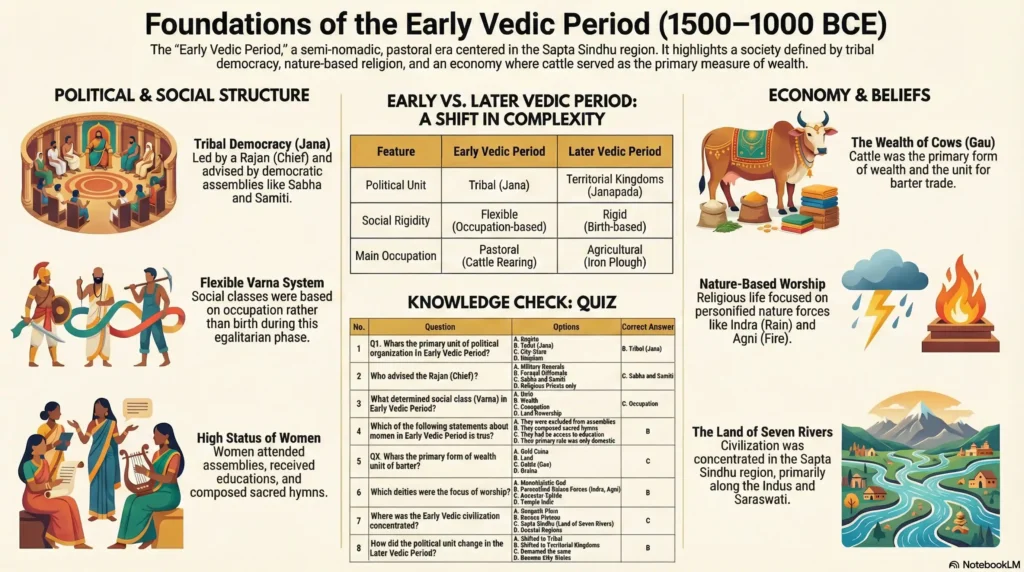
Cattle were quite simply everything to them: their food, their wealth, and their measure of worth. A rich man was, quite literally, a man of many cows. The cow was so precious that it was called “not to be killed.”
In the Rigveda, the very word for war means, syllable for syllable, “the search for cows.” Wealth was counted in cattle, and a rich man was just a man with a great many of them.
They lived in tribes rather than kingdoms, and each tribe was led by a chief who was mostly a war-leader. And here is a telling thing: his power was not absolute. He could be questioned, and even removed, by assemblies of his own people. In its own rough and early way, it was a kind of shared power.
Before the walls went up
Here is something that often surprises people about this early world. The rigid caste system that would one day divide Indian society so harshly had not yet been built at all.
In these early days, what a person did with their life was not yet fixed forever by the family they happened to be born into. The lines between people were softer, and they could be crossed. And women held a place that they would sadly lose in later ages. They could stand and speak in the tribal assemblies, and, quite remarkably, some of the sacred hymns of the Rigveda itself were composed by women. In these important ways, the world of the earliest hymns was freer and more open than the far more rigid one that would follow it.
Later Vedic Period c. 1000-600 BCE: The Age of Iron and Kingdoms
Gods of fire and thunder
Their gods were not distant kings sitting in marble temples. In fact, these people had no temples at all, and not a single statue. Their gods were the great forces of nature itself, alive and vivid and personal.
Greatest of them was Indra, the thundering warrior-god of storm and rain, who smashed the demon that had locked away the waters and set the rivers running free. There was Agni, the god of fire, who was dearly loved because he was the messenger: when you burned an offering, it was Agni, the fire, who carried it upward to the gods. And there was Varuna, the solemn guardian of cosmic order, who watched over the world to make sure that both nature and people stayed true. To reach these gods, the people would light a sacred fire beneath the open sky and feed it their offerings while chanting the hymns. The fire itself was their temple, and their road to heaven.
Reign of Chandragupta Maurya 321-297 BCE: The First Empire of India
The hymn that dared to doubt
And now, the most astonishing thing of all. You might expect a book of truly ancient hymns to be filled from end to end with certainty about the gods and about how the world was made. But tucked away inside the Rigveda is a short and breathtaking poem that does the very opposite.
It asks where the whole universe came from. And then, instead of handing us a confident answer, it stops, and it wonders, and at last it quietly admits that it does not know. The gods themselves, the poem points out, came into being after the world was already made, so how on earth could even they know how it all began?
One of the oldest poems in the world asks where the universe came from, and then dares to reply: no one truly knows how it began. And perhaps not even God knows.
That a people we so often dismiss as “ancient” or “primitive” could compose, three thousand years ago, a hymn so brimming with honest doubt and open wonder, is a deeply humbling thing to sit with.
Still being sung
So this is the strange and lovely gift of the Early Vedic people. They built no cities for us to marvel at, they raised no temples, and they left almost nothing at all in the ground for archaeologists to brush the dust from. By the usual measures we reach for, they left behind no monuments whatsoever. And yet they may have left the most lasting monument of all. Not one made of stone, which slowly crumbles, but one made of sound, which, so long as someone keeps saying it, never crumbles at all. Their hymns are not silent ruins. They are still alive, still being chanted, word for careful word, in homes and temples across India to this very day, almost exactly as they were three and a half thousand years ago. The Indus people kept their cities and lost their voice. The Vedic people did precisely the reverse. They let their bodies turn quietly to dust, and they kept their voice forever.
Rise of Jainism and Buddhism 6th Century BCE: The Shramana Revolution
If you think you have remembered everything about this topic take this QUIZ
What is the main source of information for the Early Vedic Period?
The Rigveda is the primary source.
Which river was most important to the Rigvedic people?
The Sindhu (Indus) was the most mentioned, but the Saraswati was the most revered (Naditama).
What was the main form of wealth in this period?
Cattle (Cows) were the main form of wealth.
Who was the most important god in the Rigveda?
Indra (God of thunder/rain) was the most important deity.
What was the Battle of Ten Kings?
It was a battle where King Sudas of the Bharata tribe defeated a confederacy of ten tribes on the banks of the River Parushni (Ravi).
Sources and references
- IASmania and Collegedunia (“Early Vedic Period”) — the period of about 1500–1000 BCE known mainly from the Rigveda, the Sapta Sindhu “land of seven rivers,” the pastoral cattle-based economy, and “gavishti” (the search for cows) as the term for war.
- EduRev and Careers360 — cattle as the main form of wealth (godhana) and medium of exchange, the cow called “aghnya” (not to be killed), barley as the main crop, and the tribal assemblies (Sabha and Samiti) that checked the power of the chief (Rajan).
- Collegedunia and general Vedic history — the flexible, occupation-based social order before the rigid birth-based varna system of the Later Vedic period, and the respected position of early Vedic women who attended assemblies and composed hymns.
- Wikipedia (“Rigvedic deities”) — Indra (about 250 hymns) as god of war, thunder and rain and slayer of Vritra, Agni (about 200 hymns) as the fire-intermediary between gods and humans, and Varuna as guardian of cosmic order, all worshipped through fire sacrifice without temples or idols.
- The Rigveda (Nasadiya Sukta, 10.129) and standard translations — the “Hymn of Creation” that questions the origin of the universe and concludes that perhaps only the highest overseer knows, or perhaps even he does not.
- Original Curious Indian article (“Early Vedic / Rigvedic Period”) — the oral preservation of the hymns, the pastoral tribal society, the nature-worshipping religion of fire sacrifice, and the contrast with the material remains of the Indus civilization.
Author


Exploring the Soul of Bharat through History, Science, Culture, and its Diversity
Our Mission
Curious Indian is a definitive knowledge portal dedicated to chronicling the events, personalities, and cultural shifts that defined the Indian subcontinent. From the ancient Vedic Period to the complexities of 21st-century politics, our goal is to provide deep-dive analysis that inspires.
Editorial Standards & E-E-A-T
Every article published under our brand undergoes a rigorous fact-checking process. We prioritize primary historical records, academic citations, and credible archives to ensure our readers receive accurate, high-authority information.
Historical Integrity Directly sourcing from ASI archives and academic journals.Topical Authority Comprehensive clustering of Indian Science, Biographies, and Wars.Managed by Paripurna Datta and TEAM | Dedicated to the Knowledge of India.