
How Two Thousand Songs Systematically Dismantled Patriarchy Without Announcing It
In the villages of Bengal in the nineteenth century, a man with no caste, no recorded religion, and no fixed social address composed over two thousand songs about the mystery of the human body, the absurdity of religious boundaries, and the specific quality of divine love that does not distinguish between man and woman, Hindu and Muslim, high born and low born. Lalon Fakir’s songs were sung by wandering musicians who had rejected the social order entirely and who carried his words through a landscape that was simultaneously devout and deeply oppressive along lines of gender, caste, and faith. What scholars until recently struggled to articulate is what the women who sang those songs in the nineteenth century already understood instinctively: that Lalon was writing feminist theology before the word existed in any language available to him. He did not announce revolution. He sang it, in a language that everyone could understand and that contained, for those willing to listen carefully, a systematic destruction of everything the patriarchal religious and social order was built on.
The Man Who Rejected All Categories
The first and most fundamental feminist act in Lalon Fakir’s life was his absolute refusal to have a social identity. Not his rejection of a particular social identity, but his refusal of the category itself. The circumstances of his birth are disputed, and Lalon himself appears to have encouraged the dispute deliberately. Some accounts place his birth in a Hindu family in Nadia district. Others suggest a Muslim origin. The most carefully researched biographical scholarship concludes that the dispute cannot be definitively resolved and that Lalon’s own behaviour throughout his life suggests he understood the unresolvability of the question as a gift rather than a problem.
He had been ill as a young man, possibly with smallpox, and had been abandoned by his family and caste community during the illness. A Baul couple nursed him back to health, accepting him without reference to his birth identity. When he recovered, he did not return to whatever social category he had come from. He remained with the Baul community, and he extended the experience of that abandonment and that rescue into a philosophy that would take him a lifetime to develop.
If caste community abandons you when you are ill and dying, and a community of people who have rejected caste saves your life, what does that tell you about the moral worth of caste? This is not a rhetorical question in Lalon’s songs. It is the foundational question from which everything else follows. He argued, across two thousand songs, that the categories by which human beings divide and rank each other, caste, religion, gender, are impositions on the human body that have no basis in the body’s actual nature. The body, in Lalon’s understanding, is a vessel of the divine, equally so regardless of whose body it is. The social categories overlaid on the body by religious and social tradition are not descriptions of the body’s reality. They are distortions of it.
How Swami Vivekananda Brought Vedanta to the Modern World
The Sacred Body and the Divine Within
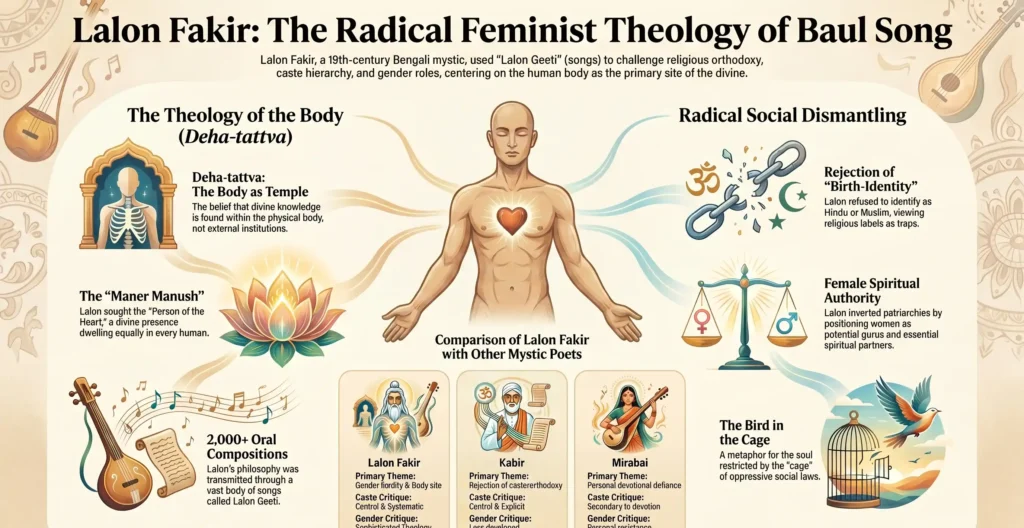
The theological foundation of Lalon’s feminist critique is his understanding of the human body as the primary site of the divine, a concept he expresses in the Baul philosophical vocabulary as Deha-tattva, the philosophy of the body. This understanding directly challenges the established religious traditions of Bengal in the nineteenth century, both Hindu and Islamic, which shared a fundamental agreement despite their disagreements on most other matters: the female body was a source of spiritual danger that required management, restriction, and subordination to male religious authority.
In the Hindu tradition, this manifested through caste-based rules about female purity and pollution, through restrictions on women’s participation in ritual, and through theological frameworks in which women’s spiritual liberation was understood to depend on their correct performance of wifely duty rather than on any direct relationship with the divine. In the Islamic tradition as institutionally practiced in the Bengal of Lalon’s time, restrictions on women’s public participation in religious life and the theological positioning of women’s spiritual status as derivative of their relationship to male family members served similar functions of subordination through different mechanisms.
Lalon rejected both frameworks with equal thoroughness through the single move of insisting that the divine is located in the body and that the body’s natural state is one of equivalence across all the social distinctions that have been imposed on it. If the divine is in the body, and all bodies equally contain the divine, then the female body is as much a temple as the male body. This argument appears across Lalon’s songs in multiple registers and through multiple metaphors, in the repeated insistence that the guru, the teacher, the source of spiritual knowledge, can be found in any body, including and specifically including the bodies of those whom the dominant social order has classified as inferior.
The Birdcage and the Imprisoned Spirit
Some of Lalon’s most celebrated and philosophically dense songs use the image of a bird in a cage to explore the relationship between the soul, the body, and the social structures that restrict both. The cage in Lalon’s songs is not only the body. It is also the social body, the network of rules and restrictions and prescribed roles that the dominant culture constructs around the individual body and calls dharma or correct behaviour for a woman of your station. The bird that cannot fly is not only the soul awaiting death. It is the woman whose capacities and whose spiritual life are constrained by the social structures that have been built around her body and presented to her as the natural order of things.
When Lalon asks, in one of his most famous compositions, who built this cage and who keeps the bird inside, the question has an obvious metaphysical dimension. It also has an obvious social one, and in nineteenth century Bengal, where the question of who keeps women inside the restrictions placed on their bodies and their spiritual lives was an extremely pressing political question, the social dimension of Lalon’s imagery was not available to be missed by anyone paying attention. The women who sang Lalon’s songs understood the birdcage songs not only as meditations on the soul but as commentary on their own specific social situation. They used them, in the way that subordinated communities have always used the arts available to them, as a language for naming their experience that the dominant culture could not quite bring itself to suppress because it was expressed in terms that the dominant culture recognised as spiritual rather than political.
The Fearless Verses of Kabir That Challenged Orthodox Society
The Female Guru and the Inversion of Authority
One of the most radical feminist propositions in the entire body of Lalon’s work is his insistence on the possibility, and in some songs the necessity, of a female guru. The guru in the Indian spiritual tradition is the teacher whose direct transmission of knowledge to the student is the mechanism through which spiritual realisation is achieved. In the dominant understanding of both Hindu and Muslim spiritual traditions in nineteenth century Bengal, the guru was male. The spiritual authority that the guru embodied was understood as inherently masculine, associated with the social authority of the Brahmin priest and the Islamic imam.
Lalon systematically dismantled this assumption through his consistent presentation of the guru as the Maner Manush, the divine person who dwells within the human body, who can be encountered in any body regardless of gender, caste, or religious identity, and who must be recognised through the quality of direct spiritual experience rather than through the social credentials of birth or institutional ordination. The Baul practice that this philosophy generates, in which the female practitioner is understood as a potential vehicle of the highest spiritual knowledge and in which the male practitioner’s relationship with a female spiritual partner is understood as a necessary dimension of the most advanced spiritual work, represents one of the most thoroughgoing inversions of patriarchal spiritual authority structures available within any indigenous South Asian tradition. In this framework, the woman is not the object of the man’s spiritual practice. She is its teacher.
The Dissolution of Religious Identity
The most immediately accessible feminist dimension of Lalon’s songs is their systematic demolition of religious identity as a meaningful category of human self-understanding. The connection between this demolition and feminist politics lies in understanding how religious identity systems functioned in nineteenth century Bengal. Both Hindu and Muslim religious identity were patriarchal in their structure in ways that were not accidental but functional. Religious identity was transmitted through the male line, enforced through male religious authority, and expressed through practices that consistently positioned women as objects of religious regulation rather than subjects of religious life.
When Lalon asks, in one of his most celebrated songs, who made you a Hindu, who made you a Muslim, where were these distinctions when you were born and where will they be when you die, he is asking a question that is simultaneously about religious identity and about gender. The body that exists before the imposition of religious identity, that exists after the stripping away of all social categories in the moment of death, is a body without gender hierarchy as well as without caste or religious hierarchy. A philosophy that makes all identity categorisation theologically illegitimate necessarily makes the gender-specific applications of that categorisation equally illegitimate. In the context of nineteenth century Bengal, where the categorisation of women by caste and religious identity was one of the primary mechanisms through which their subordination was maintained and justified, this was a statement of profound feminist significance.
The Compassionate Teachings of Sant Tukaram in Maharashtra
The Fluid Body and the Fixed World
Among the most philosophically sophisticated dimensions of Lalon’s feminist theology is his engagement with the question of gender itself, not only as a social category but as a bodily one. The Deha-tattva philosophy that underlies his songs understands the human body as containing within it both masculine and feminine principles, called Purush and Prakriti in the Sanskrit vocabulary that Lalon draws on alongside the Sufi and indigenous Bengali vocabularies he uses with equal freedom. The spiritual practice that the Baul tradition prescribes is understood as a process of bringing these principles into a specific relationship within the practitioner’s body, a relationship that dissolves the rigid distinction between masculine and feminine rather than simply asserting the equality of men and women as they are socially defined.
This understanding of gender as fluid, as a set of principles in dynamic relationship within each body rather than as a fixed binary characteristic of bodies, is philosophically ahead of most contemporary gender theory and was completely foreign to the religious and social institutions of nineteenth century Bengal. If gender is fluid and internally multiple rather than fixed and binary, then the entire social architecture built on the assumption of fixed gender difference, the architecture that assigns different roles, different rights, different spiritual statuses, and different social values to bodies classified as male or female, is built on a false foundation. Lalon did not use the language of gender theory to make this argument. He used the language of Baul song, which is simultaneously more accessible and more philosophically dense than academic discourse, because it communicates through the full range of human experience, through music and metaphor and the specific quality of emotional recognition that a great song produces.
The Women Who Sang and What They Knew
There is a specific historiographical problem with the account of Lalon Fakir that the scholarly tradition has constructed. The scholarship on Lalon has been produced primarily by men, writing in a tradition that understands the Baul songs primarily as philosophical and theological texts whose gender dimensions are secondary to their mystical and literary significance. The women who sang Lalon’s songs, who carried them through Bengal across the nineteenth and twentieth centuries, who understood their feminist implications from the inside of the experience of being a woman in the social world those songs were critiquing, have been significantly underrepresented in the scholarship.
A scholarship that approaches Lalon’s songs primarily as theology tends to see the feminist dimensions as incidental to the theological project rather than as central to it. A scholarship informed by the experience of the women who sang those songs, who used them as a language for naming and resisting their own specific social situation, tends to see the feminist dimensions as the most politically live and the most historically significant aspect of the entire body of work. The women who sang Lalon’s songs understood their feminist theology with a clarity that the male scholars who first documented the tradition did not always share. They understood the birdcage as their own imprisonment. They understood the dissolution of identity categories as the dissolution of the mechanisms through which their subordination was justified. They understood the sacred body as a theology that made their own bodies sacred, irreducible to the restrictions the dominant order placed on them. The recovery of the women’s perspective on Lalon is one of the most important tasks facing contemporary scholarship on the Baul tradition, and it begins with recognising that the women always knew what the male scholars are still learning.
The Musical Revolution of Chaitanya Mahaprabhu in Medieval India
If you think you have remembered everything about this topic take this QUIZ
Results


#1. In Lalon Fakir’s celebrated “birdcage” songs, what does the bird metaphorically represent beyond just the human soul?
#2. Which fundamental principle of the Deha-tattva philosophy in Lalon’s songs directly challenges the patriarchal religious authority of his era?
#3. How does Lalon’s signature concept of the Maner Manush dismantle standard social hierarchies?
#4. What is the title of Lalon’s famous Bengali song that systematically demolishes caste and religious identity as meaningful human categories?
#5. According to the text, the Deha-tattva philosophy understands gender fluidly by balancing which two cosmic principles within each individual body?
#6. Which primary institutional center located in Kushtia, Bangladesh, maintains the authoritative archive and transcriptions of Lalon’s songs?
#7. According to the Quick Comparison Table, what distinguishes Lalon Fakir from the ancient historical poet Akka Mahadevi?
#8. In which year was Baul music inscribed on the UNESCO Representative List of Intangible Cultural Heritage of Humanity?
Who was Lalon Fakir and why are his songs considered feminist?
Lalon Fakir was the most celebrated poet-musician of the Baul tradition of Bengal, who composed over two thousand songs in the nineteenth century that collectively constitute one of the most radical critiques of religious orthodoxy, caste hierarchy, and gender-based social organisation produced in South Asia. His songs are considered feminist because they systematically dismantle the theological foundations of patriarchal religious authority, presenting the human body as an equally sacred vessel of the divine regardless of gender, arguing for the spiritual authority of female practitioners, maintaining deliberate gender ambiguity in the address to the divine, and philosophically dissolving the rigid gender binary through the Deha-tattva understanding of the body as containing both masculine and feminine principles in dynamic relationship.
What is Deha-tattva and how does it connect to feminist philosophy?
Deha-tattva is the Baul philosophical understanding of the body as the primary site of divine knowledge and spiritual practice, drawing on Tantric Hindu, Sufi Islamic, and indigenous Bengali spiritual vocabularies. Its connection to feminist philosophy lies in its insistence that the divine is located equally in every human body regardless of gender, caste, or religious identity, making any social structure that restricts women’s access to the divine through their bodies theologically illegitimate rather than naturally ordained. By grounding spiritual authority in the body rather than in institutional credentials, Deha-tattva makes the female body as legitimate a site of spiritual authority as the male body, inverting the patriarchal assumption that spiritual knowledge flows from male institutional authority to female lay recipient.
How did Lalon Fakir’s treatment of religious identity connect to his feminist theology?
Lalon’s systematic demolition of religious identity as a meaningful category of human self-understanding is directly connected to his feminist theology because the religious identity systems of nineteenth century Bengal, both Hindu and Muslim, were patriarchal in their structure in ways that were not accidental but functional. Religious identity was transmitted through the male line, enforced through male religious authority, and expressed through practices that consistently positioned women as objects of religious regulation rather than subjects of religious life. By making all religious identity categorisation theologically illegitimate, Lalon simultaneously made the gender-specific applications of that categorisation equally illegitimate, because the subordination of women was not a variation between religious systems but a feature of the religious identity system as such.
What was the role of women practitioners in the Baul tradition as shaped by Lalon?
Within the Baul tradition as shaped by Lalon’s philosophical framework, female practitioners were understood as potential vehicles of the highest spiritual knowledge rather than as subordinate students or passive instruments. The specific Baul practice associated with Lalon’s teaching understood the male practitioner’s relationship with a female spiritual partner as a necessary dimension of the most advanced spiritual work, in which the female practitioner’s body was a site of divine knowledge that the male practitioner must approach with receptive attention rather than instructional authority. This represents one of the most thoroughgoing inversions of patriarchal spiritual authority structures available within any indigenous South Asian tradition and was understood by the Baul women who practiced within it as a position of spiritual authority rather than spiritual service.
How do Lalon’s songs resonate with contemporary feminist discourse?
Lalon’s songs resonate with contemporary feminist discourse in several specific ways. Their insistence that gender is a social imposition on the body rather than a natural feature of the body anticipates contemporary gender theory’s distinction between biological sex and social gender. Their presentation of the female body as an equally sacred site of the divine provides an indigenous South Asian theological resource for feminist challenges to patriarchal religious authority that does not require importing Western feminist frameworks into the South Asian context but draws instead on the deepest currents of the South Asian mystical tradition itself. Their systematic critique of the interlocking systems of gender, caste, and religious identity anticipates intersectional feminist analysis. And their community of practice, in which women were spiritual authorities rather than spiritual objects, provides a historical model for gender-equal spiritual community that the dominant religious traditions of the region have consistently failed to provide.
Sources & References
Lalon Fakir’s role in the Baul tradition and the composition of Lalon Geeti — Lalon Fakir was the most celebrated poet-musician of the Baul tradition of Bengal, composing over two thousand songs called Lalon Geeti that were transmitted orally through his community and later transcribed by scholars, establishing a philosophical and theological framework for Baul spirituality that drew simultaneously on Tantric Hindu, Sufi Islamic, and indigenous Bengali spiritual vocabularies.
The Deha-tattva philosophy and its feminist theological implications — The Deha-tattva philosophy that underlies Lalon’s songs understands the human body as the primary site of divine knowledge and spiritual practice, containing both masculine and feminine principles in dynamic relationship, making the theological claim that the divine is equally present in all bodies regardless of gender, caste, or religious identity and that any social structure restricting women’s spiritual access through their bodies is theologically illegitimate.
Lalon’s systematic critique of caste, religion, and gender identity — Lalon’s songs systematically dismantle the categories of caste, religious identity, and gender as meaningful distinctions, arguing that these are social impositions on the body with no basis in the body’s actual nature or spiritual reality, a critique that connects caste abolition to gender equality through a shared theological foundation that makes all identity-based hierarchy illegitimate.
The female guru and spiritual authority in Baul practice as shaped by Lalon’s philosophy — Lalon’s philosophy established a Baul spiritual practice in which the female practitioner was understood as a potential vehicle of the highest spiritual knowledge and a necessary spiritual partner in the male practitioner’s advanced spiritual work, representing one of the most thoroughgoing inversions of patriarchal spiritual authority available within any indigenous South Asian tradition.
Rabindranath Tagore’s selective absorption of Lalon’s philosophical framework — Tagore acknowledged the direct influence of Lalon’s songs on his Nobel Prize-winning Gitanjali collection and worked to bring the Baul tradition to wider attention, but his engagement with Lalon was selective, absorbing the aesthetic and mystical dimensions more fully than the socially and politically radical aspects including the gender critique and caste abolition at the core of Lalon’s vision.