The Story of Mahabali, the Golden Age of Equality, and the Homecoming Kerala Prepares For
Every land tells stories about its kings. Most of them are about power, or war, or gold.
Kerala’s favourite story about a king is a different kind altogether. It is about a good and generous ruler who was sent away from his own kingdom, and who is allowed to return to see his people only once a year. And it is about how those people, every single year, fill their homes with flowers, cook a great feast, and put on their very best clothes, so that when their old king arrives, he will see that they are still happy. This is Onam, and the beloved king at its heart is called Mahabali.
The Golden Age of Maveli
Long, long ago, the story goes, Kerala was ruled by a king named Mahabali, whom everyone lovingly called Maveli. He came from the line of the asuras, who are usually the demons of Indian myth. But Maveli was no monster at all.
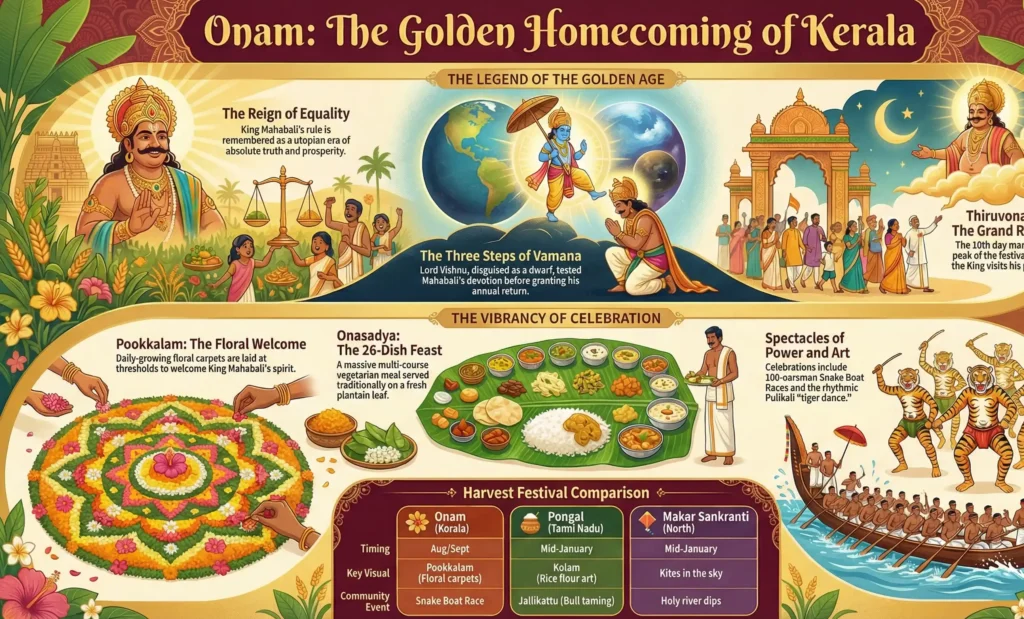
Under his rule, Kerala lived through a golden age. There was no rich and no poor, because everyone was treated as equal. There was no lying, no cheating, no stealing, and no fear. People still sing an old song about those days that says it in the simplest possible way.
The old Onam song remembers his reign in a single line: when Maveli ruled the land, all the people were equal, and no one lied, and no one was afraid.
Chola Dynasty 850-1279 CE: The Imperial Age of South India
The Three Small Steps
Maveli became so loved, and his kingdom grew so happy and so powerful, that even the gods up in heaven began to feel uneasy about him.
So the god Vishnu came down to earth in a clever disguise. He appeared as a tiny dwarf boy, a poor young Brahmin, and walked up to the king during a grand ceremony where Maveli was giving gifts to everyone who asked. The boy asked for something that seemed almost nothing: just three paces of land, measured out by his own small feet. The king smiled and agreed at once.
Then the little boy began to grow. He grew and grew until he was as huge as the sky. With one enormous stride he covered the entire earth, and with a second he covered all of the heavens. Now, he asked, where should he place his third step? Maveli had given his word, and he would never break a promise. So the king quietly bowed his head and offered it for that final step. And with it, he was pressed down and out of his beautiful kingdom, into the world below.
The Boon that Kerala Keeps
But the story does not end in sorrow, and that is the important part.
Vishnu had only been testing the king, and he was deeply moved by what he saw: a ruler so honest that he would give up his own crown rather than break a single promise. So Vishnu offered the fallen king one wish. Maveli asked for just one thing. He wanted to be allowed to come back, only once every year, to see the land and the people he loved so much. Vishnu agreed. And so, every year, on the day called Thiruvonam, the good king comes home.
This is the tender secret hidden inside Onam.
Kerala does not mourn the day its king was sent away. It joyfully celebrates the one day he is allowed to come home.
Eid al-Fitr and Eid al-Adha: Celebrating Faith and Community
Flowers, a Feast, and Best Clothes, All for Him
Once you know this, every custom of Onam suddenly makes perfect sense. The whole festival is simply the preparing of a home for a returning loved one.
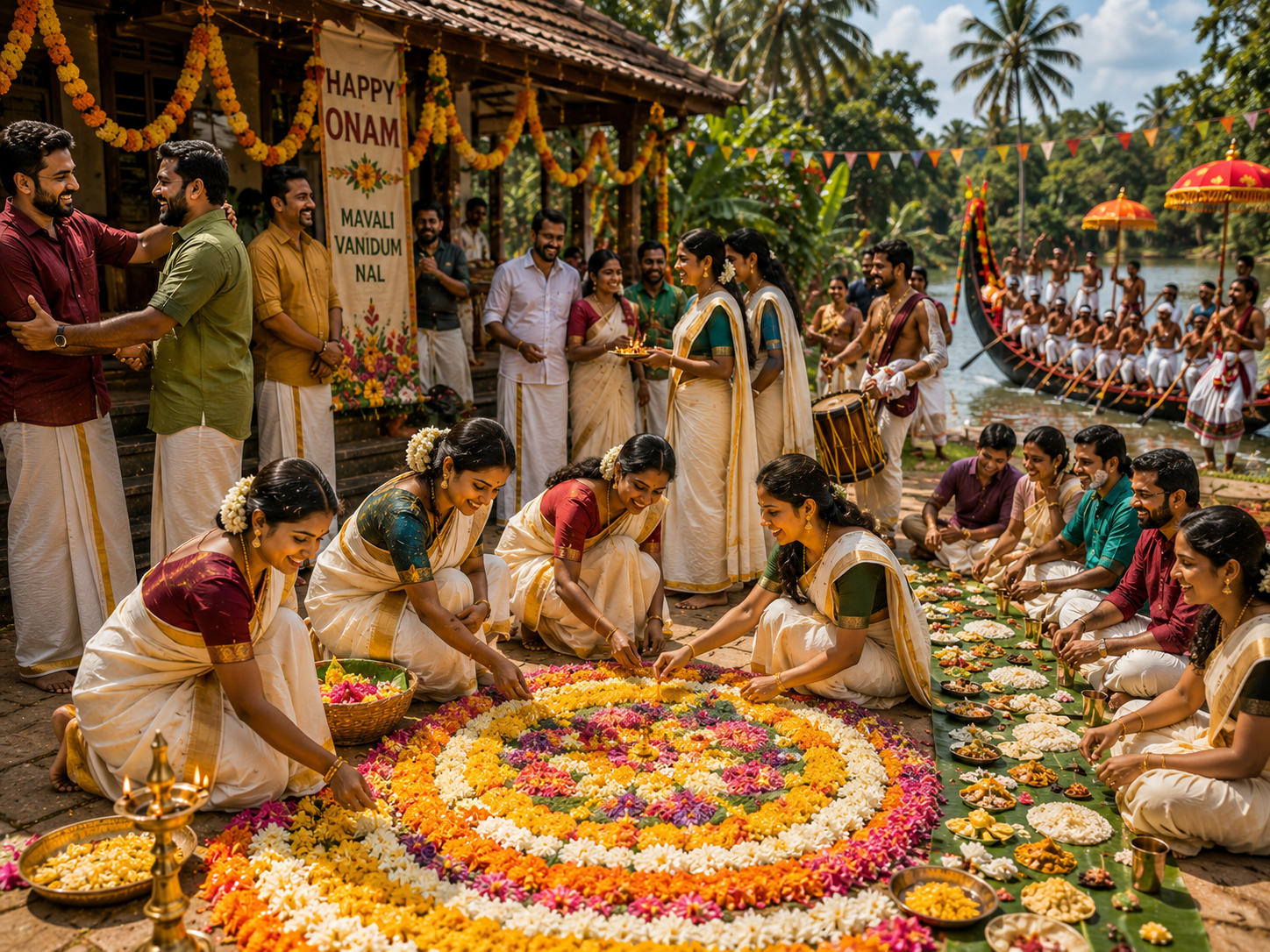
For ten days, families lay down a carpet of fresh flowers at their doorstep, called a pookalam, and it grows a little bigger and more beautiful each day. It is a welcome mat spread out for the king’s feet. On the great day, they cook the Onasadya, an enormous feast of dozens of dishes served on a banana leaf, the kind of meal you set before your most honoured guest. Everyone bathes early and dresses in fine new clothes.
And here is the part that touches the heart. Even families who have very little will stretch themselves to look their best and lay the richest table they can manage. They do it because they cannot bear the thought of their old king arriving and seeing them unhappy, or in need. The whole of Onam is, in a gentle way, a loving performance, put on to reassure a returning ruler that his people are still doing well.
A Festival That Belongs to Everyone
Christmas in India: A Festive Blend of Tradition
Because Maveli’s golden age was about a fair and equal world, and not about any single temple or god, Onam belongs to the whole of Kerala.
Hindus, Christians and Muslims all keep it side by side, as one people. It is the official festival of the state, and it works as a yearly homecoming not only for a king, but for an idea: the memory of a time when everyone was equal. That shared warmth is why the long snake boats thunder down the backwaters with a hundred rowers heaving in each one, why men paint themselves as leaping tigers and dance through the streets, and why all of Kerala, of every faith, sits down together to share the very same feast.
The Happiness We Keep Up for Him
There is something quietly beautiful in the whole idea. Once a year, an entire people agrees to be at its happiest and its most equal, all because a beloved king who lost everything is coming to make sure that they are alright.
Mahabali gave up his throne rather than break his word, and Kerala has never once stopped loving him for it. So every autumn the people roll out their flowers, lay their long feast, put on their finest clothes, and welcome home a king who now lives only inside a story. And in the simple act of trying to look happy for him, for one bright day, they truly are.
Pongal and Makar Sankranti: Sun, Gratitude, and New Beginnings
If you think you have remembered everything about this topic take this QUIZ
Results


#1. In which Malayalam month is the 10-day festival of Onam celebrated?
#2. Which mythical and righteous Asura King’s annual homecoming is commemorated during Onam?
#3. According to the legend, which avatar did Lord Vishnu take to test King Mahabali?
#4. What is the traditional Malayalam term for the vibrant floral carpets laid outside homes during the festival?
#5. What is the name of the grand, multi-course vegetarian feast traditionally served on a fresh banana leaf during Onam?
#6. During the festival, men in Thrissur paint their bodies to perform a vibrant street dance known as Pulikali. What animals do they represent?
#7. According to the comparison table, what is the key visual art difference between Onam and the Tamil Nadu festival of Pongal?
#8. Which of the following is an exhilarating community event held on the backwaters of Kerala during Onam?
Why is Onam celebrated?
Onam is a harvest festival celebrated to welcome the annual visit of the mythical, righteous King Mahabali back to Kerala.
What is the grand feast of Onam called?
It is called Onasadya, a 26+ dish vegetarian meal served on a banana leaf.
Who was Vamana?
Vamana was the fifth avatar (incarnation) of Lord Vishnu, who took the form of a dwarf Brahmin to humble King Mahabali.
What is the famous boat race held during Onam?
The Vallam Kali, commonly known as the Snake Boat Race.
What are the floral designs made during Onam called?
They are called Pookkalam, created daily at the entrance of homes starting from the day of Atham.
Sources and references
- Encyclopaedia Britannica and Kerala Tourism accounts — Onam as Kerala’s ten-day harvest festival in the month of Chingam, culminating in Thiruvonam, celebrating the annual homecoming of the asura king Mahabali.
- Gulf News and standard retellings of the myth — Mahabali (Maveli) as a just and generous asura king and grandson of Prahlada, his golden age of equality without theft or deceit, the Devas’ jealousy, and Vishnu’s Vamana avatar asking for three paces of land.
- Springdale Heritage and Sanskriti Magazine — Vamana growing to cover earth and heaven in two steps, Mahabali offering his own head for the third and being sent to the netherworld, and the boon granted by Vishnu allowing him to return to his people once a year.
- ShubhDivas and Bhaktiras (on Onam’s meaning) — the folk song “Maveli naadu vaaneedum kaalam” recalling an age when all people were equal, and Onam’s celebration by Malayalis of every religion as Kerala’s secular state festival.
- Original Curious Indian article (“Onam: Kerala’s Festival”) — the pookalam flower carpets, the Onasadya feast on a banana leaf, the Vallam Kali boat races and Pulikali tiger dance, the new Onakodi clothes, and the ten-day structure of the festival.
Author


Exploring the Soul of Bharat through History, Science, Culture, and its Diversity
Our Mission
Curious Indian is a definitive knowledge portal dedicated to chronicling the events, personalities, and cultural shifts that defined the Indian subcontinent. From the ancient Vedic Period to the complexities of 21st-century politics, our goal is to provide deep-dive analysis that inspires.
Editorial Standards & E-E-A-T
Every article published under our brand undergoes a rigorous fact-checking process. We prioritize primary historical records, academic citations, and credible archives to ensure our readers receive accurate, high-authority information.
Historical Integrity Directly sourcing from ASI archives and academic journals.Topical Authority Comprehensive clustering of Indian Science, Biographies, and Wars.Managed by Paripurna Datta and TEAM | Dedicated to the Knowledge of India.