Kharchi Puja is a seven-day festival celebrated in Old Agartala, Tripura, in which fourteen deities of the Tripuri royal pantheon are ritually bathed in the Khow river to purify the earth after the impurity brought by Ambubachi. Rooted in the traditions of the Manikya dynasty and presided over by hereditary Chantai priests, the festival blends indigenous Tripuri faith with later Hindu influences, drawing hundreds of thousands of devotees and visitors each year to the Chaturdasha Temple complex. It stands as one of the most theologically layered and culturally distinctive festivals in all of Northeast India.| Detail | Information |
| Festival Name | Kharchi Puja |
| Location | Agartala, Tripura, Northeast India |
| Duration | Seven days |
| Timing | Eight days after Ambubachi, month of Ashar (June to July) |
| Primary Community | Tripuri people (Debbarma clan and broader Tripuri groups) |
| Deities Worshipped | Fourteen gods of the Tripuri royal pantheon |
| Presiding Priests | Chantai priests of the Tripuri tradition |
| Primary Venue | Old Agartala, Chaturdasha Temple complex |
| Royal Association | Manikya dynasty of Tripura |
| UNESCO Status | Under consideration for intangible heritage documentation |
| Governing Body | Tripura Tribal Areas Autonomous District Council |
How Kharchi Puja Remained Sacred Despite Growing Spectacle
There is a belief held by the Tripuri people that the earth is not simply ground beneath our feet. The earth is a living mother, and like any living being, she passes through periods of impurity that must be addressed with care, with ritual, and with devotion. Kharchi Puja exists because of this belief. It is the festival through which Tripura cleanses the earth itself, and it has been doing so for centuries.
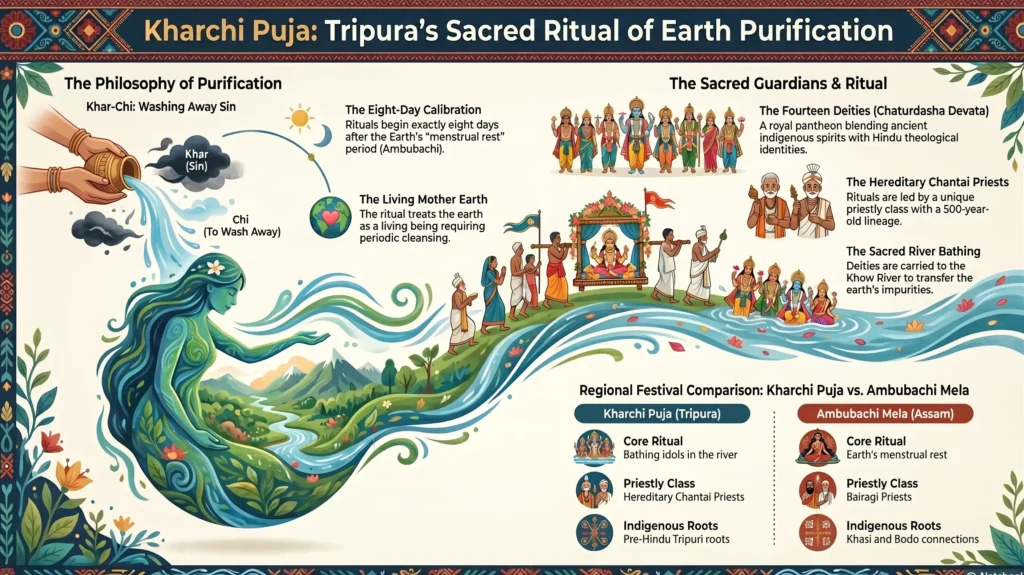
The name Kharchi carries within it the seed of the entire philosophy. In the old Tripuri understanding, Khar means sin or impurity and Chi means to wash away. The festival is, at its most essential, an act of washing. Not the washing of hands or clothes or temple floors, but the washing of the earth’s own accumulated weight of sin, a weight that builds through the months and must be lifted before life can move forward cleanly.
Kharchi Puja is a seven-day festival celebrated in Old Agartala, Tripura, in which fourteen deities of the Tripuri royal pantheon are ritually bathed in the Khow river to purify the earth after the impurity brought by Ambubachi. Rooted in the traditions of the Manikya dynasty and presided over by hereditary Chantai priests, the festival blends indigenous Tripuri faith with later Hindu influences, drawing hundreds of thousands of devotees and visitors each year to the Chaturdasha Temple complex. It stands as one of the most theologically layered and culturally distinctive festivals in all of Northeast India.
The World Before the Festival Begins
To understand Kharchi Puja, you must first understand Ambubachi. This is the period, observed across many parts of India but with particular intensity in the eastern and northeastern regions, during which the earth is considered to be menstruating. For three days, the earth goddess rests. Farmers do not plough. Temples close or restrict worship. The ordinary rhythms of agricultural and devotional life pause out of respect for the earth’s own biological cycle. When Ambubachi ends, the earth rises again, but she carries the ritual impurity of that period within her. Eight days after Ambubachi concludes, Kharchi Puja begins. The timing is not accidental. It is calibrated with precision, the ritual response arriving exactly when it is needed most, as the monsoon fills the rivers and the fields prepare to receive the season’s first serious cultivation.
Yaoshang Festival: The Spring That Lights Up Manipur
The Fourteen and the Temple That Holds Them
At the centre of Kharchi Puja stands the Chaturdasha Devata temple complex in Old Agartala, a site whose very name means fourteen deities. The temple houses fourteen gods of the Tripuri royal pantheon, and their identities form a theological map of how the Tripuri people understood the forces governing human existence.
The fourteen deities are Hara, Uma, Harithi, Kartik, Ganesh, Lakshmi, Saraswati, Dipra, Lama, Amara, Aukkar, Seba, Khuluma, and Buraha. These names carry both Sanskrit resonances and deeply indigenous Tripuri identities, reflecting centuries of spiritual layering. Some scholars of Tripuri religion, including those whose work is archived at the Indira Gandhi National Centre for the Arts, describe this pantheon as a theological bridge between the ancient animist faith of the Tripuri people and the Vaishnavite and Shaivite influences that arrived through contact with the Bengal Sultanate and later the Mughal periphery.
The temple itself is believed to have been established by the Manikya kings no later than the fifteenth century, making it one of the oldest continuously active religious sites in Northeast India. What matters during Kharchi Puja is not only who these fourteen deities are but what is done for them, and through them, for the earth.
The Chantai Priests and an Unbroken Line
The rituals of Kharchi Puja are not conducted by ordinary temple priests. They are presided over by hereditary Chantai priests, a priestly class unique to the Tripuri tradition whose lineage and ritual authority stretch back to the Manikya dynasty itself. The Chantai are the custodians of a liturgical knowledge that is not written in any publicly accessible text. It is transmitted orally, from father to son, across generations, making their lineage over five hundred years old in active ritual practice.
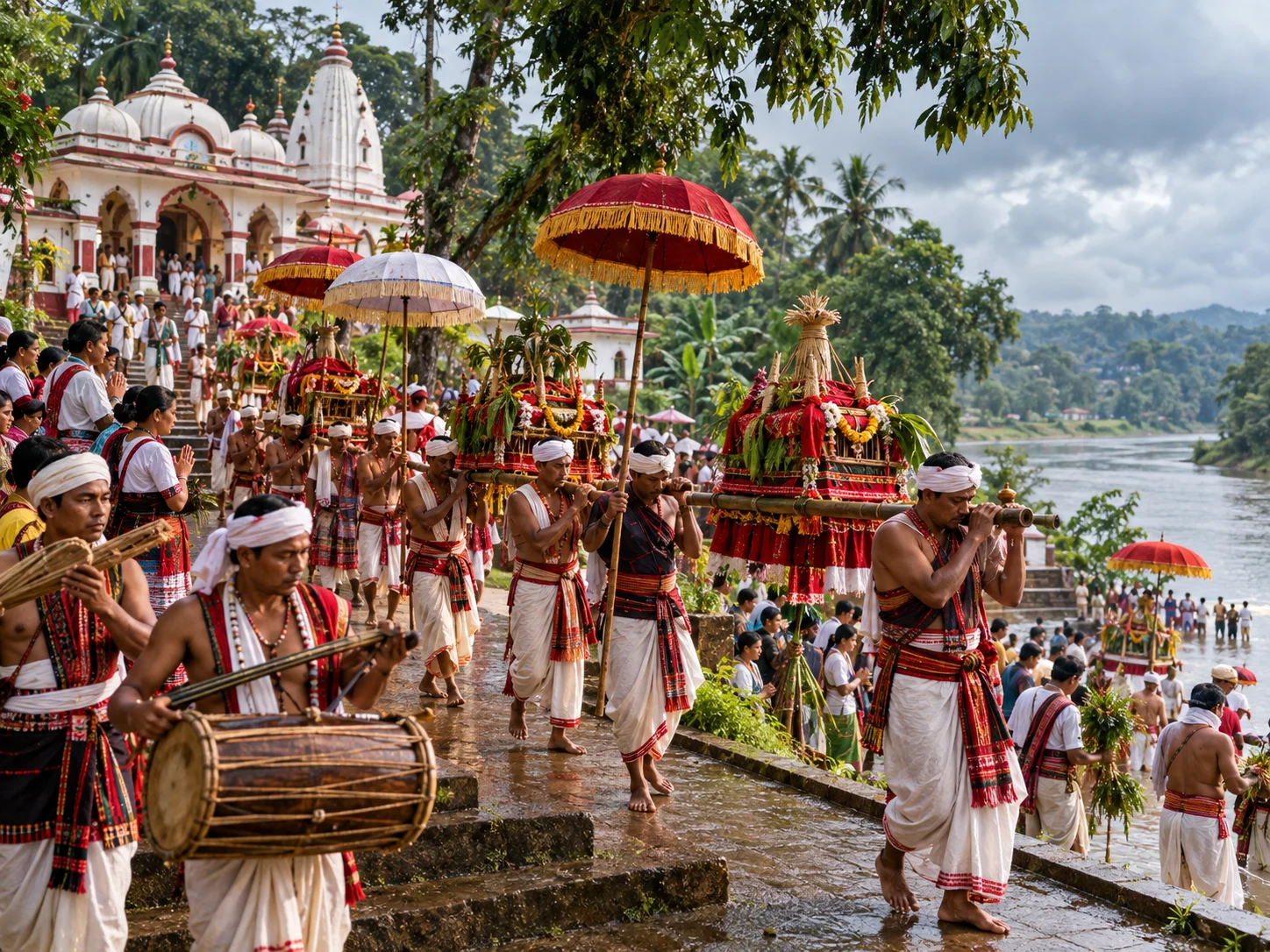
During Kharchi Puja, the Chantai priests perform the central act of the festival, the ritual bathing of the fourteen deities in the Khow river. The idols are carried in a ceremonial procession from the Chaturdasha temple to the riverbank. This procession is not a march. It is a slow, devotional movement, accompanied by traditional Tripuri music played on instruments including the Lebang, a bamboo clapper, and the Sarinda, a string instrument of great antiquity in the region.
The bathing of the idols, called Snan in the broader Hindu tradition but understood through a specifically Tripuri ritual vocabulary during this festival, is the moment when the earth’s purification is considered to actually occur. The water of the Khow river, itself considered sacred during this period, receives the impurity drawn out of the earth by the deities, and the cycle of the year turns clean again.
The anthropological record of this priestly tradition has been noted in regional scholarship supported by the North East India Studies Programme at Jawaharlal Nehru University, which has documented the Chantai’s ritual role as one of the most distinctive hereditary priesthoods surviving in active practice anywhere in Northeast India.
The Manikya Kings and the Royal Foundation
Kharchi Puja cannot be separated from the history of the Manikya dynasty, the royal house that ruled Tripura for over five centuries from the fourteenth century until the state’s merger with the Indian Union in 1949. The Manikya kings were not simply political rulers. They were the ritual protectors of the Tripuri people’s relationship with their deities, and Kharchi Puja was, historically, a royal festival in the most direct sense.
The king himself, or his designated representative, participated in the purification rituals. The royal family’s involvement was understood not as patronage but as obligation. The earth’s purity was the kingdom’s health, and the kingdom’s health was the king’s responsibility. This connection between political authority and ritual duty is one of the defining features of early Tripuri statecraft, and it is documented in the Rajmala, the royal chronicle of Tripura written in Bengali verse that serves as the primary historical record of the Manikya dynasty.
The Rajmala, one of the oldest dynastic records in Northeast India, describes Kharchi Puja as an institution of the state, embedded in the governing structure of the kingdom alongside taxation, military organisation, and diplomatic relations. This gives Kharchi Puja a historical weight that purely devotional festivals do not carry. It is a piece of constitutional history dressed in ritual form.
The Seven Days
The festival runs for seven days, and each day carries its own ritual texture. The first day is marked by the initial purification ceremonies at the temple, with the Chantai priests beginning the liturgical preparations that will build toward the river procession. Devotees arrive from across Tripura and from neighbouring Bangladesh, where the Tripuri diaspora maintains a living connection to these traditions. This cross-border participation is significant: Tripura shares a border with Bangladesh along most of its perimeter, and a substantial number of Kharchi Puja devotees cross from Bangladesh each year, reflecting how the Tripuri cultural community extends well beyond India’s political boundaries.
The middle days of the festival are the most publicly visible. The temple complex in Old Agartala becomes a site of continuous activity. Food stalls, craft vendors, and cultural performances surround the sacred core of the festival, creating the layered atmosphere common to great Indian religious fairs where the devotional and the festive exist in genuine harmony rather than uneasy tension.
Animal sacrifice has historically been part of the Kharchi Puja rituals, reflecting the festival’s pre-Hindu indigenous roots in which the relationship between the community and its deities was understood in terms of reciprocal obligation. The deities receive, and in exchange, they protect. This practice continues today, though it has been a subject of discussion within Tripuri communities and among regional cultural organisations regarding its continuation alongside the festival’s growing profile as a tourism event.
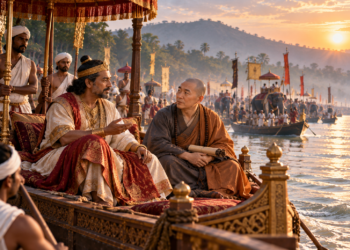
The river procession, when it comes, draws the largest gathering of the entire seven days. Hundreds of thousands of people line the route from the temple to the Khow river. The procession moves slowly, the idols carrying decorated palanquins under ceremonial umbrellas, the Chantai priests walking in solemn sequence, the crowd pressing close but maintaining the particular quality of reverence that distinguishes a true pilgrimage from a public spectacle.
The Sacred Beneath the Sanskrit
One of the most intellectually rewarding aspects of Kharchi Puja is what happens when you look beneath the Sanskrit names of the fourteen deities and their Hinduised ritual framing. What you find is a spiritual system that predates Hinduism’s arrival in Tripura by an unknown but certainly significant period of time.
The Tripuri people belong to the Tibeto-Burman linguistic and ethnic family, and their original religious world was animist in character, structured around relationships with nature spirits, ancestral forces, and a pantheon of indigenous deities. When Hinduism arrived, primarily through cultural contact with Bengal, it did not replace this world. It negotiated with it.
The fourteen deities of the Chaturdasha complex are the result of that negotiation. Their Sanskrit names are, in many cases, overlaid onto much older indigenous identities. Scholars working within the framework of the Tribal Research Institute of Tripura have argued that figures like Lama and Khuluma in the Kharchi pantheon represent pre-Hindu Tripuri nature deities who were gradually incorporated into a Hinduised ritual system without losing their original significance to the community.
This process of religious layering is not unique to Tripura. It is a pattern visible across South and Southeast Asia, from the Balinese integration of Hindu and animist traditions to the way Buddhism absorbed pre-existing spirit cults in Myanmar and Thailand. What makes the Tripuri case distinctive is how clearly the layers remain visible during Kharchi Puja if you know where to look.
The Khow River and Sacred Geography
The Khow river, also known locally as the Chhota Gomti or Gumti tributary, is not a celebrated river by national standards. It does not appear in the Puranas. It is not a destination for pan-Indian pilgrimage. But during Kharchi Puja, it becomes one of the most sacred bodies of water in the country, because the earth’s purification flows through it.
This is an example of what geographers of religion call the sacralisation of local landscape, the process through which a community transforms an ordinary geographic feature into a spiritually charged site through consistent ritual use over generations. The Khow river’s sacred status exists entirely within the Tripuri cultural imagination, and it is no less real or powerful for that.
Tarnetar Fair: The Umbrella Processions That Carry Gujarat’s Soul
Tribal Faith Beneath the Sanskrit Names
One of the most intellectually rewarding aspects of Kharchi Puja is what happens when you look beneath the Sanskrit names of the fourteen deities and their Hinduised ritual framing. What you find is a spiritual system that predates Hinduism’s arrival in Tripura by an unknown but certainly significant period of time.
The Tripuri people belong to the Tibeto-Burman linguistic and ethnic family, and their original religious world was animist in character, structured around relationships with nature spirits, ancestral forces, and a pantheon of indigenous deities. When Hinduism arrived, primarily through cultural contact with Bengal, it did not replace this world. It negotiated with it.
The fourteen deities of the Chaturdasha complex are the result of that negotiation. Their Sanskrit names are, in many cases, overlaid onto much older indigenous identities. Scholars working within the framework of the Tribal Research Institute of Tripura have argued that figures like Lama and Khuluma in the Kharchi pantheon represent pre-Hindu Tripuri nature deities who were gradually incorporated into a Hinduised ritual system without losing their original significance to the community.
This process of religious layering is not unique to Tripura. It is a pattern visible across South and Southeast Asia, from the Balinese integration of Hindu and animist traditions to the way Buddhism absorbed pre-existing spirit cults in Myanmar and Thailand. What makes the Tripuri case distinctive is how clearly the layers remain visible during Kharchi Puja if you know where to look.
The Khow River and Sacred Geography
The Khow river, also known locally as the Chhota Gomati or Gumti tributary, is not a celebrated river by national standards. It does not appear in the Puranas. It is not a destination for pan-Indian pilgrimage. But during Kharchi Puja, it becomes one of the most sacred bodies of water in the country, because the earth’s purification flows through it.
This is an example of what geographers of religion call the sacralisation of local landscape, the process through which a community transforms an ordinary geographic feature into a spiritually charged site through consistent ritual use over generations. The Khow river’s sacred status exists entirely within the Tripuri cultural imagination, and it is no less real or powerful for that.
The relationship between sacred geography and festival practice in Northeast India is a subject that the Curious Indian feature on the sacred rivers and pilgrimage traditions of Northeast India explores in substantial depth, offering valuable context for understanding how rivers become living participants in religious life across the region.
The Tension Between Faith and Spectacle
The Government of Tripura has, in recent decades, invested in Kharchi Puja as a cultural tourism event. The festival is listed as a major event in the state’s tourism calendar, and infrastructure improvements around the Old Agartala temple complex have been undertaken to manage the growing volume of visitors. The Tripura Tourism Development Corporation actively promotes Kharchi Puja to domestic and international visitors through its official channels.
This governmental embrace of the festival is largely positive in its effects. Greater visibility has brought resources to the Chaturdasha temple complex and has introduced the festival to audiences well beyond Tripura. National media coverage during the festival has grown significantly over the past decade.
However, some scholars and community members raise the same concern that surfaces around many living traditions that attract state attention: the risk that the festival’s outer spectacle becomes the story while its inner ritual life, maintained by the Chantai priests and the Tripuri community’s own devotional practice, recedes from view. Kharchi Puja has survived centuries without being a tourism product. The question for the coming generations is whether its sacred core can remain intact as its public profile continues to grow.
The Tripura Tribal Areas Autonomous District Council plays an active role in the cultural governance of the festival, working alongside the temple management and the Chantai community to ensure that the ritual protocols of Kharchi Puja remain under the stewardship of those to whom they belong.
Quick Comparison Table
| Feature | Kharchi Puja (Tripura) | Ambubachi Mela (Assam) | Rath Yatra (Odisha) | Thrissur Pooram (Kerala) |
| Duration | Seven days | Three to four days | Ten to twelve days | One day |
| Deities | Fourteen gods of Tripuri pantheon | Goddess Kamakhya | Lord Jagannath | Vadakkunnathan and associated deities |
| Ritual Core | Bathing of idols in river | Earth’s menstrual rest and renewal | Chariot procession of the deity | Elephant procession and fireworks |
| Priestly Tradition | Hereditary Chantai priests | Bairagi priests of Kamakhya | Servitor families of Puri temple | Namboothiri priests |
| Indigenous Element | Very strong, pre-Hindu Tripuri roots | Strong, Khasi and Bodo connections | Moderate | Moderate |
| Royal Association | Manikya dynasty of Tripura | Ahom kingdom historically | Gajapati kings of Odisha | Cochin and Poonjar royal families |
| Tourism Profile | Growing, state promoted | High, national pilgrimage | Very high, international | Very high, international |
Curious Indian: Fast Facts
- The name Kharchi literally means the washing away of sin in the old Tripuri linguistic tradition, making it one of the few Indian festival names that directly describes its own spiritual purpose.
- The fourteen deities worshipped during Kharchi Puja are collectively called Chaturdasha Devata, and their temple in Old Agartala is believed to have been established by the Manikya kings no later than the fifteenth century.
- The Chantai priests who conduct Kharchi Puja rituals are believed to descend from the original priestly families appointed by the Manikya royal court, making their lineage over five hundred years old in active ritual practice.
- Kharchi Puja begins precisely eight days after the end of Ambubachi, a timing so consistent and deliberate that it reflects a sophisticated understanding of the lunar and agricultural calendar maintained across many generations.
- The Rajmala, the royal chronicle of Tripura, is one of the oldest dynastic records in Northeast India and contains some of the earliest written references to Kharchi Puja as a state institution.
- Tripura shares a border with Bangladesh along most of its perimeter, and a significant number of Kharchi Puja devotees cross from Bangladesh each year, reflecting how the Tripuri cultural community extends well beyond India’s political boundaries.
- Some of the fourteen deities of the Kharchi pantheon have names that do not appear in any Sanskrit text, strongly suggesting they are pre-Hindu Tripuri nature deities who were incorporated into the festival’s structure during the period of Hinduisation.
- The Lebang Boomani dance, performed during Kharchi Puja celebrations, is a traditional Tripuri dance in which performers mimic the movements of insects and seasonal creatures, reflecting the festival’s deep roots in nature worship.
Conclusion
What Kharchi Puja Asks of Its Witnesses
There is something specific that Kharchi Puja asks of anyone who comes to see it, whether as a devotee, a researcher, or a curious traveller from another part of India. It asks you to accept that the earth has a condition, that this condition matters, and that human beings have a responsibility to address it through organised, collective, and deeply intentional ritual action.
This is not a passive philosophy. It places the community at the centre of the cosmic order rather than at its periphery. The fourteen deities do not descend to purify the earth on their own. They require the Chantai priests, the royal descendants, the river, the procession, the devotees, and the seven days of sustained human attention. The festival is the mechanism. The community is the engine.
In an era of growing ecological concern, there is something quietly radical about a tradition that has always understood the earth as a living being whose health is a moral and spiritual responsibility of the community that lives upon it.
Kharchi Puja is one of those festivals that rewards patience. Its full meaning does not arrive immediately. It comes gradually, as you begin to understand the relationship between the earth’s condition and the community’s responsibility, between the Chantai priests and the knowledge they carry, between the fourteen deities and the centuries of spiritual negotiation they represent.
Tripura is one of India’s smaller states, tucked against the eastern edge of the country with Bangladesh on three sides. It does not always receive the cultural attention its depth deserves. Kharchi Puja is a compelling reason to change that. This is a festival with royal chronicles behind it, a hereditary priesthood conducting rituals unchanged across centuries, a sacred river receiving the earth’s purification each monsoon, and a living community for whom this is not heritage to be preserved in a museum but faith to be practised under an open sky.
The fourteen deities will return to the river next year. The Chantai priests will recite the same liturgy their fathers recited. The Khow river will receive what it has always received. And the earth, according to the Tripuri understanding that has never wavered, will be clean again. There are not many places left in the world where a community can still say, with complete sincerity, that they are responsible for the purity of the earth beneath their feet. Tripura is one of them. Kharchi Puja is the proof.
Rann Utsav Under the Full Moon: Where the Salt Desert Comes Alive
If you think you have remembered everything about this topic take this QUIZ
Results


#1. In the old Tripuri linguistic tradition, what is the literal meaning of the words Khar and Chi that form the name of this festival?
#2. Kharchi Puja begins precisely eight days after the conclusion of which other major regional period of the earth’s ritual rest?
#3. How many total deities belonging to the Tripuri royal pantheon are housed and worshipped at the temple complex in Old Agartala?
#4. Which unique, hereditary priestly class is solely authorized to preserve the oral liturgy and preside over the central rituals of Kharchi Puja?
#5. In which sacred local body of water are the fourteen deities ritually bathed by the priests to wash away the earth’s accumulated impurity?
#6. Which historic royal dynasty ruled Tripura for over five centuries and historically integrated Kharchi Puja into the governing structure of the state?
#7. What is the name of the ancient Tripura royal chronicle written in Bengali verse that documents Kharchi Puja as an official state institution?
#8. Which traditional Tripuri bamboo clapper instrument is used to play folk music during the sacred, slow-moving river procession?
Poush Mela and the Baul Singers Who Keep Shantiniketan’s Soul Alive
What is the significance of the fourteen deities in Kharchi Puja?
The fourteen deities, collectively called Chaturdasha Devata, represent the divine pantheon of the Tripuri royal tradition. They include figures with both Sanskrit names and indigenous Tripuri identities, reflecting centuries of spiritual layering between the original animist faith of the Tripuri people and the Hindu traditions that arrived through contact with Bengal. During Kharchi Puja, these fourteen deities are ritually bathed in the Khow river to purify the earth after the impurity of the Ambubachi period.
Why does Kharchi Puja begin eight days after Ambubachi?
Ambubachi is the period during which the earth is considered to be in a state of ritual impurity associated with menstruation. During this time, farming and temple worship are restricted across much of eastern and northeastern India. Kharchi Puja begins eight days after Ambubachi ends as a deliberate ritual response, a cleansing ceremony timed to purify the earth precisely when agricultural activity is about to resume during the monsoon season.
Who are the Chantai priests and why are they important?
The Chantai are a hereditary priestly class unique to the Tripuri tradition, appointed originally by the Manikya kings to conduct the state’s most sacred rituals. Their liturgical knowledge is transmitted orally across generations and is not documented in any publicly available text. During Kharchi Puja, the Chantai priests perform the central ritual of bathing the fourteen deities in the Khow river, making them the irreplaceable custodians of the festival’s sacred core.
Can visitors attend Kharchi Puja and how should they prepare?
Kharchi Puja is a public festival and visitors are welcome to attend. The Tripura Tourism Development Corporation provides information on the festival’s schedule and the location of the Chaturdasha temple complex in Old Agartala. Visitors should dress modestly, be prepared for very large crowds particularly during the river procession, and approach the ritual spaces with the respectful awareness that this is an active devotional event, not a performance staged for audiences.
How is Kharchi Puja different from other river bathing festivals in India?
Most river bathing festivals in India involve devotees bathing themselves in sacred water. Kharchi Puja reverses this dynamic. It is the deities who are bathed in the river, with the explicit purpose of drawing the earth’s accumulated impurity through the idols and into the sacred water, thereby purifying the earth itself. This ritual logic, rooted in the Tripuri understanding of the earth as a living being requiring periodic cleansing, makes Kharchi Puja theologically distinctive among India’s many river-associated festivals.