How the Tarnetar Fair Keeps the Ancient Art of Being Chosen Alive
There is a particular kind of quiet that falls over the Saurashtra peninsula in the days before the monsoon arrives. The land lies flat and patient under the dry heat. And then, when the rain comes, the villages that have spent weeks in dusty waiting suddenly fill with colour. It is into this transformed landscape that the Tarnetar Fair arrives each year, and it arrives with umbrellas.
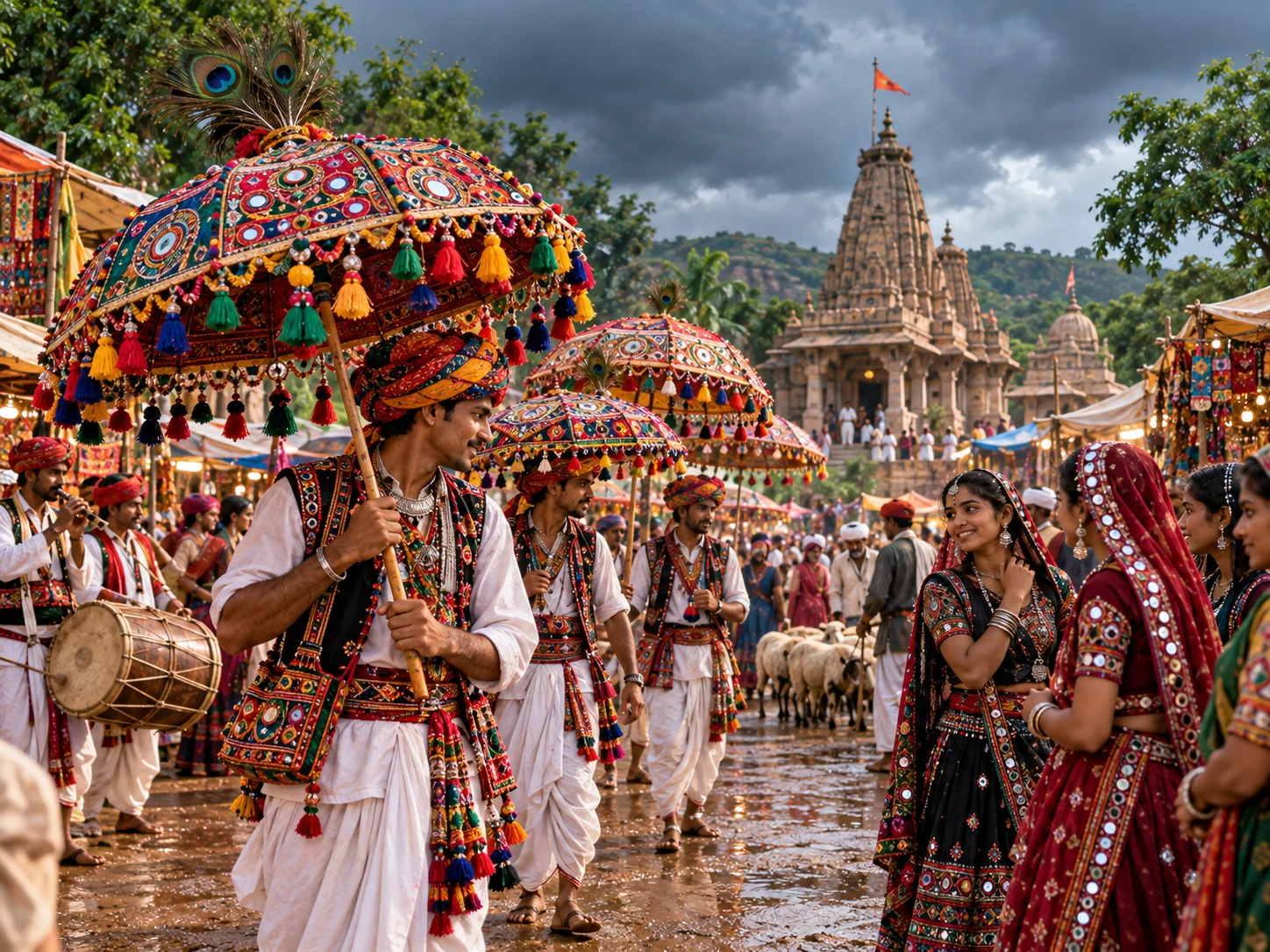
Not ordinary umbrellas. Not the plain, functional kind that keep rain off city shoulders. These are objects that have taken weeks or months to create, stretched across bamboo frames and covered in mirror work, silk embroidery, wool tassels, peacock feathers, and beadwork so intricate that examining a single panel can occupy an attentive eye for several minutes. Each umbrella is unique. Each one is, in the most direct sense possible, a self-portrait of the man who made it or commissioned it, a declaration of his creativity, his cultural pride, and his readiness to be seen.
The Tarnetar Fair, formally known as the Trinetreshwar Mahadev Fair, is a three-day festival held annually in Tarnetar village in Surendranagar district during the monsoon month of Bhadrapad. Rooted in the mythological swayamvar of Draupadi described in the Mahabharata and centred on the ancient Trinetreshwar Mahadev temple, the fair is most famous for its tradition of young tribal men carrying elaborately hand-embroidered umbrellas through the fairgrounds as a form of courtship display. It is simultaneously a religious pilgrimage, a tribal matrimonial gathering, and one of the most spectacular showcases of Gujarat’s living textile and craft traditions anywhere in the world.
Yaoshang Festival: The Spring That Lights Up Manipur
The Mahabharata Comes to Saurashtra
Kharchi Puja: Where Fourteen Deities Cleanse the Soul of Tripura
The Tarnetar Fair does not begin with a craft tradition or a trade route or a royal decree. It begins with an arrow.
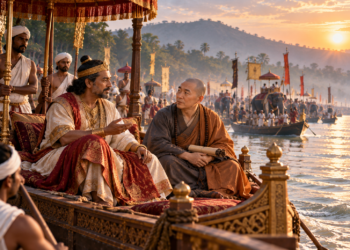
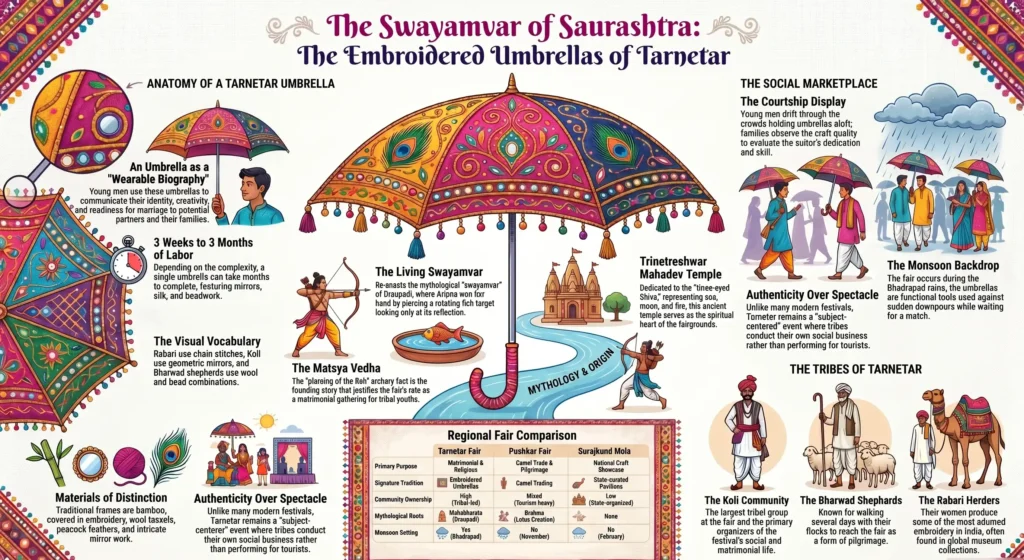
According to the mythological account that the local tradition holds as its founding story, it was here, at the site of the Trinetreshwar Mahadev temple in what is now Tarnetar village, that Arjuna performed the feat of archery that won him Draupadi’s hand during her swayamvar. The task, as recorded in the Mahabharata, required a suitor to pierce a rotating fish target by looking only at its reflection in the water below. This feat is called Matsya Vedha in Sanskrit, meaning the piercing of the fish, and it is one of the most celebrated archery episodes in all of Indian epic literature. Arjuna accomplished it. Draupadi was wed.
The connection between this episode and the Tarnetar Fair is not incidental. The entire social logic of the fair, in which young men display their skills and young women make their choices, mirrors the swayamvar tradition in which a bride’s family creates a contest through which suitors prove their worth and the woman exercises her right of selection. The fair is, in this reading, a living re-enactment of one of the Mahabharata’s most celebrated episodes, transposed from the royal courts of mythological India into the everyday world of Saurashtra’s tribal communities.
The Trinetreshwar Mahadev temple at the fair’s centre is an ancient structure, believed to be over a thousand years old, dedicated to Lord Shiva in his three-eyed form. Three eyes, in the Shaivite tradition, represent the sun, the moon, and fire, the three sources of light that together illuminate all of existence. Pilgrims come to the temple throughout the three days of the fair, and the religious dimension of Tarnetar is entirely genuine, not a backdrop to the craft spectacle but a living, breathing foundation beneath it.
The Umbrella as Language
To understand the Tarnetar umbrella tradition, you have to first accept that in some cultures, objects speak more fluently than words. In the Saurashtra tribal world, embroidery and mirror work are not decorative hobbies. They are a primary visual language through which identity, community membership, marital status, and aesthetic sensibility are communicated.
The umbrella, in this context, becomes a kind of wearable biography. A young man arriving at Tarnetar with his umbrella is not simply carrying shade. He is carrying everything he wants a potential partner and her family to know about him in a single glance.
The tradition works as follows. Young men from the Koli, Bharwad, Rabari, and other tribal communities of Saurashtra arrive at the fair carrying their decorated umbrellas. They walk through the fairgrounds, displaying their umbrellas openly. Young women and their families observe. Conversations begin. Introductions are made. In many cases, matches that will result in marriage are initiated under the open monsoon sky of Tarnetar.
This is the swayamvar made social and democratic. There is no king’s court, no royal proclamation, no single dramatic contest. Instead, there is three days of quiet, continuous, beautifully adorned human evaluation happening across an entire fairground. The umbrella is both the invitation and the resume.
The embroidery traditions on display at Tarnetar represent some of the finest surviving examples of Gujarat’s extraordinary textile heritage. The Rabari community’s chain stitch work, the Koli community’s geometric mirror inlays, and the Bharwad shepherds’ wool and bead combinations each carry a distinct visual vocabulary that trained eyes can read like a regional dialect. The Rabari community women of Saurashtra are considered among the finest embroiderers in India, and their work displayed at Tarnetar has entered museum collections in Europe, the United States, and Japan. A single elaborately embroidered Tarnetar umbrella can take anywhere from three weeks to three months to complete, depending on the intricacy of the mirror work and embroidery chosen by its maker.
The craft density at a single Tarnetar umbrella procession is, by any measure, extraordinary. Textile scholars and museum curators have noted that the concentration of living embroidery traditions visible at Tarnetar in three days rivals what many major museums have accumulated over decades of dedicated collection. Gujarat has over twenty distinct regional embroidery traditions, and scholars have identified representatives of at least twelve of them consistently present among the umbrella makers at Tarnetar each year.
What the Fair Actually Looks Like
Rann Utsav Under the Full Moon: Where the Salt Desert Comes Alive
Words make an honest attempt at Tarnetar and fall somewhat short. But here is what you would find if you arrived on the second morning of the fair, when the crowds have settled into their rhythm and the full scale of the event becomes visible.
The fairground surrounds the temple complex, spreading outward in concentric rings of activity. Closest to the temple, the devotional life of the fair is most concentrated. Priests conduct continuous worship. Pilgrims queue patiently for darshan. The smell of incense and marigold garlands is dense and constant.
Moving outward, the craft world takes over. Artisans from across Saurashtra and beyond have set up stalls displaying and selling embroidered textiles, beadwork, traditional jewellery, leather goods, and carved wood objects. This is not a curated craft fair with clean white stalls. It is the organic, chaotic, brilliant spillover of a living tradition meeting a marketplace, and it has been happening in roughly this form for centuries.
Further out still, the social life of the fair unfolds. Food vendors, folk musicians, and acrobats occupy the outer rings. Children run between the legs of adults who are deep in conversation. Old women sit in groups with the particular authority of those who have attended this fair for sixty years and know exactly where everything is and what everything means.
And moving through all of it, in no fixed route or formation, are the umbrella carriers. They drift through the crowds with their extraordinary objects held aloft, occasionally stopping, occasionally being stopped, the whole courtship drama playing out in plain sight with a casualness that makes it more affecting, not less.
The folk music that accompanies the Tarnetar Fair deserves its own moment of attention. The Dhol, Shehnai, and Nagada provide the sonic backdrop to the entire event. Traditional Garba and Raas performances, specific to the Saurashtra region and distinct in their movement vocabulary from the Garba performed during Navratri, take place in the evenings. These performances are not staged for tourists. They are the community dancing for itself, as it has always done, and this authenticity is immediately apparent to anyone who has seen both the genuine article and its packaged imitation.
The Communities That Make Tarnetar
The Tarnetar Fair belongs, in the most essential sense, to the tribal and pastoral communities of Saurashtra. The Koli community, numerically the largest tribal group in Gujarat, has historically been the primary organising community of the fair’s social life. The Bharwad shepherds, who have roamed the Saurashtra grasslands with their flocks for generations, bring a specific visual identity to the fair through their distinctive dress and embroidery style. The Rabari camel and cattle herders, whose women produce some of the most admired embroidery in all of India, are present in significant numbers.
These are not communities that appear at Tarnetar as performers of their own culture for an outside audience. They appear as themselves, conducting their own social business, meeting relatives, initiating marriages, trading goods, and participating in a religious festival that is genuinely theirs. The Bharwad shepherds who attend Tarnetar traditionally walk to the fair with their flocks, a journey that can take several days from remote pasture areas, treating the travel itself as a form of pilgrimage. This distinction matters enormously. Tarnetar has not yet become a festival where the community is the spectacle. The community is still the subject.
The economic dimension of the fair is substantial. For artisan communities, the three days of Tarnetar represent a significant portion of the annual income from craft sales. The density of buyers at the fair, including collectors, retailers, and export buyers who attend specifically to source authentic Gujarati textiles, has made Tarnetar commercially important to the survival of several embroidery traditions that might otherwise struggle to find markets in the ordinary course of the year.
The Monsoon Setting and Why It Matters
Poush Mela and the Baul Singers Who Keep Shantiniketan’s Soul Alive
One detail about Tarnetar that photographs consistently fail to capture is the role of the monsoon weather itself in the festival’s atmosphere. The fair takes place during Bhadrapad, deep in the Gujarat monsoon season. The sky on any given day of the fair may be brilliant blue in the morning, dramatically overcast by noon, and delivering a sudden warm downpour by afternoon.
This is not incidental weather. It is part of the festival’s character. The umbrellas that the young men carry are functional as well as decorative, and watching a procession of hand-embroidered umbrellas open against a darkening monsoon sky is one of those specific visual experiences that seems almost too beautiful to be accidental.
The monsoon timing also connects the fair to the agricultural cycle of Saurashtra. The rains have come, the planting is done or underway, and there is a brief window before the harvest demands full community attention. The fair fills this window. It is the community’s reward to itself for the year’s first hard labour, and the marriage matches made under the monsoon sky of Tarnetar will shape the community’s structure for the next generation.
Tourism and the Question of Authenticity
The Gujarat Tourism Department has, with increasing intensity over the past two decades, promoted the Tarnetar Fair as a flagship cultural tourism event. The fair now appears in international travel publications, attracts photographers from across the country and abroad, and has become a recognised stop on the cultural tourism circuit of western India.
This growth in visibility has brought genuine benefits. Infrastructure around the Tarnetar fairground has improved. Artisans report broader market access. The fair’s mythological and cultural significance has received coverage that has introduced it to audiences who would never otherwise have encountered it.
The concern, and it is a concern worth naming directly, is the gradual aestheticisation of a living social institution. When photographers outnumber pilgrims at the temple steps, or when the umbrella procession is staged for a camera crew rather than conducted for its own social purpose, something essential shifts. The Tarnetar Fair has not reached that point. But the trajectory of many Indian festivals that have received similar tourism attention suggests that the community’s stewardship of the event’s inner life will require active, intentional protection in the years ahead.
What Tarnetar Tells Us About India
Every country has festivals. Not every country has festivals where the making of a single object, an umbrella covered in months of embroidered labour, constitutes the primary act of courtship. Not every country has festivals where a mythological event from an ancient epic is re-enacted each year not through performance or pageant but through the actual social behaviour of the community.
Tarnetar sits at the intersection of mythology, craft, ecology, and social organisation in a way that reveals something fundamental about how certain Indian communities have always understood the relationship between beauty and purpose. At Tarnetar, beauty is not decorative. It is functional. The embroidered umbrella is beautiful because it has to be. Because the stakes of being seen and chosen are real.
That seriousness beneath the spectacle is what gives Tarnetar its particular emotional weight. You can enjoy the fair as pure visual pleasure, and it delivers that abundantly. But if you stay long enough to understand what the umbrellas are actually for, and what they cost in time and attention and hope, the fair becomes something considerably more profound.
The Tarnetar Fair lasts three days. Those three days contain, if you are paying attention, several lifetimes of accumulated human knowledge about beauty, community, faith, and the extraordinary complexity of finding someone to love.
The embroidered umbrella is the fair’s most famous image, and it deserves every photograph ever taken of it. But the umbrella is a surface. Beneath it is a young man who spent months preparing for this moment, who learned his community’s embroidery language from his mother or his grandmother or from watching older men at previous fairs, who understands that the care he put into this object is the most honest self-presentation he is capable of making.
And somewhere in the fairground is a young woman and her family, evaluating not just the umbrella but the person who chose to make it this particular way, with these particular colours, these particular mirrors, this particular density of peacock feathers along the rim.
This is the swayamvar that the Mahabharata described. Not the royal court version with kings and armies watching, but the human version, repeated every monsoon in a Gujarat village, conducted with embroidery thread and bamboo and the particular courage it takes to walk into a crowd holding something you made with your own hands and say, quietly but unmistakably, here I am.
That courage is what Tarnetar has always celebrated. It will celebrate it again next monsoon. The umbrellas will open. The rain may fall. And the oldest human business of all will continue, as it always has, under an embroidered sky.
The Mythological World Woven Inside a Baluchari Saree
If you think you have remembered everything about this topic take this QUIZ
Results


#1. In which specific administrative district of Gujarat’s Saurashtra region is the historic Tarnetar Fair celebrated annually?
#2. Which landmark epic episode from the Mahabharata serves as the primary mythological foundation for the courtship traditions at the fair?
#3. The ancient temple at the center of the fair grounds is dedicated to Lord Shiva in which specific mythological form?
#4. What unique custom do young tribal men practice at the Tarnetar Fair as a visual courtship display and personal invitation?
#5. During which Hindu monsoon calendar month does the three-day Tarnetar festival take place?
#6. Which prominent tribal community, known for its distinct chain stitch work, is among the primary pastoral groups shaping the textile traditions of the fair?
#7. What celebrated Sanskrit term is used to describe the legendary fish target archery feat performed by Arjuna at the Tarnetar site?
#8. According to the Quick Comparison Table, what distinguishes the environmental setting of the Tarnetar Fair from the Pushkar Fair?
What is the Tarnetar Fair and where is it held?
The Tarnetar Fair, formally known as the Trinetreshwar Mahadev Fair, is a three-day annual festival held in Tarnetar village in Surendranagar district of Gujarat’s Saurashtra region. It takes place during the monsoon month of Bhadrapad and combines religious pilgrimage to the ancient Trinetreshwar Mahadev temple with a tribal matrimonial gathering and one of India’s most spectacular living craft showcases.
What is the mythological significance of the Tarnetar Fair?
The fair is traditionally associated with the swayamvar of Draupadi from the Mahabharata. According to local tradition, it was at the site of the Trinetreshwar Mahadev temple that Arjuna performed the fish-eye archery feat that won him Draupadi’s hand in marriage. The fair’s social structure, in which young men display their skills and young women exercise their right of selection, mirrors the swayamvar tradition directly.
Why do young men carry embroidered umbrellas at Tarnetar?
The decorated umbrella is the central courtship object of the Tarnetar Fair. Young men from tribal communities including the Koli, Bharwad, and Rabari carry hand-embroidered umbrellas covered in mirror work, silk embroidery, peacock feathers, and beadwork as a display of their artistic skill, cultural identity, and readiness for marriage. The umbrella functions as a visual self-introduction, allowing young women and their families to assess potential partners through the quality and character of their craft.
Which tribal communities participate in the Tarnetar Fair?
The fair draws primarily from the tribal and pastoral communities of Saurashtra, with the Koli, Bharwad, and Rabari communities being the most prominently represented. Each community brings a distinctive embroidery and decoration style to the fair’s umbrella tradition, and the visual diversity of the processions reflects the rich plurality of craft traditions concentrated in the Saurashtra region of Gujarat.
How should a first-time visitor prepare for attending the Tarnetar Fair?
First-time visitors should check the exact dates through Gujarat Tourism’s official calendar, as the fair follows the lunar calendar and shifts annually. The fair is held in a small village, so accommodation arrangements in nearby Surendranagar town are advisable well in advance. Visitors should be prepared for large crowds, monsoon weather, and the need to move slowly and attentively to appreciate both the religious and craft dimensions of the event. Lightweight, modest clothing is appropriate given the combination of temple visits and outdoor fairground activity.
Sources & References
Tarnetar Fair and Draupadi’s swayamvar — Three-day annual festival during monsoon month of Bhadrapad in Surendranagar district, rooted in the mythological swayamvar of Draupadi from the Mahabharata. The fair’s social logic mirrors the swayamvar tradition where young men display their worth and young women exercise their right of selection.
Arjuna’s Matsya Vedha archery feat — According to local tradition, Arjuna performed his famous fish archery feat (Matsya Vedha) at the Trinetreshwar Mahadev temple site, winning Draupadi’s hand by piercing a rotating fish target while viewing only its reflection. This mythological foundation structures the fair’s entire courtship mechanism.
Embroidered umbrellas and tribal communities — Young men from the Koli, Bharwad, and Rabari communities carry hand-embroidered umbrellas that take three weeks to three months to complete, displaying them as courtship declarations. Each umbrella functions as a wearable biography showcasing the maker’s artistic skill, cultural identity, and readiness for marriage.
Monsoon timing and agricultural significance — The fair takes place during Bhadrapad, connecting directly to Saurashtra’s agricultural cycle and serving as the community’s reward to itself after the year’s first hard labour. The monsoon weather is integral to the fair’s character, with rain-functional umbrellas opening dramatically against darkening skies.
Tourism, authenticity, and community stewardship — While Gujarat Tourism has promoted the fair as a flagship cultural event with genuine benefits for infrastructure and market access, the challenge lies in protecting the community’s stewardship of the event’s inner life as it attracts increasing numbers of photographers and international attention.