How Abanindranath Tagore Turned the Abstract Idea of a Nation into a Mother People could Love
How do you love a country?
You can love a person easily enough. You can see their face, picture them when they are away, miss them when they are gone. But a whole nation is a much harder thing to love. It is an idea, a word, a shape on a map, an argument. In 1905, a Bengali artist named Abanindranath Tagore solved that problem with a single small painting. He gave the idea of India a face and a body: a gentle mother, standing quietly, holding out her hands to her children. And after that, India was no longer only an idea to argue about. It was a mother to love. This is the story of that painting, Bharat Mata.
An Idea in the Air
The painting was born in an angry and hopeful moment. In 1905, the British rulers cut the province of Bengal in two, a move that most Indians were certain was meant to weaken and divide them.
The anger boiled over into what became the Swadeshi movement. People boycotted British cloth and British goods, and vowed to use only things made in their own land. And floating in the air already was a powerful idea, carried by a famous novel and its stirring song “Vande Mataram,” of the country not as a mere place, but as a mother, a divine mother to be honoured and served. It was a beautiful idea. But it was still only an idea, made of words. It had no face that a person could actually picture.
Indian Textiles: From Lustrous Silk Sarees to Hand-Block Prints
A Mother you could Picture
Abanindranath Tagore gave it one, and what he chose to paint was quietly surprising.
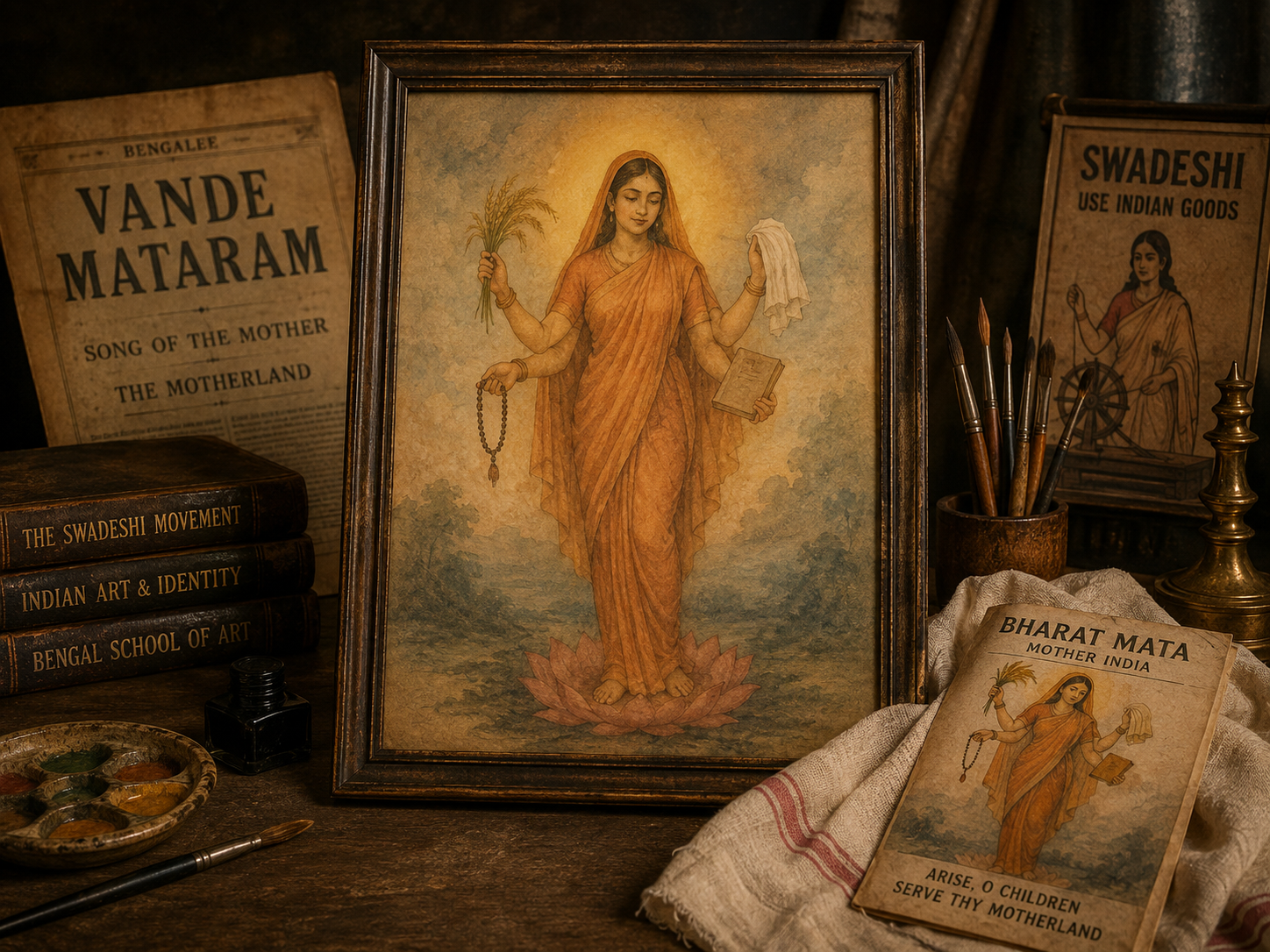
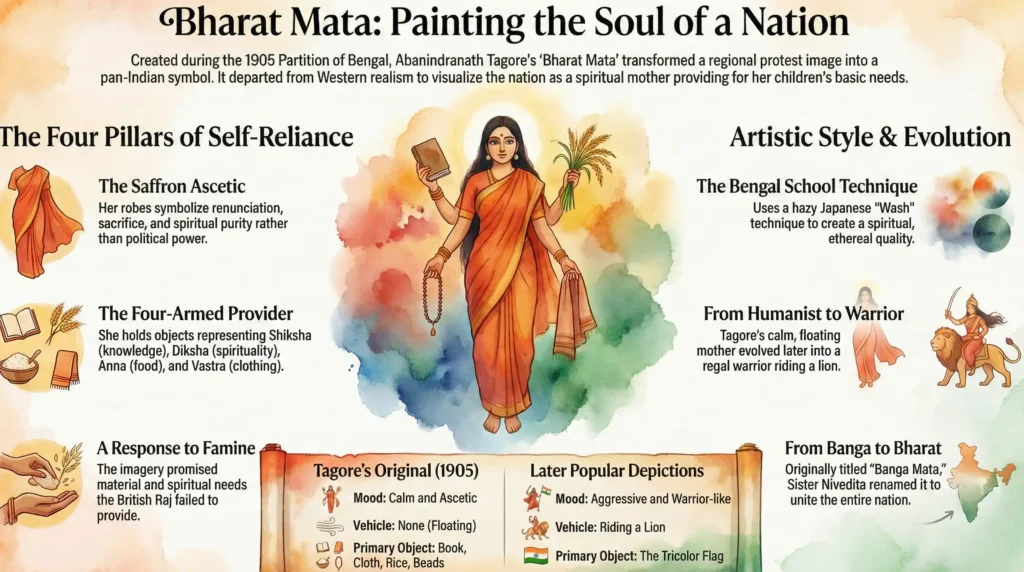
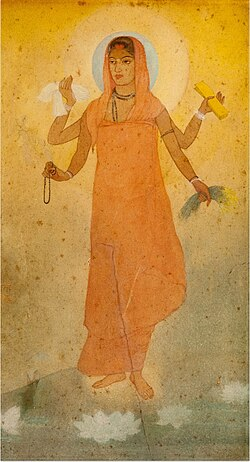
He did not paint a fierce warrior-goddess, or a grand and distant queen. He painted a calm, gentle young woman, dressed simply in the saffron robes of someone who has given up all worldly riches. He modelled her, it is said, on the ordinary Bengali women he saw around him every day, perhaps even on his own daughter. She was not a stranger to be feared, but a mother anyone could recognise and love.
She has four arms, in the way of a goddess, and in each hand she holds out a gift for her children.
In her four hands, Mother India holds not weapons but gifts: sheaves of rice, a piece of white cloth, a book, and a string of prayer beads. Food, clothing, learning, and faith, the simple things a mother gives her children so they can live well.
This is worth pausing on. The very first Bharat Mata offered her children not a sword, but sustenance. She was not demanding that they go and fight for her. She was gently holding out to them the things they needed in order to live. The white cloth carried an extra, timely meaning too: at that very moment, it was a quiet nod to the Swadeshi call to wear only India’s own homespun cloth.
Khajuraho Temples: 3 Myths 23 Temples and Truth About “Erotic” Art
A Rebellion in the Brushwork
There was a second rebellion hidden inside the painting, one that only fellow artists noticed at first.
In those days, the art schools of India taught their students to paint in the Western manner, with hard outlines, lifelike shadows, and the fashions of Europe. Abanindranath deliberately turned his back on all of it. He revived older Indian ways of painting, and he borrowed a soft, misty “wash” technique from Japan, so that his colours seem to glow and blur gently, like a half-remembered dream rather than a sharp photograph.
So the little painting was a declaration of independence twice over. It showed an Indian nation, painted as an Indian goddess, in a proudly Indian style. It was a refusal to see India, or even to paint her, through the coloniser’s eyes. Out of this, Abanindranath became the father of a whole new movement in art, which came to be known as the Bengal School.
Nil Darpan: The Mirror of Indigo
The Face that Travelled
The painting itself was tiny, smaller than a sheet of notebook paper. And that turned out to be part of its power, because it was made to be copied, shared, and passed from hand to hand.
A close friend of the movement, an Irishwoman known as Sister Nivedita, saw at once how important this small image could become. It was she who suggested changing its name from “Banga Mata,” which means Mother Bengal, to “Bharat Mata,” Mother India, so that the figure could belong to the whole country rather than to one province alone. And belong to it she did. Cheap printed copies of the little painting soon appeared on posters, in magazines, and at fundraising drives all over the land. Across a vast country, people who had never agreed on very much discovered that they could all love the very same gentle mother.
Subramania Bharati: The Mahakavi of Indian Nationalism
The Mother in the Mind
That is the quiet magic of what Abanindranath Tagore did with a small sheet of paper and a few soft washes of colour.
He took something enormous and impossibly abstract, a nation of hundreds of millions of people, spread across many languages and many faiths, and he shrank it down into something a child could understand and an ordinary person could hold dear: a mother, holding out food and cloth and a book. He did not invent the idea of Mother India. But he was the one who first gave her a face. And once people had seen that face, they could never again think of their country as merely a line drawn on a map. A tiny painting, made in gentle Japanese washes by a soft-spoken Bengali artist, had helped a huge and scattered people begin to feel, for the first time, like one single family, with one mother worth loving and worth serving.
If you think you have remembered everything about this topic take this QUIZ
Results


#1. In which year did Abanindranath Tagore paint the famous watercolor “Bharat Mata”?
#2. What was the original title of the painting before it was renamed to “Bharat Mata”?
#3. Who was the disciple of Swami Vivekananda that reprinted the image and popularized the name “Bharat Mata”?
#4. The hazy, mist-like effect in the painting is a classic example of which technique adapted by Abanindranath?
#5. The literary concept of the motherland as a goddess was first popularized in which 1882 novel by Bankim Chandra Chatterjee?
#6. What unique feature is housed inside the Bharat Mata Temple inaugurated by Mahatma Gandhi in Varanasi in 1936?
#7. The soft, misty look of the painting was directly influenced by Abanindranath’s interaction with which Japanese artist?
Who painted the famous image of Bharat Mata in 1905?
Abanindranath Tagore painted it.
What do the four hands of Bharat Mata symbolize?
They symbolize Food (Paddy), Clothing (White Cloth), Knowledge (Book), and Faith (Rosary/Mala).
What was the original title of the painting?
The original title was Banga Mata (Mother Bengal).
Which artistic style does the painting belong to?
It belongs to the Bengal School of Art.
Who played a key role in popularizing the painting as ‘Bharat Mata’?
Sister Nivedita popularized it.
Sources and References
- Encyclopaedia Britannica (“Abanindranath Tagore”) — Bharat Mata painted in 1905 as his most iconic work, depicting India as a four-armed goddess in an orange sari, drawing on the nation-as-divinity idea from Bankim Chandra Chatterjee’s Anandamath, and its retitling from Banga Mata on Sister Nivedita’s advice.
- Smarthistory and GKToday — the four blessings held in her hands (food as grain, clothing as cloth, knowledge as a manuscript, faith as prayer beads), the lotuses and halo, and the painting’s use on Swadeshi posters and in vernacular magazines.
- Wikipedia (“Bharat Mata (painting)”) and Astaguru — the small gouache work (about 26.6 by 15.2 cm), the saffron-clad sadhvi imagery, the original conception as Banga Mata modelled on an everyday Bengali woman, and its home at the Victoria Memorial Hall, Kolkata.
- Artflute and Sadhana (on technique and context) — the delicate “wash” technique merging colour and atmosphere, Abanindranath’s rejection of Western academic realism, his founding role in the Bengal School, and the painting’s circulation during the anti-partition Swadeshi movement.
- Original Curious Indian article (“Bharat Mata Painting”) — the symbolism of the four gifts, the Swadeshi and Partition-of-Bengal context, and the painting’s role as an early icon of Indian nationalism.
Author


Exploring the Soul of Bharat through History, Science, Culture, and its Diversity
Our Mission
Curious Indian is a definitive knowledge portal dedicated to chronicling the events, personalities, and cultural shifts that defined the Indian subcontinent. From the ancient Vedic Period to the complexities of 21st-century politics, our goal is to provide deep-dive analysis that inspires.
Editorial Standards & E-E-A-T
Every article published under our brand undergoes a rigorous fact-checking process. We prioritize primary historical records, academic citations, and credible archives to ensure our readers receive accurate, high-authority information.
Historical Integrity Directly sourcing from ASI archives and academic journals.Topical Authority Comprehensive clustering of Indian Science, Biographies, and Wars.Managed by Paripurna Datta and TEAM | Dedicated to the Knowledge of India.