From the Indus Valley’s fast colours to Dhaka’s “woven air” and the block printer’s table
Thousands of years ago, much of the world wore dull, plain cloth. Where people did manage to dye it, the colour usually ran and faded in the very first wash. But in one corner of the world, a people had already solved a puzzle that would baffle others for ages. They had learned how to make colour stay in cloth, bright and fast, forever.
That corner was the Indus Valley, and that one secret would make India the cloth-maker to the entire world for almost four thousand years. This is the story of Indian textiles: a story of brilliant colour, of global fame, of a cruel unravelling, and of a thread that simply refused to break.
Reign of Akbar 1556-1605: The Golden Age of the Mughal Empire
The people who cracked colour
The story begins astonishingly early. Around five thousand years ago, at cities like Mohenjo-daro and Harappa, people were already growing cotton, the oldest cotton known anywhere on earth, and spinning, weaving and dyeing it. A scrap of madder-red cotton has survived from about 3000 BCE. While the great civilisations of Egypt and Mesopotamia were still clothed mostly in wool and linen, the people of the Indus were dressed in cotton.
But their real secret was chemistry. They had mastered the use of the mordant.
A mordant is a kind of invisible glue, a metal salt that locks a dye onto the thread so it cannot wash out or fade. Indian dyers had learned this thousands of years ago, while the rest of the world’s colours still ran in the wash.
That is why Indian reds, drawn from the madder root, and Indian blues, drawn from the indigo plant, stayed vivid after years of washing. In a world of fading cloth, India made colour that lasted, and that changed everything.
The cloth that dressed the world
Because of that secret, Indian cloth became the most wanted thing in the world.
For centuries it travelled everywhere: to Rome and Greece, to Egypt, across Southeast Asia and Africa, and later all over Europe. Words from small Indian towns turned into the world’s words for cloth. “Calico” comes from the city of Calicut. “Muslin” and “chintz” came the same way. In ancient Greece, the word for India was almost the same as the word for cotton.
The very finest of it came from Bengal, and it had a beautiful name.
Weavers in Dhaka made a cotton so fine it was called “woven air.” A long piece could be pulled through a finger-ring or folded up small enough to fit inside a little snuffbox.
Dhaka muslin was probably the finest cloth ever made by human hands. Its threads were so delicate that spinners worked in the damp of early morning, so the fibres would not snap. Nothing quite like it has ever been made again.
Colonial Architecture in India: Indo-Saracenic & Art Deco
The golden age of pattern
Under the Mughal emperors, the craft reached a new peak of beauty. The Mughals loved Persian designs, and their royal workshops filled cloth with winding flowers, small scattered blossoms called buti, climbing trellis patterns, and the curving teardrop shape the world now calls paisley.
Indian fabric of this age was so rich and so admired that it shaped what fashionable people wore on the other side of the planet.
How a print is really made
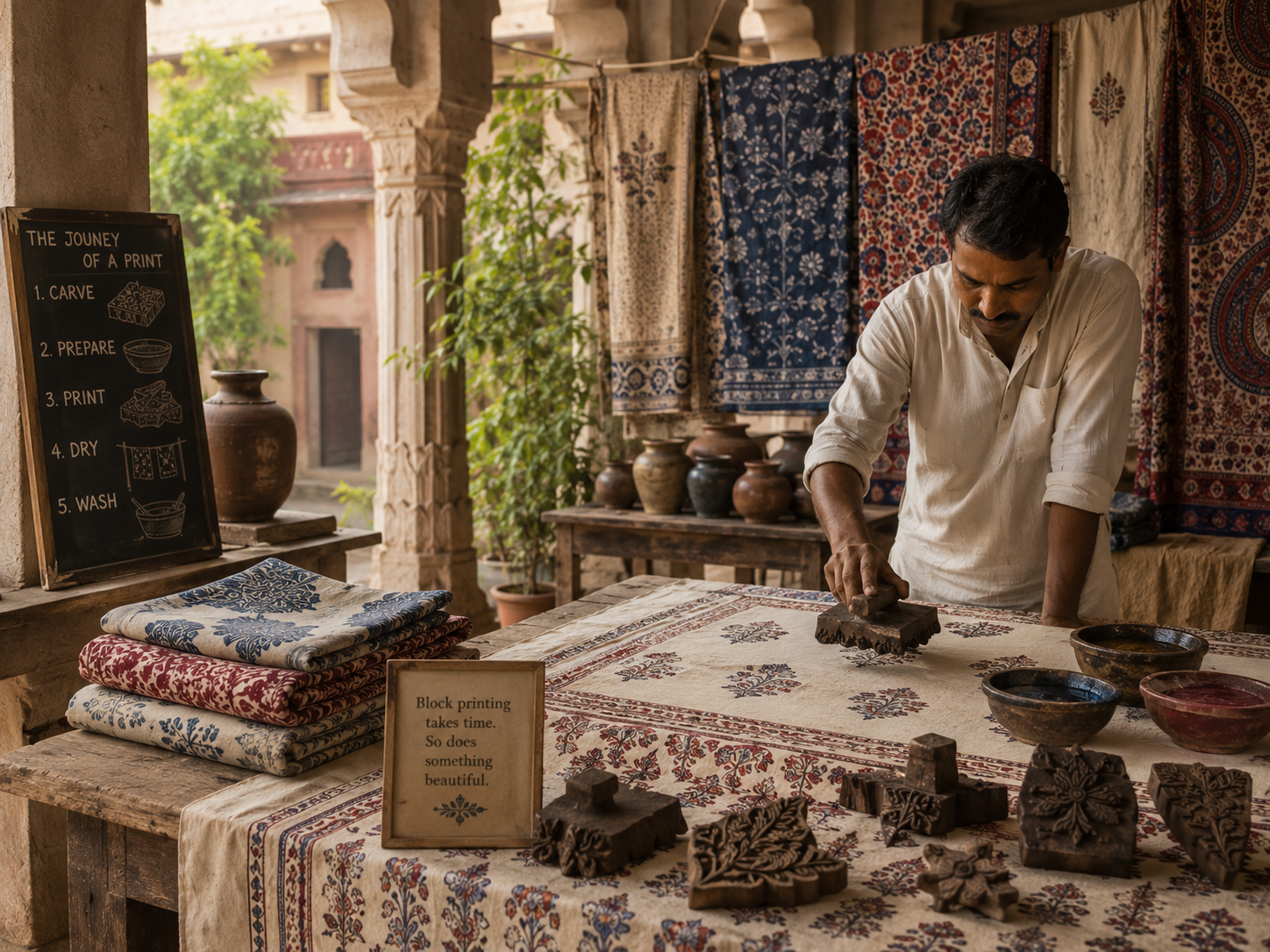
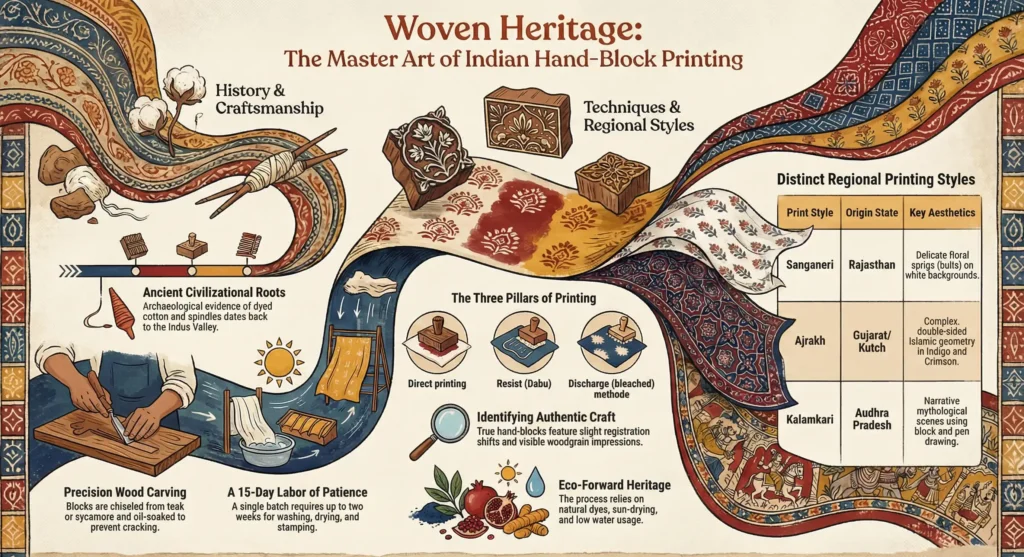
Behind all this beauty lay slow, patient, human work, and much of it still survives in hand-block printing.
First, a carver cuts a design into a block of wood and soaks it in oil for days so it will not crack. The cloth is washed and pinned tight to a long table. Then the printer begins, pressing the block down, lifting it, moving a hand’s width along, and pressing again, lining up every single stamp by eye alone. Each colour needs its own separate block, laid down in turn, with time to dry in between. A single run of cloth can take ten to fifteen days to finish.
There are three main ways to do it. In direct printing, the colour is simply stamped straight onto the cloth. In resist printing, parts of the cloth are first covered with a paste of clay or mud, as in the Dabu style, so the dye cannot reach them; when the paste is washed off, pale patterns and lovely cracked, vein-like textures are left behind. In discharge printing, a paste is stamped onto already-dyed cloth to bleach the colour away, so bright shapes seem to glow out of a dark background.
Each region grew its own signature. There is Bagru and Sanganeri in Rajasthan, Ajrakh in the Kutch region of Gujarat with its rich double-sided geometry in indigo and deep red, and Kalamkari in Andhra Pradesh, which mixes block printing with stories drawn freehand by pen. On wild Tussar silk, with its natural golden shimmer, these same prints take on a festive glow.
The Indus Valley Civilization: The First Urban Society
The great unravelling
And then this astonishing craft was very nearly destroyed, on purpose.
When Britain built its own great cloth mills in cities like Manchester, India’s famous fabric stood directly in the way of their profits. So the answer was brutally simple. Heavy taxes were placed on Indian cloth, and India was flooded with cheap fabric churned out by British machines. A village weaver, working by hand, could not possibly compete with a factory, and so weaver after weaver, village after village, was ruined.
The country that had clothed the world for four thousand years was forced instead to wear the cheap mill-cloth of its rulers.
Some of the greatest skills of all were simply lost. The making of Dhaka’s “woven air” died out, and even the special cotton plant it needed has now almost vanished from the earth. It is one of the saddest chapters in the whole history of trade.
The thread that would not break
But the thread did not snap completely.
During the fight for freedom, Indians turned cloth itself into a weapon. Spinning their own simple homemade khadi, and refusing to buy foreign fabric, became a proud way of resisting the empire. After India won its freedom in 1947, the new country worked hard to bring its old handlooms back to life. And today, in a world drowning in identical machine-made things, the old hand-block prints are wanted once more, for a surprising reason.
The beauty of the imperfect
Here is the lovely final twist in the story.
If you want to know whether a cloth was truly printed by human hands, you look for its little flaws. A colour that slips a hair’s width out of line. A spot where the block stamped twice. The faint grain of the wood pressed softly into the weave. A machine makes everything flawless and exactly the same, over and over. A human hand leaves these tiny, honest marks, and they are the proof that a real person once stood at a table and pressed each one by hand.
So when you wear such a cloth, you are wearing something very old indeed. You are wearing a secret the whole world once envied: the colour that would not wash out, and the craft that, in the end, would not quite die.
Contemporary Indian Sculpture: Exploring 20th and 21st Century Innovations
If you think you have remembered everything about this topic take this QUIZ
Results


#1. Before adopting the hybrid Indo-Saracenic style, which architectural styles did the British initially use to project imperial authority?
#2. Which iconic Mumbai building is cited as the ultimate example of High Victorian Gothic architecture, designed by F.W. Stevens?
#3. In the term “Indo-Saracenic,” what does the word “Saracenic” refer to?
#4. Which Indian city is noted for having the second-largest collection of Art Deco buildings in the world (after Miami)?
#5. Which of the following is a key feature of the Art Deco architectural movement?
#6. How was the Art Deco style “tropicalized” or adapted specifically for the Indian climate?
#7. When building New Delhi, architects Edwin Lutyens and Herbert Baker created a disciplined blend of European Classicism with subtle Indian elements known as what?
#8. In 2018, which specific ensemble of buildings in Mumbai was inscribed as a UNESCO World Heritage Site?
What is hand-block printing?
It is a centuries-old technique where artisans stamp fabric with intricately carved wooden blocks dipped in dye to create repeating patterns.
What is the difference between Direct, Resist, and Discharge printing?
Direct printing stamps color straight onto the fabric. Resist printing uses a clay paste to block dye from certain areas. Discharge printing uses chemicals to remove existing dye to create a pattern.
How can you tell if a fabric is truly hand-block printed?
Look for slight irregularities—tiny color overlaps, slight shifts in pattern alignment, or the faint texture of the woodblock. These “imperfections” are the signature of the human hand.
What is Tussar silk?
Tussar is a type of wild silk produced in India. It is highly valued for its rich texture, natural golden sheen, and its ability to beautifully hold block-printed dyes.
What are “Ajrakh” and “Kalamkari”?
Ajrakh is a complex, geometric block-print style from Gujarat/Rajasthan. Kalamkari is an art form from Andhra Pradesh that combines block printing with freehand pen drawing, often depicting mythological scenes.
Sources and references
- Daughters of India (“Indian Textiles Through History” and “Cotton: India’s Gift to the World”) — cotton at Mehrgarh from around 5000 BCE as the oldest known cotton, the dyed-cloth and indigo evidence at Mohenjo-daro, and the destruction of the Dhaka muslin tradition and near-extinction of its cotton variety under colonial rule.
- Anaadi (“From Looms to Gloom”) — the Indian mastery of mordants that made “fast” colours when the world’s dyes ran, the madder reds and indigo blues, Dhaka muslin as “woven air” that could fold into a snuffbox, and the collapse of handlooms under colonial policy.
- Pearl Academy and IIAD (histories of the Indian textile industry) — Indian textiles reaching Greece, Rome and Southeast Asia, the words “calico” and “muslin” deriving from Calicut and Dhaka, India as a byword for cotton, and the post-1947 revival through the handloom boards and khadi.
- MeMeraki (“Rich Heritage of Indian Textiles”) — the madder-dyed cotton near Mohenjo-daro dated to around 3000 BCE and the early spinning and weaving traditions of the Indus Valley.
- Original Curious Indian article (“Indian Textiles”) — the Mughal-era motifs (buti, jaal, paisley), the hand-block printing workflow and oil-soaked wooden blocks, the direct, resist and discharge techniques, the regional styles (Bagru, Sanganeri, Ajrakh, Dabu, Kalamkari), printed Tussar silk, and the “imperfect charm” that marks genuine handwork.
Author


Exploring the Soul of Bharat through History, Science, Culture, and its Diversity
Our Mission
Curious Indian is a definitive knowledge portal dedicated to chronicling the events, personalities, and cultural shifts that defined the Indian subcontinent. From the ancient Vedic Period to the complexities of 21st-century politics, our goal is to provide deep-dive analysis that inspires.
Editorial Standards & E-E-A-T
Every article published under our brand undergoes a rigorous fact-checking process. We prioritize primary historical records, academic citations, and credible archives to ensure our readers receive accurate, high-authority information.
Historical Integrity Directly sourcing from ASI archives and academic journals.Topical Authority Comprehensive clustering of Indian Science, Biographies, and Wars.Managed by Paripurna Datta and TEAM | Dedicated to the Knowledge of India.