How One of the World’s First Great Civilizations Left Brilliant Cities, No Kings and Not a Word We can Read
Nearly five thousand years ago, in the valleys of the Indus river, people built cities so clean, so orderly, and so cleverly planned that much of the rest of the world would take thousands of years to catch up.
We can walk their streets today. We can look at their bathrooms, their covered drains, and their children’s toys. And yet, for all of that, we cannot read a single word they wrote, we do not know the name of even one of their kings, and we are not truly sure why they disappeared. This is the great, haunting puzzle of the Indus Valley Civilization. We can see exactly how these people lived. We simply cannot hear a single thing they said.
Cities Built to a Plan
About 4,500 years ago, while most of the world still lived in scattered villages, the people of the Indus built enormous, planned cities, Harappa, Mohenjo-daro, Dholavira and more, spread across an area larger than ancient Egypt and Mesopotamia put together.
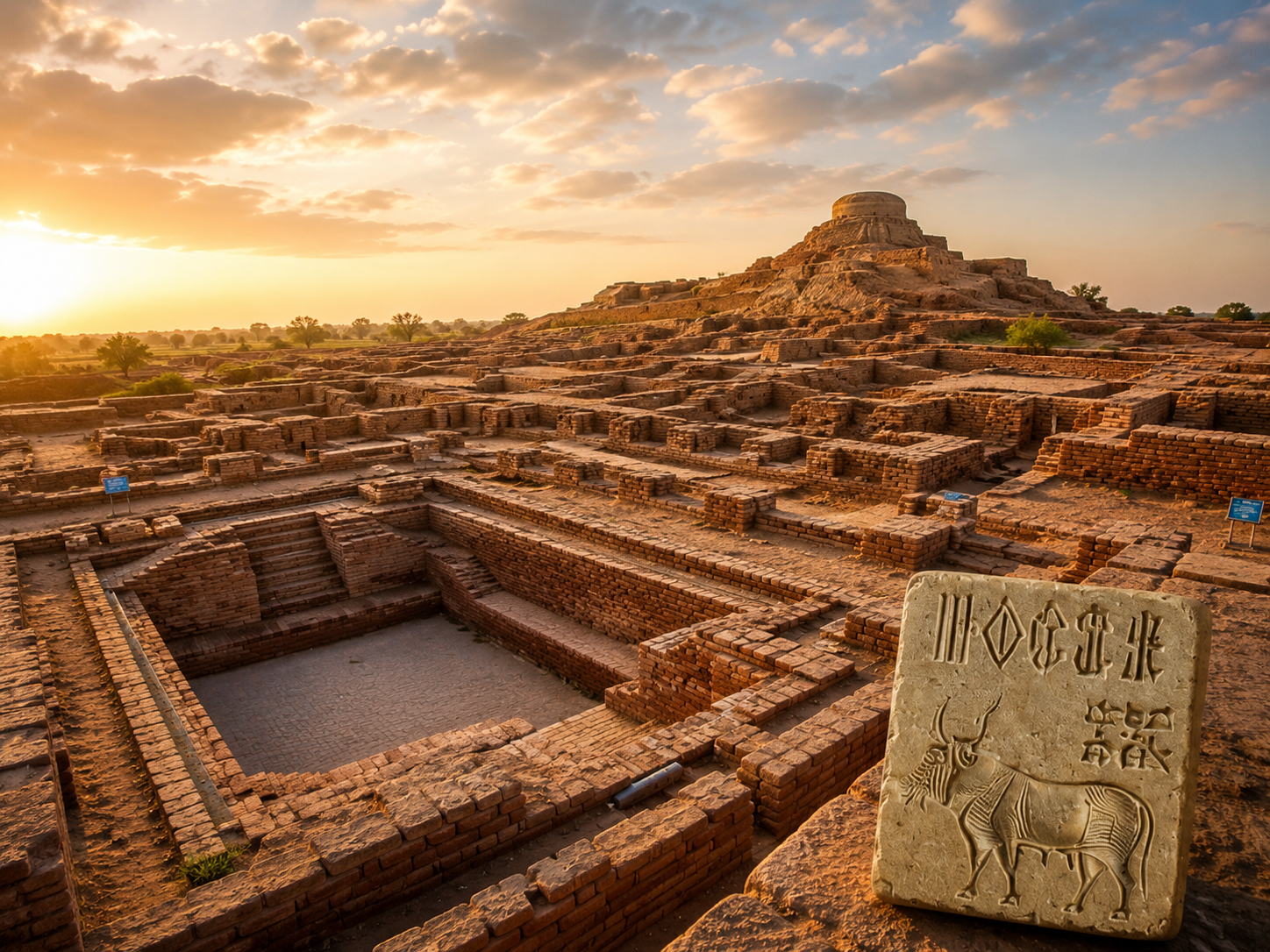
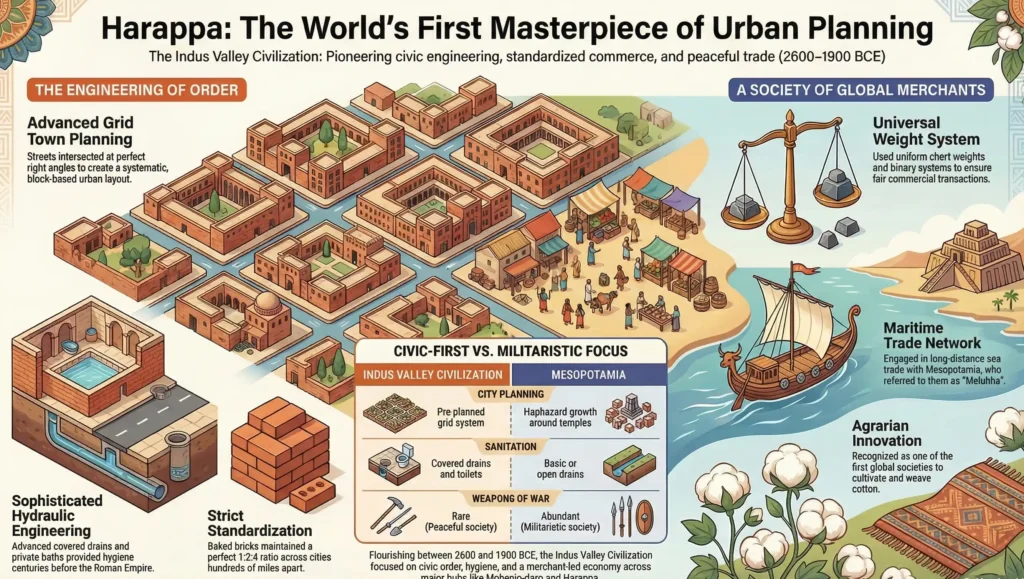
And these were not cities that had simply grown up by accident. They were designed. The streets were laid out in a neat grid, crossing one another at clean right angles, just like a modern city. The houses were built from bricks made to the very same size and shape across hundreds of miles, as though a single rulebook were being followed everywhere at once.
Most astonishing of all was the plumbing.
Nearly every house had its own bathroom and toilet, joined to a network of covered drains running beneath the streets, a system of city sanitation that much of the world would not manage to match for thousands of years.
Mature Harappan Phase Begins: The Golden Age of Indus Cities
The Silence
And here is where the mystery begins in earnest. These people could write. They left behind thousands of small carved seals and tablets, covered in a neat little script of tiny pictures and symbols.
But in all the years since, no one has ever been able to read it. We do not know what language they spoke. We do not know their word for “king,” or “god,” or even “home.” Every one of their names, their stories, and their prayers is locked away inside a code that has never been cracked. A whole brilliant civilization stands right in front of us, and it is completely, utterly silent.
The Battle of Saraighat That Stopped a Mughal Empire
The Empire with no Emperor
But the strangest thing of all is not what these cities contain. It is what they are missing.
Walk through the ruins of ancient Egypt and you find towering tombs and giant statues of god-kings. Walk through old Mesopotamia and you find grand palaces, huge temples, and stone carvings of armies and great battles. Then walk through the cities of the Indus, and you find almost none of that. No palace. No royal tomb stuffed with treasure. No towering temple. No proud statue of a ruler, no carvings of war, and barely a weapon to be found.
It is as if this enormous, wealthy, beautifully organised civilization had no kings and no army at all.
The Indus cities have left behind no palaces, no royal tombs, no grand temples, and almost no weapons.
Nobody is quite sure how such a thing could work. Someone, surely, must have organised all those identical bricks and those careful grid-streets across such a vast land. But whoever they were, they built no monuments to themselves. The houses are mostly a similar size as one another, and the graves hold broadly similar things. To the genuine surprise of many historians, it looks as though this may have been one of the most equal and peaceful societies the ancient world ever produced: a civilization run by farmers, craftsmen and traders, rather than by kings and soldiers.
A People of Makers and Traders
What these people left behind, instead of monuments to power, were beautiful, useful, deeply human things.
Delicate necklaces of tiny beads. Fine painted pottery. Toys, dice, and little clay animals. A small, confident bronze figure of a dancing girl, still full of attitude after four thousand years. And a set of stone weights so exact and so standardised that a trader in one city could completely trust the scales in another. They were great traders, too. Their goods have been dug up far away in Mesopotamia, whose own people wrote of a rich land to the east that they called Meluhha, which was almost certainly the Indus. So we even have the word of others that these people lived and traded and thrived, even though we still cannot read a word of their own.
Vedic Period 1500-500 BCE: From Nomadic Hymns to Iron Age Kingdoms
The Slow Fading
And then, gradually, they went away.
For a long time, people guessed that fierce invaders must have swept in and destroyed them. But careful modern study has largely put that idea to rest, because there is very little sign of any great war. The likeliest answer is quieter, and sadder. These cities lived and died by their rivers. Around four thousand years ago, the climate seems to have slowly turned against them: the seasonal rains weakened, and one of the great river systems that watered their fields began to dry up and wander from its course.
As the water failed, the harvests failed with it, and so, in time, did the cities. The people did not vanish in a single day. They drifted away, moving east and south in search of water and kinder land, and their great cities were left standing empty, to be slowly buried under the dust.
Rise of Jainism and Buddhism 6th Century BCE
Lost, and Found
For the next three and a half thousand years, the world simply forgot that they had ever existed at all. Their mighty cities sank into low, grassy mounds. Their ancient bricks were even carted away by railway builders in the 1800s, who had no idea they were pulling apart one of the oldest cities on earth.
It was only in the 1920s that archaeologists finally dug down into those mounds and gasped at what rose up to meet them: a whole lost civilization, as old and as great as any the world had ever known.
So today we know them, and yet we do not. We can measure their streets, admire their drains, and hold their children’s toys in our hands. But until someone, someday, at last cracks that little picture-script, they will keep their deepest secrets locked away: who exactly they were, who led them, what they believed, and what it truly felt like to live in the cleanest, quietest, most orderly cities of the ancient world. We can see them perfectly. We just cannot, not yet, hear them.
Reign of Chandragupta Maurya: The First Empire of India
If you think you have remembered everything about this topic take this QUIZ
What are the main features of the Indus Valley Civilization?
Advanced urban planning (grid system), baked brick houses, sophisticated drainage systems, standardized weights, and an undeciphered script.
Which city is known for the Great Bath?
Mohenjo-daro (in modern-day Sindh, Pakistan).
Did the Aryans destroy the Indus Valley Civilization?
No, modern archaeological and climatic evidence suggests the decline was caused by climate change (weakening monsoons) and the drying up of rivers, not a violent invasion.
What was the Indus script used for?
It was primarily found on steatite seals, likely used for trade, identification, and administrative authority. It remains undeciphered.
Which Harappan city had a dockyard?
Lothal, located in Gujarat, India, which served as a major maritime trade hub.
Sources and References
- World History Encyclopedia and The Collector — the absence of a standing army, palaces, temples and named rulers in the Indus cities, the grid-planned streets and skilled urban planning, and the trade with Mesopotamia, which knew the region as Meluhha.
- The Archaeologist and Science News Today — the uniformly sized baked bricks, the Great Bath and granaries, the remarkably egalitarian character suggested by similar house sizes and grave goods, and the undeciphered script leaving the rulers and language unknown.
- Curious Indian’s own overview and Psychology Today — the mature phase dates of about 2600–1900 BCE, the area larger than Egypt and Mesopotamia combined, the covered drainage and indoor toilets, the steatite seals (including the “unicorn” and “Pashupati” seals), and the question of a possibly egalitarian society.
- Science News Today and Prakriti Darshan (on the decline) — the weakening monsoon, tectonic shifts, and the drying and rerouting of the Ghaggar-Hakra (linked by some to the Saraswati) river system as the leading explanation for the gradual decline after 1900 BCE.
- Modern archaeology on the decline — the discrediting of the “Aryan Invasion” as the cause of collapse, in favour of gradual climate-driven de-urbanisation and migration.
Author


Exploring the Soul of Bharat through History, Science, Culture, and its Diversity
Our Mission
Curious Indian is a definitive knowledge portal dedicated to chronicling the events, personalities, and cultural shifts that defined the Indian subcontinent. From the ancient Vedic Period to the complexities of 21st-century politics, our goal is to provide deep-dive analysis that inspires.
Editorial Standards & E-E-A-T
Every article published under our brand undergoes a rigorous fact-checking process. We prioritize primary historical records, academic citations, and credible archives to ensure our readers receive accurate, high-authority information.
Historical Integrity Directly sourcing from ASI archives and academic journals.Topical Authority Comprehensive clustering of Indian Science, Biographies, and Wars.Managed by Paripurna Datta and TEAM | Dedicated to the Knowledge of India.