How a Scattered Village World became One Standardized Civilization, with No King to Command It
Around 4,600 years ago, something quiet and astonishing happened across the northwest of the Indian subcontinent. Over a short stretch of time, scattered farming villages that had each done things their own way suddenly began doing everything the same way.
They built their cities to the same plan. They baked their bricks to the very same measurements. They weighed their goods on the very same scales. And they did all of this across an area the size of western Europe, so that a brick made in one city would have slid neatly into a wall in a city eight hundred kilometres away. Historians call this great coming-together the beginning of the Mature Harappan phase. It is the moment a collection of villages became one of the first great civilizations on earth.
Before and After
To feel how big the change was, you have to picture what came before it.
For centuries, the people of this region had lived in what we call the Early Harappan cultures: large villages and small towns, each with its own style of pottery, its own rough mud-brick houses, and its own local ways. There was writing of a sort, but only simple marks. Trade happened, but mostly with the next town over. Life was settled and skilled, but it was local, and it was patchy.
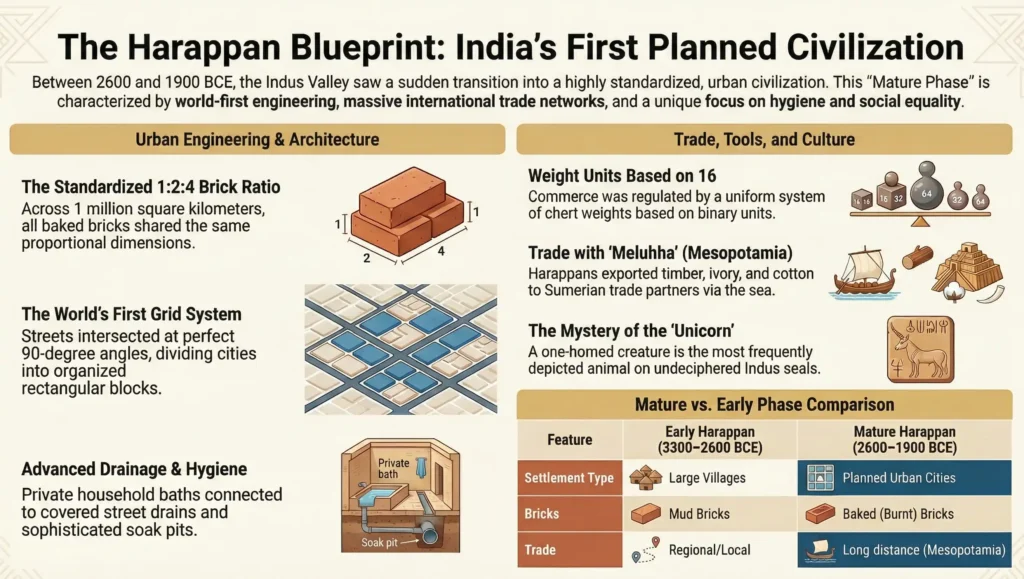
Then, around 2600 BCE, all of that changed with surprising speed. The villages grew into large, carefully planned cities like Harappa, Mohenjo-daro and Dholavira. The rough mud bricks became hard, baked bricks of a standard size. The simple marks grew into a full written script. And the local trade reached out across the sea to distant lands. In the space of a few generations, a scattered village world had pulled itself together into a single, connected civilization.
Decline of the Indus Valley Civilization
The Mystery of the Matching Bricks
And here is the part that still makes archaeologists shake their heads in wonder.
This new civilization was astonishingly uniform. Across roughly a million square kilometres, people suddenly began using bricks built to the same fixed ratio, one part thick, two parts wide, four parts long. They used the same set of carefully cut stone weights, rising in a neat doubling pattern. They laid out their cities in the same way and made their pottery in the same styles.
Across an area the size of a continent, everyone somehow began using the same bricks, the same weights, and the same city plan, as if a single rulebook had been handed out to all.
How did that happen? In Egypt or in Mesopotamia, a powerful king with an army could force everyone to follow his rules. But in the Indus cities, as we will see, there is no sign of such a king or such an army. So the puzzle is a deep one. Either there was some strong shared authority we have not yet found, or these people managed something even more remarkable: a vast network of traders and craftsmen who chose, together, to follow one common standard, simply because it worked. A civilization that agreed.
Cities Drawn Before they were Built
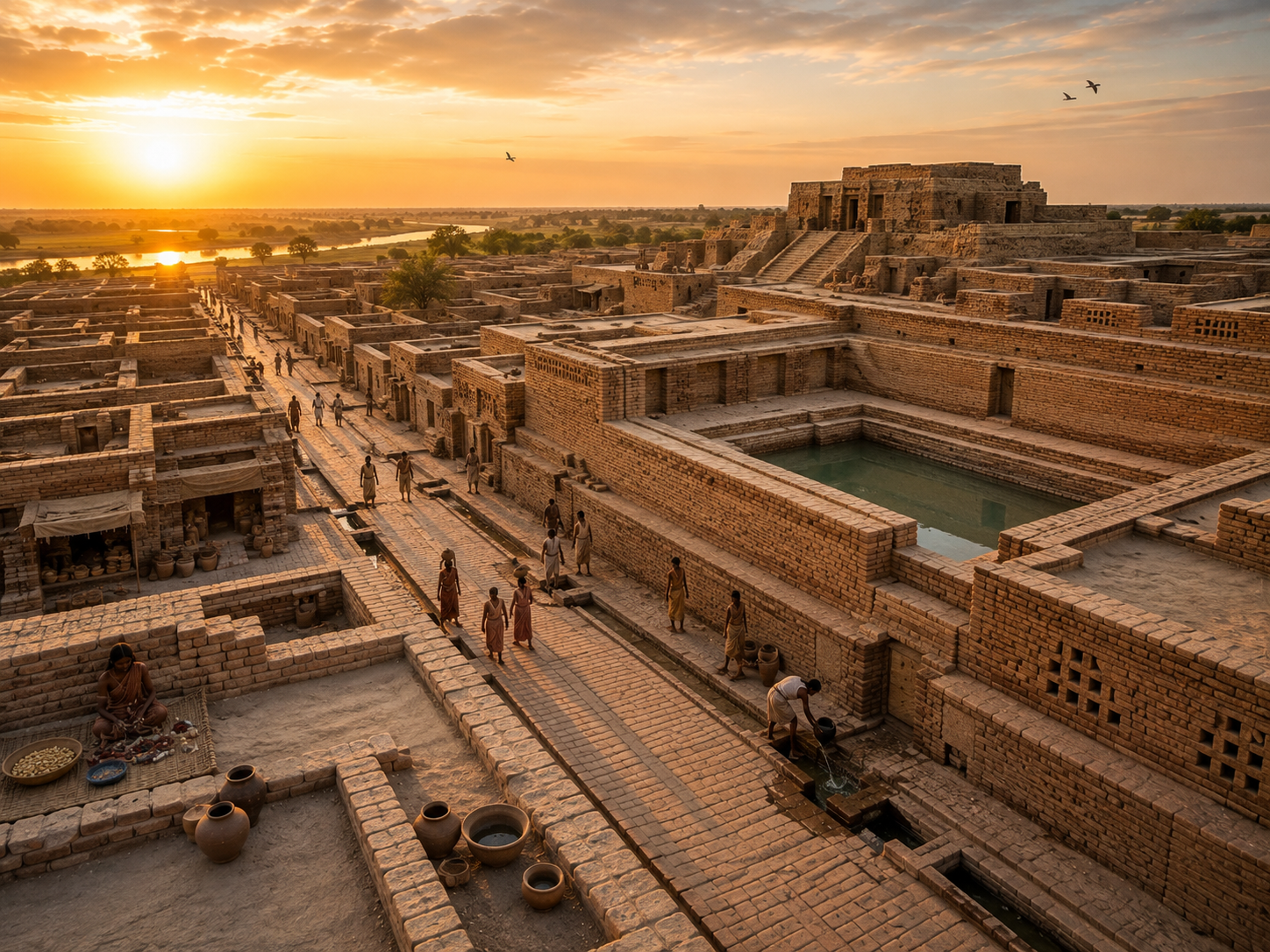
That love of order shows most clearly in the cities themselves, which were planned before a single brick was laid.
The streets were set out in a neat grid, crossing one another at clean right angles and slicing the city into tidy rectangular blocks, like a chessboard. Most cities had two clear parts. To one side stood a raised platform, sometimes called the citadel, which held the important public buildings. Below and beside it spread the lower town, where ordinary families lived and where the workshops and markets buzzed. At Mohenjo-daro, on the high platform, sat a great watertight tank now called the Great Bath, carefully sealed with tar, most likely used for some kind of ritual cleansing, an early echo of the importance water still holds in India today.
Early Vedic Period 1500-1000 BCE: The Age of the Rigveda
Plumbing Before its Time
The Harappans cared about cleanliness to a degree that can still surprise us.
Nearly every house had its own bathing area and toilet, joined by clay pipes to a covered drain that ran along the street outside. There were even soak pits to trap the waste before it reached the main drains. It was a system of household plumbing and public sanitation that much of the rest of the world, including Europe, would not manage to build again for well over two thousand years.
A World Knit Together by Trade
What powered all this was trade, and the Mature Harappans traded far and wide.
They were skilled farmers who grew wheat and barley, and they were among the very first people anywhere to grow cotton and weave it into cloth. Whole towns, like Chanhudaro, seem to have been given over almost entirely to craft, turning out beautiful beads from red carnelian stone. And their goods travelled a very long way. Harappan seals have been dug up in the cities of faraway Mesopotamia, whose people wrote of trading with a rich eastern land they called Meluhha, which was almost certainly the Indus.
Rise of Jainism and Buddhism 6th Century BCE
The Empire that Hid its Rulers
For all their cities and wealth and reach, the Mature Harappans left behind one enormous puzzle, the same one that hangs over the standard bricks.
They built no grand palaces for kings, and no towering temples for priests. No royal tombs stuffed with gold have been found, and very few weapons of war. Someone, clearly, organised those matching bricks and those planned streets across a vast land, and yet nobody left a monument boasting that they had done it. Instead there are the small, human traces of ordinary life: toys and dice, bead necklaces, a horned figure seated on a seal that may be an early god, and again and again the image of a strange one-horned creature we now simply call the unicorn.
A Flash of Brilliance
The Mature Harappan phase lasted around seven hundred years, from about 2600 to 1900 BCE, before the changing climate and the drying of its rivers slowly brought it to an end. But while it lasted, it was one of the most orderly and peaceful civilizations the ancient world ever saw.
Its people showed something that is easy to forget: that a society can grow rich and clever and clean without kings glorifying themselves, without great armies, and without grand tombs. They built their wonder not upward, into monuments, but outward, into well-run cities and shared, trusted standards. A whole world, quietly agreeing on the size of a brick. Nearly five thousand years later, that quiet agreement is still one of the most remarkable things anyone has ever built.
Reign of Chandragupta Maurya: The First Empire of India
If you think you have remembered everything about this topic take this QUIZ
Results


#1. What is the defining feature of town planning during the Mature Harappan Phase?
#2. What was the highly standardized size ratio of the burnt bricks used across the civilization?
#3. By what name did the ancient Mesopotamians refer to the Indus Valley region?
#4. In which major city was the massive watertight tank known as “The Great Bath” discovered?
#5. The Harappans are credited with being the first people in the world to cultivate which crop?
#6. Unlike civilizations in Egypt or Sumer, which of these structures have archaeologists NOT found in Harappan cities?
#7. Which Harappan city featured massive stone walls and a sophisticated system of water reservoirs?
#8. What is the most common animal depicted on the seals of the Indus Valley Civilization?
What is the time period of the Mature Harappan Phase?
It lasted from roughly 2600 BCE to 1900 BCE.
Which city is known for the Great Bath?
Mohenjo-daro.
What was the main material used for construction?
Burnt (baked) bricks were used for major buildings and drains.
Did the Harappans use money?
No, they likely used a barter system, facilitated by standardized weights and seals for accounting.
What is the “Grid System”?
It is a method of town planning where streets intersect at right angles, creating rectangular blocks for houses.
Sources and References
- Britannica (“Indus civilization”) and World History Encyclopedia — the mature phase of about 2600–1900 BCE, the transition from Early Harappan regional cultures to large standardized cities, and the absence of palaces, temples, royal tombs and standing armies.
- The Collector and The Archaeologist — the standardization of baked bricks, weights and city planning across a vast area suggesting either strong central coordination or a cooperative network, and the emphasis on drainage, bathrooms and public hygiene in every excavated city.
- Curious Indian’s own overview and Harappa.com — the grid-planned cities with citadel and lower town, the Great Bath of Mohenjo-daro, the soak-pit drainage, the carnelian bead craft of Chanhudaro, and the Meluhha trade with Mesopotamia and Bahrain.
- Standard accounts of Harappan material culture — the 1:2:4 brick ratio, the binary system of stone weights, the first cultivation of cotton, and the “unicorn” and Pashupati seals.
- Original Curious Indian article (“Mature Harappan Phase”) — the “Integration Era” framing, the coalescing of Kot Diji and Amri regional cultures around 2600 BCE, the chessboard cities, and the reservoirs and walls of Dholavira.
Author


Exploring the Soul of Bharat through History, Science, Culture, and its Diversity
Our Mission
Curious Indian is a definitive knowledge portal dedicated to chronicling the events, personalities, and cultural shifts that defined the Indian subcontinent. From the ancient Vedic Period to the complexities of 21st-century politics, our goal is to provide deep-dive analysis that inspires.
Editorial Standards & E-E-A-T
Every article published under our brand undergoes a rigorous fact-checking process. We prioritize primary historical records, academic citations, and credible archives to ensure our readers receive accurate, high-authority information.
Historical Integrity Directly sourcing from ASI archives and academic journals.Topical Authority Comprehensive clustering of Indian Science, Biographies, and Wars.Managed by Paripurna Datta and TEAM | Dedicated to the Knowledge of India.