How Chandragupta I married an empire into being, and honoured his queen as a partner in gold
About six hundred years before this story, a young man named Chandragupta had founded India’s first great empire, the Mauryas, and he had done it through conquest, with a ruthless genius of a mentor at his side.
Now, in the early 300s CE, another young king with almost exactly the same name, Chandragupta the First, set out to found what would one day become India’s most dazzling golden age: the Gupta empire. But he did it in a completely different, and rather stranger, way. He did not conquer his empire at all. He married it. This is the story of how one clever wedding gave birth to a golden age.
A small king from a small family
Chandragupta the First did not begin as anything especially grand. His family, the Guptas, were only minor rulers of a small kingdom in the east of India, in the old land of Magadha.
His father and his grandfather before him had held only a modest title, “great king,” and they had ruled only a modest patch of land, quite possibly as the servants of some larger power. There was really nothing about this little family to suggest that it would one day light up one of the most brilliant ages in the whole history of India. What the young Chandragupta had, though, was cleverness. And, as it turned out, a very good sense of exactly whom to marry.
Reign of Samudragupta 335-375 CE: The Napoleon of India
The marriage that made an empire
In those days, there lived in India an old and famous clan called the Lichchhavis. They were ancient royalty, so respected that their name had been spoken with honour since the time of the Buddha himself, eight hundred years earlier. They had lineage, and prestige, and power of precisely the kind that the upstart Guptas so completely lacked.
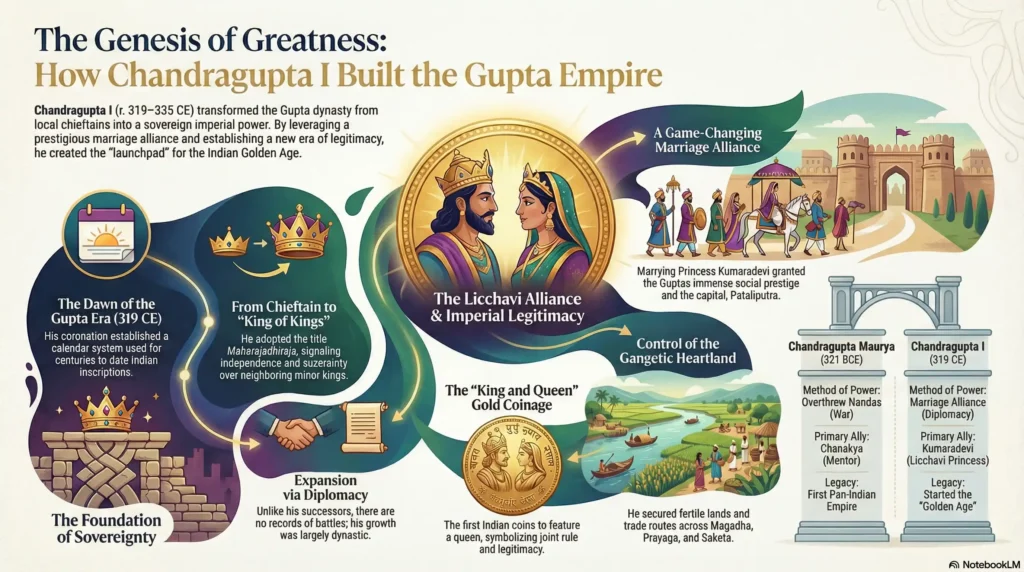
And Chandragupta married one of their princesses, a woman named Kumaradevi. It was, quite simply, the smartest thing he ever did.
Overnight, by that single marriage, a small-time king borrowed all the ancient glory of the Lichchhavis. His little kingdom became a great one, not through years of war, but through one wedding.
Their lands joined together with his. Their prestige became his prestige. Their power and their allies became his own. A little kingdom quietly swelled into a great one, not through the long, bloody grind of war, but through a marriage.
The queen on the gold coins
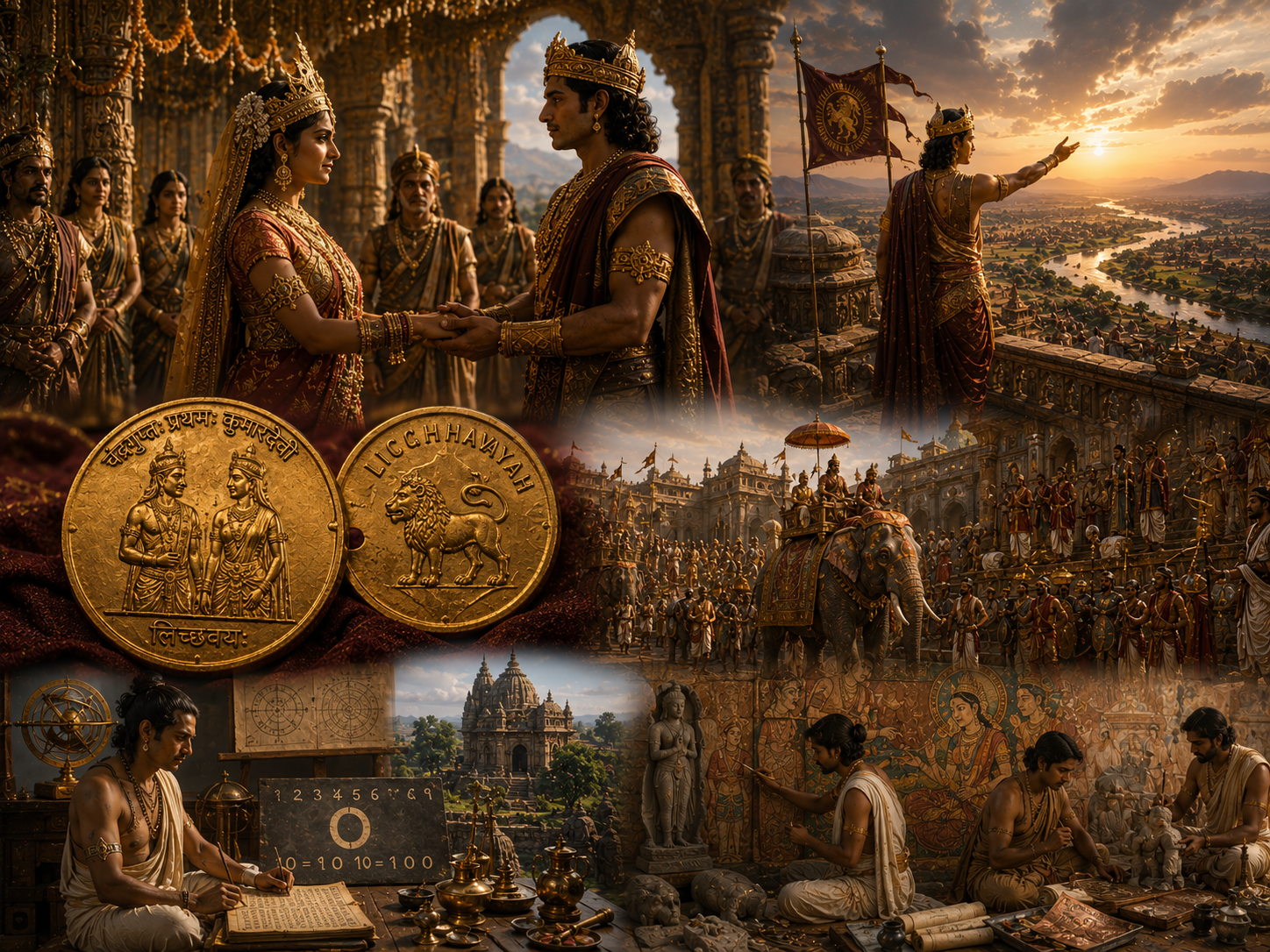
And here is the most remarkable part of the whole story, the part that makes this founding unlike almost any other in the entire ancient world. Chandragupta did not hide his new wife away, or treat the marriage as some private family matter. He was so proud of it that he announced it to the world in gold.
He struck beautiful gold coins, the very first that the Guptas ever made, and upon them he placed not only himself, but his queen. There the two of them stand, together, king and queen, side by side, and both of them are named. And on the other side of every coin, spelled out in letters of gold, is the name of her people: the Lichchhavis.
In an age when women’s names were so often left out of history altogether, here was a king who put his queen on his money as his equal partner, and honoured her family as the very source of his power.
Kumaradevi was remembered not as a mere wife tucked away in a palace, but as a genuine co-ruler of the new empire.
Reign of Chandragupta II Vikramaditya: The Golden Age of India
The king of kings
With his new power and his new prestige, Chandragupta made a bold announcement to the whole world. His father and his grandfather had been quite content to be called simply “great king.” Chandragupta took a far grander title for himself: “great king of kings”, the title of an emperor, and a clear claim to rule over other kings beneath him.
It was his way of saying, out loud and for all to hear, that the Guptas were no longer just a small family in a small kingdom, but a real power to be reckoned with. He is even remembered as having begun a whole new counting of the years, a Gupta calendar, as though to declare that with him, a brand-new age had started. And in a way, it truly had.
The foundation of a golden age
Chandragupta the First never actually conquered a vast empire himself. His kingdom, by the end of his reign, was solid and respectable, but it was not enormous. Yet that was never really meant to be his gift to history. His gift was to build the foundation.
He took a small, obscure family and, through one clever marriage and one bold claim, turned it into a legitimate, respected, imperial power, planted firmly in the rich old heartland of India. And upon that foundation, everything else would be built.
Chandragupta conquered no vast empire. He did something harder to see, but just as important: he built the strong foundation on which his son would raise an empire, and his grandsons a golden age.
His son, Samudragupta, would take the strong and stable base that his father had so carefully made, and use it to conquer a huge empire. And his grandsons, in their turn, would take that empire and fill it with the poets and the mathematicians and the artists of the golden age, the very age that would give the world the number zero, and work out that the Earth spins on its axis. None of it could ever have happened without the quiet, clever founder who started it all.
Reign of Harshavardhana 606-647 CE: The Empire of Benevolence
The wedding at the root of the gold
It is one of the loveliest and least-known facts in all of Indian history. The golden age of India, the age of its greatest science and its greatest poetry, traces its deepest roots not to a great battle at all, but to a great marriage.
When a clever young king from a small and unremarkable family had the simple wisdom to marry well, to honour his wife openly as his partner, and to dream far bigger than any of his ancestors ever had, he lit a small flame that his descendants would go on to fan into one of the brightest fires in the whole history of the human mind. The mightiest empires, it turns out, do not always begin with a sword. This one began with a wedding, and with a king who was wise enough to share his crown, and even his coins, with his queen.
Reign of Chandragupta Maurya 321-297 BCE: The First Empire of India
If you think you have remembered everything about this topic take this QUIZ
Results


#1. Which title did Chandragupta I adopt, signifying his status as the “King of Kings”?
#2. The coronation of Chandragupta I in 319 CE marks the beginning of which historical calendar system?
#3. Chandragupta I married Princess Kumaradevi, who belonged to which powerful ancient clan?
#4. What was the unique feature of the gold coins issued by Chandragupta I?
#5. Which major region did the Guptas likely acquire through the marriage alliance with the Licchavis?
#6. The reverse side of Chandragupta I’s coins featured Goddess Durga seated on a lion with which legend?
#7. Who was the father and immediate predecessor of Chandragupta I?
#8. Chandragupta I famously selected which son as his heir in a full court assembly?
Who was the first Gupta ruler to adopt the title Maharajadhiraja?
Chandragupta I was the first to adopt this imperial title.
Which clan did Queen Kumaradevi belong to?
She belonged to the Licchavi clan.
When did the Gupta Era begin?
The Gupta Era began in 319–320 CE, marking the coronation of Chandragupta I.
What territories did Chandragupta I control?
He controlled Magadha, Prayaga, and Saketa (parts of modern Bihar and Uttar Pradesh).
Who succeeded Chandragupta I?
His son Samudragupta succeeded him.
Sources and references
- Vedantu (“Chandragupta 1 Biography”) and Testbook — Chandragupta I succeeding Ghatotkacha around 319 CE, the small early Gupta kingdom, the politically decisive marriage to Kumaradevi of the Lichchhavi clan, and his adoption of the imperial title Maharajadhiraja.
- Wikipedia (“Kumaradevi” and “Chandragupta I”) — Kumaradevi as a Lichchhavi princess and heiress, recognised as co-ruler and queen regnant, the merging of Lichchhavi territory into the Gupta kingdom, and the joint coinage depicting them as joint rulers.
- INFLIBNET (“The Gupta empire”) and Britannica — the “Chandragupta-Kumaradevi” gold coins bearing both figures and names with the legend “Lichchhavayah” on the reverse, Chandragupta as the first Gupta to issue gold coins, and the Gupta era commencing on 26 February 320 CE.
- Prepp and Lumen Learning — the humble origins of the Guptas (Sri Gupta and Ghatotkacha titled only Maharaja, possibly Kushan vassals), the ancient prestige of the Lichchhavis of Vaishali, and the debate over how the marriage came about.
- Curious Indian’s own overview (“Reign of Chandragupta I”) — the foundation of the Gupta imperial power through alliance and prestige rather than conquest, and the base it created for Samudragupta’s later conquests and the golden age.
Author


Exploring the Soul of Bharat through History, Science, Culture, and its Diversity
Our Mission
Curious Indian is a definitive knowledge portal dedicated to chronicling the events, personalities, and cultural shifts that defined the Indian subcontinent. From the ancient Vedic Period to the complexities of 21st-century politics, our goal is to provide deep-dive analysis that inspires.
Editorial Standards & E-E-A-T
Every article published under our brand undergoes a rigorous fact-checking process. We prioritize primary historical records, academic citations, and credible archives to ensure our readers receive accurate, high-authority information.
Historical Integrity Directly sourcing from ASI archives and academic journals.Topical Authority Comprehensive clustering of Indian Science, Biographies, and Wars.Managed by Paripurna Datta and TEAM | Dedicated to the Knowledge of India.