How a year of listening made Gandhi the voice of millions
Imagine coming home a hero.
You have been away for more than twenty years. In that time you have become famous across the world, invented a whole new way of fighting injustice, and forced a powerful government to sit down and bargain with you. When your ship finally docks, thousands are waiting on the quay to see you. Everyone expects you to speak, to lead, to begin.
And instead, on the advice of an old and wise friend, you decide to say almost nothing at all. For a whole year you travel your country quietly, watching and listening, and you keep your opinions to yourself.
That is exactly what Mohandas Gandhi did when he came back to India in 1915. It was one of the wisest decisions anyone in Indian public life has ever made, and it is the reason he became the Mahatma. This is the story of the year he chose to stay silent.
The stranger who came home
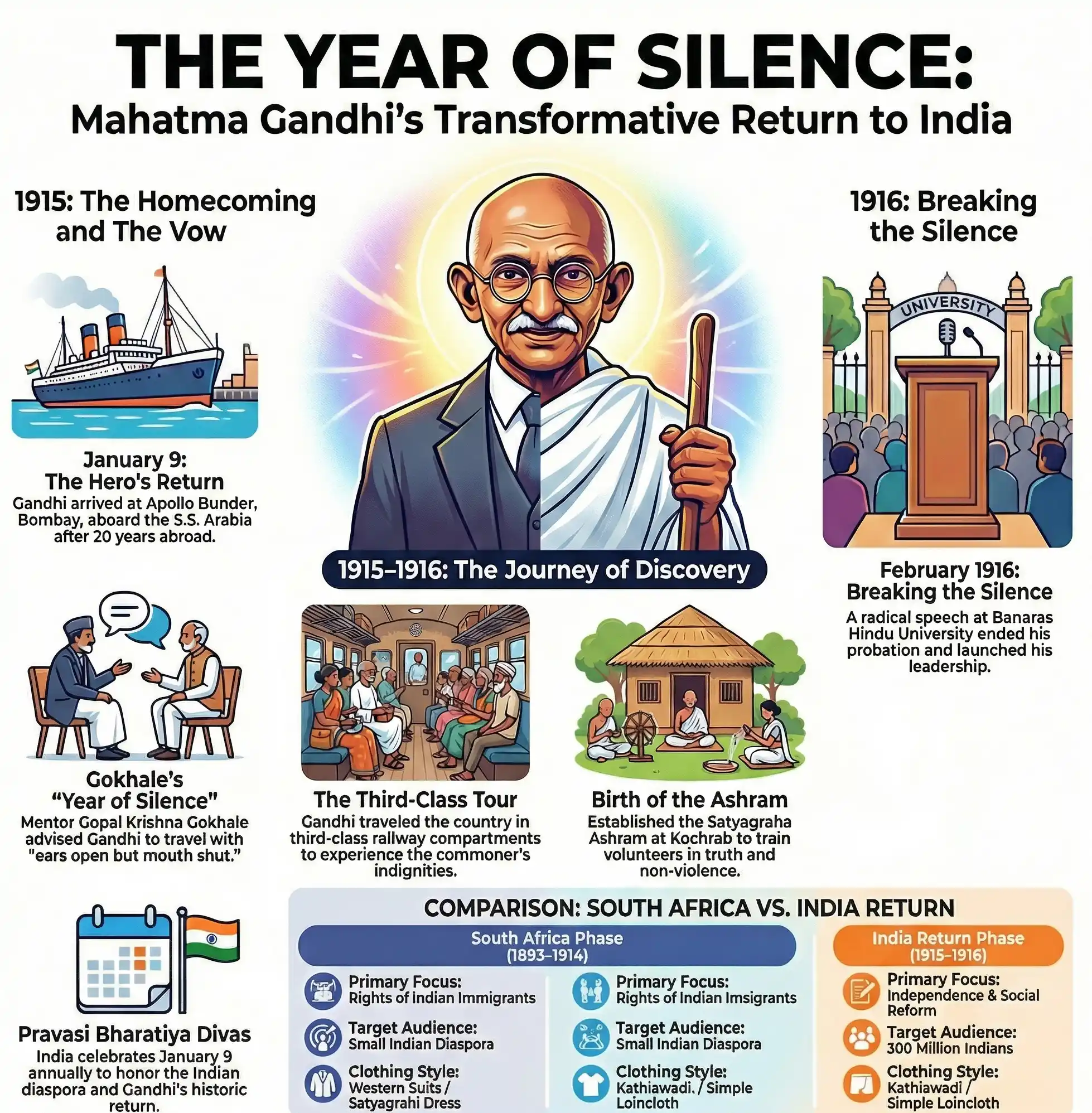
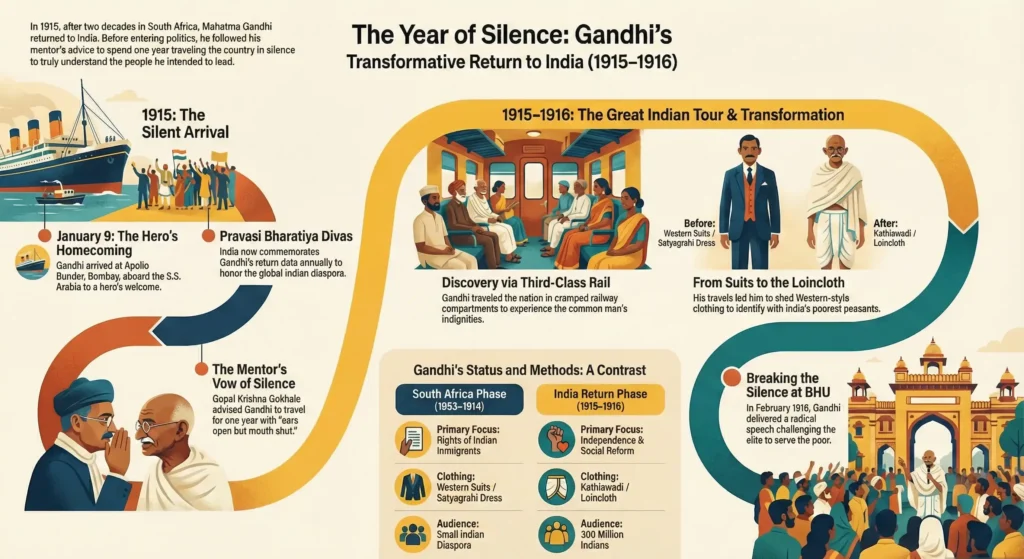
The man who stepped off the steamship S.S. Arabia at Bombay on 9 January 1915 was not the man who had left India two decades earlier.
Gandhi had sailed away in 1893 as a shy, uncertain young lawyer who could barely bring himself to speak in a courtroom. He came back a hardened campaigner. In South Africa he had spent more than twenty years fighting for the rights of the Indian community there, and along the way he had developed a strange and powerful new weapon: satyagraha, the disciplined, non-violent resistance that could shame an opponent into changing course. People already called him Mahatma, “great soul.”
There was a small, deliberate signal in the way he arrived. The other Western-educated leaders of the day stepped out in smart English suits. Gandhi came ashore in the simple cloak and turban of his native Kathiawad, quietly announcing that he had come home to belong to India again.
Non-Cooperation Movement 1920-1922: The Day India Said “No” to the British
Ears open, mouth shut
Gandhi was itching to throw himself into the fight for Indian freedom. His mentor told him to wait.
That mentor was Gopal Krishna Gokhale, the most respected moderate leader of the age, and he saw something Gandhi could not. Gandhi had been gone a very long time. The India of 1915, vast and poor and complicated, was not the India he remembered from his youth. Before this brilliant returning son could hope to lead the country, he first had to understand it.
So Gokhale asked Gandhi for a promise.
Spend one year, he said, travelling the length of India. See its people, learn their troubles, feel the country in your bones. But for that whole year, make no political speeches. Keep your ears open and your mouth shut.
Gandhi gave his word, and he kept it faithfully. There is a quiet poignancy in that, because Gokhale died only a few weeks later, in February 1915. The promise Gandhi honoured all year long was a promise to a mentor who did not live to see him honour it.
Third class
For the next twelve months, Gandhi and his wife Kasturba crossed and re-crossed India by train. And he made one rule that told you everything about the kind of leader he meant to be. He always travelled third class.
The other grandees of Indian politics rode in comfortable first-class carriages. Gandhi packed himself into the cheap compartments with the poorest travellers, in the heat and the noise and the crush, enduring the small daily indignities that were the ordinary lot of the ordinary Indian.
He rode third class on purpose, because that, he said, was where the real India travelled.
He went everywhere. He visited Tagore’s school at Shantiniketan. He went to the great Kumbh Mela at Haridwar and was troubled by the filth and the hollow show he found there in the name of religion. He listened to lawyers in the south and to peasants in the fields. He had not come to lecture India. He had come to let India teach him.
The Quit India Movement: How a Leaderless Nation Fought for Freedom
Becoming the poorest man
As the year went on, the country worked a change in the man himself.
Somewhere along those dusty roads and crowded platforms, Gandhi gave up even his Kathiawadi finery. He began to dress in a plain dhoti, a simple length of cloth, the garment of the poorest peasant in the land. He was, quite literally, remaking himself in the image of the people he wanted to serve.
In May 1915 he set up his first Indian home, the Satyagraha Ashram, near Ahmedabad, and began training a small band of followers in his vows of truth and non-violence. His principles were tested almost at once. When he admitted a family from a community then branded “untouchable” into the ashram, scandalised donors threatened to cut off his funds. Gandhi did not blink. He would rather, he said, go and live in the poorest slums than turn the family away. The ideas were no longer only ideas. He was building a life to match them.
Breaking the silence
The year of silence ended in February 1916, and Gandhi broke it with a bang.
His first great public speech came at the grand opening of the Banaras Hindu University. The hall was full of the powerful: princes dripping with jewels, maharajas, British officials, the famous Annie Besant. They expected gracious words from the returning hero. They did not get them.
Standing before a room of glittering princes, Gandhi told them there could be no salvation for India until they stripped off their jewels and held that wealth in trust for their starving countrymen.
He went on to question the filth around the holy temples, and to speak plainly about the gulf between India’s rich and India’s poor. It was so blunt that offended dignitaries began walking out. But the point had been made, and it could not be unmade. The quiet observer of the past year had become a fearless national voice. The era of the Mahatma had begun.
The Final Walk: The Conspiracy Behind Mahatma Gandhi’s Death
Why the silence mattered
There is a lesson in that year, and it is one the world finds harder to follow with every passing decade.
Anyone can arrive with answers. Gandhi arrived, and for a whole year, chose not to. He understood something rare and difficult: that if you want to speak for people, you must first take the trouble to know them, and that to know them, you have to stop talking and listen. When he finally did raise his voice, in 1917, he took it to the indigo farmers of Champaran and led his first great struggle on Indian soil. And the voice that came out was not only his own. It carried the villages he had ridden through and the third-class carriages he had sat in.
That is why he could move a nation that all the polished orators before him had never quite reached. He had earned the right to speak for India by first falling silent and letting India fill him up.
In a world that prizes the fastest opinion and the loudest voice, the man who would change India more than any other began by closing his mouth for a year and opening his ears. It remains one of the hardest things a person can do. It also remains one of the most powerful.
Salt Satyagraha 1930: Inside Mahatma Gandhi’s Historic Dandi March
If you think you have remembered everything about this topic take this QUIZ
Results


#1. On which date did Mahatma Gandhi return to India from South Africa, marking a new phase in the freedom struggle?
#2. Who was Mahatma Gandhi’s political mentor who advised him to spend one year traveling India with “his ears open but his mouth shut”?
#3. Gandhi made his first major public speech in India in February 1916 at the opening of which institution?
#4. To honor Gandhi’s return, the Government of India celebrates January 9 as which day?
#5. Where did Gandhi establish his first base in India, the Satyagraha Ashram, on May 25, 1915?
#6. Why did Gandhi deliberately choose to travel in third-class railway compartments during his tour of India?
#7. Upon his return, Gandhi initially wore a Kathiawadi cloak and turban, but during his travels, he eventually adopted which simple attire?
When did Mahatma Gandhi return to India?
He returned on January 9, 1915.
Which ship did Gandhi arrive on?
He arrived in Bombay aboard the steamship S.S. Arabia.
Who advised Gandhi to travel India for a year?
His political mentor, Gopal Krishna Gokhale, advised him to keep his “ears open and mouth shut” for one year to understand India.
Why is January 9 celebrated as Pravasi Bharatiya Divas?
It is celebrated to commemorate the return of Mahatma Gandhi, the greatest “Pravasi” (expatriate), to India, acknowledging the contribution of the overseas Indian community.
Where did Gandhi establish his first Ashram in India?
He established the Satyagraha Ashram at Kochrab, Ahmedabad, in May 1915.
Sources & References
- Encyclopaedia Britannica (“Mahatma Gandhi”) — his return to India in 1915, the year of travel, and the start of his Indian career.
- Encyclopaedia Britannica (“Gopal Krishna Gokhale”) — Gandhi’s mentor and his advice to spend a year listening before acting.
- Sabarmati Ashram (the Satyagraha Ashram) — the ashram Gandhi founded near Ahmedabad in 1915.
- Ministry of External Affairs, Government of India (Pravasi Bharatiya Divas) — the commemoration of 9 January, the day of Gandhi’s return.
Author


Exploring the Soul of Bharat through History, Science, Culture, and its Diversity
Our Mission
Curious Indian is a definitive knowledge portal dedicated to chronicling the events, personalities, and cultural shifts that defined the Indian subcontinent. From the ancient Vedic Period to the complexities of 21st-century politics, our goal is to provide deep-dive analysis that inspires.
Editorial Standards & E-E-A-T
Every article published under our brand undergoes a rigorous fact-checking process. We prioritize primary historical records, academic citations, and credible archives to ensure our readers receive accurate, high-authority information.
Historical Integrity Directly sourcing from ASI archives and academic journals.Topical Authority Comprehensive clustering of Indian Science, Biographies, and Wars.Managed by Paripurna Datta and TEAM | Dedicated to the Knowledge of India.