Why the Whole Country Thanks the Sun on One January Day, Under a Dozen Different Names
Most Indian festivals follow the moon. That is why they wander about the calendar, turning up a little earlier or a little later each year. Diwali, Holi, Eid, all of them drift, because they are counted by the changing moon.
But there is one great festival that does something different. It follows the sun. And so, on very nearly the same day every January, the whole country stops to do the same thing under a hundred different names: to thank the sun for the harvest, and to welcome back the light.
The Day the Sun Turns for Home
To understand it, you have to look at the winter sky.
Through the cold months, the sun rises each day a little further to the south, and the days grow shorter and shorter. Then, around the middle of January, that long slide stops and turns around. The sun begins to climb back towards the north, and from that day on, the days slowly stretch longer again, reaching towards summer.
To the sky-watchers of old India, this was an enormous and hopeful moment: the sun turning back towards them, a sure promise that winter’s grip was finally loosening. They named the day for exactly this event, calling it Makar Sankranti, the day the sun crosses into the sign of Makara and begins its long journey north.
On this day, the sun stops sliding south and turns back to the north. From here on, the days grow longer, and winter begins to lose its hold.
Sangam Period: The Golden Age of Tamil Literature
Story of Dadasaheb Phalke: The Man Who Gave India Its Dreams
One Sun, a Hundred Names
Because this is a real event up in the sky, the whole of India feels it on the same day. And everywhere, people celebrate, but each region in its own beautiful way.
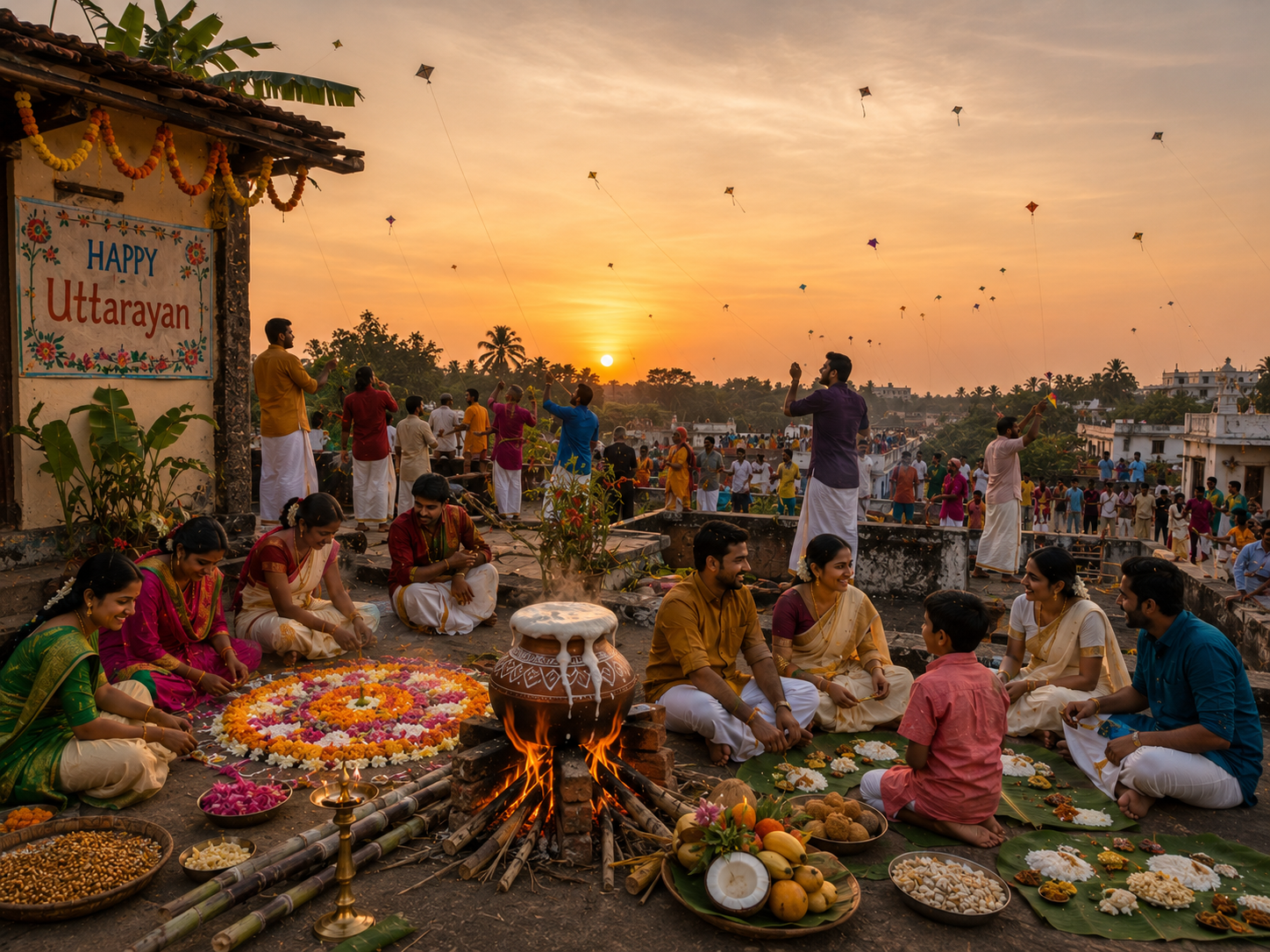
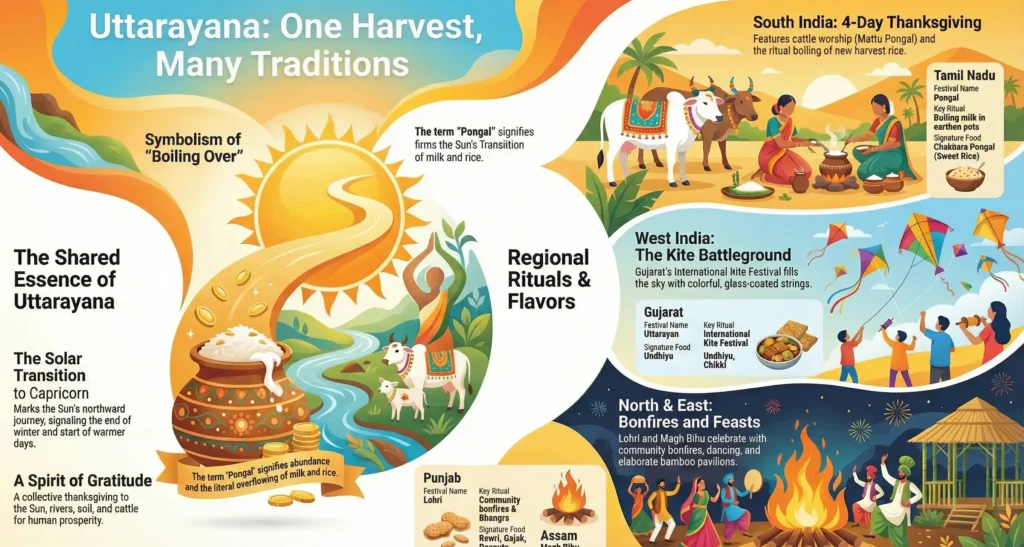
In Tamil Nadu it is Pongal, named after a dish of rice boiled with fresh milk and golden jaggery until it bubbles up and spills right over the top of the pot. That overflowing is the whole point of it, a joyful sign of plenty, and everyone cheers “Pongalo Pongal!” as it boils over. In Punjab, on the night before, there is Lohri, with tall bonfires, singing and dancing to see off the coldest nights of the year. In Gujarat it is Uttarayan, when the sky fills with thousands of kites and every rooftop becomes a friendly battlefield of string.
In Assam it is Magh Bihu, a festival of feasting and big community bonfires. In Maharashtra, people hand one another sweets of sesame and jaggery with a lovely little saying: take this sweet, and speak sweetly. And in Bengal there are pithe, soft cakes made from the newly harvested rice and date-palm syrup, while great crowds gather for a holy dip where the river Ganga finally meets the sea.
The languages are different, the foods are different, the names are different. But underneath, the meaning is exactly the same: the sun is turning north, the harvest is in, and life is returning.
Thank You to the Sun, the Earth, and the Ox
At its very heart, this is a festival of thanksgiving.
It falls just as the winter crops are gathered in, so it is a celebration of full barns and grateful hearts. People give thanks to the sun, whose light and warmth grew the grain. They give thanks to the earth that held it. And in Tamil Nadu there is even a whole day, called Mattu Pongal, set aside to thank the cattle. The oxen and cows that pulled the plough all year and gave their milk are washed, their horns are painted bright colours, they are draped in garlands, and they are allowed to rest. It is a rare and gentle thing: an entire day given over to saying thank you to animals.
Gupta Empire: When Science, Art, and Conquest Met
Out with the Old
There is also a strong feeling of a fresh start woven through the festival.
Homes are swept and cleaned from top to bottom, and in some places old and broken things are thrown onto the bonfire to burn away, so the new season can begin fresh and clean. The little sweets of sesame and jaggery carry the same quiet wish inside them: a hope that the year ahead will be warm and sweet, and that any old bitterness between people will melt away like sugar.
The Festival that Slipped past the Shortest Day
Here is a curious thing that even many who celebrate it do not know.
Long ago, this festival landed exactly on the shortest day of the year, the midwinter day when the sun is at its lowest. But the Earth does not spin perfectly straight. It wobbles, very slowly, like a spinning top that is tipping just a little, and one full wobble takes around 26,000 years. Because of that slow wobble, the traditional date the festival is pinned to has quietly drifted, by roughly one day every seventy years.
So today Makar Sankranti falls on the 14th of January, a full three weeks after the true shortest day, which now comes in late December. The festival that was born to catch the exact moment of the sun’s turning has slowly slid away from it. It is a tiny, patient reminder that even the great clock of the sky is always, ever so slowly, changing.
Ganesh Chaturthi: Honoring the Elephant-Headed God
The Oldest Thank-You
Strip away the kites and the bonfires and the boiling pots, and what is left is one of the oldest and simplest feelings a human being can have.
For thousands of years, people have watched the winter sun sink lower and lower while the world grew cold and dark, and then felt an enormous wave of relief on the day it finally, surely, turned back towards them. This is the festival of that relief. On one shared day, in a dozen different languages, a whole subcontinent looks up at the very same sun, now climbing its way back home, and says the same quiet thing: thank you, and welcome back.
Eid al-Fitr and Eid al-Adha: Celebrating Faith and Community
If you think you have remembered everything about this topic take this QUIZ
Results


#1. Unlike most Indian festivals that follow the lunar calendar, Makar Sankranti and Pongal are determined by which calendar?
#2. What astronomical event does Makar Sankranti mark, signaling the beginning of longer, warmer days known as Uttarayana?
#3. During Uttarayan in Gujarat, what massive activity turns the sky into a colorful battleground where people shout “Kai Po Che!”?
#4. What cultural message is traditionally associated with eating “Til-Gud” (sesame seeds and jaggery) during the festival?
#5. Which specific day of the four-day Pongal festival in Tamil Nadu is dedicated to bathing, decorating, and worshipping cattle?
#6. According to the comparison table, which festival in Assam features the building and burning of temporary bamboo and thatch pavilions called “Meji”?
#7. During Thai Pongal, the boiling milk spilling over the earthen pot is considered an omen. Which direction of the spill is highly auspicious?
#8. What is the name of the ancient, highly competitive bull-taming sport famously associated with Mattu Pongal in Tamil Nadu?
Why does Makar Sankranti fall on the same date every year?
Unlike most Hindu festivals that follow the lunar calendar, Makar Sankranti follows the solar calendar, marking the Sun’s entry into the Capricorn zodiac, which usually happens on January 14th or 15th.
What is the meaning of the word “Pongal”?
In Tamil, “Pongal” means to “boil over” or “overflow,” symbolizing abundance and prosperity.
Why are sesame seeds (Til) and jaggery eaten during this festival?
Sesame seeds keep the body warm during winter, and jaggery provides energy. Culturally, exchanging them symbolizes leaving behind bitter memories and speaking sweetly to one another.
What is Bhogi?
Bhogi is the first day of the Pongal festival, dedicated to cleaning the house and burning old, unwanted items in a bonfire to signify a fresh start.
Which state is famous for the International Kite Festival during Uttarayan?
Gujarat (specifically Ahmedabad) is world-famous for its massive kite-flying festival.
Sources and references
- Encyclopaedia Britannica (“Makar Sankranti”) — the festival’s solar-calendar basis giving it a nearly fixed date, its marking of the sun’s entry into Capricorn (makara) and the start of uttarayana, its origin as a winter-solstice holiday, and the drift from the solstice caused by the precession of the equinoxes.
- Wikipedia (“Makar Sankranti”) and festival guides — the celebration on 14 January (15 in some years), the worship of the sun god Surya, the ritual bathing in sacred rivers, and the sesame-jaggery sweets, rangolis and bonfires common across regions.
- AB Mantra and Vedaz (on Sankranti’s regional forms) — the shared astronomical event behind the different names (Pongal, Lohri, Magh Bihu, Uttarayan), the drift of the sidereal date, and the unifying meaning that the sun is turning north as winter loosens.
- Indrosphere and Britannica (on the astronomy) — the historical coincidence of the festival with the winter solstice around 1,500–2,000 years ago and the gradual shift of the date over centuries due to the Earth’s axial precession.
- Original Curious Indian article (“Pongal and Makar Sankranti”) — the four days of Pongal and the overflowing Pongal dish, the cattle-honouring Mattu Pongal, the regional customs (Lohri bonfires, Uttarayan kites, Bihu feasts, Bengali pithe), and the themes of harvest gratitude and new beginnings.
Author


Exploring the Soul of Bharat through History, Science, Culture, and its Diversity
Our Mission
Curious Indian is a definitive knowledge portal dedicated to chronicling the events, personalities, and cultural shifts that defined the Indian subcontinent. From the ancient Vedic Period to the complexities of 21st-century politics, our goal is to provide deep-dive analysis that inspires.
Editorial Standards & E-E-A-T
Every article published under our brand undergoes a rigorous fact-checking process. We prioritize primary historical records, academic citations, and credible archives to ensure our readers receive accurate, high-authority information.
Historical Integrity Directly sourcing from ASI archives and academic journals.Topical Authority Comprehensive clustering of Indian Science, Biographies, and Wars.Managed by Paripurna Datta and TEAM | Dedicated to the Knowledge of India.