Inside the secular, sea-trading golden age where ancient Tamil poets turned landscapes into feelings
More than two thousand years ago, in the far south of India, a remarkable group of poets did something that almost no one, anywhere in the world, has done quite so beautifully before or since. They took the whole of the human heart and mapped it onto the landscape.
In their poems, to speak of the mountains was to speak of new love. To speak of the desert was to speak of separation and loss. To speak of the seashore was to speak of anxious, aching waiting. Feeling and place became one and the same thing. This was the poetry of the Sangam age, one of the most refined and moving bodies of writing that the ancient world ever produced. And it flourished in a golden age of the Tamil south that the usual story of ancient India too often forgets.
The assembly of poets
The word “Sangam” means a gathering, or an academy. It refers to the great assemblies of Tamil poets and scholars who, according to old tradition, met in the city of Madurai under the generous patronage of the Tamil kings.
Legend tells of three such academies, held across vast and misty ages, and of two ancient lands that were swallowed up by the sea. That part is just a legend. But the poetry itself is wonderfully, solidly real. From this golden age, which lasted from roughly 300 BCE to around 300 CE, more than two thousand poems have survived down to us, written by over four hundred different poets, kings and bards, warriors and farmers, and, strikingly for the ancient world, a good number of women.
Reign of Raja Raja Chola I: The Golden Age of the Cholas
Love and war, the two halves of life
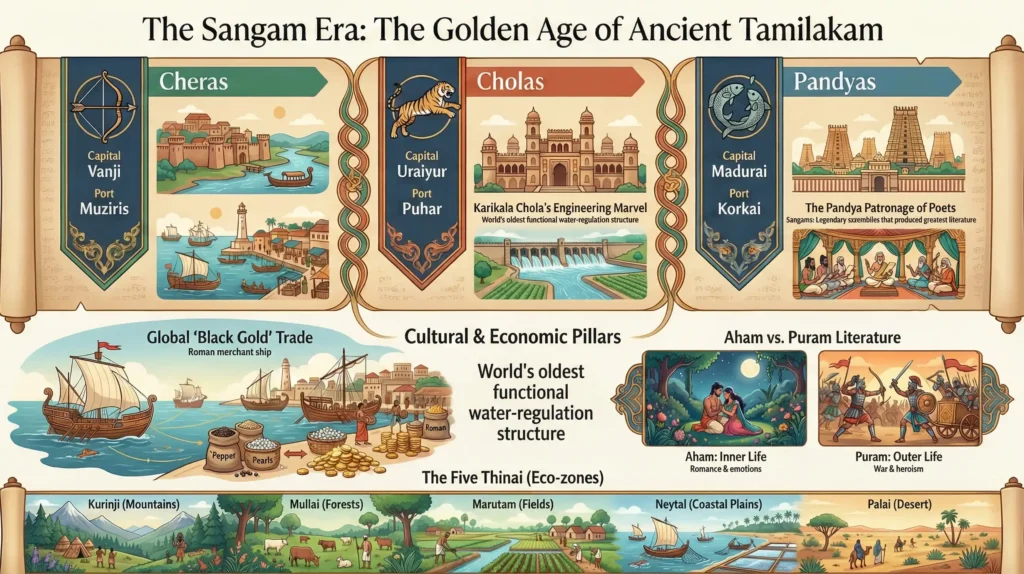
The Sangam poets divided all of their poetry, and in a way the whole of life itself, into two great halves. On the one side was akam, meaning the “interior”, the inner, private world of love: longing and meeting, quarrelling and waiting, the whole restless, tender life of the heart. On the other side was puram, the “exterior”, the outer, public world of kings and war and heroism, of generosity and death and the great deeds of great people.
And here is something genuinely surprising and wonderful about all of it.
Most ancient writing is about gods and rituals and the next world. The Sangam poets, almost uniquely, wrote about this one, about real love, real war, and real people. It is startlingly human.
Where so much of ancient India’s writing concerns itself with gods and sacred rites and the world to come, the Sangam poets turned their gaze firmly upon this world. They wrote about actual people falling in love, actual soldiers dying in battle, actual merchants and farmers and kings. It is some of the most honest, warm, down-to-earth writing to survive from anywhere in the whole ancient world.
The five landscapes of love
The most beautiful and ingenious thing these poets ever did lay in their love poetry. They built a system, quite unlike anything else known in the world, in which the landscape itself carried the emotion.
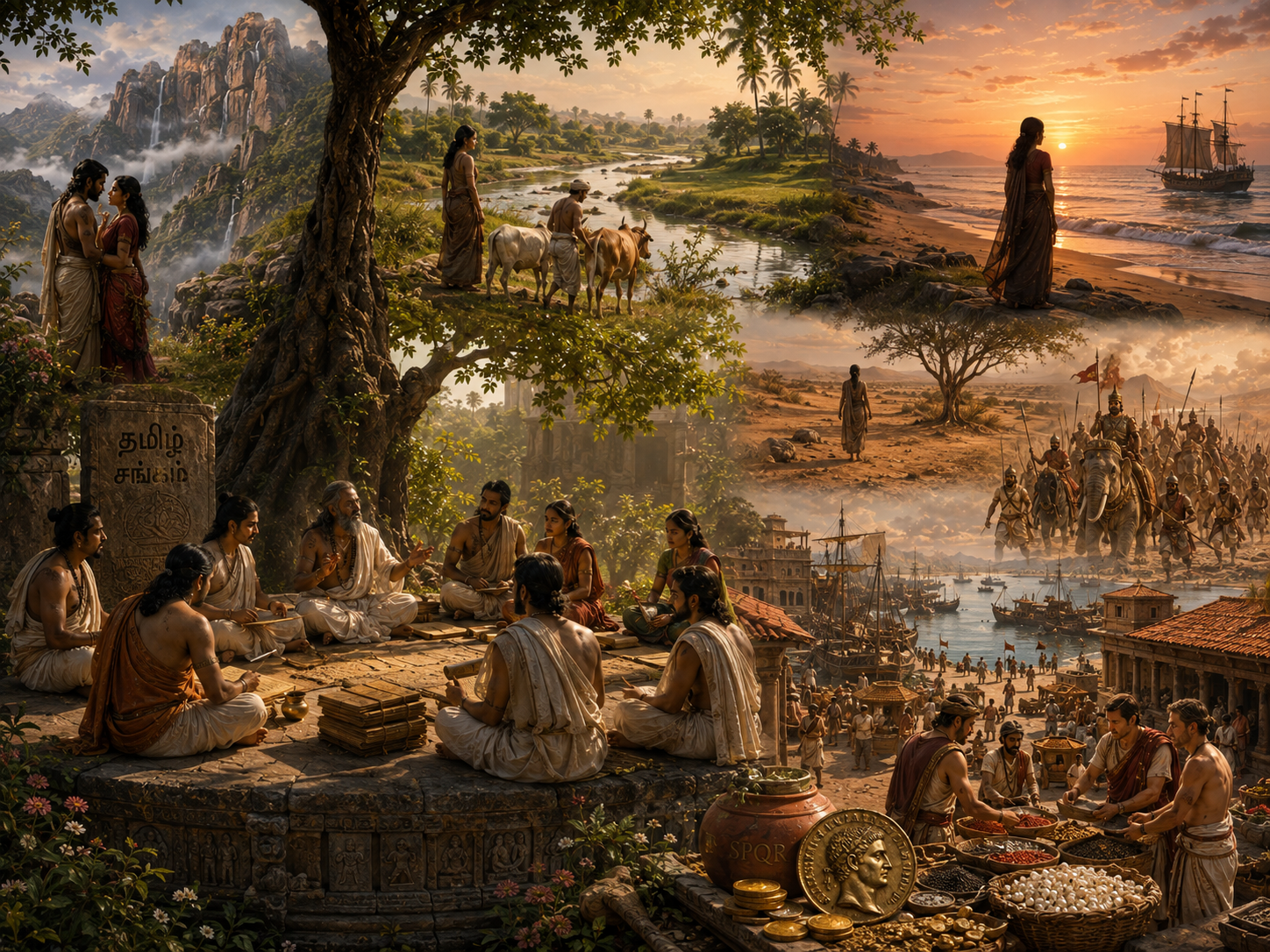
They divided the whole land of love into five distinct regions, and each region came to stand for a different mood, a different stage of the heart. The mountains, wild and misty, were the land of first meeting and of union: the place of brand-new love. The forests and green pastures were the land of patient waiting, where a woman waited faithfully for her beloved to return home. The farmlands beside the river were the land of lovers’ quarrels and sulking. The seashore was the land of anxious pining, of a heart aching for someone far away across the water. And the harsh, dry desert was the land of painful separation, of lovers parted by great distance and danger.
The mountains meant new love. The seashore meant pining. The desert meant separation. In Sangam poetry, the landscape itself carried the feeling, so that the place became the emotion.
So a Sangam poet never had to bluntly write “she felt lonely and abandoned.” He could simply set his poem in the parched and empty desert, and every listener understood at once exactly what was meant. The place was the feeling. To this very day, few poets anywhere have ever found so graceful a way of speaking about the human heart.
Chola Naval Expedition to Southeast Asia: When India Ruled the High Seas
A world that traded with Rome
These poems do far more than simply move us, though. They also swing open a window onto a rich and sophisticated world.
The Tamil land was ruled by three great crowned dynasties: the Cheras in the west, the Cholas in the centre, and the Pandyas in the south. Their kings made war on one another, gave lavishly to the poets who praised them, and built lasting works. One Chola king built a great dam across a river nearly two thousand years ago that, astonishingly, still helps to water the fields today. And this southern land was no sleepy, isolated corner of the world. It was a bustling, seafaring, trading civilisation, its ports crowded with foreign ships.
Roman gold coins, and even the broken jars that once held imported Italian wine, still turn up today in the Tamil soil. The ancient Tamil south traded across the seas with Rome itself.
Its merchants shipped pepper and pearls and fine cloth across the oceans, and in return, foreign gold came pouring in. Archaeologists still dig up hoards of Roman coins in Tamil Nadu, and the remains of jars that once carried wine all the way from Italy. The ancient Tamils, it turns out, enjoyed a cup of wine shipped from Rome.
The woman who counselled kings
Among the many voices of the Sangam age, one of the most beloved of all belongs to a woman. Her name was Avvaiyar, and she was a poet of such wisdom and such standing that she did not merely praise the kings and chieftains of her day.
She counselled them. She even scolded them when they needed it. And, remarkably, they listened. In an ancient world that so rarely allowed a woman to speak at all, here was one whose voice carried real weight and authority, and who has been remembered and revered by Tamils ever since as a living symbol of wisdom itself.
Reign of Chandragupta Maurya 321-297 BCE: The First Empire of India
The golden age we forget
When we sit down to tell the story of ancient India, we almost always tell a story of the north. We tell of the Vedas, of the great empires that rose on the plains of the Ganges, of Ashoka and his edicts carved in stone. And all of that truly matters.
But far away to the south, at the very same time, something just as remarkable was quietly unfolding. A brilliant, worldly, sea-trading civilisation was busy producing one of the finest and most deeply human bodies of poetry that the ancient world would ever know. And it was doing it in a way that no one else quite managed: by pouring the whole of the human heart into the mountains and forests and shores of its own beloved land.
The kingdoms of the Sangam age are long gone now. But their poems survived, kept carefully alive down the long centuries, and rediscovered and treasured all over again in modern times. Open one of them today, and across two thousand years you can still feel it, plain and clear: a lover waiting alone on a lonely shore, a soldier’s quiet courage, a king’s open and generous hand. And always, running underneath it all, the mountains that mean love, and the desert that means loss. It was a golden age. And it richly deserves to be remembered as one.
Reign of Samudragupta 335-375 CE: The Napoleon of India
If you think you have remembered everything about this topic take this QUIZ
Results


#1. The word “Sangam” refers to an assembly of Tamil poets and scholars centered in which city?
#2. Which of the three Sangams is the only one considered historically verifiable by historians?
#3. What is the only surviving literary work from the Second Sangam, considered the earliest Tamil grammar book?
#4. Which Chola king is famous for building the Kallanai Dam (Grand Anicut) across the Kaveri river?
#5. What was the royal emblem of the Pandya dynasty?
#6. The Sangam landscape was divided into five eco-zones called “Thinai.” Which zone refers to the agricultural plains?
#7. Which epic poem tells the story of Kannagi, who burned Madurai with her curse after her husband was wrongly executed?
#8. The Sangam period ended with the invasion of which dynasty in the 3rd century CE?
What does the word “Sangam” mean?
“Sangam” refers to an assembly or academy of Tamil poets and scholars.
Which city hosted the Third Sangam?
The Third Sangam was held in Madurai.
Who wrote the Tirukkural?
Thiruvalluvar wrote the Tirukkural, a famous work on ethics.
Which Chola king built the Kallanai Dam?
Karikala Chola built the Kallanai Dam (Grand Anicut).
What were the main exports of the Sangam age?
The main exports were pepper, pearls, ivory, textiles, and precious stones.
Sources and references
- PW.live and Grokipedia (“Sangam literature”) — the corpus composed c. 300 BCE to 300 CE in Tamilakam, named after the poet-academies at Madurai under Pandya patronage, its secular and deeply human character, and the akam (interior/love) and puram (exterior/war) thematic divisions.
- Anantam IAS (“Sangam Literature”) — the tinai system classifying love poetry by five landscapes (Kurinji/mountains/union, Mullai/forest/waiting, Marutam/farmland/quarrel, Neytal/seashore/pining, Palai/desert/separation) as set out in the Tolkappiyam, and the remarkable near-absence of religious content.
- Fiveable and Sangam Tamil sources — the 2,381 poems of the Eight Anthologies and the Ten Idylls, the Chera-Chola-Pandya kingdoms, the trade with Rome, Greece and Egypt evidenced by Roman coins, and the woman poet Avvaiyar who counselled kings.
- Testbook (UGC NET) and Wikipedia (“Legendary Tamil Sangams”) — the legend of three Sangams and lost lands treated as mythical, the third Sangam as the source of most surviving works, and the varied social backgrounds of the poets.
- Curious Indian’s own overview (“The Sangam Period”) — the golden age of Tamil literature under the Pandyas at Madurai, Karikala Chola’s Kallanai dam still in use, the Roman wine jars at Arikamedu, and the end of the period with the Kalabhra invasion.
Author


Exploring the Soul of Bharat through History, Science, Culture, and its Diversity
Our Mission
Curious Indian is a definitive knowledge portal dedicated to chronicling the events, personalities, and cultural shifts that defined the Indian subcontinent. From the ancient Vedic Period to the complexities of 21st-century politics, our goal is to provide deep-dive analysis that inspires.
Editorial Standards & E-E-A-T
Every article published under our brand undergoes a rigorous fact-checking process. We prioritize primary historical records, academic citations, and credible archives to ensure our readers receive accurate, high-authority information.
Historical Integrity Directly sourcing from ASI archives and academic journals.Topical Authority Comprehensive clustering of Indian Science, Biographies, and Wars.Managed by Paripurna Datta and TEAM | Dedicated to the Knowledge of India.