How the great Chola emperor ruled by measurement and record as much as by the sword
Most great kings are remembered for what they conquered. Rajaraja Chola conquered plenty. He took a modest little kingdom in the south of India and turned it into a mighty empire, and he sent his ships out across the open sea.
But that is not really the thing that made him so extraordinary. What made Rajaraja truly extraordinary was something far rarer in a conqueror: a deep and abiding passion for order. He did not simply win himself an empire. He measured it, he organised it, and, most remarkable of all, he wrote the whole of it down. His greatest monument, a colossal temple that still stands after a full thousand years, is not only one of the most magnificent buildings on the entire earth. It is also, from its foundations to its towering peak, one of the most carefully kept records the ancient world ever produced. This is the story of the emperor who built to last, and wrote it all down.
The making of an empire
Rajaraja came to the Chola throne in the year 985, after a stretch of trouble and bloodshed within the royal family. The kingdom he inherited was respectable but small, really just a stretch of fertile river country in the deep Tamil south. He made it enormous.
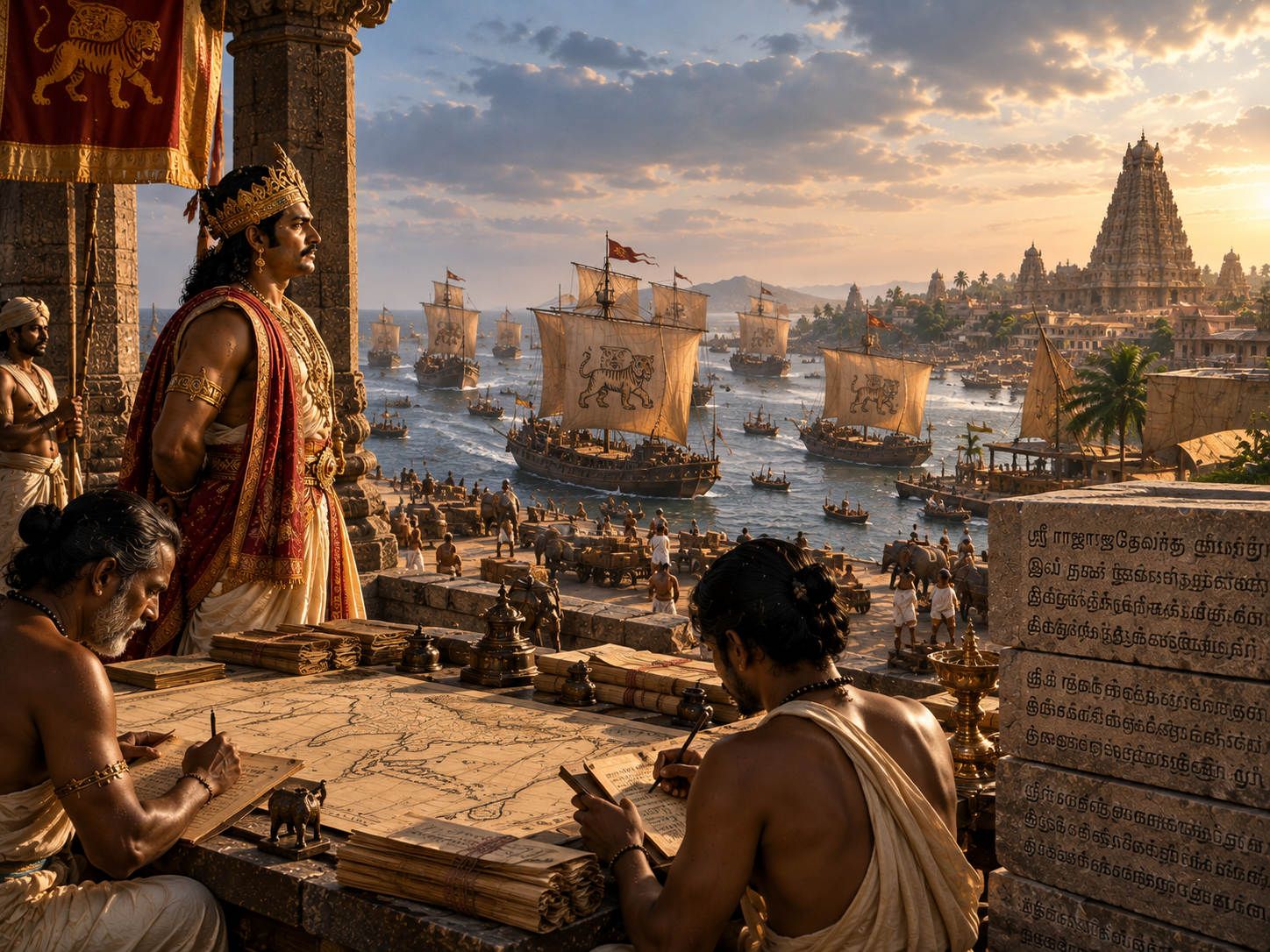
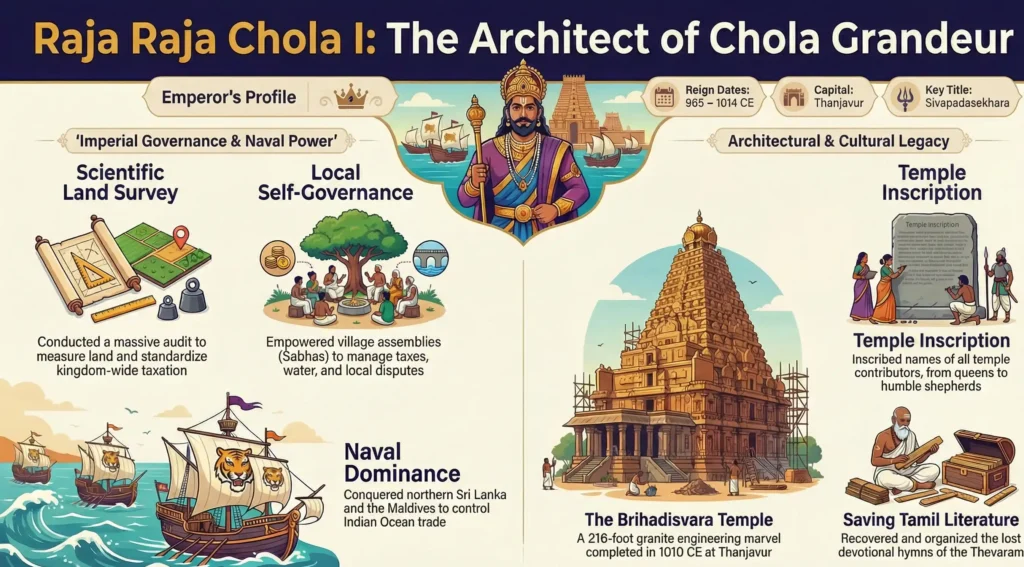
He defeated the rival Tamil kingdoms of the Cheras and the Pandyas, and united the whole of the south under his own hand. He crossed the sea and conquered the northern half of the island of Sri Lanka. He even took the far-flung Maldive islands, the first time any king of southern India had ever conquered lands right across the open ocean. By the end of his reign, his empire was roughly the size of a good-sized modern country, and he had built the powerful navy that his own son would one day sail all the way to Southeast Asia. He had well and truly earned his grand imperial name: Rajaraja, “the king of kings.”
Vasco da Gama Reaches India 1498: The Voyage That Changed the World
The king who measured everything
But Rajaraja was never the kind of king who simply conquered a land and then left it to run itself. He was a builder of systems, and he had an almost modern love of neatness and order.
Around the year 1000, he did something that most kings of his age never bothered to attempt. He ordered a great survey of his entire empire, sending his officials out to measure and record every single field, so that taxes could be set fairly and exactly, rather than by guesswork. He arranged his whole sprawling realm into a tidy ladder of provinces, districts, and villages, each with its own clear place. And then he did something even more remarkable, and rather wonderful.
A thousand years ago, Chola villages elected their own local councils by writing names on palm-leaf tickets, dropping them into a pot, and drawing them out one by one. Rajaraja, the king of kings, let his villages govern themselves.
Across the Chola land, local affairs were run by committees of ordinary villagers, and the members of those committees were chosen in a way that sounds astonishingly familiar to us today: by a simple, honest ballot drawn from a pot.
The temple that recorded everything
All of Rajaraja’s love of grandeur, and all of his love of careful order, came together at last in one single astonishing building. In his capital city of Thanjavur, he raised a temple to the god Shiva so vast that it remains, to this day, one of the great wonders of India: a veritable mountain of granite, its great tower soaring some sixty-six metres into the sky, crowned by one colossal stone. In its day it was, quite simply, the largest and grandest temple in the entire land. He finished it in 1010, and, tellingly, he named it after himself.
But here is the truly Rajaraja thing about it, the detail that shows you exactly the kind of man he was. He did not merely build the temple. He filled its walls, from top to bottom, with writing.
Rajaraja’s great temple is not only a mountain of granite. Its walls are covered in the most detailed accounts of the entire medieval world: every gift, every grant, every dancer and musician, carved into the stone forever.
And the writing does not record grand poetry. It records accounts. Every gift the temple ever received, every piece of land granted to it, the exact weights of gold and the measures of rice, all of it was carved carefully into the stone. Even the names and the daily duties of the hundreds of people who worked there, the priests and the accountants, the four hundred dancers, the musicians, and the lamp-lighters, were written down and made to last forever. His temple is, in a very real sense, the world’s most beautiful ledger. And because Rajaraja wrote things down like this, all across his empire, in thousands upon thousands of inscriptions, we now know more about how his kingdom actually worked, right down to its smallest daily details, than we do about almost any other place of its whole age.
Battle of Talikota 1565: The Fall of the Vijayanagara Empire
The devout and generous king
Rajaraja was, at heart, a deeply religious man, a devout worshipper of Shiva who took a title that meant “the one who lays his crown at Shiva’s feet.” But his own devotion never made him narrow or hard toward others.
He built temples for other Hindu gods too. And in one striking act of real openness, when the faraway Buddhist king of Srivijaya wished to build a monastery on the Chola coast, Rajaraja not only allowed it, but gave away the entire income of a village to support it. He also lovingly gathered up the old, half-forgotten Tamil hymns of the ancient saints, and had them carefully collected and sung once more in his temples, saving a great treasure of Tamil poetry that might otherwise have been lost forever. He was a king who built, and gave, and preserved.
Foundation of the Vijayanagara Empire: The Rise of Hampi
The architect of an age
Rajaraja Chola died in 1014, leaving his empire to his son Rajendra, who would go on to carry the Chola flag right across the ocean to distant foreign lands. But the true foundation, the deep, solid, beautifully ordered foundation of all Chola greatness, was Rajaraja’s own careful work.
And that, in the end, is how he most deserves to be remembered. Not merely as a conqueror, but as an architect. He built his empire the very same way a master builds a great temple: enormous in its ambition, yes, but exact and careful in every last detail, and made, above all else, to last. There is something genuinely moving in a king who cared so very much about getting the small things right, about measuring fairly, recording faithfully, and keeping honest accounts. It is not the glamorous side of power. But it may just be the side that actually holds a whole civilisation together. Rajaraja’s soldiers are long gone now, and his mighty ships have long since rotted away to nothing. But his great temple still stands, exactly as he built it, its walls still covered in his own careful writing. A thousand years later, we can still walk through the perfectly kept accounts of a vanished empire, all because one king firmly believed that a thing worth building was a thing worth writing down.
Chola Naval Expedition to Southeast Asia: When India Ruled the High Seas
If you think you have remembered everything about this topic take this QUIZ
Results


#1. What was the birth name of Raja Raja Chola I before he took the title meaning “King of Kings”?
#2. In 1010 CE, Raja Raja completed the magnificent Brihadisvara Temple (Big Temple), built entirely of granite, in which capital city?
#3. What major administrative feat did Raja Raja undertake to standardize taxation across his kingdom?
#4. What were the names of the local self-governance village assemblies that Raja Raja strengthened to collect taxes and manage water bodies?
#5. At the Battle of Kandalur Salai, whose fleet did Raja Raja destroy to establish Chola dominance over the western coast?
#6. Showcasing his religious tolerance, Raja Raja donated a village to build the Chudamani Vihara (a Buddhist vihara) for the king of which empire?
#7. Raja Raja famously recovered the lost hymns of the Thevaram and organized them into which major collection of Tamil devotional literature?
#8. According to the comparison table, what was the primary focus of Raja Raja Chola I’s reign compared to his son Rajendra Chola I’s focus on Expansion & Conquest?
Who was Raja Raja Chola I?
He was a great emperor of the Chola dynasty who ruled from 985 to 1014 CE.
What is the most famous monument built by him?
The Brihadisvara Temple (Big Temple) in Thanjavur.
Which countries did he conquer?
He conquered northern Sri Lanka and the Maldives.
What was his birth name?
His birth name was Arulmozhi Varman.
Who succeeded Raja Raja Chola?
His son, Rajendra Chola I, succeeded him.
Sources and references
- Anantam IAS and Brihadeeswara.com (“Raja Raja Chola I”) — his reign (985–1014 CE), birth name Arulmozhi Varman, the conquests of the Cheras, Pandyas, Sri Lanka and the Maldives (the first recorded overseas conquest by a South Indian power), and the empire reaching roughly 800,000 square kilometres.
- Anantam IAS and RajRAS (Connect Civils) — the comprehensive land survey and revenue assessment around 1000 CE, the division into mandalams, valanadus, nadus and villages, and village self-government through elected committees chosen by the kudavolai palm-leaf ballot.
- New World Encyclopedia and India123 — the Brihadeeswara Temple (Rajarajeswaram) consecrated in 1010, its role in distributing wealth, and Rajaraja’s vast inscriptions serving as detailed historical records of donations, endowments and temple staff.
- Curious Indian’s own overview (“Reign of Raja Raja Chola I”) and Connect Civils — his Shaivite devotion (title Sivapadasekhara), his tolerance in granting a village’s revenue to the Buddhist Chudamani Vihara at Nagapattinam for the Srivijaya king, and his support of Vishnu temples.
- India123 and general Chola histories — his revival of the Tamil Shaiva hymns (the Tevaram of Appar, Sundarar and Sambandar, compiled by Nambi Andar Nambi), the founding of Chola naval power, and his succession by Rajendra I.
Author


Exploring the Soul of Bharat through History, Science, Culture, and its Diversity
Our Mission
Curious Indian is a definitive knowledge portal dedicated to chronicling the events, personalities, and cultural shifts that defined the Indian subcontinent. From the ancient Vedic Period to the complexities of 21st-century politics, our goal is to provide deep-dive analysis that inspires.
Editorial Standards & E-E-A-T
Every article published under our brand undergoes a rigorous fact-checking process. We prioritize primary historical records, academic citations, and credible archives to ensure our readers receive accurate, high-authority information.
Historical Integrity Directly sourcing from ASI archives and academic journals.Topical Authority Comprehensive clustering of Indian Science, Biographies, and Wars.Managed by Paripurna Datta and TEAM | Dedicated to the Knowledge of India.