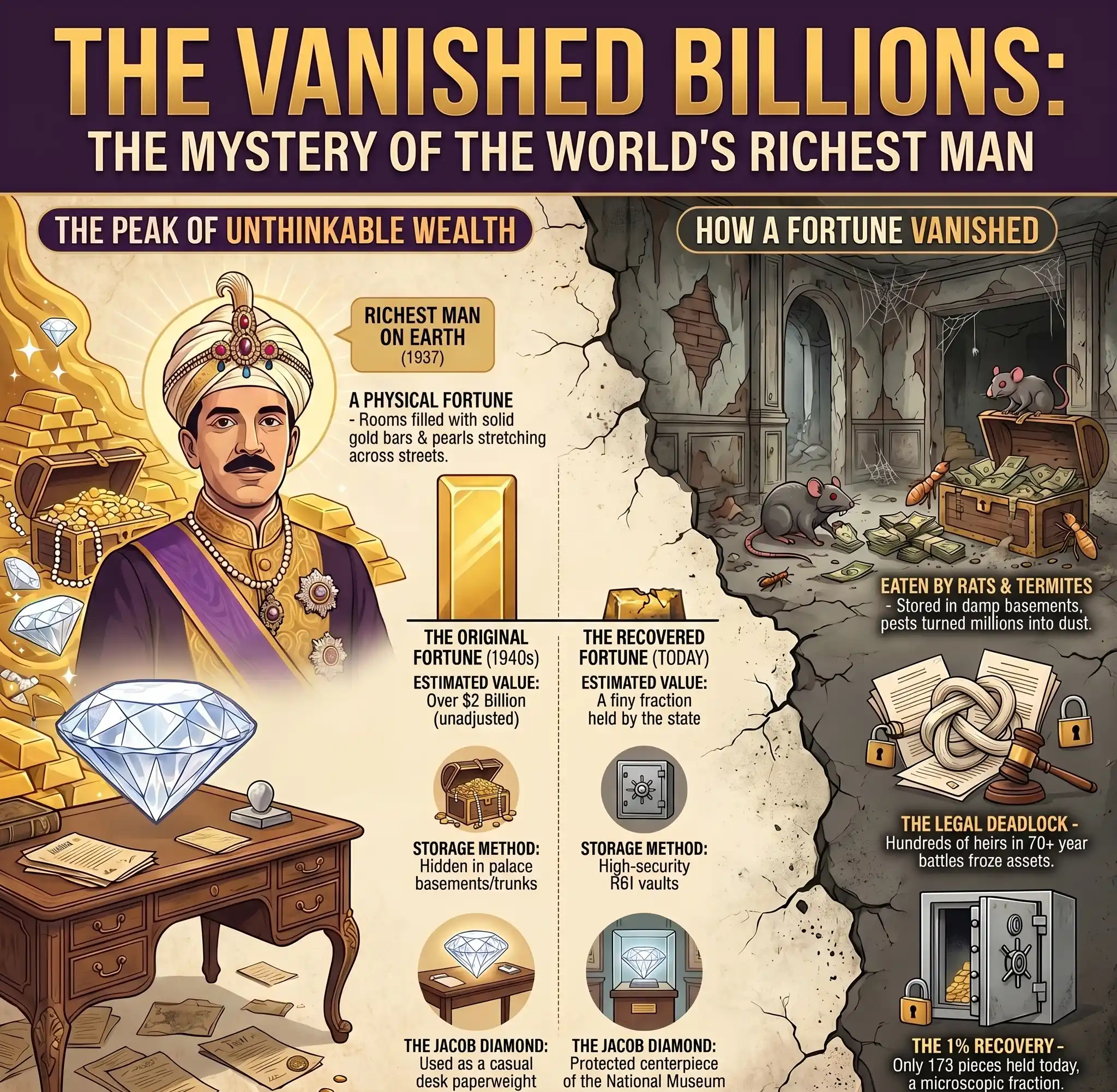
In nineteen thirty seven, Time magazine placed a single man on its cover, officially declaring him the richest human being in the world. His name was Mir Osman Ali Khan, the seventh and final Nizam of Hyderabad. His kingdom was so incredibly massive that it had its own currency, its own airline, and a private royal treasury overflowing with legendary Golconda diamonds. However, when the princely state merged with independent India, a massive historical mystery was born. While the Indian government eventually managed to secure a small fraction of his legendary jewelry, the vast majority of his unthinkable wealth completely vanished into thin air. From rumors of gold rotting in abandoned trucks to massive legal battles among hundreds of heirs, the story of the Nizam's missing billions remains the greatest unsolved treasure hunt in modern Indian history.| Feature | Details |
| Historical Figure | Mir Osman Ali Khan |
| Title | The 7th Nizam of Hyderabad |
| Famous Artifact | The 184.75 carat Jacob Diamond |
| Source of Wealth | The ancient Golconda diamond mines |
| Current Status of Fortune | Mostly missing, stolen, or lost in legal battles |
When we think of billionaires today, we usually think of modern technology CEOs living in massive glass penthouses. But less than a hundred years ago, the ultimate symbol of unthinkable wealth lived in a massive palace in southern India. Mir Osman Ali Khan, the brilliant and highly eccentric ruler of Hyderabad, sat on a fortune so incredibly massive that it makes modern billionaires look almost poor in comparison.
His wealth was not tied up in digital stocks or invisible bank accounts. It was entirely physical. He possessed literal rooms filled with solid gold bars, massive wooden chests overflowing with rubies, and strings of natural pearls so long they could easily stretch across an entire street. Yet, if you visit Hyderabad today and ask where the great Nizam’s wealth is, you will be met with a long, uncomfortable silence. The story of how the richest man on earth lost his billions is a fascinating tale of political chaos, greedy courtiers, and a deeply tragic ending.
Ashok Kumar (1911–2001): The Accidental Star Who Defined Bollywood
The Lord of the Golconda Diamonds
To understand the sheer scale of the Nizam’s wealth, you have to look at the ground beneath his kingdom. For centuries, the region of Hyderabad controlled the legendary Golconda mines, which were the only known source of high-quality diamonds in the entire world before mines were discovered in Brazil and Africa.
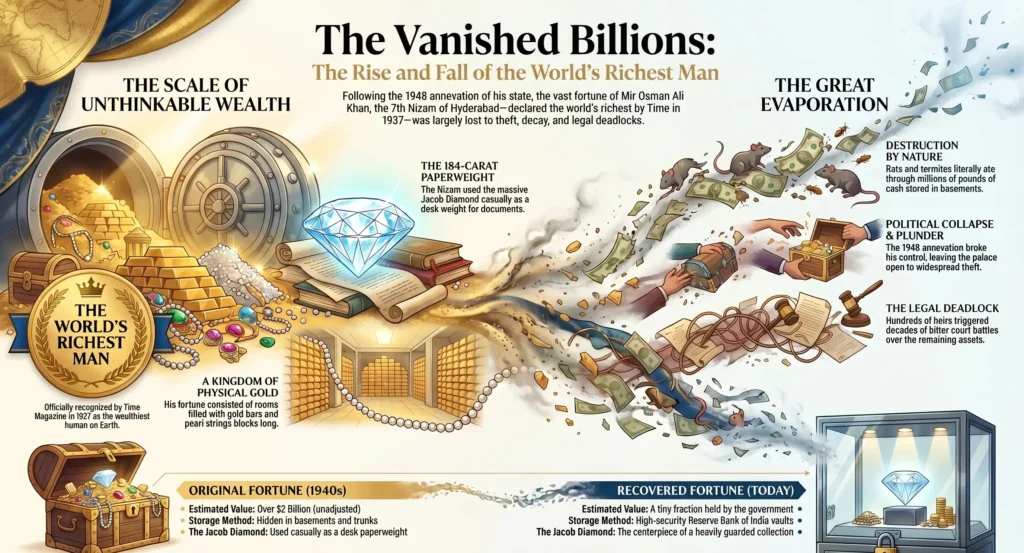
Because of this, the Nizams hoarded a massive, blinding collection of precious stones. The absolute crown jewel of this collection was the famous Jacob Diamond. It was a massive, incredibly clear diamond weighing over one hundred and eighty carats, roughly the size of a large ostrich egg. But Mir Osman Ali Khan was a highly eccentric man. Despite owning one of the most valuable diamonds on the planet, he famously kept it sitting casually on his messy desk, using it merely as a simple paperweight to keep his documents from blowing away.
A.R. Rahman : The Musical Genius Who Conquered the Globe
The Chaos of Independence
The turning point for the massive royal treasury came in nineteen forty eight. When India gained independence, the Nizam fiercely wanted Hyderabad to remain an independent, sovereign nation. He stubbornly refused to join the Indian Union. This led to a massive military standoff, culminating in “Operation Polo,” where the powerful Indian Army successfully marched into Hyderabad and officially annexed the massive princely state.
When the Nizam surrendered his absolute political power, the tight, iron grip he held over his private treasury was suddenly broken. As the royal administration collapsed in total chaos, the vast palace doors were left wide open to corruption, theft, and incredible greed.
The Plunder of King Kothi Palace
Mir Osman Ali Khan lived his final years as a recluse in the massive King Kothi Palace. It is during this chaotic period that the massive fortune began to mysteriously evaporate. The Nizam completely distrusted modern banks. He firmly believed that the only safe place for wealth was hidden inside his own home. He stashed millions of pounds of cash in the damp palace basements, buried gold under the gardens, and locked diamonds in rusty iron trunks.
According to widespread historical rumors, his trusted courtiers and palace guards slowly began robbing him blind. Because the Nizam was growing old and isolated, staff members allegedly smuggled priceless rubies out of the palace hidden inside their clothes. There are even famous, verified historical reports that the Nizam stored so much paper cash in the dark, humid basement that rats and termites literally ate through millions of pounds worth of currency, turning immense fortunes into actual dust.
From Jadoo to Javed: The Complete Biography of a Literary Giant
The Government Purchase of 1995
Before he died in nineteen sixty seven, the Nizam tried to protect what was left of his wealth by creating dozens of complex family trusts. He had a massive family, including numerous wives and hundreds of children and grandchildren. After his death, these heirs immediately began fighting each other in bitter, endless legal battles over the remaining jewelry.
To prevent the legendary royal jewels from being secretly smuggled out of the country and sold in foreign auctions, the Government of India finally stepped in. After nearly three decades of massive legal deadlocks, the government officially purchased a collection of one hundred and seventy-three exquisite pieces of the Nizam’s jewelry in nineteen ninety five for roughly two hundred and eighteen crore rupees.
Today, this specific collection is heavily guarded by the Reserve Bank of India and is occasionally displayed at the National Museum in New Delhi. While the collection is completely breathtaking—featuring the Jacob Diamond and magnificent seven-strand pearl necklaces—historians know the harsh truth. These 173 pieces represent just a tiny, microscopic fraction of the massive original royal treasury.
Where Are the Missing Billions?
So, where did the rest of the richest man’s fortune actually go? The hunt for the missing billions is a massive global puzzle. Some of the wealth was quietly smuggled to highly secretive Swiss bank accounts by fleeing royal family members. Some of it was permanently tied up in massive international legal cases, like the famous “Hyderabad Fund” case involving millions of pounds locked in a London bank account since nineteen forty eight, which was only finally resolved in two thousand and nineteen.
But the most thrilling theories point right back to the dusty grounds of Hyderabad. Many local historians strongly believe that massive secret underground vaults still exist beneath the forgotten, crumbling courtyards of the King Kothi and Chowmahalla palaces. They believe that heavy trucks filled with gold bars, which were supposedly hidden during the panic of the military annexation, are still waiting in the dark to be discovered.
The Unconventional Journey of Irrfan Khan
Quick Comparison Table
| Feature | The Original Fortune (1940s) | The Recovered Fortune (Today) |
| Estimated Value | Over $2 Billion (unadjusted for massive inflation) | A small fraction officially held by the government |
| Status of Wealth | Intact, heavily guarded by private armies | Deeply fragmented, stolen, or lost in legal battles |
| Storage Method | Hidden in palace basements and secret trunks | High security modern vaults of the RBI |
| The Jacob Diamond | Used casually as a desk paperweight | The heavily guarded centerpiece of the national collection |
Curious Indian Fast Facts
- Despite being the richest man on earth, the Nizam was famously frugal; he wore the same crumpled clothes for months and smoked cheap local cigarettes.
- He reportedly knit his own socks to save money, even though he literally owned the world’s largest collection of pearls.
- During the Indo-China war in nineteen sixty two, the Nizam donated a massive five thousand kilograms of solid gold to the National Defence Fund to help the Indian government.
- The Nizam had an estimated one hundred and forty-nine children, leading to one of the most complicated and messy inheritance battles in global legal history.
- The original Golconda mines, which created his immense wealth, were completely exhausted and abandoned by the end of the nineteenth century.
Conclusion
The story of the Nizam’s missing billions is the ultimate historical lesson in the temporary nature of massive wealth. Mir Osman Ali Khan built an empire of gold, diamonds, and pearls that he fiercely believed would last forever. But he completely failed to realize that wealth requires a stable empire to protect it. When the political winds shifted and the modern world marched into his kingdom, his massive treasure chests were helpless against the forces of time, greedy courtiers, and incredibly slow legal systems.
While the breathtaking jewelry safely sitting in the National Museum gives us a tiny glimpse into the unimaginable luxury of the past, the empty, crumbling basements of the King Kothi palace tell the real story. The greatest fortune the world had ever seen was not destroyed by an invading army, but by rats, termites, and endless human greed. The ghost of the missing billions continues to haunt the history of Hyderabad, leaving behind an incredibly thrilling mystery that will likely never be fully solved.
Beyond Boundaries: The Complete Biography of Farhan Akhtar
If you think you have remembered everything about this topic take this QUIZ
Results


#1. In 1937, which publication featured Mir Osman Ali Khan on its cover as the richest human being in the world?
#2. What was the primary source of the Nizam of Hyderabad’s immense diamond wealth?
#3. What was the weight of the famous Jacob Diamond, and how did the Nizam eccentrically use it?
#4. What was the name of the military operation that led to the annexation of Hyderabad into the Indian Union in 1948?
#5. Why did millions of pounds worth of paper cash stored in the Nizam’s palace basements eventually vanish?
#6. How many pieces of the Nizam’s jewelry did the Government of India officially purchase in 1995?
#7. How much solid gold did the Nizam donate to the National Defence Fund during the Indo-China war of 1962?
#8. In which palace did Mir Osman Ali Khan spend his final years as a recluse?
Who was Mir Osman Ali Khan?
He was the seventh and final Nizam of the princely state of Hyderabad, famously recognized by Time magazine in 1937 as the absolute richest man in the world.
What is the Jacob Diamond?
It is a massive 184.75-carat diamond, originally mined in Africa, which the Nizam famously used as a simple paperweight on his office desk.
What happened to the Nizam’s immense wealth?
While a massive portion was stolen by courtiers, eaten by termites, or lost in complex international legal battles, a small fraction was officially purchased by the Government of India in 1995.
Where can you see the Nizam’s jewelry today?
The 173 pieces purchased by the Indian government are usually kept in the high-security vaults of the Reserve Bank of India and are occasionally exhibited at the National Museum in New Delhi.
Why was the wealth so difficult to distribute?
The Nizam had created dozens of complex trusts for his massive family, which included hundreds of heirs, leading to decades of incredibly bitter and deadlocked legal battles over the inheritance.