Javed Akhtar spent fifty years on one proposition, that the person who writes the thing should be named on it and paid for it
In the early 1970s a Hindi film writer was somewhere above the lighting crew and below most of the technicians.
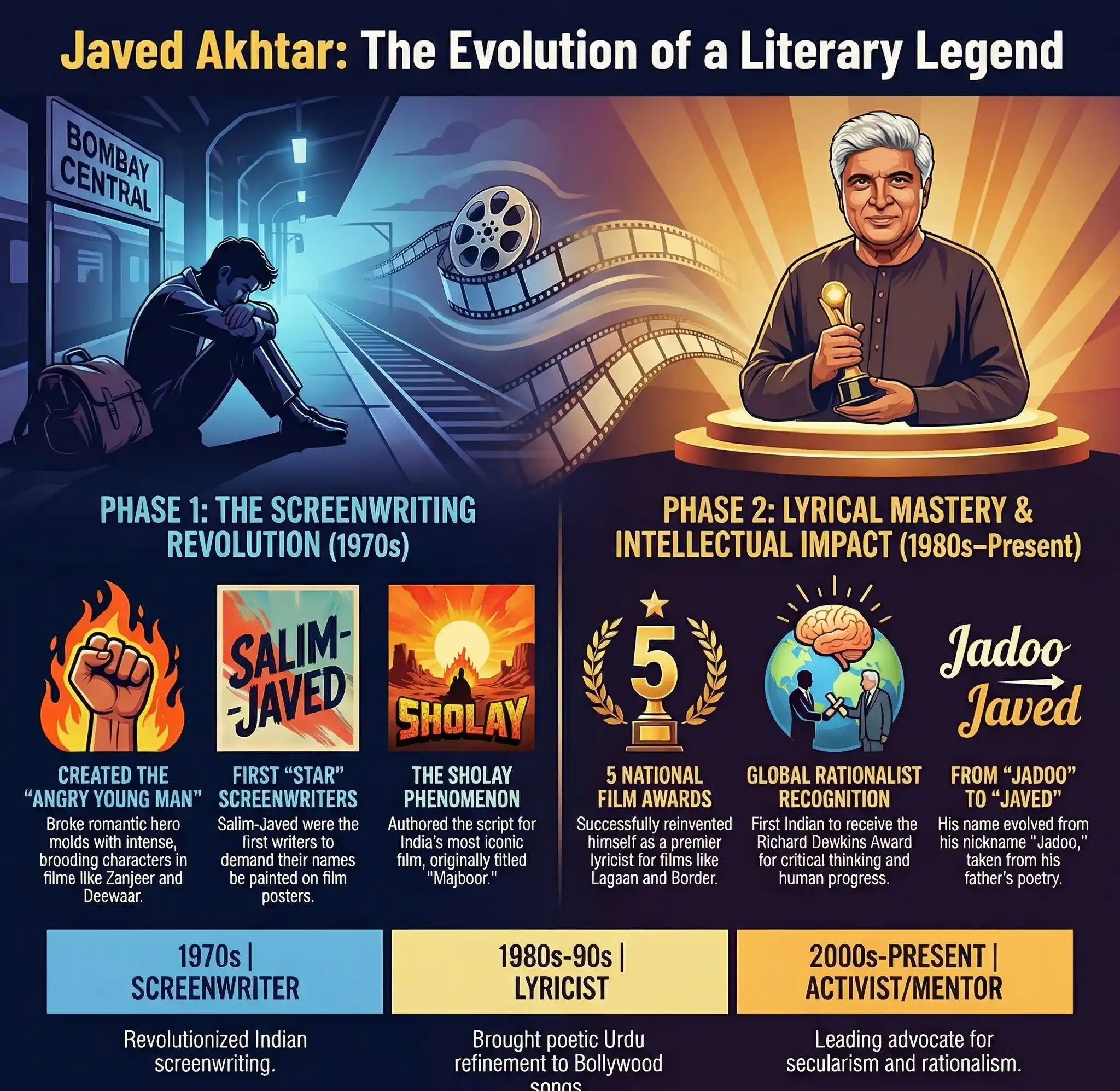
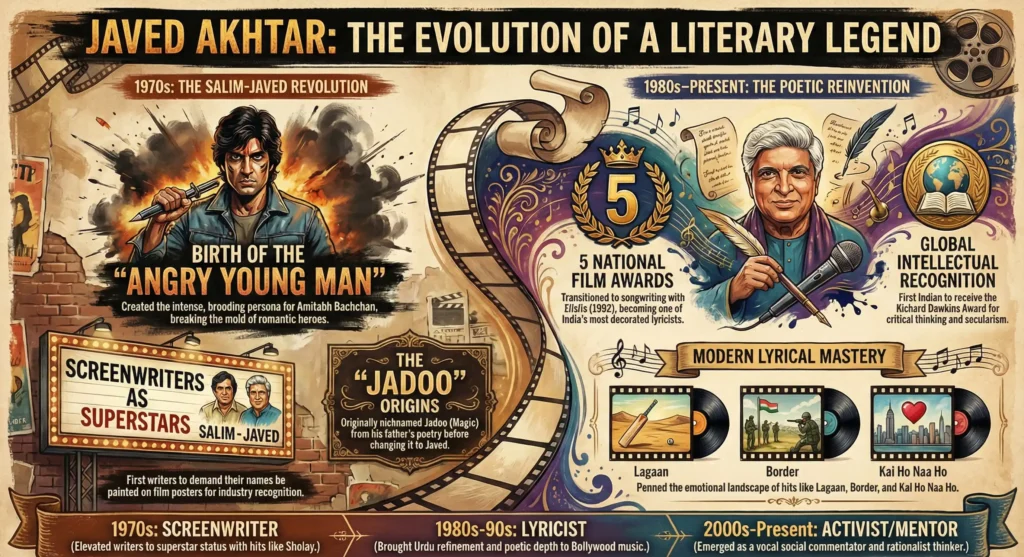
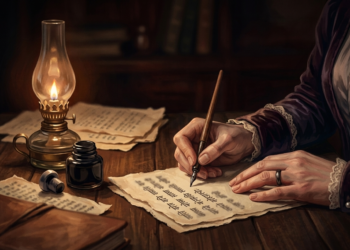
There was no convention of one person handling story, screenplay and dialogue, the three jobs were routinely split between different hands, and there was no convention of putting any of their names in the titles at all. What the two men called Salim and Javed did about this was direct. They arranged for their own names to be painted on the posters.
The gesture was not modest and it was not meant to be. It was a claim on authorship made in public, by two men who had no standing to make it, in an industry that did not accept that films had authors outside the director’s chair. Within a few years they were among the best paid people in the business, and Hindi cinema had a category it had never had before, which was the famous screenwriter.
His father was the poet Jan Nisar Akhtar. His grandfather was Muztar Khairabadi. His great great grandfather Fazl-e-Haq Khairabadi was a nineteenth century scholar, and the poet Majaz was an uncle. He was born in Gwalior in 1945, lost his mother at eight, was passed between relatives and educated at Lucknow and Bhopal, and reached Bombay in 1964 with very little.
Rajesh Khanna, of all people, gave him and Salim Khan their first real job, on Haathi Mere Saathi in 1971.
They wrote twenty-four films together between 1971 and 1987 and about twenty of them worked.
Zanjeer in 1973, then Deewaar, Sholay, Trishul, Don, Kaala Patthar and Shakti, which is a run that no writing credit in any film industry anywhere has comfortably matched. Seeta Aur Geeta, in 1972, is theirs too, and so is Yaadon Ki Baaraat. They built the angry young man and handed him to Amitabh Bachchan, and the figure they built took over Indian cinema for fifteen years.
The detail that says the most about them is not artistic. They held on to the remake rights for their own scripts and licensed the South Indian versions themselves, which is a thing no writer in that industry had thought to do.
Then it stopped
They split in 1982.
He went into lyrics, wrote for more than eighty films and collected five National Film Awards for it, which is a second career most people would settle for having as a first. Two scripts finished before the break came out afterwards, which is why Mr India in 1987 still carries both names.
He also married Shabana Azmi in 1984, which put two of the most argumentative people in Indian public life in the same house. He was by then unarguably established, which is normally the point at which a person stops picking fights about how the industry pays people.
The Indian Performing Right Society exists to collect royalties for composers and lyricists. In the 2000s the music labels effectively took control of it.
He led the counterattack, and it was a lobbying campaign rather than a protest. He was a nominated member of the Rajya Sabha from 2010, and his speech there in May 2012 did not argue about art at all. He argued about unequal bargaining power, and cited the Minimum Wages Act as the precedent.
Producers and labels fought it hard enough that they came close to demonstrating in the streets, which had never once happened over a copyright statute in India and tells you what was actually at stake. Parliament passed the amendment unanimously.
What it was worth
The Copyright Amendment Act of 2012 gave composers and lyricists a right to royalties that they cannot sign away.
Lata Mangeshkar had been making that argument since 1963, had lost Mohammed Rafi over it, and had spent fifty years failing to win it. The thing that finally moved was a piece of legislation pushed through by a screenwriter, and Indian musicians now collect royalties running to hundreds of crores a year. He recently put the annual figure at around seven hundred and thirty crore rupees.
He has done exactly one thing with his life, twice. Once with a paintbrush and a poster, and once with a bill.
If you think you have remembered everything about this topic take this QUIZ
Results
QUIZ START
#1. What was Javed Akhtar’s original childhood nickname before it was changed to Javed?
Previous
Next
#2. Javed Akhtar formed a legendary screenwriting duo with which writer, creating hits like Sholay and Deewaar?
Previous
Next
#3. In 2020, Javed Akhtar became the first Indian to receive which prestigious award for critical thinking?
Previous
Next
#4. Javed Akhtar is the father of which two celebrated filmmakers?
Previous
Next
#5. Which iconic persona did Salim-Javed create for Amitabh Bachchan in the film Zanjeer?
Previous
Next
#6. Javed Akhtar’s great-great-grandfather, Fazl-e-Haq Khairabadi, was a scholar involved in which historical event?
Previous
Next
#7. After splitting with Salim Khan, Javed Akhtar successfully reinvented himself in which role with the film Silsila?
Previous
Next
#8. Javed Akhtar is currently married to which legendary actress?
Previous
Finish
Who was Javed Akhtar’s writing partner?
He formed a legendary partnership with Salim Khan, known as the duo Salim-Javed.
How many National Awards has Javed Akhtar won?
He has won five National Film Awards for Best Lyrics.
Who are Javed Akhtar’s children?
His children are Farhan Akhtar (actor, director) and Zoya Akhtar (director), both from his first marriage to Honey Irani.
What is Javed Akhtar’s original name?
He was nicknamed “Jadoo” at birth, which later evolved into the name Javed.
Which famous poem collection did Javed Akhtar write?
He authored the acclaimed Urdu poetry collection titled Tarkash (Quiver).
Sources & References
Encyclopaedia Britannica (“Javed Akhtar”) — his career as screenwriter and lyricist and his family background.
Prashant Reddy T. and Sumathi Chandrashekaran, Create, Copy, Disrupt: India’s Intellectual Property Dilemmas (2017) — the chapter on the 2012 copyright campaign.
Rajya Sabha debates, 17 May 2012 — his speech on the Copyright Amendment Bill.
The Copyright (Amendment) Act, 2012, Government of India — the royalty rights created for composers and lyricists.
Exploring the Soul of Bharat through History, Science, Culture, and its Diversity
Our Mission
Curious Indian is a definitive knowledge portal dedicated to chronicling the events, personalities, and cultural shifts that defined the Indian subcontinent. From the ancient Vedic Period to the complexities of 21st-century politics, our goal is to provide deep-dive analysis that inspires.
Editorial Standards & E-E-A-T
Every article published under our brand undergoes a rigorous fact-checking process. We prioritize primary historical records, academic citations, and credible archives to ensure our readers receive accurate, high-authority information.
Historical IntegrityDirectly sourcing from ASI archives and academic journals.
Topical AuthorityComprehensive clustering of Indian Science, Biographies, and Wars.
Managed by Paripurna Datta and TEAM | Dedicated to the Knowledge of India.