A rejected paper, a reader at Dhaka with no reputation, and a request that Einstein translate it
Late in 1923 Satyendra Nath Bose sent a short paper on Planck’s radiation law to the Philosophical Magazine in London, which had published him before. Six months went by. Then the rejection came.
On 4 June 1924 he wrote to Albert Einstein in Berlin instead.
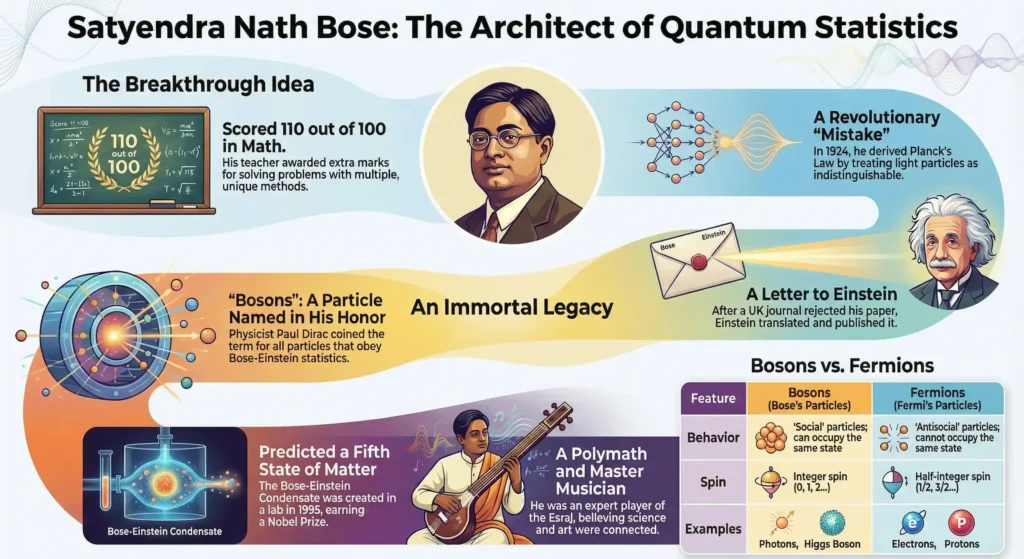
The letter is short and remarkably level. He has ventured to send the enclosed article for Einstein’s opinion, he says, and he is anxious to know what Einstein thinks of it. He explains what he has managed to derive. Then he says he does not know enough German to translate the paper himself, and asks Einstein to arrange its publication in the Zeitschrift fur Physik if he thinks it worth publishing.
He also wrote, of the man he was asking to do this: though a complete stranger to you, I do not feel any hesitation.
What Einstein did
He translated it. Personally, by hand, and sent it to the journal with a note of his own attached saying that Bose’s derivation of the Planck formula was an important advance and that the same method would yield the quantum theory of the ideal gas, which he would work out elsewhere.
The paper reached Berlin from Dhaka by post and was in print in early July. About a month, including the translation, from a rejected manuscript in East Bengal to publication in the leading physics journal in Europe.
Dr. A.P.J. Abdul Kalam: (1931-2015)
What was actually in it
Planck’s law describes how much energy a hot body radiates at each colour. It had been correct for twenty-four years and everybody who derived it did so by treating the radiation as waves in a box and counting the ways the waves could fit.
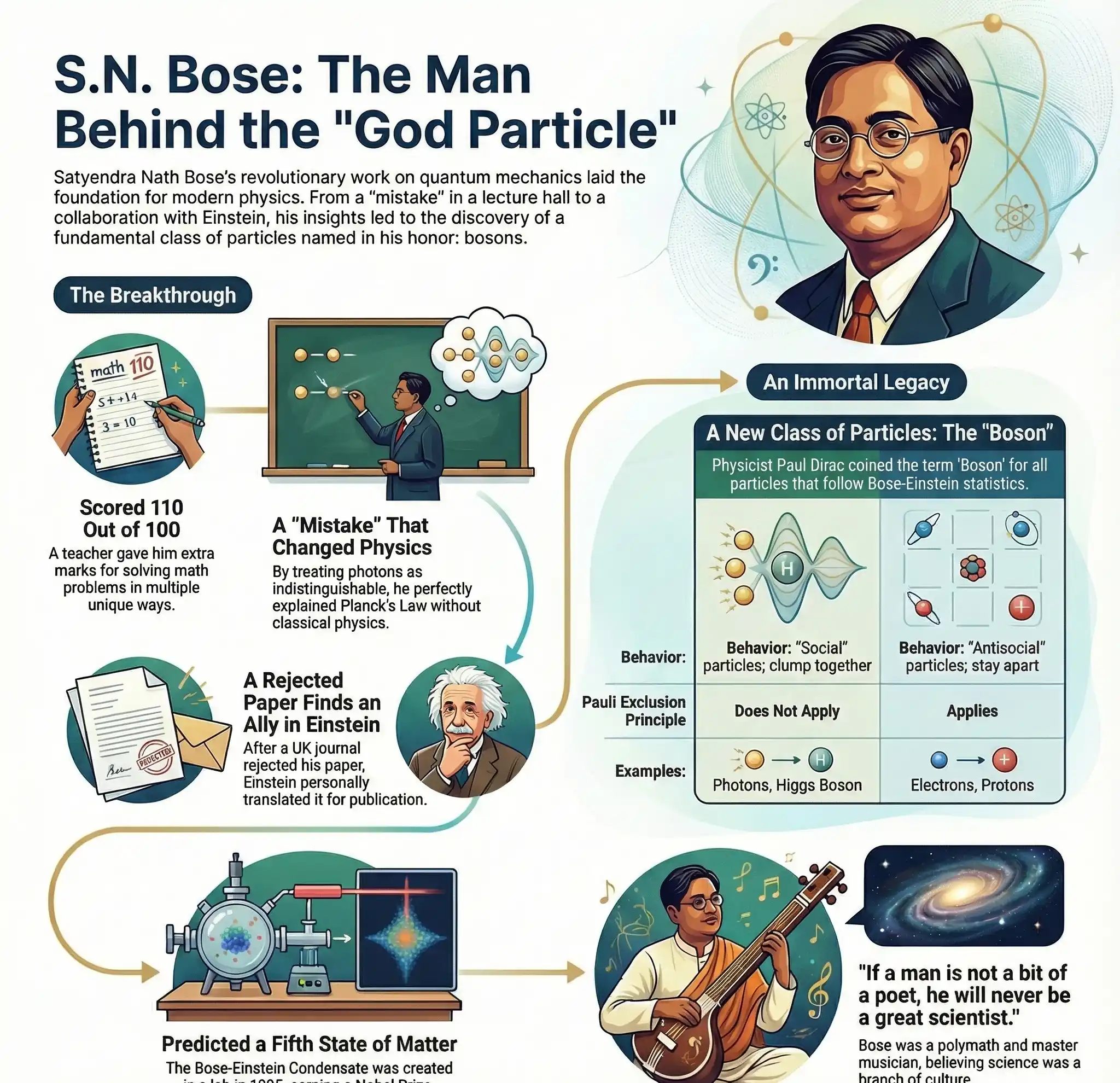
Bose threw that out and counted the light quanta themselves. The move that matters is what he did next, and it sounds trivial until you see what it does. He counted two photons of the same state as one arrangement rather than two, because there is no way, even in principle, to say which is which.
Swap them and nothing has happened. That single change in bookkeeping gives Planck’s law exactly, with no electrodynamics borrowed from the classical world.
It is not a new formula. It is a new answer to the question of what counts as a different arrangement, and everything follows from it.
The story about the mistake
The popular version says he made an error at the blackboard while teaching, got the right answer by accident, and realised afterwards that the error was a discovery. It is a good story and it is probably not what happened.
The better account is that he was preparing a lecture, found the textbook derivation unsatisfying, and deliberately turned the problem round. Partha Ghose, one of his last research students, has also pointed out that the paper gestures at the indistinguishability of photons without ever stating it outright, which is not how a man writes when he has stumbled.
What it turned into
Einstein did what his note promised. He applied the same counting to a gas of atoms and found that below a certain temperature the atoms would stop behaving as separate things and fall together into a single shared quantum state.
That prediction sat unused for seventy years because nobody could get anything cold enough. In 1995 two American groups made one, and the Nobel Prize for it went to Cornell, Wieman and Ketterle in 2001. It is called a Bose-Einstein condensate.
Particles that obey these statistics are bosons, a name Dirac coined. Photons are bosons. Gluons are bosons. So is the Higgs. Roughly half the contents of the universe is sorted into a category named after a reader at Dhaka University.
8 Defining Chapters in the Vikram Sarabhai Biography
The rest of the man
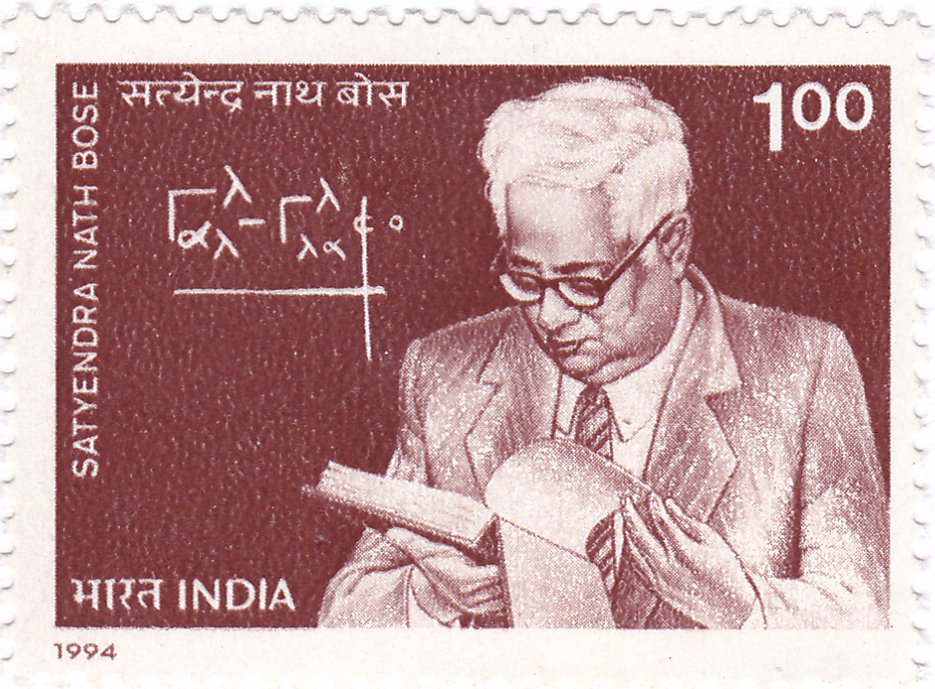
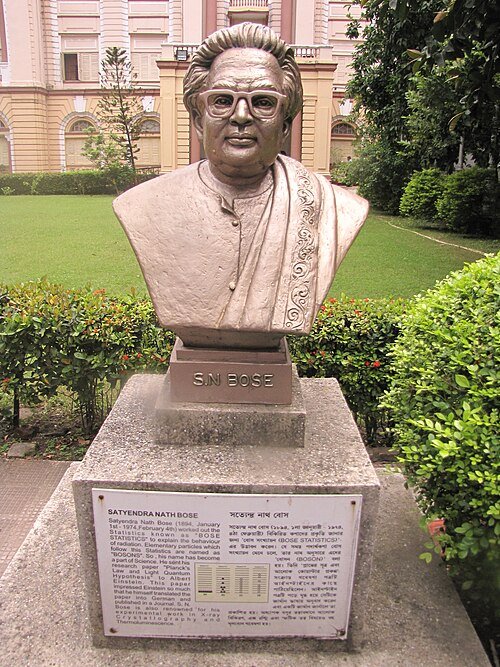
He never took a doctorate. He was made a professor without one, partly on the strength of what Einstein had written about him, and he got a European visa in 1924 by showing a postcard from Einstein at the German consulate, which was apparently enough.
Four years earlier he and Meghnad Saha had produced the first English edition of Einstein’s papers on relativity, translating from German and French. He played the esraj seriously. He spent a long stretch of his life arguing that science should be taught in Bengali and writing it in Bengali himself, which is not a career-advancing use of a physicist’s time.
The prize
Several Nobel Prizes have been given for work that rests directly on his statistics. He was nominated more than once and never got one.
Asked about it in old age, he said he had received all the recognition he deserved. People have read that as bitterness or as grace depending on what they wanted to find in it. It is also possible that a man who had Einstein for a translator did not feel short of acknowledgement.
He posted four pages to a stranger and asked for a favour. The stranger did the typing.


The Roopkund Skeleton Lake Mystery: Why Were Greeks Dying in the Indian Himalayas?
1971 Nagarwala Case: India’s Great Bank Heist Mystery
If you think you have remembered everything about this topic take this QUIZ
Results


#1. Why did Satyendra Nath Bose’s teacher award him 110 marks out of 100 on a mathematics exam?
#2. What was the radical departure from traditional physics that Bose used to derive Planck’s Law at Dacca University?
#3. How did Albert Einstein respond to the manuscript Bose sent him in 1924?
#4. According to the scientific comparison, what is a key behavioral difference between ‘Bosons’ and ‘Fermions’?
#5. Who coined the term ‘Boson’ to honor Satyendra Nath Bose’s contribution to science?
#6. What is the ‘Bose-Einstein Condensate’ (BEC) mentioned in the text?
#7. Besides physics, Bose was a master of which traditional Indian musical instrument?
#8. What was Bose’s stance on the language used for teaching science?
Why is Satyendra Nath Bose famous?
He is famous for his work on quantum mechanics in the 1920s, which led to the Bose-Einstein statistics and the prediction of the Bose-Einstein Condensate. His work provided the foundation for the classification of “boson” particles.
Did Satyendra Nath Bose win a Nobel Prize?
No, Satyendra Nath Bose did not win a Nobel Prize, although he was nominated several times. However, several Nobel Prizes have been awarded to others for work related to the concepts he pioneered, such as the discovery of the Bose-Einstein Condensate.
What is a Boson?
A boson is a type of subatomic particle that follows Bose-Einstein statistics. Examples include photons (light particles) and the Higgs boson. They are known as “force-carrier” particles.
How did Bose and Einstein collaborate?
Bose sent a research paper to Einstein after it was rejected by a British journal. Einstein recognized its importance, translated it, and helped get it published, eventually expanding Bose’s ideas into what we now call Bose-Einstein Statistics.
Where did Satyendra Nath Bose study?
Bose studied at Presidency College and the University of Calcutta, where he set academic records that stood for many years.
Sources & References
S.N. Bose, letter to Albert Einstein, 4 June 1924, reproduced in Physics Today — the request for translation and publication.
S.N. Bose, Plancks Gesetz und Lichtquantenhypothese, Zeitschrift fur Physik 26 (1924), with Einstein’s translator’s note — the derivation and Einstein’s assessment of it.
Partha Ghose, on Bose’s derivation and the question of indistinguishability (arXiv, 2023) — the reading of what the paper does and does not state.
The Nobel Prize, Physics 2001 — the first laboratory Bose-Einstein condensates and the prediction they confirmed.
Author


Exploring the Soul of Bharat through History, Science, Culture, and its Diversity
Our Mission
Curious Indian is a definitive knowledge portal dedicated to chronicling the events, personalities, and cultural shifts that defined the Indian subcontinent. From the ancient Vedic Period to the complexities of 21st-century politics, our goal is to provide deep-dive analysis that inspires.
Editorial Standards & E-E-A-T
Every article published under our brand undergoes a rigorous fact-checking process. We prioritize primary historical records, academic citations, and credible archives to ensure our readers receive accurate, high-authority information.
Historical Integrity Directly sourcing from ASI archives and academic journals.Topical Authority Comprehensive clustering of Indian Science, Biographies, and Wars.Managed by Paripurna Datta and TEAM | Dedicated to the Knowledge of India.