Western films had hired Indian actors for decades to be Indian. Irrfan Khan was the one they hired to be somebody
In Jurassic World he is Simon Masrani, who owns the park and flies the helicopter.
In Inferno he is Harry Sims, who runs a private security outfit. In The Amazing Spider-Man he is a corporate fixer called Rajit Ratha. None of those characters are about being Indian. They are men with jobs, and the actor playing them happened to be from Jaipur.
That sounds like a small thing and it was not. For most of the previous fifty years an Indian actor appearing in a Western film was there to supply India, and the part came with the country attached to it.
The available roles had names like the doctor, the driver, the shopkeeper, the holy man and the terrorist.
He took work in that territory too and simply refused to play it as a type. He is the police inspector in Slumdog Millionaire, doing an interrogation with more going on behind his face than the scene strictly requires. He is a Pakistani officer in A Mighty Heart. He played both as men with a day’s work in front of them.
There was one American television part that did more than any of the films. In the third season of In Treatment he played Sunil, a widowed maths professor sent to live with his son in Brooklyn and quietly going under. It is half a dozen episodes of a man in a chair, and it is as good as anything he did. He also turned up as the adult Pi in Life of Pi, which is to say the narrator of the whole film, carrying a story about faith without once playing mystical.
It took him ten years to be allowed to start
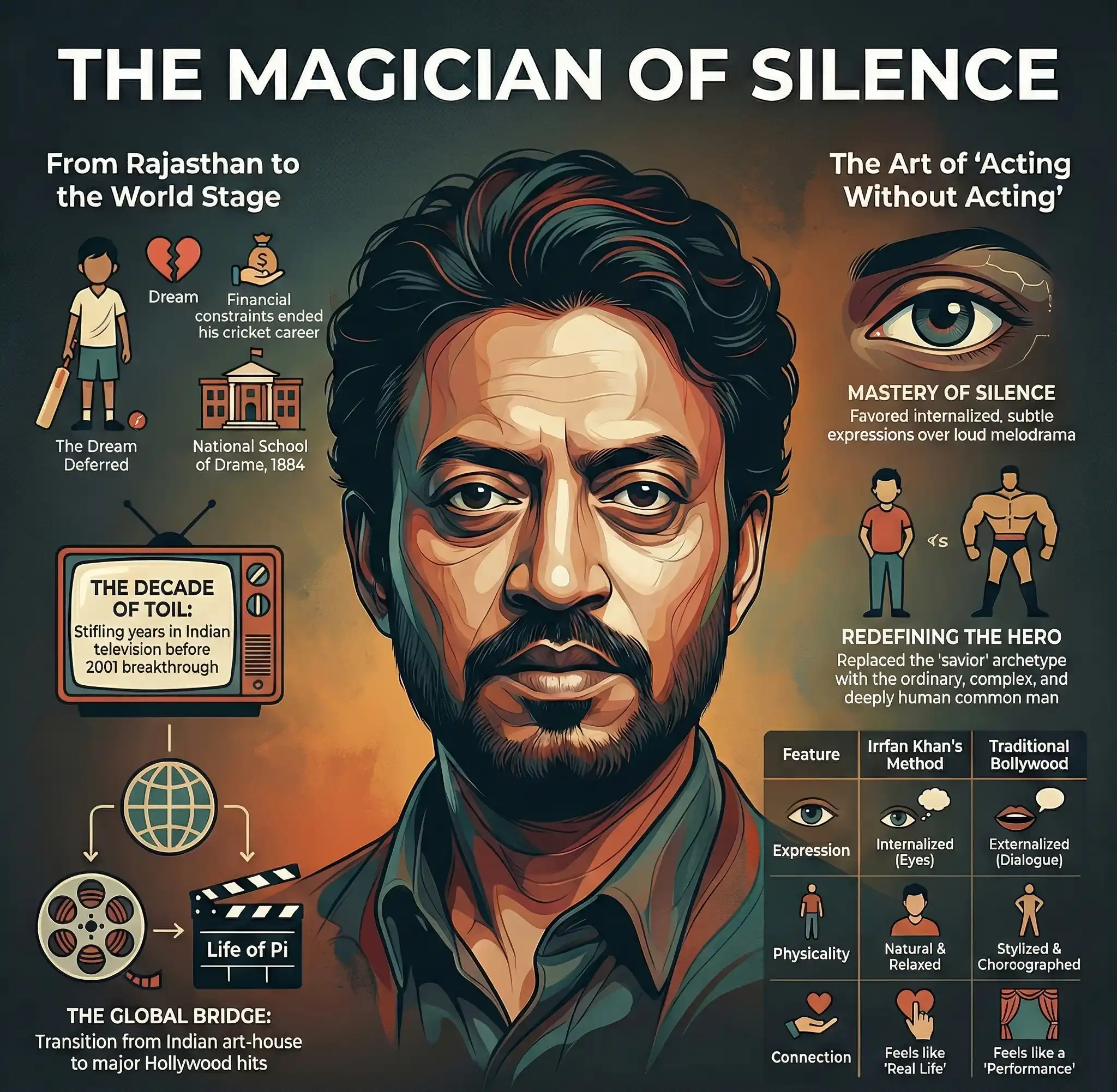
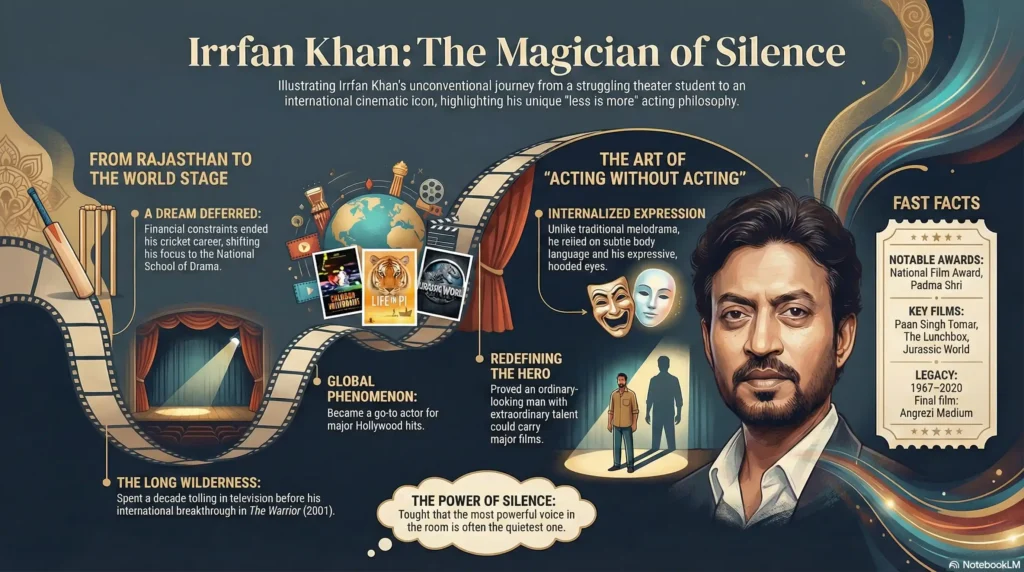
He trained at the National School of Drama and then almost nothing happened for a decade.
Mira Nair gave him a part in Salaam Bombay! in 1988 and most of it was cut. He went back to Indian television and stayed there through the 1990s, working constantly and getting nowhere, because the industry had looked at him and concluded he did not have the face for a lead.
There is a version of this story where the decade of television is a montage. It was not. It was most of his twenties and thirties, spent doing serials while being told the thing he could not change about himself was the problem. He was in his mid-thirties before that changed, which in Hindi cinema is normally the age at which people are finishing rather than starting.
Asif Kapadia cast him as a swordsman in feudal Rajasthan who decides to stop.
The Warrior came out in 2001, won the BAFTA for best British film and went forward as Britain’s entry for the foreign language Oscar. Maqbool and Haasil followed in 2003, and after that he was never short of work again.
He did not move. Through all the international films he kept making Indian ones, and the best of them are not the crossover titles. Paan Singh Tomar won him the National Film Award for Best Actor in 2012. Then The Lunchbox, Piku, Talvar, Hindi Medium.
What the technique was
He worked by taking things out.
There is very little demonstration in his performances and almost no underlining. He would let a scene sit, hold a look a beat past comfortable, and decline to tell the audience what to feel about it. In an industry built on emphasis that is an unusual instrument to bring to work.
It is also exactly why he could stand in an American blockbuster without seeming like a guest. He was not signalling anything, so there was nothing to place.
In March 2018 he announced that he had a neuroendocrine tumour, in his own words, mainly to correct what was being said about him.
He was treated in London, came back, and shot Angrezi Medium. It opened on 13 March 2020 and was the last film to reach Indian cinemas before they shut for the pandemic. He was too unwell to promote it.
His mother died in Jaipur in late April and he watched the funeral on a video link, because the country was locked down. He died on 29 April 2020, at fifty-three. His family’s statement quoted a line he had written two years earlier: “I trust, I have surrendered.”
Exploring the Soul of Bharat through History, Science, Culture, and its Diversity
Our Mission
Curious Indian is a definitive knowledge portal dedicated to chronicling the events, personalities, and cultural shifts that defined the Indian subcontinent. From the ancient Vedic Period to the complexities of 21st-century politics, our goal is to provide deep-dive analysis that inspires.
Editorial Standards & E-E-A-T
Every article published under our brand undergoes a rigorous fact-checking process. We prioritize primary historical records, academic citations, and credible archives to ensure our readers receive accurate, high-authority information.
Historical IntegrityDirectly sourcing from ASI archives and academic journals.
Topical AuthorityComprehensive clustering of Indian Science, Biographies, and Wars.
Managed by Paripurna Datta and TEAM | Dedicated to the Knowledge of India.