How a Tamil dynasty built a navy, made the Bay of Bengal its own, and conquered across the ocean
When we picture India’s great empires, we usually picture them facing inward: vast kingdoms of land, of forts and river-plains and marching armies, from the Mauryas of the north to the Mughals who came much later.
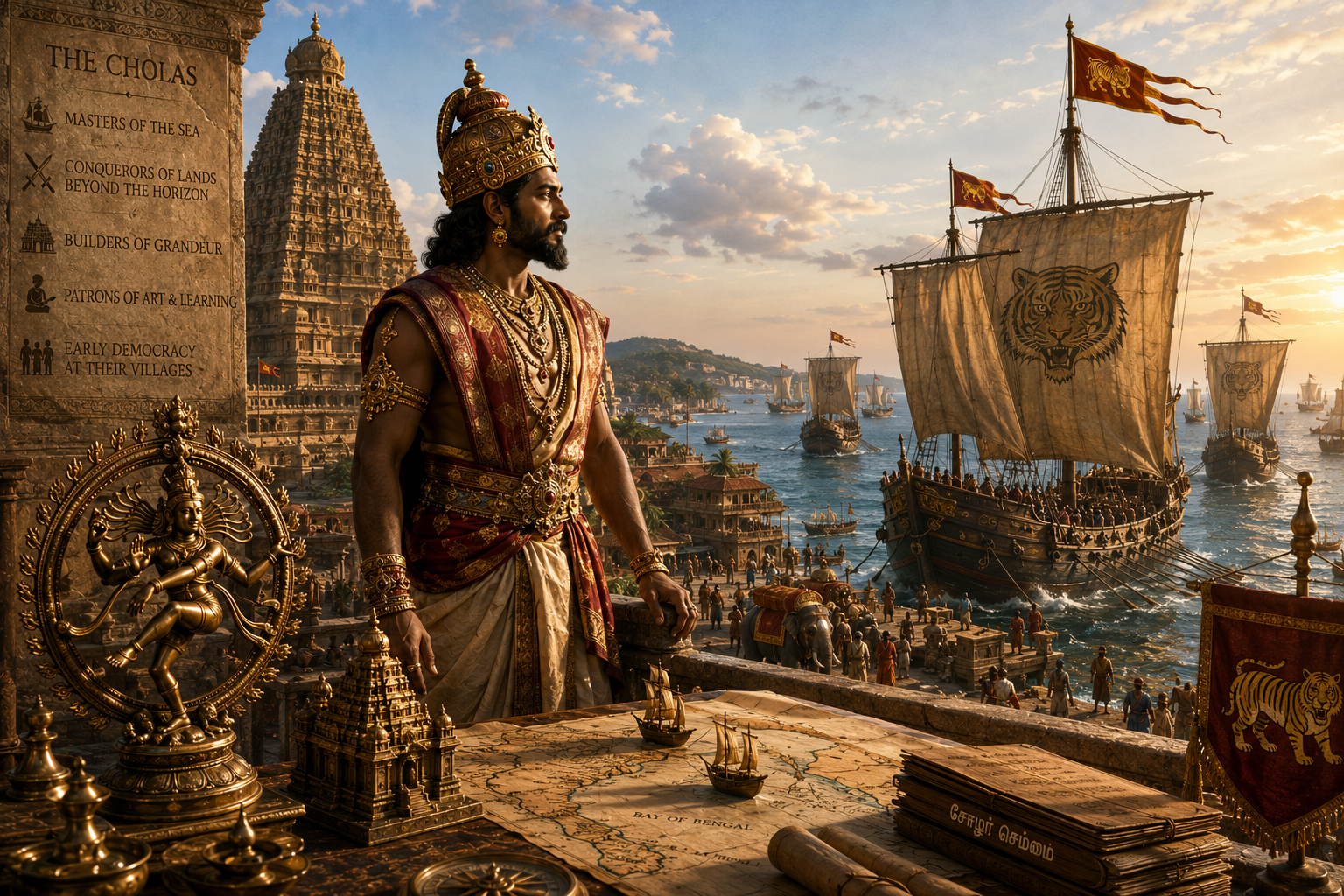
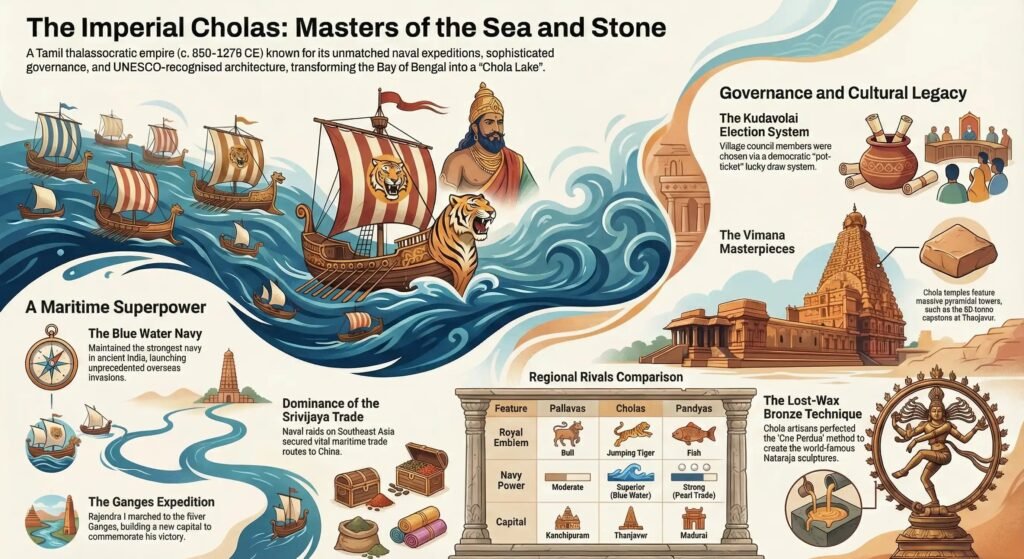
The Cholas of the far south did something almost no other Indian power ever dared to do. They turned the other way, and faced the open ocean. They built a real navy, made the Bay of Bengal into their own private lake, and then did the near-unthinkable: they sent a war-fleet across hundreds of miles of open sea to conquer lands in distant Southeast Asia. For a few remarkable centuries, this Tamil empire was one of the most powerful and far-reaching in all of Asia.
Reign of Raja Raja Chola I: The Golden Age of the Cholas
A very old name, and a golden age
The Cholas were one of the longest-lasting royal names in the whole world. Kings called Chola are mentioned as far back as the age of the emperor Ashoka, more than two thousand years ago.
But their true golden age came much later, roughly between the 9th and the 13th centuries, when a line of brilliant and ambitious kings turned a modest southern kingdom into a mighty empire. Two of these kings stand high above the rest: Rajaraja Chola, and his son Rajendra Chola.
Rajaraja, the builder
Rajaraja the First was the man who truly forged the empire. He was a hard conqueror who smashed rival fleets, took the northern half of Sri Lanka, and seized the Maldive islands far out in the sea.
But he is remembered most for what he raised at his capital, Thanjavur. There, around the year 1010, he completed the Brihadeeswarar Temple, a soaring mountain of granite crowned by a single colossal capstone weighing dozens of tonnes, somehow hauled to the very top in an age with no machines. A thousand years later, it is still standing, and it remains one of the great wonders of India.
Chola Naval Expedition to Southeast Asia: When India Ruled the High Seas
Rajendra, who conquered the Ganga and the sea
His son Rajendra carried the empire to its greatest size of all, and he did two truly astonishing things.
First, he marched an army all the way north to the sacred river Ganga, far beyond his own borders, and carried its holy water home in triumph. He was so proud of this that he took a new title, Gangaikonda Chola, “the Chola who conquered the Ganga,” and built an entire new capital city to celebrate it.
And then, in the year 1025, he did the thing that makes the Cholas stand alone in Indian history.
Rajendra Chola loaded an army onto ships and sent it across the Bay of Bengal to attack the Srivijaya empire in what is now Indonesia and Malaysia. His fleet crossed hundreds of miles of open ocean, fell upon the enemy’s ports, and won.
No other Indian empire, before him or after, ever did anything quite like it. It was the boldest overseas adventure in all of ancient Indian history.
The Bay of Bengal, a Chola lake
Why would a land of temples and green rice-fields go to the trouble of building a navy and sailing off to war? The answer, in one word, is trade.
In those days, a great river of wealth flowed back and forth across the Indian Ocean: spices, silk, and gold moving between China, Southeast Asia, India and the Arab world. Whoever controlled the sea-lanes grew immensely rich, and the Cholas decided that they would be that power. Their warships and their far-travelling Tamil merchant guilds came to dominate the whole eastern sea.
For a time, the Bay of Bengal was so firmly in Chola hands that historians half-jokingly call it a “Chola Lake.”
And it was this flood of trade wealth, carried in on the tide, that paid for everything else the Cholas are loved for.
Reign of Akbar 1556-1605: The Golden Age of the Mughal Empire
Gods cast in bronze
That wealth bought beauty. Chola artists became the finest bronze-workers India has ever produced.
They used an ancient and painstaking method sometimes called “lost-wax” casting. First they sculpted a figure in wax, then covered it in clay, then melted the wax out through a hole and poured molten metal into the empty space left behind. With it, they cast statues of the gods so full of life that they seem about to step down and move. The most famous of them all is the Nataraja, the god Shiva as the Lord of the Dance, caught forever inside a ring of fire in mid-step, dancing the whole universe into being and then out of it again. For many people, it is simply the most beautiful image India has ever made.
Democracy carved in a village wall
The Cholas were as thoughtful at home as they were bold abroad, and the proof is carved into the wall of a temple in a village called Uttiramerur.
There, more than a thousand years ago, someone chiselled out the rules by which the village governed itself, and those rules are astonishing. The village ran its own affairs through elected committees. Anyone standing for a place had to meet real standards of honesty and learning, and there were firm rules to throw out any member who cheated or failed to keep his accounts clean. Most surprising of all was how they were chosen.
The names of the candidates were written on small palm-leaf tickets, dropped into a pot, and drawn out one by one by a young child.
A working village democracy, with ballots and honest-accounting rules, carved in stone a thousand years before most of the world tried anything like it.
Reign of Chandragupta Maurya: The First Empire of India
The empire that looked outward
Every empire comes to an end, and the Cholas slowly faded after the 13th century, worn down at last by rival powers rising around them.
But they left behind something rare in the long story of India. In a history crowded with great land-powers who faced always inward, across the plains and rivers of the subcontinent, the Cholas were the shining exception. They were the Indian empire that turned to face the sea and was not afraid of it. They sailed where others would not go, traded across a whole ocean, and used the wealth of the waves to build towering temples and to cast gods that still stop visitors in their tracks. For a few glorious centuries, a Tamil kingdom looked out at the endless water and decided that it belonged to them.
Sangam Period: The Golden Age of Tamil Literature
If you think you have remembered everything about this topic take this QUIZ
Results


#1. Which specific group did Vijayalaya Chola defeat in 850 CE to capture Thanjavur and establish the Imperial Chola line?
#2. In the Chola administrative hierarchy, which unit represented a ‘Taluk’ and sat between the Valanadu and the Kurram?
#3. What distinguished the Chola ‘Vimana’ from the ‘Gopuram’ seen in later South Indian temple architecture?
#4. The Uttaramerur inscription is historically significant for detailing which aspect of Chola governance?
#5. Which Chola ruler earned the title ‘Madurai-konda’ after capturing the city from the Pandyas?
#6. What was the primary purpose of Rajendra Chola I’s naval expedition against the Srivijaya Empire?
#7. The ‘lost-wax’ technique (Cire Perdue) was most famously used by Chola artisans to create which of the following?
#8. Which animal was depicted on the royal emblem and flag of the Chola Dynasty?
Who founded the Imperial Chola line?
Vijayalaya Chola in 850 CE.
Which Chola king built the Brihadeeswarar Temple?
Raja Raja Chola I.
What was the capital of the Cholas?
The early capital was Thanjavur, later moved to Gangaikonda Cholapuram.
What is the Kudavolai system?
It was a system of selecting village council members by a lucky draw (palm leaves in a pot), detailed in the Uttaramerur Inscription.
Which Chola king conquered the Ganges?
Rajendra Chola I (Gangaikonda).
Sources and references
- Wikipedia (“Chola invasion of Srivijaya” and “South-East Asia campaign of Rajendra I”) — Rajendra Chola I’s 1025 CE naval expedition against Srivijaya in maritime Southeast Asia, described as a unique event in India’s history, and its role in expanding Tamil merchant networks.
- Drishti IAS and Insights on India — Rajendra Chola I (1014–1044) as the first Indian king to lead overseas military expeditions, the “Gangaikonda Chola” title after reaching the Ganga, the new capital at Gangaikonda Cholapuram, and one of India’s earliest blue-water navies.
- Anantam IAS and civilsonly (on Rajaraja and the empire) — Rajaraja Chola I (985–1014) as the architect of the empire, the Brihadeeswarar Temple at Thanjavur with its enormous granite capstone, the Chola bronze tradition, and the Bay of Bengal as a “Chola Lake” controlling maritime trade.
- UNESCO World Heritage listing (Great Living Chola Temples) — the Brihadeeswarar Temple (inscribed 1987) with Gangaikonda Cholapuram and Airavatesvara at Darasuram (added 2004).
- Ekam IAS and general histories — the Uttiramerur inscriptions describing elected village committees and the kudavolai palm-leaf ballot system, and the iconic Nataraja bronze representing the cosmic dance of creation and destruction.
Author


Exploring the Soul of Bharat through History, Science, Culture, and its Diversity
Our Mission
Curious Indian is a definitive knowledge portal dedicated to chronicling the events, personalities, and cultural shifts that defined the Indian subcontinent. From the ancient Vedic Period to the complexities of 21st-century politics, our goal is to provide deep-dive analysis that inspires.
Editorial Standards & E-E-A-T
Every article published under our brand undergoes a rigorous fact-checking process. We prioritize primary historical records, academic citations, and credible archives to ensure our readers receive accurate, high-authority information.
Historical Integrity Directly sourcing from ASI archives and academic journals.Topical Authority Comprehensive clustering of Indian Science, Biographies, and Wars.Managed by Paripurna Datta and TEAM | Dedicated to the Knowledge of India.