Between 1915 and 1948, industrialist Ghanshyam Das Birla and Mahatma Gandhi exchanged over 1,800 letters covering money, politics, social reform, business ethics and the personal dimensions of one of the most consequential friendships in modern Indian history. The correspondence reveals how the Indian independence movement was financed, how Gandhi navigated his relationship with Indian capital without compromising his moral authority and how Birla used his proximity to Gandhi to shape the direction of both the movement and his own business empire.| Detail | Information |
| Subject | Correspondence between G.D. Birla and Mahatma Gandhi |
| Period | 1915 to 1948 |
| Nature | Personal, political and financial letters |
| Volume | Over 1,800 letters exchanged |
| Primary Themes | Independence movement, business ethics, social reform |
| G.D. Birla Full Name | Ghanshyam Das Birla |
| Gandhi’s Assassination | 30 January 1948, Birla House, New Delhi |
| Significance | Reveals the intersection of Indian capital and nationalist politics |
Thirty-Three Years of Honest Disagreement
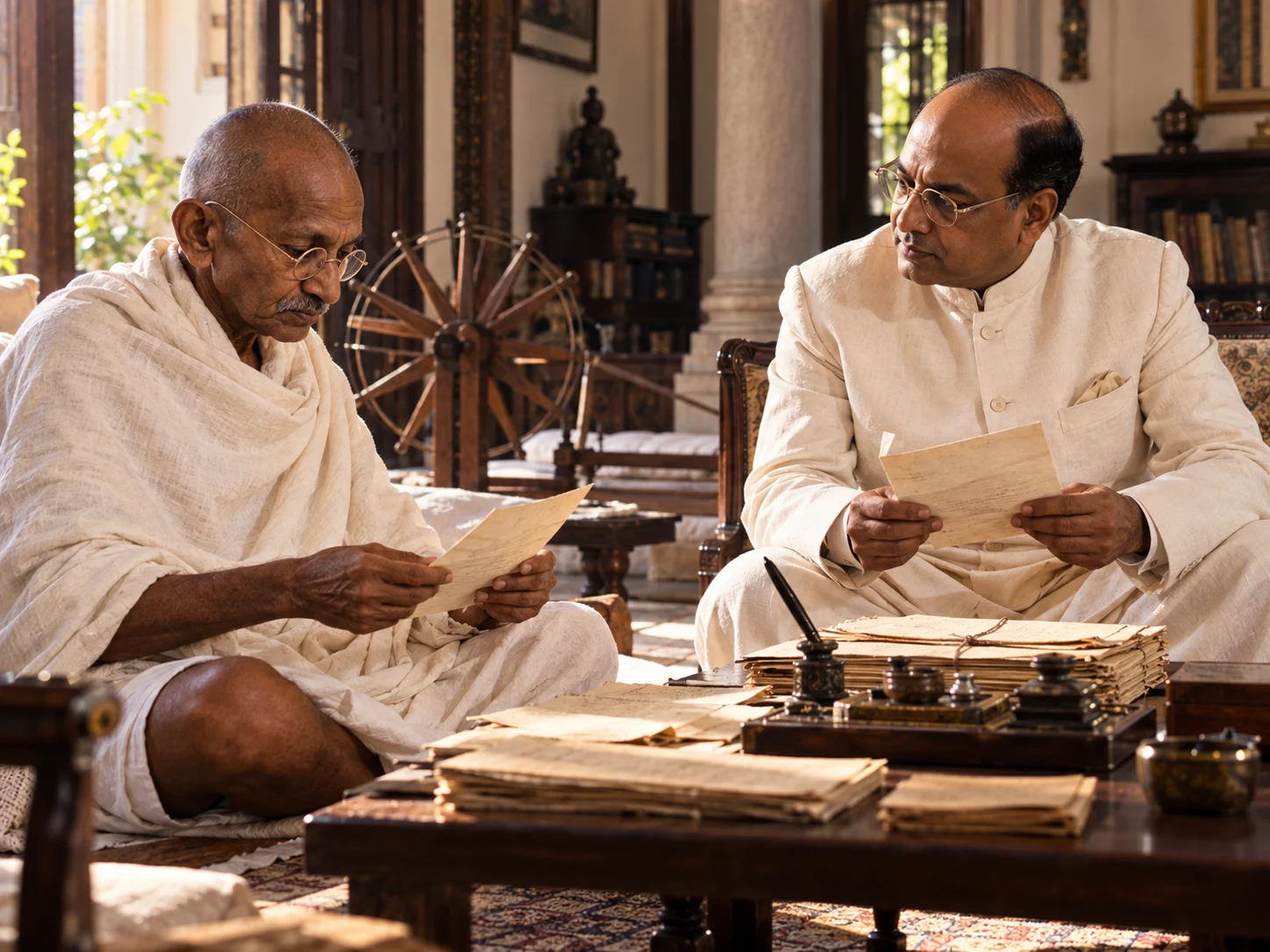
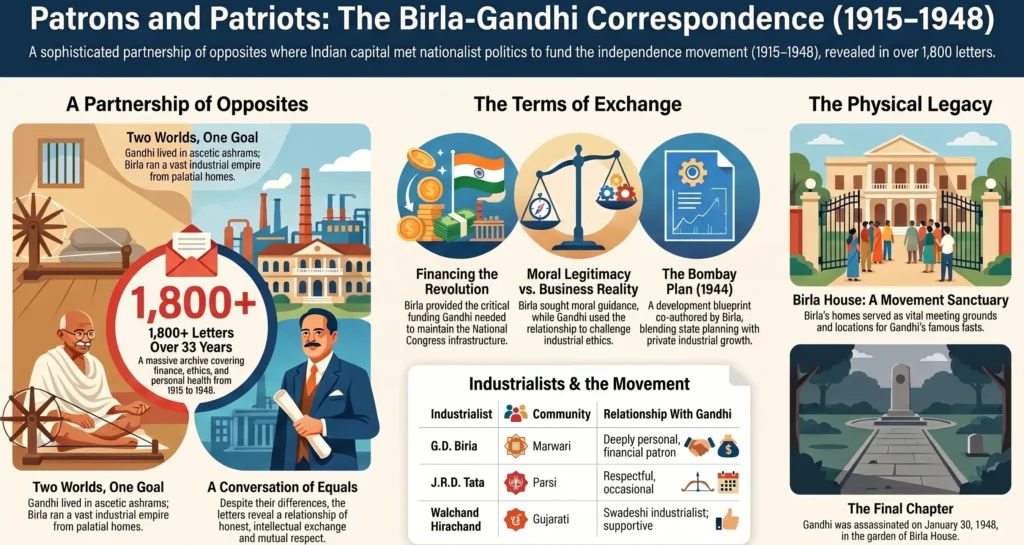
Between 1915 and 1948, industrialist Ghanshyam Das Birla and Mahatma Gandhi exchanged over 1,800 letters covering money, politics, social reform, business ethics and the personal dimensions of one of the most consequential friendships in modern Indian history. The correspondence reveals how the Indian independence movement was financed, how Gandhi navigated his relationship with Indian capital without compromising his moral authority and how two men with fundamentally different lives maintained a sustained conversation despite profound disagreements about economics, industry and the future of India.
The Two Men and the Distance Between Them
Ghanshyam Das Birla was born in 1894 into a Marwari trading family in Pilani, Rajasthan. The Birlas were already prosperous merchants when he was born, and he demonstrated early the combination of commercial instinct and intelligence that would eventually make him one of the most powerful industrialists in Indian history. By the time he met Gandhi in 1915, he was already running a significant jute trading business and beginning the expansion into manufacturing that would produce the Birla industrial empire.
Gandhi was twenty-five years older than Birla, a lawyer turned political activist who had spent two decades in South Africa developing the philosophy and techniques of nonviolent resistance. He had returned to India in 1915 with a moral authority that would grow over the following three decades into something unprecedented in Indian political history.
The distance between them was not simply age. Gandhi lived in ashrams, wore a loincloth, spun his own cotton and subjected himself to fasts that brought him close to death. Birla lived in palatial homes, wore fine clothes and ran businesses that employed thousands of workers. They inhabited different worlds almost entirely.
Yet the letters between them read as a conversation between equals—or at least between two people who respected each other’s intelligence and judgment sufficiently to engage honestly rather than performing for each other.
What Gandhi Wanted From Birla
Gandhi needed money. This is the starting point for understanding the relationship, and it is a starting point that hagiographic accounts of the independence movement have sometimes been reluctant to acknowledge. The Indian National Congress required funding to maintain its organizational infrastructure, to support full-time workers and their families, to publish newspapers and pamphlets, to organize meetings and marches across a subcontinent-sized country.
Gandhi understood, with the clear-eyed pragmatism that coexisted in him with genuine idealism, that the Indian business community was the most reliable source of that funding. He cultivated relationships with Indian industrialists deliberately and maintained those relationships through personal correspondence, visits and a moral framework that gave wealthy Indians a way to understand their financial support for the independence movement as an ethical obligation rather than simply a political investment.
Birla was the most important of these relationships. He was wealthy enough to make contributions that made a real difference to the Congress’s finances. He was politically engaged enough to care about the movement’s success. And he was personally close enough to Gandhi to understand what the movement actually needed at any given moment rather than simply writing cheques in response to general appeals.
The letters document this financial relationship with unusual candor. Gandhi writes to Birla asking for specific amounts for specific purposes. Birla responds with commitments, sometimes enthusiastic and sometimes negotiated. The correspondence makes clear that Birla was not simply a passive donor but an active participant in decisions about how the Congress’s finances were organized and deployed.
What Birla Wanted From Gandhi
The question of what Birla wanted from Gandhi is more complex. The simplest answer is moral legitimacy. Birla was a wealthy industrialist operating in a colonial economy that Gandhi frequently criticized. The Marwari business community had a complicated reputation in nationalist circles. Birla’s close relationship with Gandhi provided a form of moral cover that was valuable both personally and commercially.
But the letters suggest something more than instrumental calculation. Birla appears to have been genuinely influenced by Gandhi’s moral framework, genuinely troubled by questions about the ethics of industrial production and labor relations, and genuinely interested in Gandhi’s views on economic questions even when those views were uncomfortable for someone in Birla’s position.
Gandhi, for his part, did not simply tell Birla what he wanted to hear. The letters contain passages in which Gandhi criticizes Indian industrialists directly, including Birla’s own practices, in terms that a purely transactional relationship would not have survived. The fact that the correspondence continued and deepened despite these criticisms suggests that both men valued the relationship for reasons that went beyond its immediate practical benefits.
The researchers at the Nehru Memorial Museum and Library in New Delhi, which holds significant archival materials related to the Gandhi-Birla correspondence, have noted that the letters reveal a relationship of genuine intellectual exchange rather than simple patronage. Gandhi consistently challenged Birla to think more carefully about the social responsibilities of industrial wealth. Birla consistently pushed back with the perspective of someone who understood the practical realities of running large enterprises.
Savitribai Phule: School That Changed India’s History
The Bombay Plan and Economic Vision
In 1944, a group of leading Indian industrialists including G.D. Birla produced what became known as the Bombay Plan, a detailed proposal for the economic development of an independent India. The plan called for significant state intervention in the economy, large-scale industrialization and a planned approach to economic development that drew from both capitalist and socialist frameworks.
The Bombay Plan is sometimes presented as evidence that Indian industrialists were willing to accept state direction of the economy because they calculated that this would protect them from more radical redistribution. This reading contains some truth. But the letters between Birla and Gandhi provide context that complicates it.
The correspondence shows that Birla had been thinking seriously about the economic structure of an independent India for years before the Bombay Plan was produced, and that Gandhi’s influence on his thinking was real even where the two men disagreed. Gandhi was deeply skeptical of large-scale industrialization. Birla was committed to it. The tension between these positions runs through years of correspondence without ever being fully resolved, and that unresolved tension is part of what makes the letters intellectually interesting.
Mysterious Bird Deaths In Jatinga Valley That Science Cannot Fully Explain
Gandhi at Birla House
The physical locations of the Birla family homes became part of the geography of the independence movement in a way that is easy to overlook. Gandhi stayed at Birla House in Delhi repeatedly. He stayed at Birla properties in other cities. These were not simply convenient accommodations. They were statements about the relationship between the two men and about the Birla family’s commitment to the movement.
When Gandhi conducted his famous fasts, he often did so at Birla properties. When he needed a location for important meetings, Birla homes were available. The material infrastructure of the Birla family’s wealth was placed, at least partially, in the service of the independence movement through this relationship.
The last of these stays ended on 30 January 1948. Gandhi had been staying at Birla House when he was assassinated in the garden. G.D. Birla was among the people who had been with him in the days immediately preceding his death. The place that had been associated with the warmth and productivity of their correspondence became, in an instant, the site of its permanent ending.
Birla’s grief at Gandhi’s death was, by all accounts, genuine and profound. He had lost not only a political ally and a moral authority but a friend with whom he had maintained one of the most sustained and serious correspondences of his life. Birla House in Delhi is now preserved as Gandhi Smriti, a national memorial to Mahatma Gandhi.
Bhangarh Fort: Legends Behind India’s Most Haunted Ruins
Quick Comparison Table
| Feature | G.D. Birla | J.R.D. Tata | Walchand Hirachand | Lala Shri Ram |
| Community | Marwari | Parsi | Gujarati | Punjabi |
| Primary Industry | Textiles, cement, automobiles | Steel, aviation, chemicals | Shipping, aviation, construction | Textiles, sugar |
| Nationalist Position | Active Congress supporter, Gandhi financier | Moderate, institutional patriot | Swadeshi industrialist | Congress sympathizer |
| Relationship With Gandhi | Deeply personal, financial patron | Respectful, occasional | Supportive | Supportive |
| Post Independence Role | Built industrial empire, philanthropy | Built Tata empire, Air India | Sidelined by nationalization | Built DCM group |
Curious Indian: Fast Facts
- G.D. Birla and Gandhi exchanged over 1,800 letters between 1915 and 1948, one of the largest personal correspondences in modern Indian history.
- Gandhi was assassinated on 30 January 1948 in the garden of Birla House in New Delhi, where he had been staying as G.D. Birla’s guest.
- The Bombay Plan of 1944, co-authored by G.D. Birla, proposed a framework for the economic development of an independent India that drew from both capitalist and socialist principles.
- Birla’s financial contributions to the Indian National Congress were among the most significant from any single donor during the independence period.
- Gandhi criticized Indian industrialists including Birla directly in their correspondence, and the relationship survived these criticisms across decades.
- G.D. Birla was born in 1894 in Pilani, Rajasthan, into a Marwari trading family that was already prosperous before his expansion into manufacturing.
- The letters cover topics ranging from specific funding requests for the Congress to debates about the ethics of industrial production and the future of the Indian economy.
- Birla House in Delhi, where Gandhi was assassinated, is now preserved as Gandhi Smriti, a national memorial to Mahatma Gandhi.
The Legacy of the Correspondence
The full corpus of the Gandhi-Birla correspondence has been partially published and is available to researchers through various archives. The letters have been studied by historians of Indian nationalism, by economic historians interested in the relationship between Indian capital and the independence movement and by scholars interested in Gandhi’s views on economic questions.
What the letters reveal, taken together, is that the Indian independence movement was more complex in its internal dynamics than the standard nationalist narrative acknowledges. It was not simply a moral uprising of the Indian people against colonial rule. It was also a political and financial project that required sustained organization, funding and the navigation of difficult relationships between people with genuinely different interests and values.
Gandhi navigated these relationships with a skill that his public image as a saint sometimes obscures. He needed Birla’s money and he was willing to ask for it directly. He also maintained a moral authority that made his relationship with wealthy industrialists uncomfortable enough for both parties to be intellectually productive. That combination, of pragmatism and principle, is what the letters document most completely.
The 1,800 letters exchanged across thirty-three years are the record of what an uncommon conversation produced. The independence of India is, among other things, part of what it produced. That is not a small thing to have written, one letter at a time, across three decades of a century that changed everything.
The Magnetic Hill of Ladakh That Defies the Laws of Gravity
If you think you have remembered everything about this topic take this QUIZ
What status did the letters establish between G.D. Birla and Gandhi?
The letters established a deep personal relationship that served as a major bridge between the Indian capitalist class and the leadership of the nationalist movement. They showed an uncommon level of candor where financial backing for social and political initiatives was arranged directly alongside intense intellectual arguments over industrial ethics.
How did Gandhi maintain moral authority while accepting financial patronage from Birla?
Gandhi maintained his moral authority by refusing to compromise his core beliefs and actively criticizing corporate practices, including those of Birla, in his letters. The funds were accepted as a form of social obligation and ethical trusteeship for the nation rather than a transaction for legislative favors.
What was the significance of the Bombay Plan mentioned in the text?
The Bombay Plan of 1944 was a major development blueprint designed by prominent industrialists, including G.D. Birla, to guide the economic structure of independent India. It integrated elements of state planning with private industrial growth, highlighting how business leaders sought to engage with the economic logic of the post-independence state.
Why did Birla House become a historically vital location in this relationship?
Birla House in New Delhi became a core sanctuary for Gandhi during prolonged political negotiations and crucial fasts, illustrating how the financial assets of the industrialist directly provided the infrastructural background for nationalist operations, which ultimately concluded with Gandhi’s assassination on the grounds.
Where is the archival legacy of this correspondence preserved today?
Large collections of the historical correspondence are meticulously cataloged and preserved across national repositories such as the Nehru Memorial Museum and Library in New Delhi and the Sabarmati Ashram in Ahmedabad, offering primary research material for economic and political historians.