The story says Ashoka, sickened by the slaughter at Kalinga, founded a secret society of nine scholars to guard nine dangerous books. Follow the trail back and you do not reach the third century BCE. You reach a pulp magazine
The legend is a very good one, which is why it has lasted.
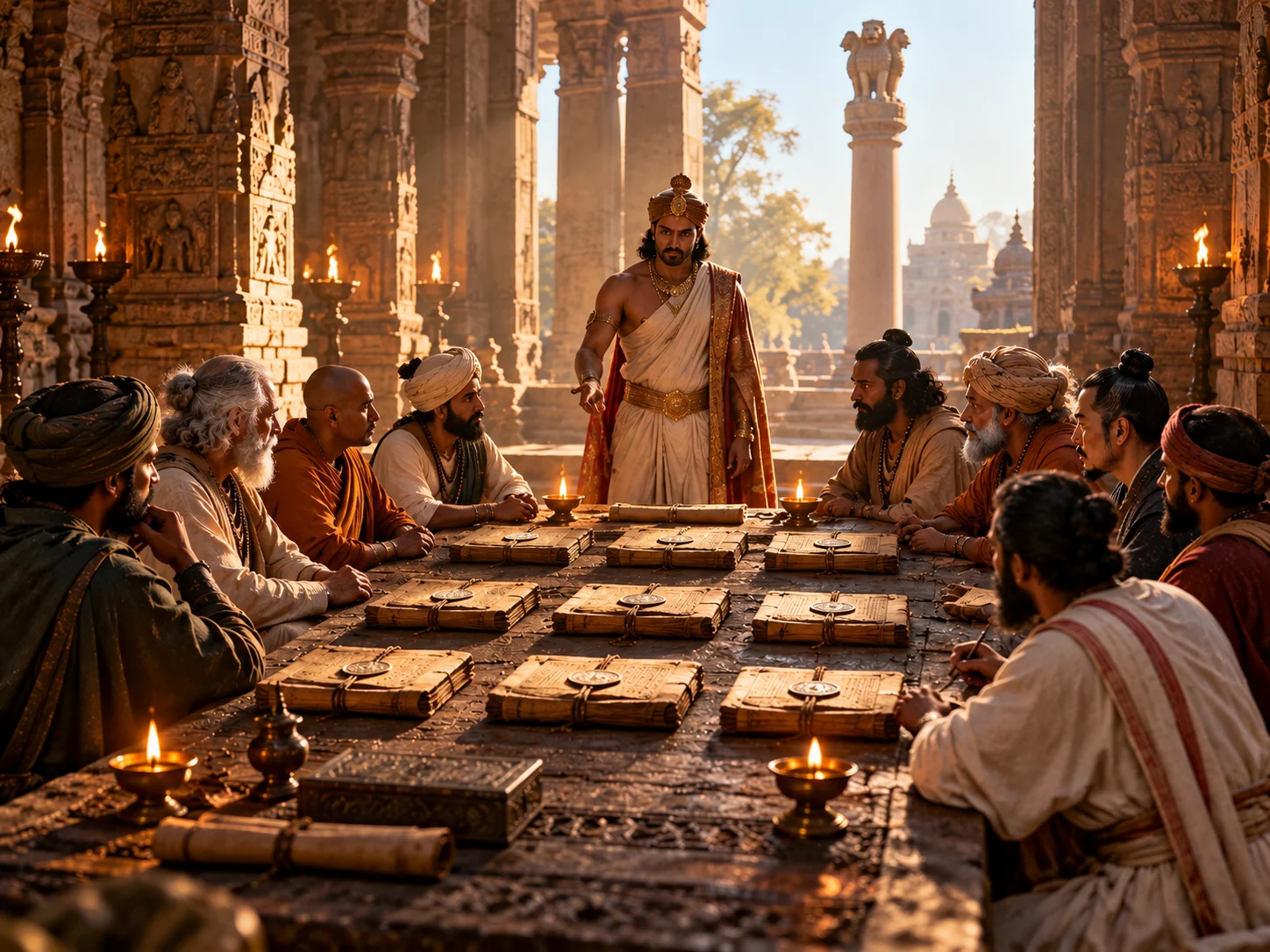
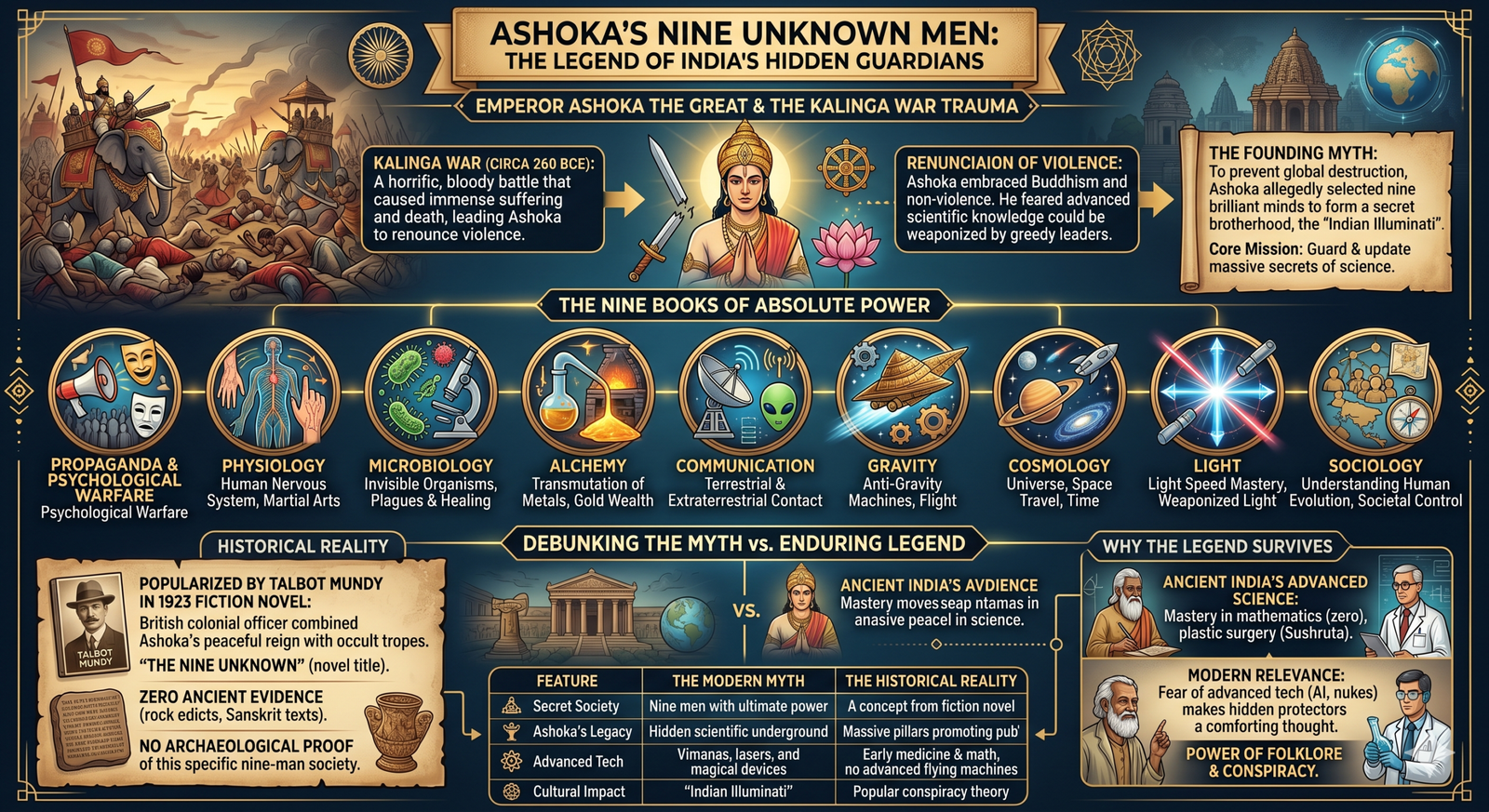
After the war in Kalinga, sickened by what he had done, the Emperor Ashoka is said to have founded a secret society of nine men. Each was given one book, holding knowledge so powerful that it could destroy the world if it fell into the wrong hands. As each of the nine grew old, he chose and trained a successor. The society has continued in secret ever since, for more than two thousand years.
The books are usually listed: propaganda and psychological warfare, physiology including a touch that can kill, microbiology, alchemy, communication, gravity, cosmogony, light, and sociology.
Nine men, nine books, and knowledge too dangerous for the world to have.
Where the list comes from
That list is the first thread to pull, because it did not come from any Indian source.
It appears in The Morning of the Magicians, a book published in France in 1960 by Louis Pauwels and Jacques Bergier: a hugely popular mixture of science, mysticism and speculation. They presented the Nine as real, founded by Ashoka around 270 BCE.
They also wrote in a way that suggested the list of the nine books came from an English novelist, Talbot Mundy.
Readers who have gone back to Mundy’s book report that the list is not in it.
The Mathematical Genius of Aryabhatta
Milestones of Balraj Sahni’s Acting Career
1923
Mundy’s The Nine Unknown was published in 1923. Before that it ran as a serial in Adventure, an American pulp fiction magazine.
It is an adventure story. A group of American, British and Indian characters set out to find the identities of the mysterious Nine. The Nine are the good guys, guardians of ancient wisdom, and they are set against nine worshippers of Kali who pretend to be them. There is a priest, Father Cyprian, who has the books and wants to burn them out of piety.
Mundy was a professional storyteller writing for a magazine that paid by the word. He was not claiming to publish a discovery.
The Frenchman before him
Pauwels and Bergier had one more authority to offer. They said that Louis Jacolliot, a nineteenth-century French colonial official who wrote popular books about mystical India, had insisted the Nine existed.
Jacolliot did write a great deal about secret wisdom in India, and he was widely read. But Pauwels and Bergier did not say which of his books the claim came from, and people who have gone looking have not found the passage.
So the trail runs like this. A French bestseller of 1960 cites a French writer of the 1870s who cannot be located, and a novel of 1923 that does not contain what it is said to contain. Behind that, nothing.
A bestseller of 1960, a source nobody can find, and a novel that does not say what it is said to say.
How Bhāskara I Decoded the Secrets of 7th-Century Science
What Ashoka actually left
The strange thing is that the real Ashoka needs no secret society to be remarkable.
He left his own words, carved on rocks and pillars across the subcontinent, from Afghanistan to Karnataka. They were unreadable for centuries until the script was deciphered in the nineteenth century. In them, an emperor speaks directly to his people about medical care for humans and animals, wells and shade trees along the roads, respect between religious communities, and officers appointed to check on the welfare of his subjects.
In one of them, he says plainly what the Kalinga war cost, and that the remorse he feels for it weighs on him.
Nowhere in that enormous body of evidence, or in the Buddhist chronicles that preserved his memory, is there a society of nine, or nine books, or a secret line of successors.
Why it stuck
It is worth asking why the legend fits so comfortably anyway.
Partly because Ashoka’s real story supplies the perfect motive. A ruler who is genuinely horrified by his own war, and who then spends his life trying to do good with his power, is exactly the kind of man you would want guarding something dangerous.
And partly because of when the legend was popularised. Pauwels and Bergier were writing in 1960, fifteen years after Hiroshima, in a world newly terrified of knowledge it could not control. A story about wise men keeping the most dangerous sciences locked away was a story that generation badly wanted to be true.
Vedic Genius of Baudhayana Mathematics and Geometry
Known men
So the real story of the Nine Unknown Men turns out to be about men who are not unknown at all.
A colonial writer who sold romantic visions of India to Europe. A pulp novelist in 1923 with a serial to deliver. Two Frenchmen in 1960 who took a novel, and a citation nobody can check, and printed it as history.
Ashoka, meanwhile, is still there on the rocks, saying what he actually wanted the world to know, in plain words, to anyone who can read them.
Scientific Foundations of the Kanada Atomic Theory
If you think you have remembered everything about this topic take this QUIZ
Results


#1. Which significant historical event led Emperor Ashoka to renounce violence and embrace Buddhism?
#2. According to the legend, why did Ashoka create the secret society of the Nine Unknown Men?
#3. Who is credited with popularizing the legend of the Nine Unknown Men in the 1923 novel “The Nine Unknown”?
#4. Which specific book among the nine was considered the most dangerous because it dealt with manipulating massive crowds?
#5. The book on “Physiology” is rumored to be the source of which leaked martial art?
#6. According to the “Gravity” book mentioned in the text, what ancient anti-gravity flying machines could be built?
#7. What is the historical reality regarding archaeological evidence or ancient Sanskrit texts mentioning the Nine Unknown Men?
#8. Which 10th-century figure was rumored to have traveled to India to meet the secret society and learn mathematics?
Did Emperor Ashoka actually create the Nine Unknown Men?
There is absolutely no historical or archaeological evidence to prove this. Historians consider it a modern myth, though Ashoka’s true history as a peaceful king is entirely real.
Who made the legend of the Nine Unknown famous?
The legend was primarily invented and heavily popularized by Talbot Mundy, a British author who wrote a science fiction/adventure novel about them in 1923.
What is supposed to be in the nine books?
The myth claims the books contain the ultimate secrets of propaganda, physiology, microbiology, alchemy, communication, gravity (anti-gravity machines), cosmology, light, and sociology.
Why do people believe the legend is real?
Because ancient India had genuinely brilliant scientific minds that were far ahead of their time, making the idea of hidden, highly advanced technology seem very plausible to modern conspiracy theorists.
Are the Nine Unknown Men considered the Indian Illuminati?
Yes, in modern pop culture and internet lore, they are frequently compared to the Illuminati because they supposedly control global events secretly from the shadows.
Sources & References
Wikipedia, “The Nine Unknown” — Mundy’s 1923 novel, its serialisation in Adventure magazine, its plot, and the claims made by Pauwels and Bergier in The Morning of the Magicians (1960).
Occult World, “Nine Unknown Men” — Louis Jacolliot’s dates and career, and how his claims were taken up by Mundy and later writers.
Nocturnal Revelries, “The unknown origins of the Nine Unknown Men” (17 October 2017) — the finding that the list of the nine books does not appear in Mundy’s novel and that the passage attributed to Jacolliot cannot be located.
E. Hultzsch, Corpus Inscriptionum Indicarum, Vol. I: Inscriptions of Asoka (Archaeological Survey of India, 1925) — the standard edition and translation used to distinguish what Ashoka’s inscriptions actually record from later legend.