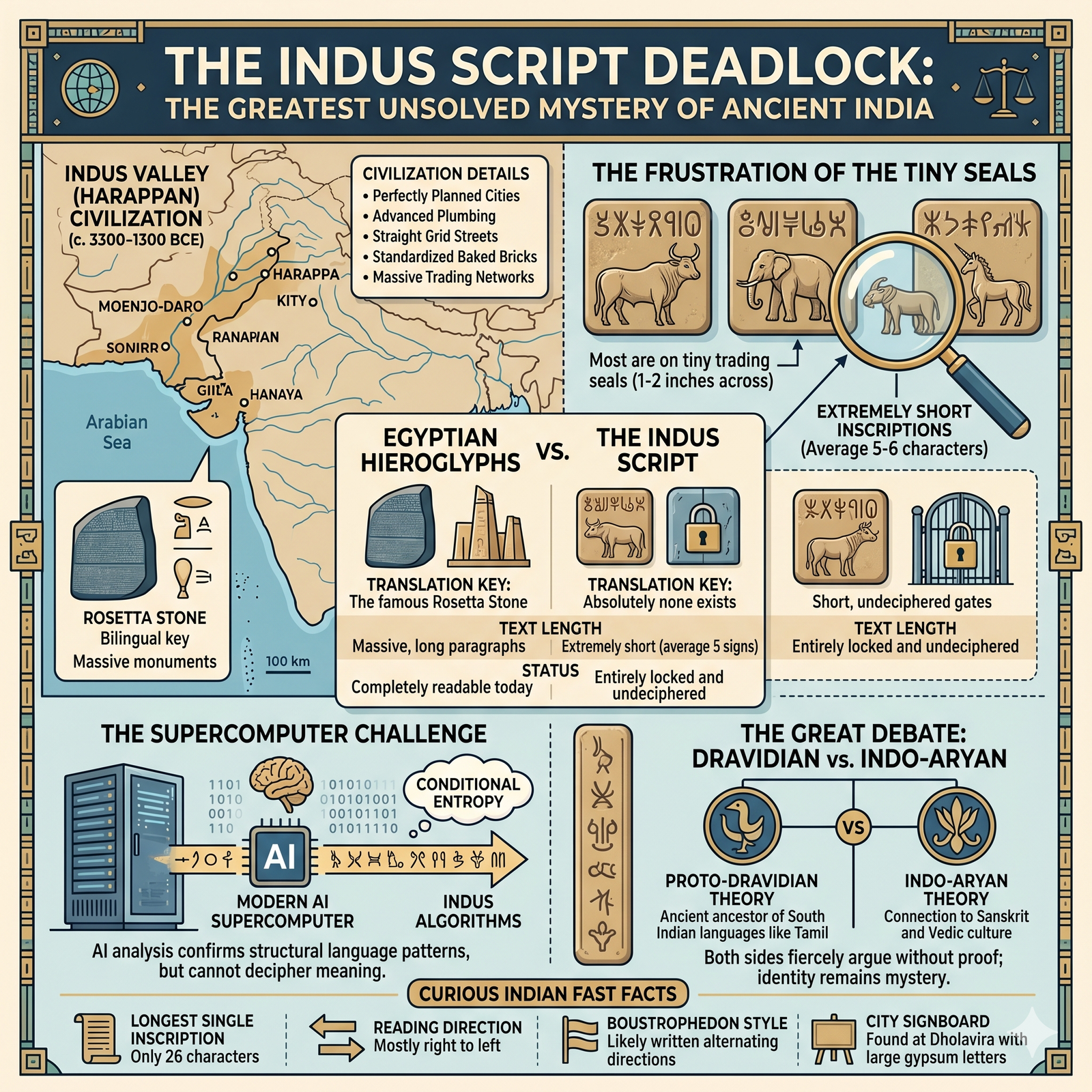
Thousands of years ago, the Indus Valley Civilization built massive, perfectly planned cities with advanced plumbing, straight grid streets, and massive trading networks. Yet, despite being one of the most brilliant ancient societies on earth, their voice remains completely silent today. This massive historical puzzle is known as the Indus script deadlock. Archaeologists have discovered thousands of tiny stone seals covered in beautiful animal carvings and strange, unknown symbols. However, because we have absolutely no bilingual translation key like the famous Rosetta Stone, modern linguists, historians, and even the world's most powerful AI supercomputers have completely failed to crack the ancient code. It remains the greatest unsolved linguistic mystery of the ancient world.| Feature | Details |
| Civilization | Indus Valley (Harappan) Civilization |
| Time Period | Circa 3300 to 1300 BCE |
| Total Base Symbols | Approximately 400 distinct signs |
| Writing Direction | Mostly right to left |
| Current Status | Completely undeciphered |
When you walk through the ancient ruins of Mohenjo-Daro or Harappa, you are instantly struck by absolute genius. Over four thousand years ago, the people living in the northwestern plains of the Indian subcontinent were master engineers. They built massive public baths, sophisticated underground drainage systems, and standardized baked bricks. They traded heavily with distant lands like Mesopotamia. But unlike the ancient Egyptians or the Mesopotamians, who left behind massive walls of translated history, the people of the Indus Valley left us with a completely locked door.
We know exactly how they built their homes and what they ate, but we have absolutely no idea what they called their gods, their kings, or even their own cities. The massive failure to read their writing is not due to a lack of trying. The Indus script deadlock has frustrated the most brilliant minds on the planet for over a century, turning these tiny stone seals into the ultimate historical puzzle.
Fatehpur Sikri(1571): The Ghost City of the Mughal Empire
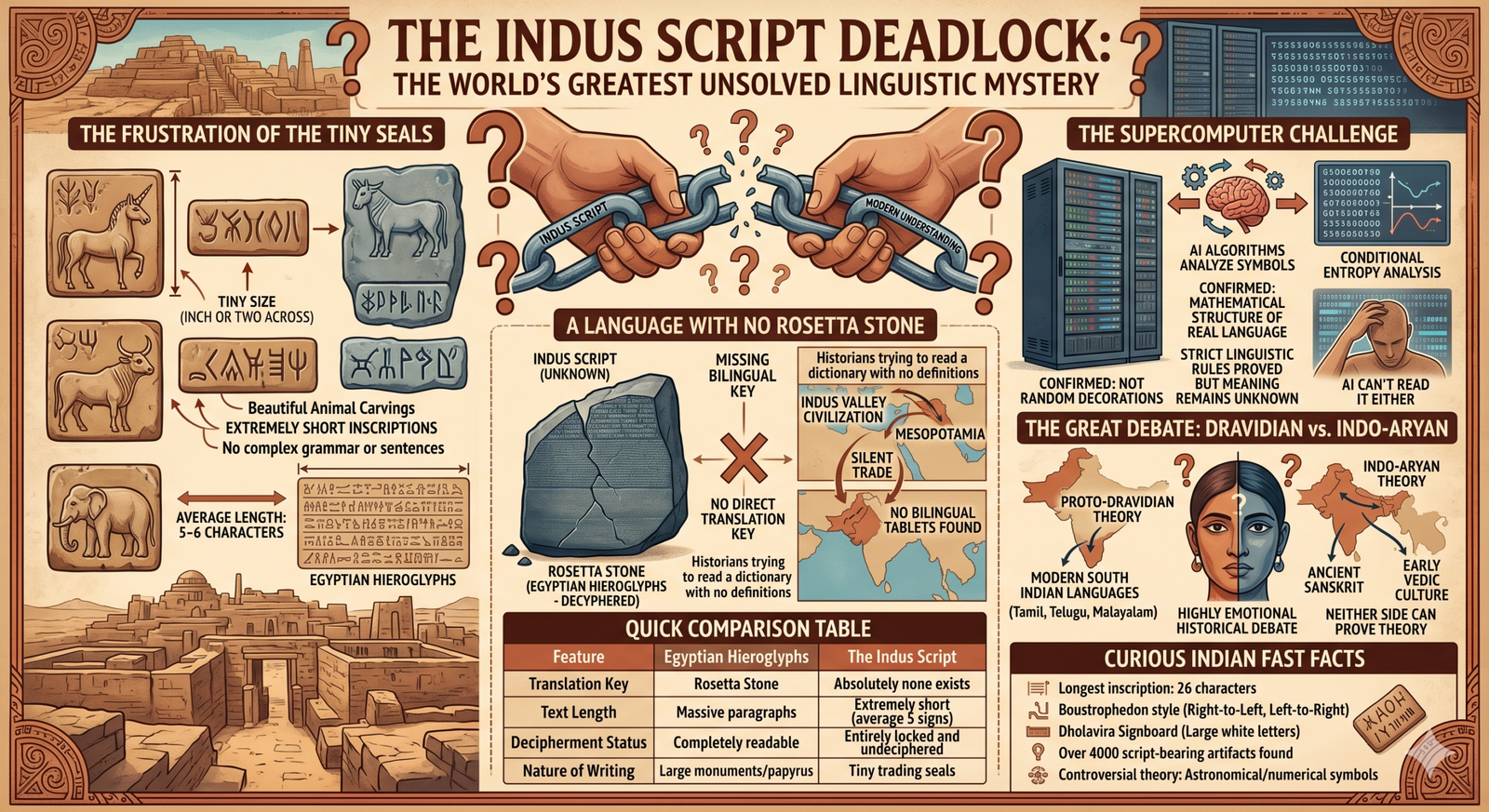
The Frustration of the Tiny Seals
The primary reason this script is so incredibly difficult to crack is the physical nature of the writing itself. The Harappans did not write massive, long books on papyrus, nor did they carve huge historical poems into the sides of mountains. Instead, the vast majority of their writing has been found on tiny, square steatite seals, usually measuring just an inch or two across.
These beautiful little seals almost always feature a beautifully carved animal—like a powerful bull, an elephant, or a mysterious one-horned unicorn—accompanied by a very short string of symbols at the top. The average length of an Indus inscription is incredibly short, usually just five or six characters. Because the texts are so incredibly brief, it is almost impossible for linguists to find repeating grammatical patterns or complex sentence structures.
A Language With No Rosetta Stone
When historians finally cracked ancient Egyptian hieroglyphs, they had a massive cheat sheet called the Rosetta Stone. It was a single massive rock that featured the exact same message written in unknown Egyptian hieroglyphs and perfectly readable ancient Greek. By matching the known Greek words to the unknown Egyptian symbols, they unlocked the entire language.
The biggest tragedy of the Indus script deadlock is that we have never found an Indian Rosetta Stone. Even though the Harappans traded heavily with Mesopotamia, archaeologists have never discovered a bilingual clay tablet that translates an Indus phrase into a known ancient language like Sumerian. Without a direct translation key, scholars are essentially trying to read a dictionary with no definitions.
Madhubani Painting: The Ancient Wall Art of Mithila
The Supercomputer Challenge
In recent years, the massive frustration of human linguists led to the introduction of advanced technology. Researchers brought in highly powerful AI algorithms and modern supercomputers to analyze the script. They fed thousands of distinct Indus symbols into complex computer models to see if machines could see a pattern that human eyes had missed.
The computers performed massive mathematical calculations using a concept called “conditional entropy.” The results were incredibly fascinating. The supercomputers absolutely confirmed that the symbols are not just random, meaningless decorations or simple family logos. The mathematical structure of the symbol placement perfectly matches the structure of a real, spoken language. The computers proved that the script follows strict linguistic rules, but ironically, even the most advanced AI on earth cannot tell us what those specific words actually mean.
Establishment of the Delhi Sultanate: From Slave Kings to the Lodis
The Great Dravidian vs. Indo-Aryan Debate
Because we cannot read the script, a massive and highly emotional debate has erupted among modern historians about who the Harappan people actually were. There are two primary camps in this massive linguistic war.
One group of leading scholars firmly believes that the script is a proto-Dravidian language, meaning it is the ancient ancestor of modern South Indian languages like Tamil, Telugu, and Malayalam. They argue that as the civilization declined, the people migrated southward, taking their language roots with them.
The other prominent group fiercely argues that the script is closely related to early Indo-Aryan languages, suggesting a deep, direct connection to the ancient Sanskrit language and the early Vedic culture. Because the script remains totally locked, neither side can absolutely prove their theory, leaving the true identity of these brilliant ancient builders completely shrouded in mystery.
Holi: Welcoming Spring with the Ultimate Festival of Colours
Quick Comparison Table
| Feature | Egyptian Hieroglyphs | The Indus Script |
| Translation Key | The famous Rosetta Stone | Absolutely none exists |
| Text Length | Massive, long paragraphs | Extremely short (average 5 signs) |
| Decipherment Status | Completely readable today | Entirely locked and undeciphered |
| Nature of Writing | Found on large monuments and papyrus | Found mainly on tiny trading seals |
Curious Indian Fast Facts
- The longest single Indus script inscription ever discovered contains only a mere 26 characters.
- Evidence heavily suggests the script was written in a “boustrophedon” style, meaning it was read right-to-left on the first line, and then left-to-right on the next line.
- In the ancient city of Dholavira in Gujarat, archaeologists found a massive “signboard” with large white gypsum letters that likely hung over the city’s main gate.
- Over four thousand individual artifacts bearing the script have been dug up across Pakistan, India, and even as far away as Iraq.
- Some modern scholars controversially suggest the script might not be a spoken language at all, but rather a complex system of astronomical or numerical symbols.
Conclusion
The Indus script deadlock is a beautiful and deeply humbling reminder of the limits of modern science. We live in an era where we can instantly translate dozens of foreign languages using the smartphones in our pockets, yet we are completely paralyzed by a handful of symbols carved into ancient river stones four thousand years ago.
Decline of Indus Valley Civilization: How a Great Urban Order Faded
The Harappan civilization left behind an incredible legacy of peaceful trade, brilliant urban planning, and stunning artwork. Their inability to speak directly to us across the centuries only makes their story that much more incredibly fascinating. Until a lucky archaeologist’s shovel finally strikes a bilingual translation stone hidden in the dusty earth, the brilliant people of the Indus Valley will keep their deepest secrets completely to themselves, forcing us to constantly wonder about the true voices of India’s earliest masters.
If you think you have remembered everything about this topic take this QUIZ
Results


#1. What is the primary reason why the Indus script remains undeciphered?
#2. What is the average length of an Indus inscription found on the stone seals?
#3. What did AI supercomputers conclude after analyzing the mathematical structure of the Indus symbols?
#4. . Which two language families are at the center of the debate regarding the identity of the Harappan people?
#5. In which ancient city was a massive “signboard” with large white gypsum letters discovered?
#6. According to the text, what is the “boustrophedon” style of writing?
#7. Most Indus script inscriptions have been found on which type of material?
#8. What is the total number of distinct base symbols identified in the Indus script?
What exactly is the Indus script deadlock?
It is the massive, ongoing historical failure of modern scholars, linguists, and supercomputers to decipher the written language of the ancient Indus Valley Civilization.
Why is it so hard to translate this ancient script?
It is incredibly difficult because the inscriptions are extremely short, there are no known modern descendant languages confirmed, and we have never found a bilingual translation key like a Rosetta Stone.
Did the Harappans write on paper or walls?
No paper has survived. The vast majority of their writing has been found deeply carved into tiny, square steatite stone seals used for trading, as well as on a few copper plates and pottery pieces.
What did the supercomputers discover about the script?
Advanced supercomputers and AI algorithms analyzed the sequence of the symbols and mathematically proved that the script genuinely represents a structured, spoken language, rather than just random decorative artwork.
Is the language related to Sanskrit or Tamil?
This is currently the biggest debate in ancient Indian history. Some scholars fiercely argue it is an early ancestor of Dravidian languages (like Tamil), while others strongly believe it is linked to early Indo-Aryan languages (like Sanskrit), but neither can be proven yet.