Santiniketan, 1938: with no commission and almost no money, Ramkinkar Baij built a Santhal family out of cement and the red gravel of the land they farmed
Around Santiniketan the land is red and worn. The monsoon has cut it into gullies and bare, eroded ridges that the people of the area call khowai. The ground is full of laterite: rust-coloured granules and gravel that crunch underfoot and colour everything they touch.
In 1938, Ramkinkar Baij went out onto that ground and started collecting it by the fistful. He was going to use it to make a family.
The Real Story Of Ashoka’s Nine Unknown Men
No money
Ramkinkar worked at Kala Bhavana, the art school of Rabindranath Tagore’s university, Visva-Bharati. Tagore wanted the campus filled with art in the open air, and Ramkinkar had been doing it on his own initiative since the early 1930s.
Nobody paid him to. Visva-Bharati had no money to commission anything. Tagore was begging, borrowing and putting his own royalties into keeping the place running. A group of large figures in bronze or stone would have cost many times what the university could find.
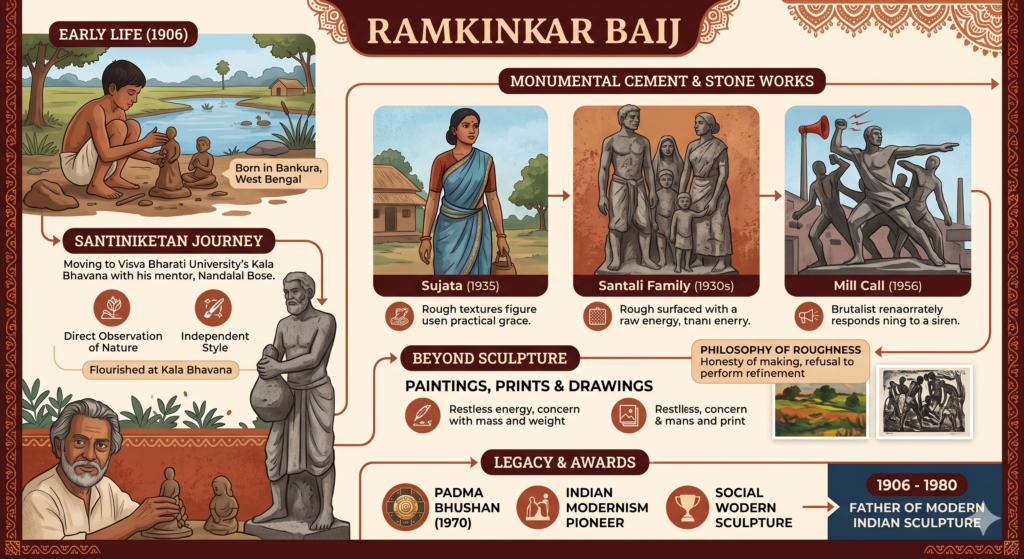
So Ramkinkar used what was lying around. He mixed the laterite gravel of the khowai with just enough cement to bind it. He had tried the mix once before, in 1935, for a tall, slim figure called Sujata, built up over a skeleton of bamboo poles and split cane tied together. Bamboo was the cheapest frame he could get. For the new work, which would be much bigger and more complicated, it would not hold. This time he used iron rods and steel wire, fixed into the foundation.
Up close you can see the grains of gravel in the woman’s arm and the man’s face.
Two trades in one pair of hands
The Mysterious Sinking Of PNS Ghazi
The way he worked came from two trades at once.
First he worked like a clay image-maker. Ramkinkar had grown up in Bankura, watching the local image-makers build their clay gods for the festivals. Now he did something like what they did. He took fistfuls of the wet mix and threw them at the iron frame, piling the material up where the bodies needed to be, and scraped away the extra with a rough blade before it set.
Then, once it had dried hard, he became a stone carver. With a hammer and chisel he went back into the figures and cut the detail: the features of the faces, the age of each body, the strain in a muscle, the tilt of a head. The surface stayed coarse and grainy, full of the gravel, but the expressions were carved with great care.
The family
What he made is a young Santhal couple with their children and their dog, half as large again as life, striding down a road.
The man carries a bamboo pole over his shoulder, a weighing basket hanging from each end, and one child rides in the front basket. His thin gamchha is wound up round his head against the sun. The woman holds a baby against her left hip and steadies a basket on her head with her right hand, a rolled mat on top of it. They are poor and barely dressed. They seem to be on their way home from market, where they have sold what they grew, and they are hurrying to get back before dark.
The legs of the couple fall together almost like a march, and the man’s right arm swings back, driving him on. His neck stretches out ahead of his body. The dog trots along beside them.
When it was finished, the group stood in the open on a low concrete base, beside a dusty red road of the same laterite it was made of. It faced west, towards the setting sun, the way the family was walking.
Sculpture in India had given this kind of grandeur to gods and kings. Ramkinkar gave it to a Santhal farmer, his wife and their dog. It is often called the first modern public sculpture in India.
Nobody paid him to. Visva-Bharati had no money to commission anything.
Why the gravel
Touching the Past at the Bhimbetka Rock Shelters
Cost was one reason for the material. It was not the only one. The critic Pranabranjan Ray, who studied the work closely, argued that Ramkinkar wanted the bodies of these people to look and feel like the soil they lived on and worked. They were made from it.
Ramkinkar knew the Santhal villages around Santiniketan well, and their people run through his work. “I have to be independent,” he once said. “Fiercely independent.”
Eighteen years after the Santhal Family he made another group a short walk away, Mill Call: women workers leaning forward into the wind, rushing to answer the siren of a factory. It was made the same way.
Still walking
The Santhal Family is still on the Kala Bhavana campus. It has a roof over it now and a fence around it, and the red road beside it has been tarred black. The setting it was made for has mostly gone.
But the figures are still the colour of the ground around Santiniketan, because they are made of it. Up close you can see the grains of gravel in the woman’s arm and the man’s face. They are still walking west.
Why Jamini Roy abandoned oil painting for Kalighat roots
If you think you have remembered everything about this topic take this QUIZ
Who was Ramkinkar Baij and why is he important to Indian art?
Ramkinkar Baij was a sculptor, painter and printmaker born in Bankura, West Bengal in 1906. He is widely regarded as the father of modern Indian sculpture because he was among the first artists in India to develop a genuinely modernist sculptural language that drew from Indian life and landscape rather than European academic conventions or ancient classical traditions.
Where can you see Ramkinkar Baij’s sculptures today?
Several of his most important outdoor cement sculptures remain on the campus of Visva Bharati University in Santiniketan, West Bengal, including Santali Family, Sujata and Mill Call. His work Yaksha Yakshi is installed at the Reserve Bank of India building in New Delhi. The National Gallery of Modern Art also holds works from his career.
What materials did Ramkinkar Baij prefer to work with?
He worked across a range of materials including cement, stone, wood, metal and terracotta. He is particularly known for his large outdoor cement sculptures, which he often finished with deliberately rough, unpolished surfaces. He sometimes mixed his own materials when resources were limited.
What was the relationship between Ramkinkar Baij and Santiniketan?
Santiniketan was the center of his entire working life. He came to Kala Bhavana as a young student, was mentored there by Nandalal Bose, and eventually became a teacher at the institution himself. He lived on the campus for most of his adult life and drew his subjects directly from the landscape and communities surrounding it.
Did Ramkinkar Baij receive recognition during his lifetime?
He received the Padma Bhushan in 1970, which was a significant national recognition. However, his commercial success was limited because he lived away from major art market centers and showed little interest in cultivating collectors. His full critical and popular recognition grew substantially after his death in 1980.
Thimithi Festival: How Tamil Devotion Walks Through Fire
Sources & References
Pranabranjan Ray, “Ramkinkar Baij’s Santhal Family,” Art News & Views (Aakriti Art Gallery), no. 30, July 2012 — the khowai laterite mix, the bamboo armature of Sujata (1935), the iron armature, the throw-and-carve method, Visva-Bharati’s lack of funds, the original setting facing west, and the argument about soil.
Wikipedia, “Santhal Family” and “Ramkinkar Baij” — 1938 date, cement and laterite mortar, Ramkinkar’s campus sculptures from the early 1930s, and the work’s status as India’s first public modernist sculpture.
DAG, “Ramkinkar Baij” — the quotation on independence and Mill Call.
Indian Tribal Heritage, “Representing tribal peasants with grace and dignity” — his Bankura childhood among clay image-makers and his closeness to Santhal communities.