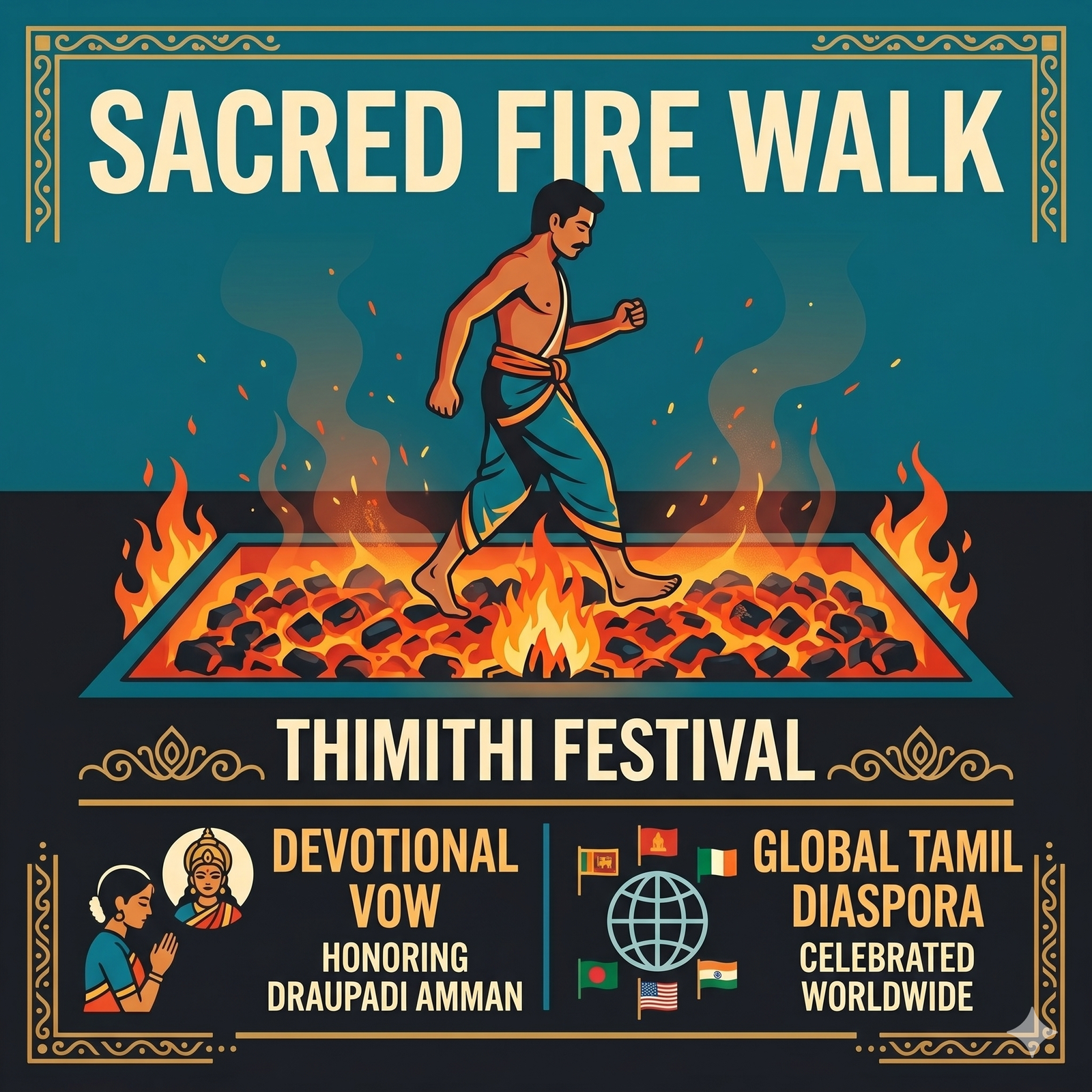
Thimithi is a Hindu festival celebrated primarily in Tamil Nadu and among Tamil communities worldwide in which devotees walk barefoot across a long bed of burning coals as an act of devotion to Draupadi Amman, the goddess form of Draupadi from the Mahabharata. The ritual commemorates Draupadi's own fire walk as a test of purity in the epic and is understood by participants as the fulfillment of a personal vow made to the goddess. This piece explores the mythological roots of the festival, the ritual preparation that precedes the fire walk, the physiology and faith debate that surrounds it and why this practice has traveled with Tamil communities across the world.| Detail | Information |
| Subject | Thimithi Festival |
| Location | Tamil Nadu, India and Tamil diaspora globally |
| Primary Deity | Draupadi Amman |
| Occasion | Commemorates Draupadi’s walk over fire in the Mahabharata |
| Primary Participants | Devotees, primarily men |
| Festival Period | October to November, Tamil month of Aippasi |
| Key Ritual | Walking barefoot over a bed of burning coals |
| Significance | Act of devotion, purification and fulfillment of vows |
A Vow Fulfilled in Fire
Thimithi is a Hindu festival celebrated primarily in Tamil Nadu and among Tamil communities worldwide in which devotees walk barefoot across a long bed of burning coals as an act of devotion to Draupadi Amman, the goddess form of Draupadi from the Mahabharata. The ritual commemorates Draupadi’s fire walk as a test of purity in the epic and is understood by participants as the fulfillment of a personal vow made to the goddess. The festival is structured around a simple exchange: the devotee made a promise to the goddess during difficulty. Now they repay that promise by crossing fire.
The Coal Bed and the Festival Calendar
The coals are prepared hours before the walking begins. Workers rake burning wood into a long rectangular bed, typically measuring three to ten meters in length depending on the temple and its traditions. By the time devotees are ready to cross, the surface temperature of the coal bed reaches several hundred degrees. The fire is real. The question that the festival poses is whether the faith the devotee brings to the crossing is equally real.
Thimithi takes place during the Tamil month of Aippasi, falling between October and November in the Gregorian calendar. It is observed at Draupadi Amman temples across Tamil Nadu, most famously at the Draupadi Amman temple in Chennai. The festival has traveled with Tamil communities to Singapore, Malaysia, South Africa, Mauritius and wherever Tamil people have settled in sufficient numbers to maintain their religious traditions.
How the Kailasa Temple Was Carved From a Single Mountain
Draupadi Amman and the Fire Walk
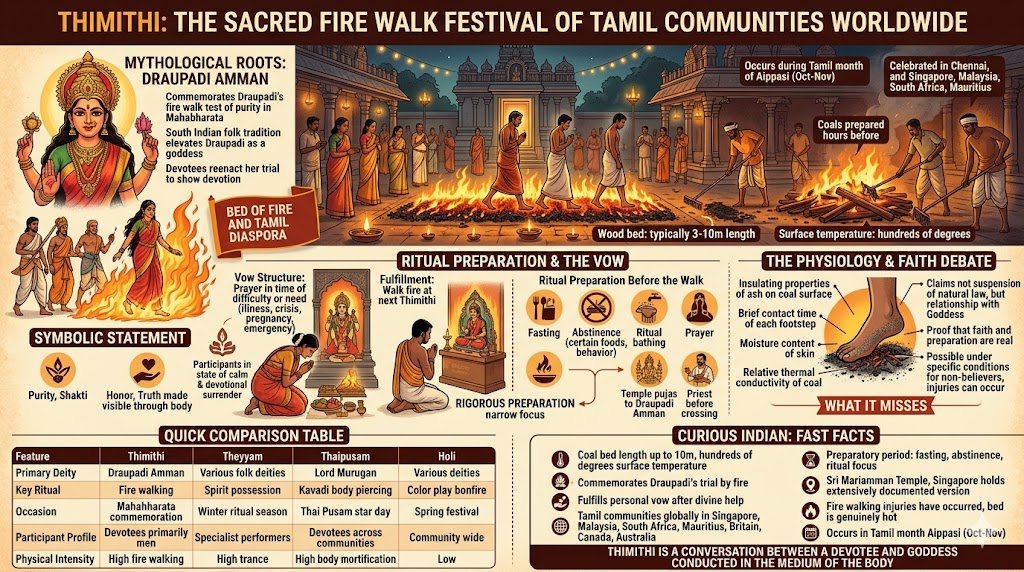
The mythological source of Thimithi is the figure of Draupadi in the Mahabharata. Draupadi, the wife of the five Pandava brothers, was a central figure in the epic and was understood in South Indian folk tradition as possessing qualities of divine purity and power. In Tamil folk tradition, Draupadi is worshipped as a goddess in her own right.
The specific episode commemorated by Thimithi varies somewhat in its telling across different temple traditions, but the core narrative is consistent: Draupadi, whose honor had been violated and whose purity had been questioned, walked across fire and emerged unharmed. The fire bore witness to what her accusers would not acknowledge. Her walk was not a physical achievement. It was a spiritual truth made visible through the body’s submission to the test.
When devotees walk the coals at Thimithi, they are reenacting this moment. They are not performing a feat of endurance. They are making the same statement Draupadi made—that their devotion is real, that their vow is sincere and that the goddess whose protection they seek will honor the faith they bring to the crossing.
The Vow and Its Fulfillment
The Thimithi fire walk is almost always the fulfillment of a vow made to Draupadi Amman at an earlier time of difficulty or need. A devotee who prayed to the goddess during illness, financial crisis, a difficult pregnancy or a family emergency, and promised that if the goddess helped them they would walk the fire at the next Thimithi, is fulfilling a personal contract when they step onto the coals.
This vow structure is central to understanding what the festival is and is not. It is not a test of bravery in the secular sense. It is the repayment of a spiritual debt. The devotee who walks is not proving something to an audience. They are fulfilling an obligation to a deity whose help they received and whose claim on their devotion they are now honoring in the most physical form available. This distinction explains the calm that observers report seeing in the faces of those who cross the coals. They are not suppressing fear through concentration. They are in a state of devotional surrender that has a different relationship to fear than ordinary courage does. Within the framework of the vow, the question of whether the fire will burn them is already answered. The goddess made a commitment when she responded to their prayer. The devotee is making their commitment now.
How Chhau Mask Dance of Purulia Invoke Martial Spirits
The Ritual Preparation
The period leading up to the Thimithi fire walk involves ritual preparation that varies between temples and family traditions but typically includes a period of fasting, abstinence from certain foods and behaviors, ritual bathing and prayer. Devotees who are preparing to walk often describe the preparatory period as a time of increasing mental and spiritual focus, in which ordinary concerns recede and attention narrows to the act of the crossing and its meaning.
On the day of the festival, the preparatory rituals intensify. Temple priests conduct specific pujas to Draupadi Amman. The coal bed is consecrated. Devotees who will walk are often blessed by priests before they approach the crossing point.
The priests conducting the rituals at major Draupadi Amman temples, including those whose practices are documented through the Hindu Religious and Charitable Endowments Department of the Tamil Nadu government, emphasize that the ritual preparation is not separate from the fire walk itself. It is part of the same continuous act of devotion. The physical crossing is the culmination of a process that began with the original vow and continued through every preparatory step.
Vitthala Temple Musical Pillars When Stone Becomes Music
The Physics and the Faith
Thimithi has attracted scientific attention because the apparent contradiction between burning coals and unburned feet is one that physiologists and physicists have attempted to explain. Theories have included the insulating properties of ash that form on the surface of coals, the brief contact time of each footstep, the moisture content of the foot’s skin and the relative thermal conductivity of coal compared to other materials.
These explanations are not entirely wrong. The physics of fire walking is not miraculous in the laboratory sense. Coal beds at Thimithi temperatures are crossable by non-believers under specific conditions, and there have been instances of fire walking injuries when conditions are not optimal or when participants are not in the expected state of focused calm. But this debate consistently misses what the participants themselves are saying. They are not claiming a miracle in the sense of a suspension of natural law. They are claiming a relationship with the goddess that makes the crossing possible for them in ways it might not be possible for someone without that relationship. The fire walking is not proof that physics stops working. It is proof that the devotee’s faith and preparation are real.
Konyak Naga Facial Tattoos: History Written on Human Skin
Thimithi Across the Tamil World
One of the most remarkable things about Thimithi is how completely it has traveled with Tamil communities across the world. The festival is celebrated with full ritual authenticity in Singapore, where the Sri Mariamman Temple fire walking is one of the most significant annual events in the Tamil community’s cultural calendar. It is observed in Malaysia, Mauritius, South Africa and among Tamil communities in Britain, Canada and Australia.
This global persistence reflects something important about the festival’s structure. Because Thimithi is built around the personal vow, the individual’s relationship with the goddess rather than a specific geographic sacred site, it does not require a particular location to retain its meaning. Draupadi Amman travels with her devotees. The coal bed can be prepared wherever they are. The documentation of Thimithi’s global practice has been supported by Tamil cultural organizations and religious bodies including those affiliated with the Hindu Endowments Board of Singapore, which maintains detailed records of the Sri Mariamman Temple fire walking as one of the most extensively documented versions of the festival outside India.
Quick Comparison Table
| Feature | Thimithi, Tamil Nadu | Theyyam, Kerala | Thaipusam, Tamil Nadu | Holi, North India |
| Primary Deity | Draupadi Amman | Various folk deities | Lord Murugan | Various, Holi legend |
| Key Ritual | Fire walking | Spirit possession, elaborate costume | Kavadi carrying, body piercing | Color play, bonfire |
| Occasion | Mahabharata commemoration | Winter ritual season | Thai Pusam star day | Spring festival |
| Participant Profile | Devotees, primarily men | Specialist performers | Devotees across communities | Community wide |
| Physical Intensity | High, fire walking | High, trance and costume | High, body mortification | Low |
Curious Indian: Fast Facts
- The Thimithi coal bed can measure up to ten meters in length depending on the temple tradition, with surface temperatures reaching several hundred degrees
- The festival commemorates Draupadi’s fire walk as a proof of purity in the Mahabharata, with devotees reenacting her crossing as an act of devotion to Draupadi Amman
- Almost every participant is fulfilling a personal vow made to the goddess during a time of difficulty or need
- Thimithi is celebrated by Tamil communities in Singapore, Malaysia, South Africa, Mauritius, Britain, Canada and Australia
- The preparatory period before the fire walk typically involves fasting, abstinence and increasing ritual focus
- The Sri Mariamman Temple in Singapore holds one of the most extensively documented versions of the festival outside India
- Instances of fire walking injury have been recorded when conditions are not optimal, confirming that the coal bed is genuinely hot
- The festival falls in the Tamil month of Aippasi, between October and November in the Gregorian calendar
The Conversation That Continues
The Thimithi fire walk is one of those human practices that resists comfortable explanation from the outside. Watch it long enough and the categories you bring to it—the scientific, the anthropological, the skeptical—begin to feel insufficient. Not because what is happening is impossible but because the framework the participants are working within is different from the framework most observers use.
What Thimithi is, most essentially, is a conversation between a devotee and a goddess conducted in the medium of the body. The vow was made in language. The fulfillment is made in fire. The goddess’s response came in the form of changed circumstances in the devotee’s life. The devotee’s response comes in the form of a crossing that costs them something real, something that cannot be faked, something that the body either does or does not do. That economy of exchange, so physical and so personal, is what has kept the festival alive through centuries of social change, through migration across continents, through the many transformations that Tamil culture has undergone. The fire is the same fire it has always been. The faith is the same faith. And somewhere in the space between them, the conversation continues.
The Rhythmic Buddhist Chanting of the Monks of Ladakh
If you think you have remembered everything about this topic take this QUIZ
This quiz no longer existsWhat is Thimithi and which deity is worshipped during the festival?
Thimithi is a Hindu fire walking festival celebrated primarily in Tamil Nadu and among Tamil communities worldwide. It honors Draupadi Amman, the goddess form of Draupadi from the Mahabharata, who is understood in Tamil folk tradition as a powerful deity whose purity was demonstrated by her ability to walk through fire. Devotees who participate in the fire walk are fulfilling personal vows made to Draupadi Amman.
Is the fire walk dangerous and have people been injured?
The coal bed used in Thimithi is genuinely hot and instances of injury have been recorded, particularly when conditions are not optimal or when participants are not in the expected state of ritual preparation. The risks are real, which is part of what gives the act of crossing its meaning within the devotional framework. The ritual preparation, including fasting and prayer, is understood by participants and priests as essential to a safe and spiritually valid crossing.
Why do people make vows to walk the fire at Thimithi?
Vows are typically made to Draupadi Amman during times of personal difficulty, illness, financial hardship or family crisis, promising that if the goddess helps resolve the situation the devotee will walk the fire at the next Thimithi festival. The fire walk is therefore the fulfillment of a personal contract with the goddess, a repayment of devotion for help received, rather than a voluntary act of bravery or religious performance.
How has Thimithi spread to Tamil communities outside India?
The festival has traveled with Tamil diaspora communities to wherever they have settled in sufficient numbers to maintain their religious traditions. Because Thimithi is structured around the personal vow between a devotee and Draupadi Amman rather than a specific sacred site, it does not require a particular geographic location and can be conducted wherever the ritual materials, priests and community are present. Singapore, Malaysia, Mauritius and South Africa have particularly well-established Thimithi traditions.
What is the connection between Thimithi and the Mahabharata?
The festival commemorates the episode in which Draupadi walked across fire as a demonstration of her purity. In the Tamil folk tradition, Draupadi is understood as a goddess whose divine nature was most fully expressed in this act of fire walking. When devotees cross the coals at Thimithi, they are reenacting Draupadi’s crossing and declaring, through their own bodies, the same kind of faith in divine protection that Draupadi demonstrated in the epic.