How Bengal Turned a Demon-Slaying Goddess into a Beloved Daughter on a Yearly Visit
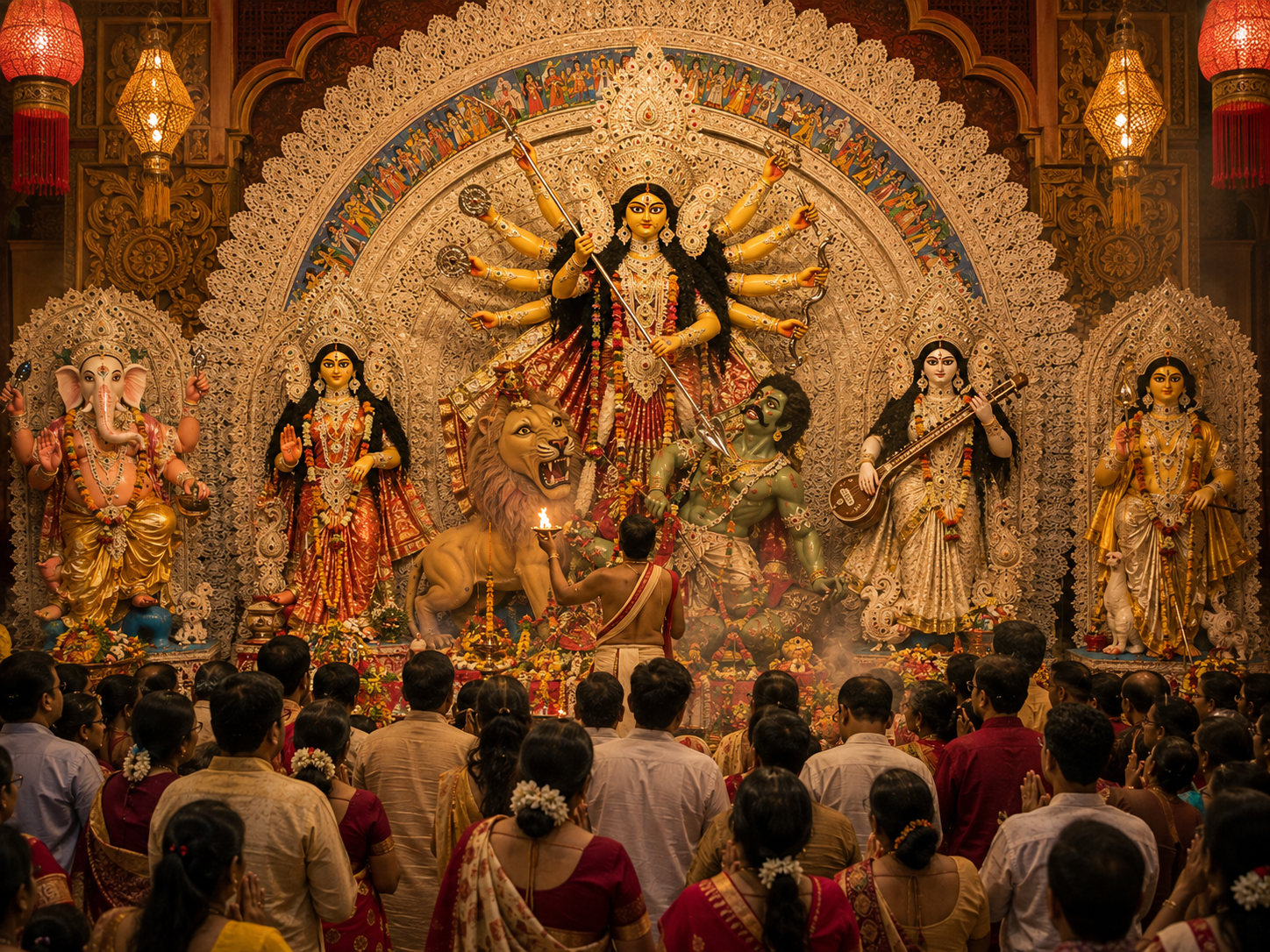
In the old myths, she is a warrior. She has ten arms, each holding a weapon, and she rides a lion. She was born from the gathered light of all the gods to kill a demon that no one else could kill.
But if you ask anyone in Bengal who Durga really is, you may get a much softer answer. She is a daughter, coming home. For a few days each autumn, the whole of Bengal welcomes back a beloved girl who has been away far too long, and then, on the very last day, has to let her go again. That aching, tender feeling is the real secret heart of Durga Puja.
The Goddess the Gods had to Build
First, the reason she is worshipped at all.
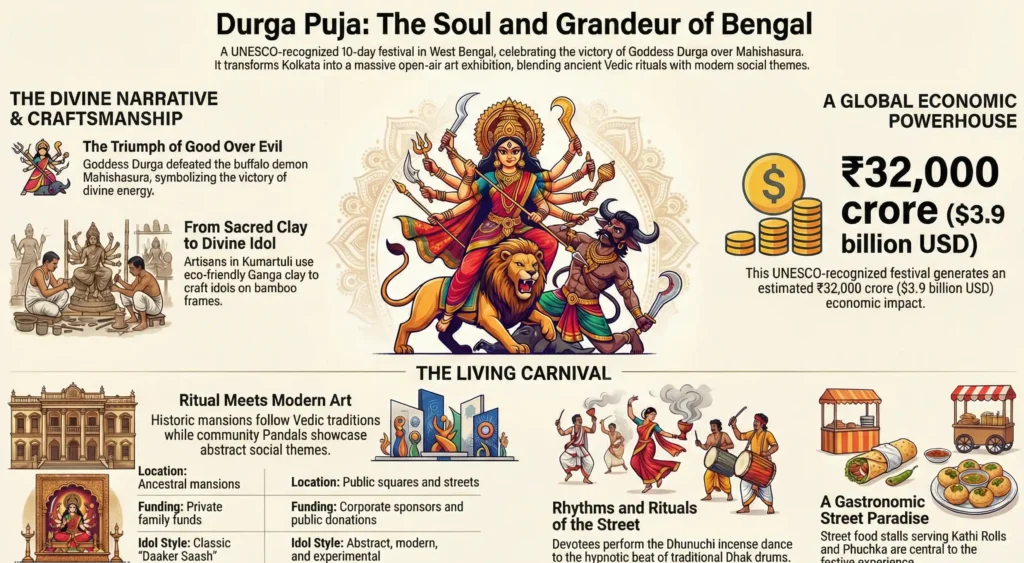
There was once a demon named Mahishasura, who could take the shape of a great buffalo. He had won a special promise that no man and no god would ever be able to kill him, and drunk on that power, he drove the gods right out of heaven. On their own, none of them could stop him.
So the gods did something they had never done before. They poured all of their power together into a single being, and out of that blazing, combined light rose a goddess: Durga. Each god handed her a weapon for one of her ten hands. Riding her lion, she battled Mahishasura for nine days and nights, and on the tenth day she struck him down.
No man and no god could kill the demon. So the gods combined all their strength into a goddess, and she did what none of them could do alone.
His clever promise had one gap in it. He was safe from man and god, but not from the Mother.
Bengal’s Own Daughter
Bengal took this mighty, victorious goddess, and did something wonderfully tender with her.
In the Bengali way of seeing it, Durga is a married daughter who lives far away on Mount Kailash with her husband, the god Shiva. Once a year, in the autumn, she comes back to her parents’ home for a short visit. And she does not come alone. She brings her four children with her: Lakshmi, Saraswati, Ganesh and Kartik.
So the festival is not only the worship of a warrior. It is a family welcoming home their girl. For four short days they feed her, dress her in her finest, and dote on her without pause. Every single Bengali becomes, for that one week, a proud and slightly anxious parent whose daughter is finally, blessedly, back under their roof.
Ganesh Chaturthi: Honoring the Elephant-Headed God
The Mother Made of River Clay
Months before she “arrives,” in a crowded lane of North Kolkata called Kumartuli, the idol-makers begin their work.
They build her over a frame of bamboo and straw, using soft clay pulled from the river Ganga. Layer by patient layer, the goddess takes shape under their hands. Her eyes are always painted last, on the day called Mahalaya, and it is said that the moment those eyes are finished, the goddess wakes and comes to life.
There is one quiet rule about the clay that tells you everything about who this Mother is meant to be.
Mixed into the clay there must be a handful of earth taken from the doorstep of the women whom society looks down on the most and pushes to its very edges.
The belief behind it is simple and beautiful. The Mother belongs to everyone. No one, however shunned or shamed by the world, stands outside her love. She is built, quite literally, from the soil of the forgotten.
The Days of the Visit
For weeks beforehand, the city fills with the deep beat of the dhaak drums, the sweet smell of shiuli flowers on the ground at dawn, and tall white kaash grass swaying by the roadsides. It is autumn’s own way of whispering that she is coming.
The main days run from the sixth to the tenth. Her face is unveiled and welcomed. There are quiet mornings of flowers and prayer, and one hushed, exactly-timed moment of worship that falls between two of the days. And everywhere, all through the nights, people who have saved all year put on brand-new clothes and pour into the streets, walking from one pandal to the next. For these few days, the entire city becomes one gigantic open-air gallery of art, all of it built around her.
Onam: Kerala’s Harvest Festival
The Festival Where the Lines Disappear
Long ago, this puja happened only in the courtyards of rich landlord families, a private display of both devotion and social standing.
Then, a little over two hundred years ago, groups of ordinary neighbours began pooling their small savings to hold their own “everyone’s puja,” out in the open, for the whole locality to share. That change turned the festival into what it is today. The grandest pujas now are these community ones, free and open to all, where the richest and the poorest of the neighbourhood stand in the very same line to see the very same goddess.
Nil Darpan: The Mirror of Indigo
In 2021, this enormous, month-long outpouring of art and faith was honoured by UNESCO, which added it to its list of the living cultural treasures of humanity and called it one of the finest examples anywhere of religion and art performed together in public. It is a festival, they noted, where the usual walls of class and religion quietly fall away.
And Then She Must Go
And then, always far too soon, the tenth day arrives. It is called Vijaya Dashami, and it is the day the visit ends and the daughter must return to her husband’s distant home.
First, the married women gather close around her and smear one another with red vermillion in a bittersweet, laughing, half-crying farewell, sending her off the way a family sees a daughter to the door. Then the idols are carried in great processions to the river and gently lowered into the water, and the clay that once came out of the Ganga slowly dissolves back into it. People weep openly. They call out a promise to her as she goes: may it all happen again next year.
For all its colour and size and joyful noise, Durga Puja ends, every single time, on the soft ache of a goodbye.
Sunayani Devi: A Woman’s Voice in the Bengal School
The Goodbye That Always Comes Back
That is the quiet genius of what Bengal did. It did not keep its goddess only as a distant, terrifying slayer of demons, worshipped from far away in fear.
It made her a daughter. And so, once every year, a whole people gets to feel the simplest human joy there is, a loved one coming home, followed by the simplest human sorrow, watching that loved one leave. In the myths, she will slay the demon over and over again. But in Bengal, she will also, again next autumn, walk back in through her parents’ door, and for four short and precious days she will be nobody’s warrior and everybody’s girl.
If you think you have remembered everything about this topic take this QUIZ
Results


#1. In what year was Kolkata’s Durga Puja inscribed on the UNESCO Representative List of the Intangible Cultural Heritage of Humanity?
#2. Which traditional potters’ quarter in North Kolkata is famous for crafting the eco-friendly clay idols of the Goddess?
#3. The sacred ritual of “Chokkhu Daan” performed on Mahalaya signifies breathing life into the clay. What specific action does this involve?
#4. During Sandhi Puja on the eighth day (Ashtami), exactly how many lotus flowers and oil lamps are lit?
#5. What is the name of the traditional dance performed by devotees holding clay pots filled with burning coconut husks and camphor?
#6. On Dashami, before the idol is immersed, married women celebrate sisterhood and marital bliss by smearing which substance on the Goddess and each other?
#7. 7. According to the comparison table, how are the traditional “Bonedi Bari” pujas primarily funded?
#8. 8. Tradition dictates that a handful of soil (Punya Mati) must be mixed with the clay of the Ganges to make the idol. Where is this soil traditionally collected from?
Why is Durga Puja celebrated?
It celebrates the victory of Goddess Durga over the buffalo demon Mahishasura, symbolizing the triumph of good over evil.
What is the significance of the “Dhak”?
The Dhak is a traditional Bengali drum. Its rhythmic beating is essential to all Durga Puja rituals and dances, acting as the heartbeat of the festival.
What happens on Dashami (the 10th day)?
Dashami marks the end of the festival. Women participate in Sindoor Khela (smearing vermilion), followed by the immersion (Bisorjon) of the idol in the river.
What is a “Pandal”?
A Pandal is a temporary, elaborately decorated structure made of bamboo and cloth that houses the idol during the festival.
Why did Kolkata’s Durga Puja get UNESCO recognition?
It was recognized for its role in safeguarding living culture, promoting collective creativity, and acting as an inclusive, large-scale public art installation.
Sources and references
- UNESCO Intangible Cultural Heritage listing (“Durga Puja in Kolkata”) — the ten-day worship of the goddess Durga, the idols sculpted from unfired Ganga clay in workshops like Kumartuli, the painting of the eyes on Mahalaya to bring the goddess to life, the immersion on the tenth day, and the festival’s meaning as a “home-coming.”
- Encyclopaedia Britannica (“Vijayadashami” and “Durga Puja”) — the strongly held Bengali belief that Durga visits her parental home with her children Lakshmi, Saraswati, Ganesha and Kartikeya and departs on Vijaya Dashami, the punya mati soil gathered from a brothel’s threshold mixed into the clay, and the sindoor khela and immersion rituals.
- Mythlok and Exotic India — the myth of Durga created from the combined powers of the gods to slay the buffalo-demon Mahishasura, her ten arms and weapons, and the Akalbodhan or autumn invocation linked to Rama.
- Discovery of Bharat and The Conversation — the history of Durga Puja from private aristocratic (zamindar) celebrations in the 16th–17th centuries to the community “sarbojanin” pujas from the late 18th century onward, and the festival’s spread among the Bengali diaspora worldwide.
- Original Curious Indian article (“Durga Puja in Bengal”) — the framing of the goddess’s homecoming, the pandals and Kumartuli idol-making, the sequence of the main days, and the immersion and Bijoya farewell.
Author


Exploring the Soul of Bharat through History, Science, Culture, and its Diversity
Our Mission
Curious Indian is a definitive knowledge portal dedicated to chronicling the events, personalities, and cultural shifts that defined the Indian subcontinent. From the ancient Vedic Period to the complexities of 21st-century politics, our goal is to provide deep-dive analysis that inspires.
Editorial Standards & E-E-A-T
Every article published under our brand undergoes a rigorous fact-checking process. We prioritize primary historical records, academic citations, and credible archives to ensure our readers receive accurate, high-authority information.
Historical Integrity Directly sourcing from ASI archives and academic journals.Topical Authority Comprehensive clustering of Indian Science, Biographies, and Wars.Managed by Paripurna Datta and TEAM | Dedicated to the Knowledge of India.