Wednesday, May 20, 2026
20 °c
Columbus
Curious Indian
  • Arts & Culture
  • Festivals of India
  • Indian History
  • Indian Politics
  • Biography
    • Entertainment Personalities
    • Science Personalities
  • Unsolved India
No Result
View All Result
  • Arts & Culture
  • Festivals of India
  • Indian History
  • Indian Politics
  • Biography
    • Entertainment Personalities
    • Science Personalities
  • Unsolved India
No Result
View All Result
Curious Indian
No Result
View All Result
Home Arts & Culture

How the Kailasa Temple Was Carved From a Single Mountain

paripurnadatta by paripurnadatta
in Arts & Culture, Indian History, Medieval India, Sculpture
Reading Time: 13 mins read
0 0
A A
Kailasa temple

Kailasa temple

Share on FacebookShare on Twitter

Table of Contents

Toggle
  • The Moment the Mind Catches Up with the Eyes
  • The Dynasty That Conceived the Impossible
  • How You Carve Downward Through a Mountain
  • The Sculpture That Covers Every Surface
  • The Galleries, the Shrines and the River Goddesses
  • What 200,000 Tons of Removed Rock Means
  • Quick Comparison Table
  • Curious Indian: Fast Facts
  • Conclusion
  • If you think you have remembered everything about this topic take this QUIZ
  • Results
    • #1. The Kailasa temple at Ellora was built by which dynasty in the 8th century CE?
    • #2. Which king began the Kailasa project, and who oversaw its completion?
    • #3. What unique construction method did the craftsmen use to build the Kailasa temple?
    • #4. Approximately how many tons of rock did craftsmen remove to reveal the temple complex?
    • #5. Which institution studied the structural logic of the excavation and found evidence of sophisticated planning like survey marks and pilot trenches?
    • #6. What does the most celebrated narrative sculptural panel at the Kailasa temple depict?
    • #7. . In which year was the Ellora caves complex, including the Kailasa temple, designated as a UNESCO World Heritage Site?
    • #8. According to the Quick Comparison Table, which dynasty is associated with the Mahabalipuram Rathas?
    • Why is the Kailasa temple considered the largest rock cut structure in the world? 
    • How long did it take to build the Kailasa temple? 
    • How did the craftsmen plan such a complex project without modern technology? 
    • Is the Kailasa temple still used for religious worship? 
    • What is the significance of the Ravana shaking Mount Kailash panel? 
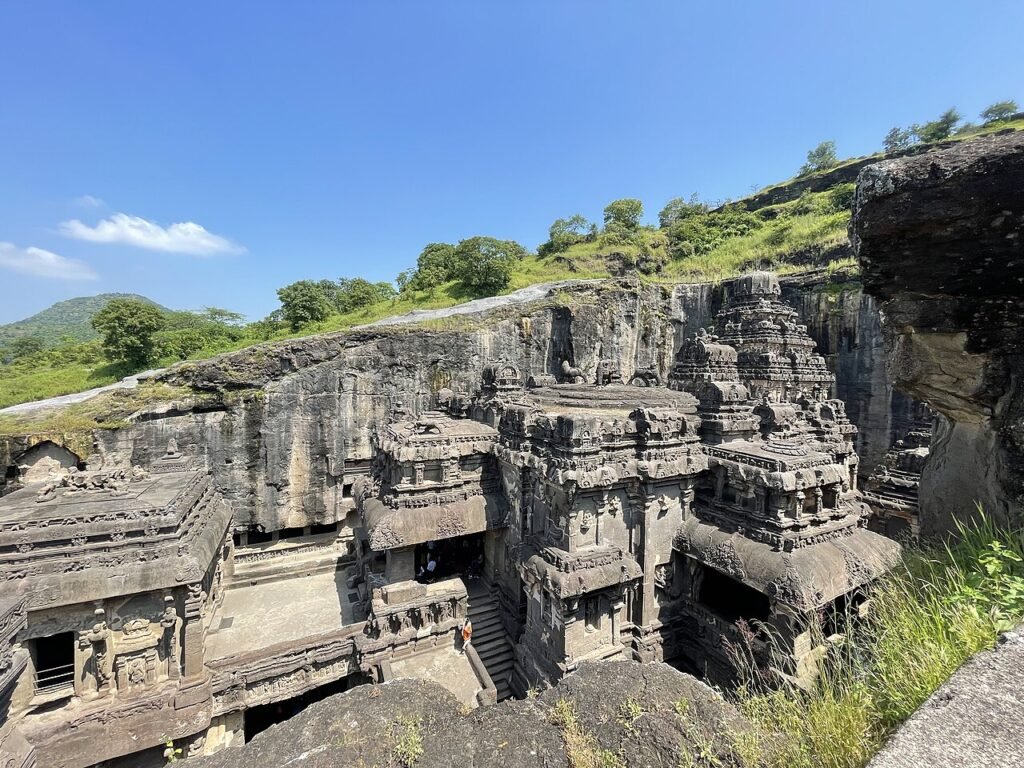
The Kailasa temple at Ellora in Maharashtra is the largest rock cut structure in the world and one of the most astonishing achievements in the history of human construction. Built by the Rashtrakuta dynasty in the 8th century CE, it was carved entirely from a single basalt cliff by working downward from the top, with craftsmen removing an estimated 200,000 tons of rock to reveal a fully formed temple complex below. Every element, from the towering shikhara to the sculpted elephants at the base, the narrative panels covering the walls and the subsidiary shrines surrounding the main structure, emerged from one unbroken piece of the earth. This piece traces how it was done, who did it and why the Kailasa temple continues to redefine what architecture can mean.
DetailInformation
SubjectKailasa Temple at Ellora
LocationEllora, Aurangabad, Maharashtra, India
DynastyRashtrakuta
Built ByKing Dantidurga, completed under Krishna I
Period8th century CE (circa 756 to 773 CE)
TypeRock cut monolithic temple
Dedicated ToShiva
MaterialSingle basalt cliff
UNESCO StatusPart of Ellora Caves World Heritage Site since 1983

The Moment the Mind Catches Up with the Eyes

There is a particular moment when visiting the Kailasa temple at Ellora when the mind catches up with what the eyes have been looking at. You have walked through the entrance, descended into the courtyard cut from the rock, and looked up at the main tower rising above you. You have seen the sculpted elephants arranged along the base of the platform, life-sized, their trunks raised, each one carved from the same stone as the ground beneath your feet. You have looked at the panels on the walls showing scenes from the Ramayana and Mahabharata in a detail so fine it reads like an illustration.

And then it arrives. The understanding that there are no joins in any of this. That the elephant you are looking at is the same piece of rock as the tower above it and the courtyard floor beneath it and the cliff face behind it. That none of this was assembled. All of it was revealed, coaxed out of a single basalt mountain by human hands working with iron chisels over several decades in the 8th century CE. The scale of the ambition is almost incomprehensible. 

Kailasa temple

The Dynasty That Conceived the Impossible

The Rashtrakuta dynasty came to power in the Deccan in the mid-8th century when Dantidurga overthrew the Chalukyas and established a new ruling house with its center in what is now Maharashtra. The Rashtrakutas were ambitious in every dimension of their rule, militarily expansive, culturally sophisticated and deeply engaged with the arts and architecture of the period. 

READ MORE:  Martyrdom of Guru Arjan Dev: The Event That Transformed Sikhism

Dantidurga began the Kailasa project and his successor Krishna I oversaw its completion. The temple was dedicated to Shiva as his mythological abode, Mount Kailash in the Himalayas. In conceiving a temple that would physically represent the mountain home of the god, the Rashtrakuta kings chose the most demanding possible form of expression. They would not build a mountain. They would find one inside a cliff and set it free.

The fact that this ambition was realized, and realized at a scale that dwarfs every comparable project of the period, tells us something significant about the Rashtrakuta court. The resources required in terms of skilled craftsmen, iron tools, logistical organization and sustained royal patronage over multiple decades were extraordinary. This was a civilization operating at full creative and administrative capacity.

How You Carve Downward Through a Mountain

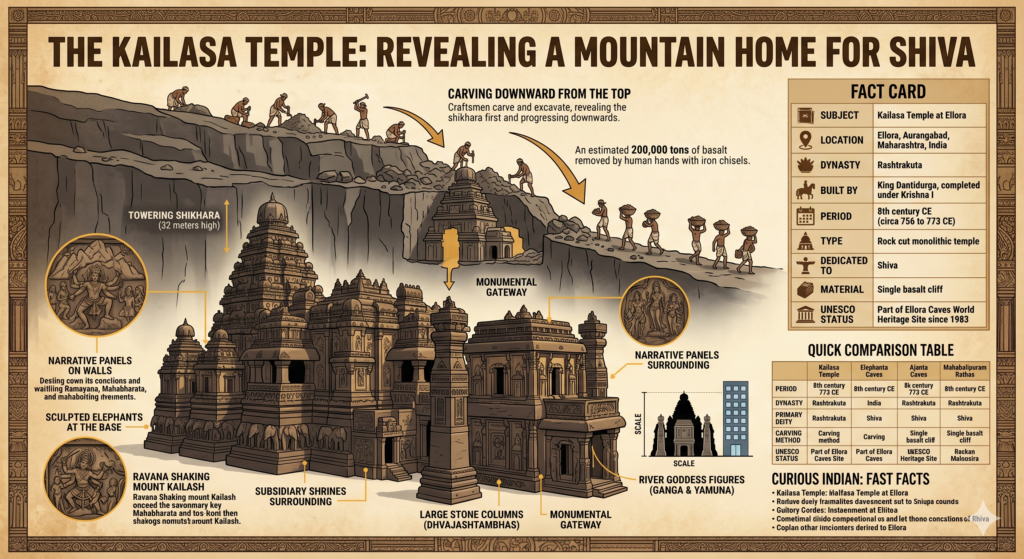
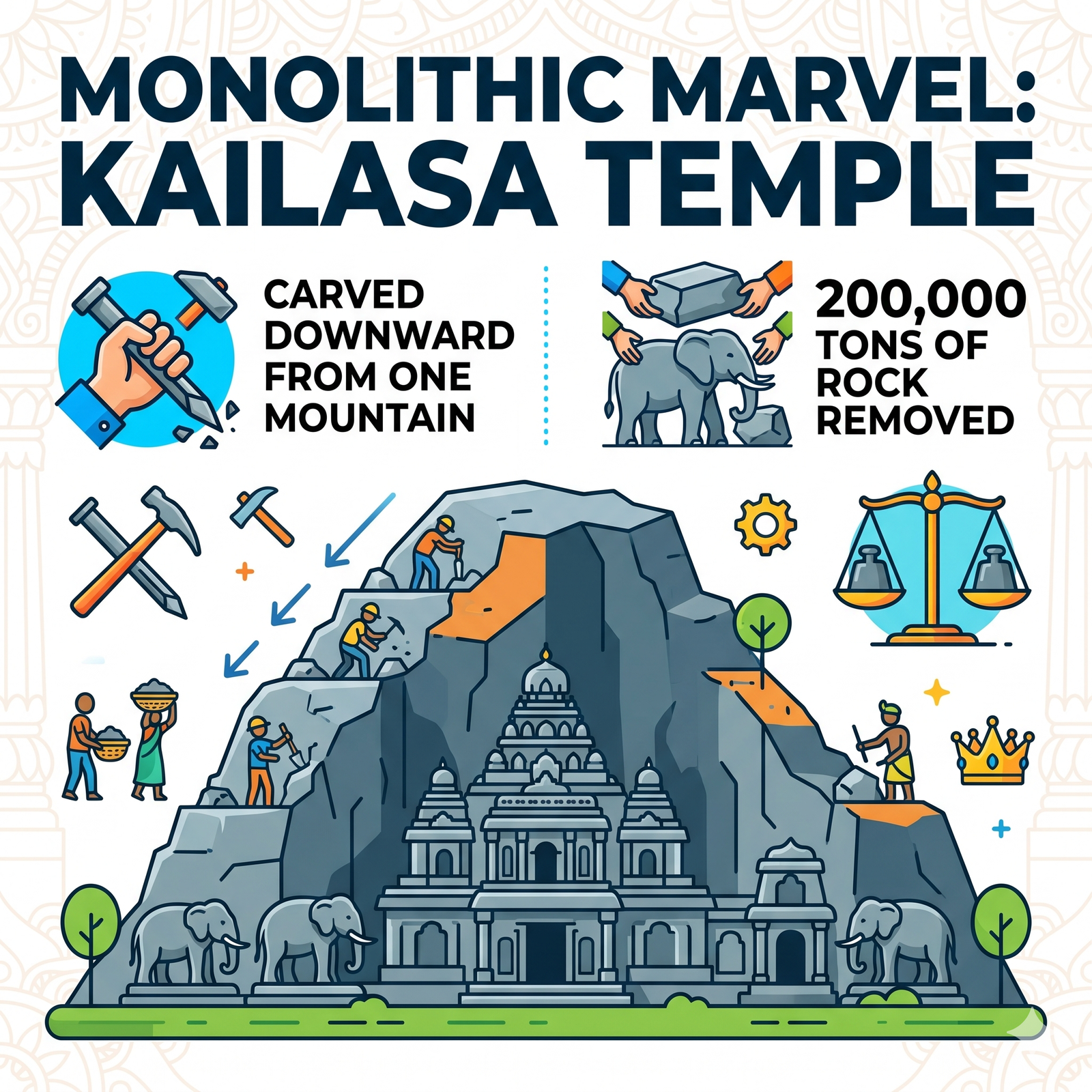
The method used to create the Kailasa temple is the detail that most surprises people when they first encounter it, because it is the reverse of almost every other construction process in history. Rather than building upward from a foundation, the craftsmen of Ellora began at the top of the cliff and worked downward, removing rock to reveal the structure below.

This meant that the shikhara, the main tower of the temple, was the first element completed. The craftsmen carved the top of the tower from the surface of the cliff, then worked down around it, excavating the courtyard while the tower grew taller relative to the descending floor. By the time the courtyard reached its final depth, the shikhara rose approximately 32 meters above it, its form having been determined at the beginning of the process and maintained with extraordinary precision throughout. To fully appreciate how early civilizations used structural landscape geometry to trace grand astronomical movements, explore our detailed resource on the ancient civilizations and the vedic age at curiousindian.in.

This approach required the entire design to exist completely in the minds of the craftsmen and planners before a single chisel stroke was made. There was no possibility of correction in the way that conventional construction allows. You cannot put basalt back. Every decision about proportion, depth, the placement of a sculptural panel or the width of a corridor had to be made correctly the first time, in sequence from top to bottom, with the full understanding that the rock removed was gone permanently.

Scholars at institutions including the Deccan College Post Graduate and Research Institute in Pune have analyzed the structural logic of the Kailasa excavation and found evidence of sophisticated planning including survey marks and pilot trenches cut into the cliff before the main excavation began. These preliminary marks suggest a detailed architectural plan was transferred to the rock surface before work began, a three-dimensional blueprint expressed in stone. 

The Sculpture That Covers Every Surface

Once the structural excavation was complete, an entirely separate phase of work began. Every surface of the revealed temple was carved with sculpture. The walls of the main shrine carry panels depicting episodes from the Shaiva Puranas. The columns of the assembly hall are carved with figures of celestial beings. The ceiling panels show geometric and floral patterns of extraordinary intricacy. The base of the main platform is lined with elephants and lions in high relief, their bodies emerging from the rock with a naturalism that still feels alive.

The most celebrated sculptural panel at Kailasa depicts Ravana shaking Mount Kailash. In this scene from the Ramayana, the demon king Ravana attempts to uproot Shiva’s mountain home by brute force, while Shiva sits above in serene composure and presses the mountain back down with his toe. The Kailasa carvers rendered this scene with theatrical energy, Ravana’s multiple arms straining, the mountain shaking, the divine couple above utterly undisturbed.

READ MORE:  7 Secrets of Padmanabhaswamy Temple Treasure

There is an additional layer of meaning in choosing this scene for this temple. The Kailasa at Ellora is itself a carved mountain. The story of Ravana attempting to move Mount Kailash through force, and failing because Shiva’s stillness is stronger than his effort, resonates with the entire project. The craftsmen did not force the mountain. They listened to it, following its grain, working with the logic of the stone to find the temple that was already inside it. 

The Galleries, the Shrines and the River Goddesses

The Kailasa complex is not simply a single temple. It includes a series of subsidiary shrines carved into the walls of the excavated courtyard, a monumental gateway through which visitors enter, two large stone columns called dhvajashtambhas that flank the entrance to the main shrine, and a continuous gallery running along three sides of the courtyard at a level above the main floor.

Among the most refined sculptural elements of the complex are the river goddess figures, images of Ganga and Yamuna carved at the doorways of the main shrine with a fluidity and grace that represents some of the finest figurative work of the 8th century in India. These figures have a quality of movement unusual in stone, their bodies turning slightly, their drapery falling in soft curves, their expressions alert and present in a way that the more formal sculptural programs of the walls do not always achieve. 

The detailing of these goddess figures and the Ravana panel have been studied in depth through the conservation and documentation programs of the Archaeological Survey of India, which maintains the Ellora complex and has produced extensive photographic and structural records of both the excavation and sculptural phases of the Kailasa’s construction.

What 200,000 Tons of Removed Rock Means

The figure of 200,000 tons of removed basalt is the one that tends to stop conversations. People struggle to visualize what that quantity of stone looks like, where it went and how it was moved. The answers are that it was chipped away in fragments by iron chisels, carried out of the excavation in baskets by a continuous chain of workers, and deposited in areas around the cliff face. Archaeological survey of the surrounding area has confirmed the presence of debris deposits consistent with this scale of removal.

The workforce required to accomplish this over the estimated timeline of several decades was substantial. Estimates based on the volume of material removed and plausible working rates suggest hundreds of craftsmen working continuously, supported by an even larger number of laborers moving the debris. This was not a spontaneous act of creative energy. It was a sustained industrial operation in the service of religious and political ambition.

That combination, industrial scale in the service of sacred vision, is what makes Kailasa genuinely unique. There are other monolithic rock cut structures in India and across the world. None of them approach the Kailasa in the combination of scale, structural complexity and sculptural density. The UNESCO World Heritage designation that covers the Ellora caves, granted in 1983, specifically notes the Kailasa as the outstanding achievement within a complex that is itself already extraordinary. 

Quick Comparison Table

FeatureKailasa TempleElephanta CavesAjanta CavesMahabalipuram Rathas
Period8th century CE5th to 7th century CE2nd century BCE to 6th century CE7th to 8th century CE
DynastyRashtrakutaKalachuri or ChalukyaSatavahana to VakatakaPallava
Primary DeityShivaShivaBuddhistShiva and Vishnu
Carving MethodTop down, single monolithHorizontal cave excavationHorizontal cave excavationTop down, individual rocks
UNESCO StatusWorld Heritage SiteWorld Heritage SiteWorld Heritage SiteWorld Heritage Site

Curious Indian: Fast Facts

  • The Kailasa temple required the removal of an estimated 200,000 tons of basalt from a single cliff face, all done with iron hand tools.
  • The craftsmen worked from the top of the cliff downward, completing the shikhara first before excavating the courtyard below.
  • No mortar or separate stone pieces were used at any point in the construction.
  • The temple was dedicated to Shiva and conceived as a representation of his mythological mountain home, Mount Kailash.
  • King Dantidurga began the project and his successor Krishna I oversaw its completion in the 8th century CE.
  • The complex includes subsidiary shrines, a monumental gateway, two large stone columns and a continuous surrounding gallery.
  • The Ravana shaking Mount Kailash panel is considered one of the finest narrative sculptural reliefs in Indian art history.
  • UNESCO included the Ellora caves, including the Kailasa temple, in its World Heritage List in 1983.
READ MORE:  Beyond the Stars: How Mahaviracharya Defined Modern Math

Conclusion

The Kailasa temple was built by removing everything that was not a temple from a mountain. That sentence sounds like a paradox, but it is an accurate description of the process. The craftsmen did not create the structure. They found it inside the cliff and freed it by taking away everything surrounding it.

This way of thinking about creative work is itself a philosophical position, one that resonates with the Shaiva tradition the temple was built to honor. Shiva is both creator and destroyer, but in the iconography of the Kailasa the destroyer is not a violent force. He is the still point around which the mountain organizes itself. In pressing down on Mount Kailash with his toe while Ravana strains below him, Shiva demonstrates that the deepest power is not force but composure.

The craftsmen who worked on the Kailasa for decades demonstrated the same thing. They moved 200,000 tons of rock not through brute application of strength but through precision, patience and an understanding of the material so complete that they could carry an entire architectural vision in their minds from the first chisel stroke at the top of the cliff to the last detail carved at the base. 

What remains is the result. A mountain that became a temple. A cliff that became a story. A monument that has now outlasted the empire that built it by over a thousand years and still has not finished saying what it was made to say. 

If you think you have remembered everything about this topic take this QUIZ


Results

Share your score!
Tweet your score!
Tweet your score!
Share to other
QUIZ START

#1. The Kailasa temple at Ellora was built by which dynasty in the 8th century CE?

Previous
Next

#2. Which king began the Kailasa project, and who oversaw its completion?

Previous
Next

#3. What unique construction method did the craftsmen use to build the Kailasa temple?

Previous
Next

#4. Approximately how many tons of rock did craftsmen remove to reveal the temple complex?

Previous
Next

#5. Which institution studied the structural logic of the excavation and found evidence of sophisticated planning like survey marks and pilot trenches?

Previous
Next

#6. What does the most celebrated narrative sculptural panel at the Kailasa temple depict?

Previous
Next

#7. . In which year was the Ellora caves complex, including the Kailasa temple, designated as a UNESCO World Heritage Site?

Previous
Next

#8. According to the Quick Comparison Table, which dynasty is associated with the Mahabalipuram Rathas?

Previous
Finish

Why is the Kailasa temple considered the largest rock cut structure in the world? 

The Kailasa temple surpasses all other rock cut structures in the combination of volume excavated, structural complexity and sculptural coverage. Approximately 200,000 tons of basalt were removed from a single cliff to create the complex, which includes a main temple rising 32 meters above the courtyard floor, subsidiary shrines, gateways, columns and continuous sculptural programs covering every available surface.

How long did it take to build the Kailasa temple? 

The construction is generally dated to between approximately 756 and 773 CE, suggesting a core period of around 17 years. However, some scholars believe the sculptural programs were extended and refined over a longer period following the completion of the main structural excavation. The project spanned at least the reigns of two Rashtrakuta kings, Dantidurga and Krishna I.

How did the craftsmen plan such a complex project without modern technology? 

Evidence suggests that the craftsmen used detailed survey marks and pilot trenches cut into the cliff surface before the main excavation began, transferring an architectural plan onto the rock itself. The entire design had to be conceived completely in advance because the top-down carving method allowed no structural corrections once begun. The sophistication of the planning is one of the most remarkable aspects of the Kailasa project.

Is the Kailasa temple still used for religious worship? 

The Kailasa temple at Ellora is maintained as an archaeological monument by the Archaeological Survey of India and receives enormous numbers of tourists and pilgrims. Some ritual activity continues at the site. The temple remains dedicated to Shiva and retains its sacred character for Hindu devotees who visit it.

What is the significance of the Ravana shaking Mount Kailash panel? 

The panel depicts the demon king Ravana attempting to uproot Mount Kailash while Shiva sits above in complete composure and presses the mountain back into place with his toe. It is considered one of the finest narrative sculptural reliefs in Indian art. At the Kailasa temple specifically, the scene carries additional resonance because the temple itself is a carved mountain, making the story of a mountain’s stillness resisting force directly applicable to the monument that houses the carving.

Tags: Ellora cavesEllora UNESCOKailasa templeMaharashtraRashtrakuta DynastyRock cut temple IndiaShiva temple IndiaUNESCO World Heritage India
ShareTweetPin
paripurnadatta

paripurnadatta

Related Posts

Khudiram Bose
Biography

The Final Letters of Khudiram Bose and Soul of Young Bengal

May 19, 2026
Bhikaiji Cama
Biography

How Madam Bhikaiji Cama Unfurled India’s Flag in Germany

May 19, 2026
Matangini Hazra
Biography

Matangini Hazra: The Widow Who Walked Into Gunfire

May 19, 2026
No Result
View All Result

Stay Updated

  • Trending
  • Latest
Life of Mahavira: From Prince Vardhamana to Great Conqueror

Life of Mahavira: From Prince Vardhamana to Great Conqueror

April 11, 2026
Life of Buddha: The Journey to Enlightenment

Life of Buddha: The Journey to Enlightenment

April 11, 2026
Christmas in India

Christmas in India: A Festive Blend of Faith, Flavors, and Tradition

April 11, 2026
From Shimla to Stardom: The Complete Biography of Anupam Kher

From Shimla to Stardom: The Complete Biography of Anupam Kher

April 11, 2026
Khudiram Bose

The Final Letters of Khudiram Bose and Soul of Young Bengal

May 19, 2026
Bhikaiji Cama

How Madam Bhikaiji Cama Unfurled India’s Flag in Germany

May 19, 2026
Matangini Hazra

Matangini Hazra: The Widow Who Walked Into Gunfire

May 19, 2026
Gommateshwara statue

Gommateshwara Statue and the Philosophy of Inner Peace

May 19, 2026

Widget Title

Facebook Twitter Youtube RSS
Curious Indian Logo

Explore the soul of Bharat with Curious Indian. A definitive guide to Indian history, arts, culture, biographies, and the events that defined our future.

Follow us on social media:

Recent News

  • The Final Letters of Khudiram Bose and Soul of Young Bengal
  • How Madam Bhikaiji Cama Unfurled India’s Flag in Germany
  • Matangini Hazra: The Widow Who Walked Into Gunfire

Category

  • Ancient Civilizations & The Vedic Age
  • Architecture
  • Artists & Cultural Icons
  • Arts & Culture
  • Battles of India
  • Biography
  • Business & Industrialists
  • Colonial India
  • Cultural Insights
  • Dance & Music
  • Entertainment Personalities
  • Festivals of India
  • Freedom Fighters
  • Freedom Movement
  • Historical Events & Turning Points
  • Indian History
  • Indian Politics
  • Major Festivals
  • Medieval India
  • North East India
  • Paintings & Visual Arts
  • Political Leaders
  • Post-Independence India
  • Regional Culture
  • Religious & Spiritual Figures
  • Science Personalities
  • Scientific Discoveries
  • Sculpture
  • Social Issues
  • SOCIETY & MYSTERIES
  • Strange & Unknown Stories
  • Textiles & Handicrafts
  • Uncategorized
  • Unsolved India
  • Unsung Heroes

© 2026 Curious Indian- Everything about India

Welcome Back!

Login to your account below

Forgotten Password?

Retrieve your password

Please enter your username or email address to reset your password.

Log In

Add New Playlist

No Result
View All Result
  • Arts & Culture
  • Festivals of India
  • Indian History
  • Indian Politics
  • Biography
    • Entertainment Personalities
    • Science Personalities

© 2026 Curious Indian- Everything about India

This website uses cookies. By continuing to use this website you are giving consent to cookies being used. Visit our Privacy and Cookie Policy.
Are you sure want to unlock this post?
Unlock left : 0
Are you sure want to cancel subscription?
×