How the Burning of the Meji Renews an Ancient Covenant with the Earth
The fire that burns at the centre of Magh Bihu is not simply a bonfire. It is a conversation with forces much older than recorded history, a ritual act that connects the Assamese farmer standing in a January field at dawn to a chain of agricultural communities stretching back through centuries of rice cultivation in the Brahmaputra Valley, each of them making the same offering to the same fire at the same turning of the same season, asking for the same things that people who depend on harvests have always needed to ask for. Magh Bihu carries its mythology in its smoke and its feasting, in the structures it builds only to burn, and in the memory of gods and ancestors that every flame it lights is meant to reach.
Another living centre of Assam’s cultural landscape is Majuli Island.
The Valley That Learned to Feed Itself
The Brahmaputra Valley is one of the most fertile river systems in the world. The river itself, one of the largest by discharge volume on the planet, carries an enormous sediment load that it deposits across the flood plains of Assam in annual floods that are simultaneously destructive and regenerative, destroying settlements and infrastructure while renewing the agricultural potential of the soil with a consistency that has sustained rice cultivation in the valley for thousands of years.
The communities that settled the Brahmaputra Valley and built their agricultural civilization around its flood rhythms developed a relationship with the land, the river, and the cycle of seasons that was, from its earliest expressions, religious in character. The rice harvest was not simply an economic event. It was the culmination of a year of participation in a natural cycle understood as sacred, governed by forces that required acknowledgment, propitiation, and reciprocal relationship.
Magh Bihu stands at the end of that cycle. It marks the point at which the winter rice, the sali rice that is the primary crop of the Assamese agricultural year, has been brought in from the fields and stored. The harvest is complete. The granaries are full. The community has survived another agricultural year. What the festival does, in its most fundamental ritual logic, is acknowledge the forces that made that survival possible and prepare the ground, literally and spiritually, for the cycle to begin again.
How Goa’s Shigmo Festival Carries Myths Older Than Its Own Name
The Fire That Speaks to Agni
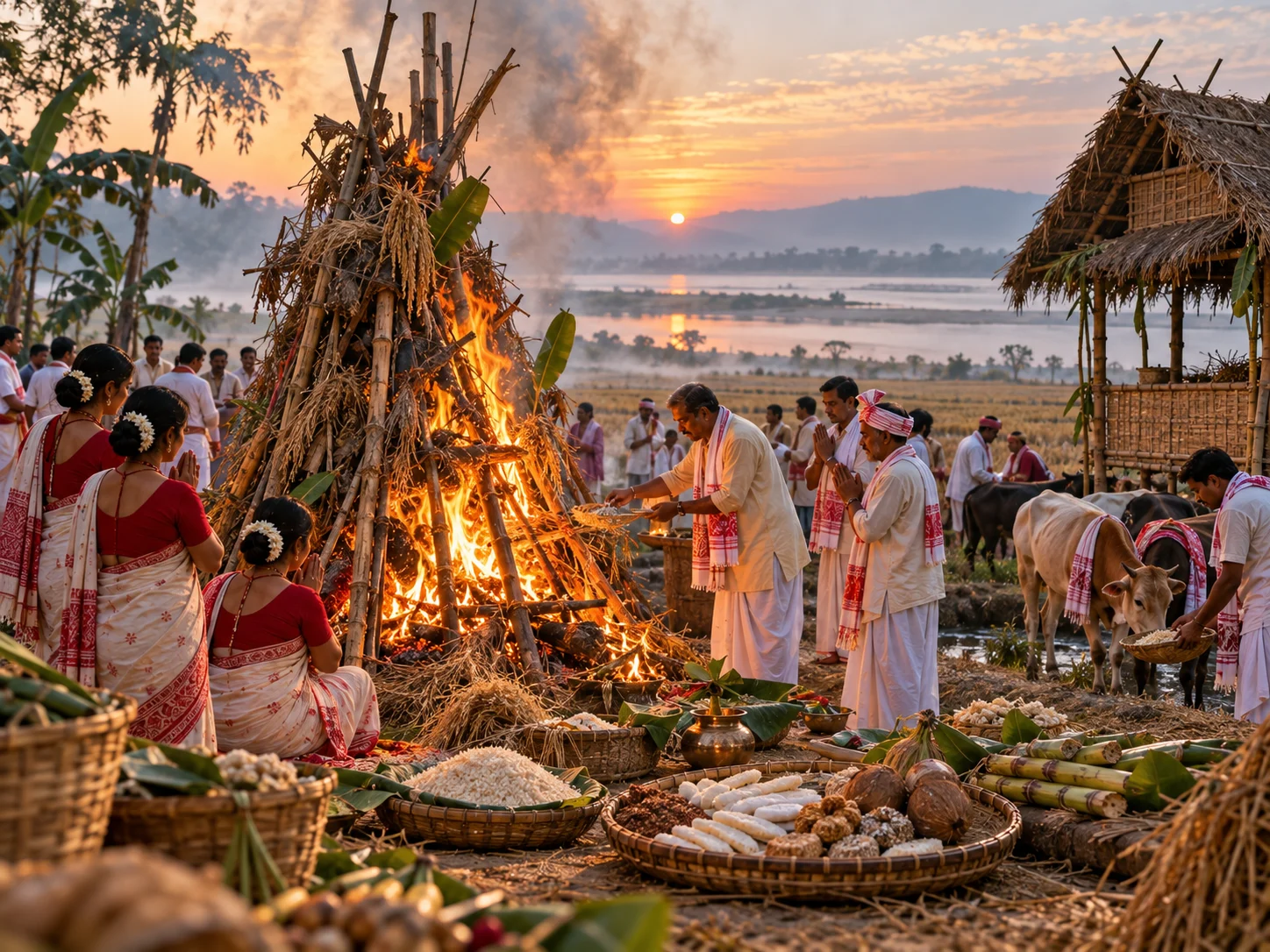
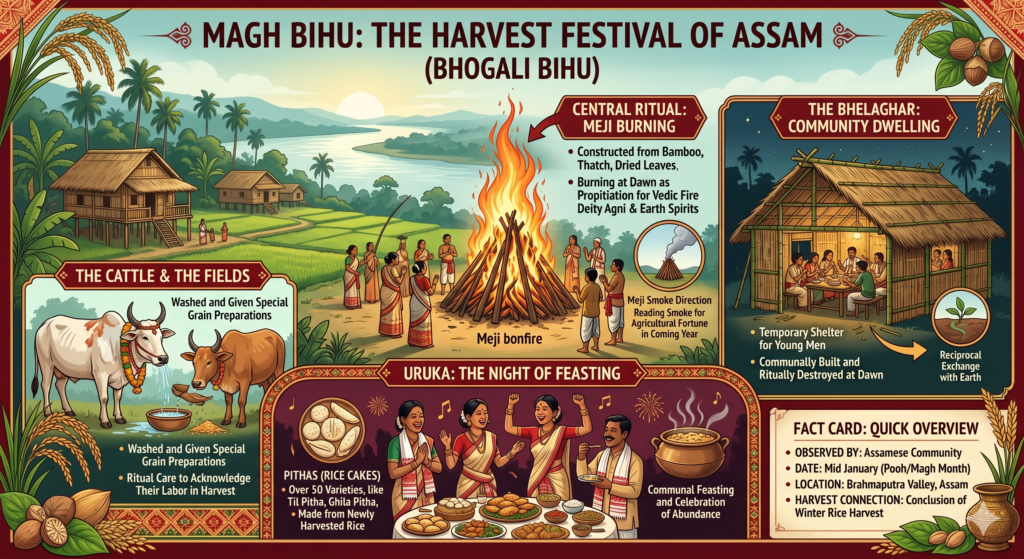
The central ritual of Magh Bihu is fire. Specifically, the construction and ceremonial burning of the Meji, a large bonfire structure built from bamboo, thatch, dried leaves, and agricultural waste in the fields or on the banks of rivers and water bodies, on the evening before the main festival day. The Meji is lit at dawn on the day of Magh Bihu itself, as the sun rises, and the community gathers around it to offer prayers, cook the first foods of the festival day in its flames, and observe the direction of its smoke and the manner of its burning for signs about the agricultural prospects of the coming year.
The connection of the Meji burning to the Vedic fire deity Agni is explicit in the ritual vocabulary of Magh Bihu. Agni is the divine mediator in the Vedic religious system, the god who carries offerings from the human realm to the divine realm through the transformative medium of fire. When offerings are placed in a Vedic sacred fire, it is Agni who conveys them to the gods for whom they are intended. The burning of the Meji operates within this same theological logic. The agricultural materials burned in the Meji, the bamboo, the thatch, the dried plant matter of the concluded harvest, are offerings conveyed through Agni to the forces governing agricultural abundance, acknowledging their role in the completed harvest and seeking their continued favour in the season to come.
But the Agni connection in Magh Bihu is layered over a fire relationship that almost certainly predates the arrival of Vedic religious frameworks in the Brahmaputra Valley. The animist agricultural traditions of the pre-Aryan communities of Northeast India understood fire as a direct spiritual force rather than as a divine intermediary, and the ritual burning of agricultural material at the end of the harvest season is a practice documented across multiple pre-Aryan agricultural cultures of the region. The Magh Bihu Meji carries both these traditions simultaneously, the Vedic theological interpretation and the older animist practice, in a layering that characterizes the festival’s mythological complexity throughout.
The Bhelaghar and the Community It Builds to Destroy
The night before Magh Bihu belongs to the Bhelaghar. This is a temporary structure, built communally from bamboo, thatch, and agricultural materials in the days leading up to the festival, large enough to shelter the young men of the community who traditionally spend the night before the festival inside it, feasting, singing, and celebrating through the hours of darkness before the dawn burning of the Meji.
The Bhelaghar is built to be destroyed. This is not incidental to its function. It is its function. The deliberate construction of a dwelling structure followed by its deliberate ritual destruction at dawn is one of the most ancient forms of agricultural sacrifice documented across multiple world cultures, an enactment of the principle that what the earth gives must be returned to the earth in order for the cycle of giving to continue.
The mythological logic of the Bhelaghar’s construction and destruction connects to broader Assamese folk beliefs about the relationship between the community of the living and the spirits of the cultivated land. The harvest has been taken from the earth. The burning of the Bhelaghar, along with the Meji, returns something to it, completing a reciprocal exchange that keeps the relationship between human agriculture and the spiritual forces governing it in balance.
The materials used to build both the Bhelaghar and the Meji are agricultural in origin, bamboo that grew in the fields and on the field boundaries, thatch from harvested crops, dried plant matter from the concluded growing season. What is burned is not arbitrary material. It is the physical substance of the completed harvest itself, returned to the earth and the air through fire, completing a material cycle that mirrors the spiritual cycle the ritual enacts.
The foods prepared and consumed at Magh Bihu carry their own mythological weight within this framework. The rice cakes called pithas, prepared in extraordinary variety across Assamese households during the festival period, are made from the newly harvested rice. Preparing and eating pitha at Magh Bihu is an act that closes the circle of the harvest, transforming the grain that came from the earth into food that sustains the community, in a ritual context that acknowledges the sacred chain connecting seed, soil, rain, labour, harvest, and nourishment.
Rukmini Devi Arundale and the Rebirth of Bharatanatyam
The Mythology of the Earth Spirits
Beneath the Vedic framework of Agni and the agricultural sacrifice logic of the Bhelaghar, the mythological substrate of Magh Bihu includes a layer of animist belief in earth spirits and ancestral presences that is perhaps the oldest element of the festival’s religious content.
In the folk traditions of the Brahmaputra Valley, the earth is not an inert agricultural resource. It is inhabited by spirits, called by various names across the different communities of the region, who govern the fertility of the soil, the behaviour of the rains, the health of the crops, and the safety of the community through the agricultural year. These spirits require propitiation at the major turning points of the agricultural calendar, and Magh Bihu, as the culmination of the harvest year, is the most important of these propitiation moments.
The offerings made at the Meji fire in the folk tradition of Magh Bihu include not just agricultural materials but specific food items, betel nut, coconut, sugarcane, and rice preparations, that are understood as preferred by the earth spirits and ancestral presences being propitiated. The direction in which the smoke of the Meji travels is read as a communication from these presences about the agricultural conditions of the coming year. A smoke rising straight upward is auspicious. A smoke that bends toward the fields is read as a sign of particular abundance in the coming season.
This divinatory reading of the Meji smoke is not a Vedic practice. It belongs to an older system of agricultural divination that is documented across multiple tribal and pre-literate agricultural communities of Northeast India, and its preservation within the Magh Bihu ritual complex is evidence of the festival’s function as a container for religious practices that predate the Hinduization of the Brahmaputra Valley by centuries.
Uruka and the Night of Feasting
The evening before Magh Bihu, called Uruka, is in many ways the emotional heart of the festival. The word Uruka is believed to derive from an older Assamese term meaning the last night, the final evening of the Pooh month before the new agricultural cycle begins with Magh. It is the night of the Bhelaghar, the night of communal feasting, music, and the particular warmth that comes from a community gathered together at the conclusion of a shared labour.
The feasting of Uruka carries its own mythological dimension within the festival’s logic. The abundance displayed in the Uruka feast, the variety and generosity of the food prepared and shared, is itself understood as a form of acknowledgment of the harvest’s completion and a demonstration of gratitude that the spirits of the earth and the forces governing agricultural abundance can witness. To feast generously at Uruka is to show that the harvest has been sufficient, that the community is provided for, and that the reciprocal relationship between human cultivation and divine or spiritual support has been fulfilled on both sides.
The communal dimension of Uruka, the gathering of neighbours, the shared cooking and eating, the breaking of whatever social distances may have accumulated through the working year, is itself an expression of an agricultural community’s understanding that the harvest is a collective achievement rather than an individual one. The Brahmaputra Valley rice harvest requires communal labour at its most critical stages, transplanting and reaping, and the communal celebration of Uruka mirrors the communal character of the agricultural work it commemorates.
Ustad Bismillah Khan and the Shehnai That Became His Prayer
The Cattle and the Sacred Farm
One of the less discussed but ritually significant elements of Magh Bihu is the role of cattle in the festival’s observance. On the morning of Magh Bihu, cattle are washed, fed special foods, and treated with particular care and reverence in a practice that connects directly to the agricultural mythology of the festival.
In the agricultural cosmology of the Brahmaputra Valley, cattle are not simply working animals. They are participants in the agricultural cycle whose labour makes the harvest possible and whose wellbeing is therefore directly connected to the community’s agricultural fortune. The ritual care of cattle at Magh Bihu is an extension of the same propitiation logic that governs the Meji burning, an acknowledgment of the cattle’s role in the completed harvest and a reciprocal gesture of care that is understood to maintain the relationship between the community and the animals whose work sustains it.
The specific foods given to cattle on Magh Bihu morning, including special preparations of rice, sesame, and other grains, are the same foods offered in other ritual contexts to propitiate earth spirits and ancestral presences, indicating that the cattle in this context are being treated as ritual participants in the festival rather than simply as beneficiaries of agricultural prosperity. This treatment of cattle as sacred ritual participants at harvest time is a practice documented across multiple agricultural traditions of South and Southeast Asia and connects the Magh Bihu tradition to a wider regional pattern of harvest festivals in which the animals of agricultural labour receive ceremonial acknowledgment alongside the human community they serve.
The Continuity That Defies Time
Magh Bihu is a festival that has been accumulating meaning for longer than any written record of it can reach. The fire at its centre is older than the Vedic interpretation that names it as Agni’s domain. The earth spirit propitiation that shapes its offerings is older than the Hindu theological framework that the Brahmaputra Valley eventually adopted. The communal logic of the Bhelaghar, built to be destroyed so that the earth receives something back for what it gave, is as old as the agricultural civilization of the valley itself.
What makes Magh Bihu remarkable as a living tradition is not simply its antiquity but its integrity. The festival has absorbed successive religious frameworks, Vedic, Tantric, Vaishnava, without losing the animist agricultural core that gives it its particular character. The fire still burns at dawn. The smoke is still read for what it says about the coming season. The cattle are still fed with ritual care. The pitha is still made from the newly harvested rice. The community still gathers on Uruka night to feast together in acknowledgment that the harvest was a shared achievement and that the forces which made it possible deserve acknowledgment. This continuity across centuries and across the layering of religious traditions is what the Brahmaputra Valley has produced in Magh Bihu. A harvest festival that remembers, in its smoke and its fire and its feasting, that the relationship between a community and the land it cultivates is not simply agricultural. It is sacred, reciprocal, and requires tending as carefully as the rice fields themselves.
Mythological Origins of the Kumbh Mela and Descent of the Ganga
If you think you have remembered everything about this topic take this QUIZ
Results


#1. Which of the three Bihu festivals in the Assamese calendar is considered the most ancient and deeply rooted in pre-Hindu animist tradition?
#2. What is the specific agricultural significance of Magh Bihu in the Brahmaputra Valley?
#3. According to the text, which primary cultural institution in Guwahati documented that Magh Bihu preserves traces of pre-Aryan agricultural practice?
#4. What is the fundamental ritual function of constructing and deliberately destroying the Bhelaghar?
#5. In the folk traditions of Magh Bihu, how is a Meji smoke that bends toward the fields interpreted?
#6. The alternative name for Magh Bihu, Bhogali Bihu, derives from the Assamese word ‘bhog’, which translates to what?
#7. What does the word ‘Uruka’ mean in the context of the older Assamese term from which it is derived?
#8. Why are cattle treated as sacred ritual participants and given special grain preparations on Magh Bihu morning?
What is the mythological origin of Magh Bihu?
Magh Bihu’s mythological origins are multilayered, drawing from Vedic, animist, and pre-Aryan agricultural traditions. The central fire ritual connects to the Vedic deity Agni, who mediates between the human and divine realms through fire. Beneath this Vedic layer lies an older animist agricultural tradition in which earth spirits governing soil fertility are propitiated through ritual burning of agricultural materials at the conclusion of the harvest season. Together these traditions form the mythological foundation of the festival’s core rituals.u003cbru003e
What is the significance of the Meji bonfire in Magh Bihu?
The Meji is a large bonfire structure built from bamboo, thatch, and agricultural materials and burned ceremonially at dawn on the day of Magh Bihu. Its burning simultaneously functions as an offering to Agni conveyed to the forces governing agricultural abundance, a propitiation of earth spirits through the return of harvested agricultural material to the elements, and an act of agricultural divination in which the direction and behavior of the smoke is read for signs about the coming season’s prospects.u003cbru003e
What is Bhelaghar and why is it built only to be burned?
The Bhelaghar is a temporary community dwelling built from bamboo and thatch in the days before Magh Bihu, used for communal feasting and celebration on Uruka night, and then ritually burned along with the Meji at dawn on the festival day. Its deliberate construction and destruction enacts the principle of reciprocal exchange with the earth that underlies the festival’s agricultural mythology. What the earth gave through the harvest is symbolically returned through the burning, completing a cycle that the tradition understands as necessary to sustain the earth’s continued generosity in the coming agricultural year.u003cbru003e
How does Magh Bihu differ from the other two Bihu festivals?
The three Bihu festivals correspond to different moments in the Assamese agricultural calendar. Magh Bihu or Bhogali Bihu in mid January marks the end of the winter harvest and is the most ancient and mythologically complex of the three. Bohag Bihu or Rongali Bihu in mid April celebrates the beginning of the new sowing season with energetic outdoor celebration and is the most widely known internationally. Kati Bihu or Kongali Bihu in mid October is observed quietly during the growing season when the crops are still in the field and the granaries are lean, with earthen lamps lit in the fields to protect the standing rice.u003cbru003e
What role do cattle play in Magh Bihu observance?
Cattle receive ritual care and attention on Magh Bihu morning, including washing, special grain preparations, and particular reverence that elevates them beyond their everyday agricultural role. Within the festival’s mythological framework, cattle are understood as sacred participants in the agricultural cycle whose labor makes the harvest possible. The specific food offerings given to cattle on Magh Bihu morning are identical in character to offerings made to earth spirits in other ritual contexts, indicating that the cattle are being treated as ritual participants in the festival’s propitiation structure.u003cbru003e
Sources & References
Magh Bihu’s layered mythological foundations in Vedic and animist traditions — Magh Bihu’s mythology draws from Vedic interpretations centred on Agni as the divine mediator of offerings, layered over older pre-Aryan animist agricultural traditions of earth spirit propitiation documented across multiple tribal communities of Northeast India that predate the Hinduization of the Brahmaputra Valley.
The Meji bonfire ritual as simultaneous religious and divinatory practice — The central ritual burning of the Meji at dawn on Magh Bihu serves simultaneously as an offering to Agni conveyed to forces governing agricultural abundance, as propitiation of earth spirits through return of harvested materials to the elements, and as agricultural divination through reading the direction and behaviour of the smoke for signs of coming seasonal conditions.
The Bhelaghar’s ritual destruction as reciprocal agricultural exchange — The deliberate construction and burning of the Bhelaghar temporary dwelling enacts an agricultural sacrifice principle documented across multiple world cultures in which what the earth gave through harvest must be returned to earth to sustain the cycle of continued agricultural generosity in the coming year.
Regional variations in Magh Bihu practice across Assamese communities — Documentation by the North East Zone Cultural Centre identifies significant variations in Magh Bihu observance across different districts and communities of Assam, with hill district versions preserving more explicitly animist earth spirit propitiation frameworks while valley versions show greater Vedic theological reinterpretation.
The ritual status of cattle as sacred participants in Magh Bihu observance — The special care, washing, and grain offerings given to cattle on Magh Bihu morning, identical to offerings made to earth spirits in other ritual contexts, indicate that cattle are understood within the festival’s mythology as sacred participants in the agricultural cycle rather than simply as working animals or agricultural beneficiaries.