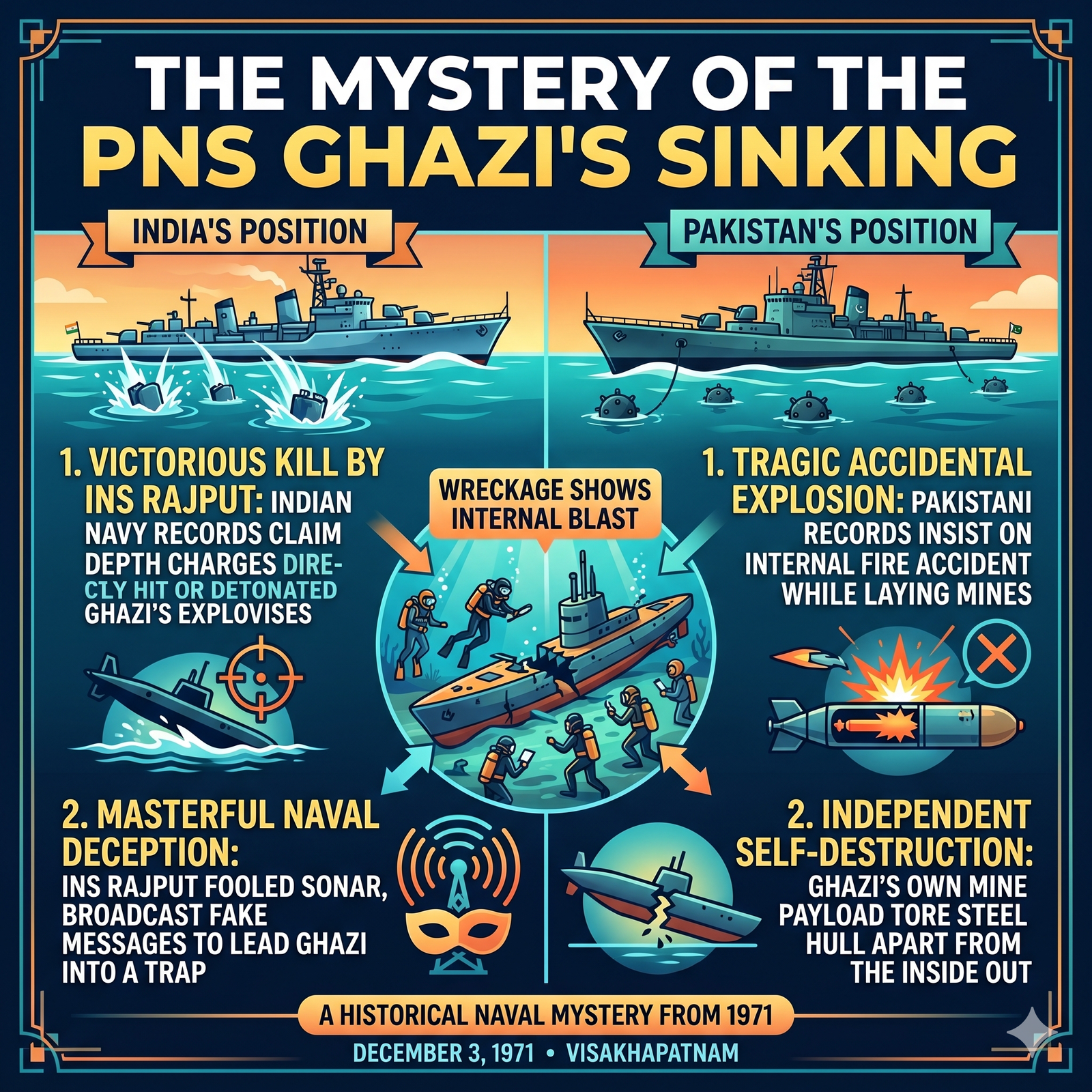
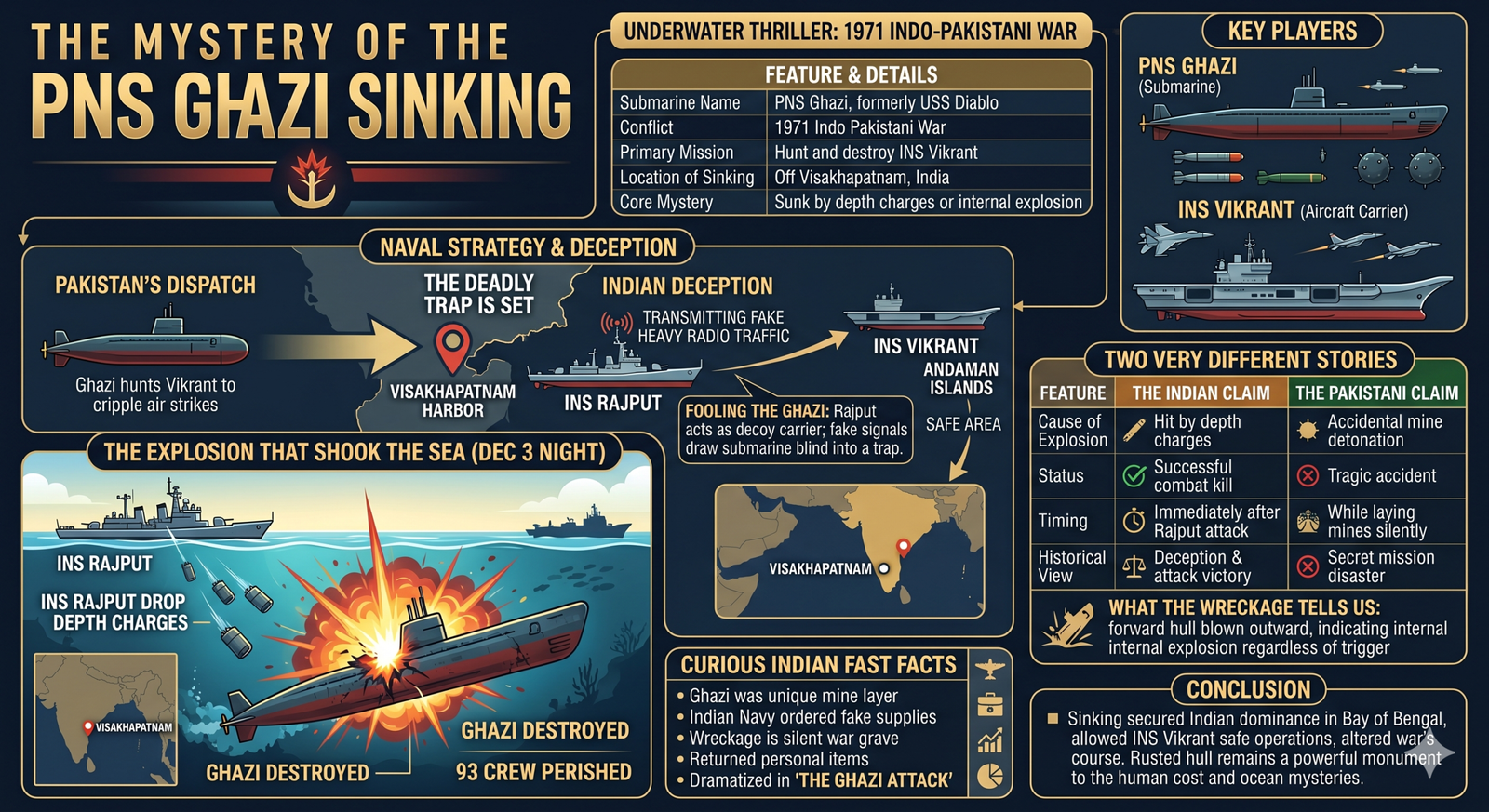
During the dark and tense days of the nineteen seventy one Indo Pakistani war the deep waters of the Bay of Bengal became the stage for a legendary underwater thriller. Pakistan dispatched its most deadly weapon the PNS Ghazi to silently hunt down and destroy India's majestic aircraft carrier the INS Vikrant. However the Indian Navy launched a brilliant masterclass in military deception hiding the carrier and laying a deadly trap near the coast of Visakhapatnam. On the night of December third a massive underwater explosion shook the ocean completely destroying the Ghazi. To this day a fierce historical debate continues. The Indian Navy claims a victorious kill using depth charges while Pakistan insists it was a tragic accidental internal explosion.| Feature | Details |
| Submarine Name | PNS Ghazi (formerly USS Diablo) |
| Conflict | 1971 Indo Pakistani War |
| Primary Mission | Hunt and destroy INS Vikrant |
| Location of Sinking | Off the coast of Visakhapatnam, India |
| Core Mystery | Sunk by Indian depth charges or an internal mine explosion |
When two nations go to war the battles are not just fought in the sky or on the bloody ground. Some of the most terrifying and strategic warfare happens completely out of sight deep beneath the crushing waves of the ocean. In the winter of nineteen seventy one the Indian subcontinent was on the absolute brink of a massive war. While armies marched toward the borders a completely silent and deadly hunter was slipping quietly through the dark waters of the Bay of Bengal.
This hunter was the PNS Ghazi a massive American built submarine loaned to the Pakistani Navy. Its mission was incredibly clear and highly dangerous. It had to swim thousands of miles around the Indian peninsula, sneak into the eastern waters, and sink the ultimate pride of the Indian Navy: the aircraft carrier INS Vikrant. What followed was a brilliant game of military chess, ending in a massive underwater explosion that remains one of the most debated naval mysteries of the modern era.
Milestones of Balraj Sahni’s Acting Career
The Pride of the Pakistani Navy
To understand the sheer terror this submarine caused we must look at its immense power. Originally named the USS Diablo it was a massive World War Two era submarine that the United States had leased to Pakistan. It was heavily armed capable of carrying deadly torpedoes and laying massive underwater mines. For the Pakistani Navy the Ghazi was their ultimate ace card.
The military leaders in Pakistan knew that if they could successfully sink the INS Vikrant they would completely cripple India’s ability to launch fighter jets over East Pakistan (which is modern day Bangladesh). Sinking the carrier would be a massive psychological and tactical victory. So in utter secrecy the Ghazi was dispatched on its long, silent journey toward the eastern coast of India.
The Mathematical Genius of Aryabhatta
The Brilliant Indian Deception
The Indian Navy was not foolish. The naval intelligence officers heavily suspected that the Ghazi was prowling the waters looking for their prized aircraft carrier. They knew that if the Vikrant stayed near the major port of Visakhapatnam it would be a sitting duck. So the Vice Admiral made a completely brilliant and daring decision. He ordered the INS Vikrant to quietly sail far away to the remote and safe waters of the Andaman and Nicobar Islands.
But simply moving the ship was not enough. They needed to completely fool the Ghazi into thinking the aircraft carrier was still sitting perfectly in Visakhapatnam. To pull off this massive deception they used an aging destroyer named the INS Rajput.
The Deadly Trap is Set
The Indian Navy started broadcasting fake, heavy radio traffic from Visakhapatnam making it sound like the massive aircraft carrier was ordering supplies and preparing its crew locally. The INS Rajput began deliberately acting like the Vikrant, generating heavy signals to completely confuse the enemy sonar. The trick worked absolutely perfectly. The commander of the Ghazi intercepted the fake messages and steered his massive submarine straight toward the heavily heavily guarded port of Visakhapatnam, walking completely blind into a deadly naval trap.
How Bhāskara I Decoded the Secrets of 7th-Century Science
The Explosion That Shook the Sea
On the dark night of December third the tension reached its absolute peak. The INS Rajput was sailing out of the Visakhapatnam harbor. Suddenly the ship’s navigation officer noticed a severe disturbance in the water. Believing that a submarine was lurking directly below them the captain of the Rajput instantly ordered his crew to drop heavy depth charges into the dark ocean.
A few moments later a massive, deafening underwater explosion completely rocked the sea. The blast was so incredibly powerful that it shook the window panes of houses sitting on the coastline miles away. The mighty PNS Ghazi, the absolute pride of the Pakistani Navy, was instantly blown completely apart, sinking to the cold, muddy bottom of the ocean along with all ninety three of its brave crew members.
Two Very Different Stories
While there is absolutely no doubt that the submarine sank that night, the exact reason why it exploded remains a massive point of historical argument.
The Indian Claim of Victory
The official Indian Navy records strongly claim that the depth charges dropped by the INS Rajput directly hit the submarine or caused a massive shockwave that detonated the torpedoes inside the Ghazi. For the Indian military, it was a perfectly executed tactical kill. The Rajput had successfully defended the harbor and eliminated the greatest naval threat of the entire war.
The Pakistani Claim of Accidental Detonation
However, the Pakistani military tells a completely different story. They firmly completely deny that the INS Rajput sank their submarine. According to their official naval records, the Ghazi was in the middle of secretly laying highly explosive underwater mines around the Visakhapatnam harbor. They claim that an internal error, a sudden fire, or a tragic accidental detonation of their own mines caused the massive explosion. They insist that the Indian depth charges either missed completely or were dropped long after the submarine had already destroyed itself.
Scientific Foundations of the Kanada Atomic Theory
What the Wreckage Tells Us
A few days after the explosion Indian Navy divers swam down into the dark, muddy water to examine the tragic wreckage. They found the submarine completely split open. The entire forward section where the torpedoes and mines were stored was completely blown outward.
Naval experts who studied the damage suggest that the massive explosion definitely happened from the inside out. This means that regardless of whether an Indian depth charge triggered it, or a tragic internal accident caused it, it was the Ghazi’s own massive payload of explosives that ultimately tore the steel hull apart. The divers recovered logbooks, secret codes, and personal items, bringing a quiet, somber closure to the underwater battle.
Quick Comparison Table
| Feature | The Indian Claim | The Pakistani Claim |
| Cause of Explosion | Hit by depth charges from INS Rajput | Accidental internal mine/torpedo detonation |
| Status of Sinking | A successful military combat kill | A tragic operational accident |
| Timing of Blast | Immediately after Rajput dropped charges | While the submarine was silently laying mines |
| Historical View | A masterclass in naval deception and attack | An unfortunate disaster during a secret mission |
Curious Indian Fast Facts
- The PNS Ghazi was the only submarine in the entire conflict region capable of laying massive underwater mines.
- To make the deception flawless, the Indian Navy even ordered massive amounts of meat and vegetables from local Visakhapatnam vendors under the name of INS Vikrant.
- The wreckage of the Ghazi still lies at the bottom of the sea near Visakhapatnam, serving as a permanent, silent war grave for the ninety three sailors who perished.
- In nineteen seventy three, India respectfully returned the recovered personal items and letters of the deceased sailors to the Pakistani government.
- The intense psychological warfare and the sinking were beautifully dramatized in the popular Indian movie “The Ghazi Attack”.
Vedic Genius of Baudhayana Mathematics and Geometry
Conclusion
The sinking of the PNS Ghazi remains one of the most absolutely gripping chapters in modern naval history. It is a story filled with brilliant tactical deception, incredible bravery, and the terrifying, silent reality of submarine warfare. Whether it was the explosive depth charges of the INS Rajput or a tragic internal spark that caused the final blast, the outcome completely changed the entire course of the nineteen seventy one war.
By eliminating the Ghazi, the Indian Navy secured total, unquestioned dominance over the Bay of Bengal, allowing the INS Vikrant to safely launch massive airstrikes that helped win the war. Today, the rusted steel hull resting quietly in the dark waters serves as a powerful, silent monument. It reminds us of the terrible human cost of war and the deep, foggy mysteries that the ocean often refuses to fully explain.
If you think you have remembered everything about this topic take this QUIZ
Results


#1. What was the original name of the PNS Ghazi before it was leased to Pakistan?
#2. What was the primary mission of the PNS Ghazi during the 1971 Indo-Pakistani War?
#3. To which location did the Indian Navy secretly move the INS Vikrant to keep it safe?
#4. Which Indian Navy ship was used to deceive the Ghazi by pretending to be the INS Vikrant?
#5. How did the Indian Navy simulate the presence of the INS Vikrant at Visakhapatnam to fool Pakistani intelligence?
#6. On what date did the massive underwater explosion occur that destroyed the PNS Ghazi?
#7. According to the Pakistani claim, what was the cause of the Ghazi’s sinking?
#8. How many crew members were lost when the PNS Ghazi sank?
What was the main mission of the PNS Ghazi?
Its primary mission was to secretly navigate to the eastern coast of India and sink the Indian aircraft carrier, INS Vikrant, to cripple India’s naval air power.
How did the Indian Navy trick the submarine?
The Indian Navy secretly moved the INS Vikrant to the Andaman Islands and used the INS Rajput to broadcast fake radio signals, tricking the Ghazi into thinking the carrier was still in Visakhapatnam.
Did India or Pakistan recover the submarine?
No, the submarine was completely destroyed and broke apart. Indian divers went down to inspect the wreckage and recover logbooks, but the heavy steel hull was left at the bottom of the sea as a war grave.
Why does Pakistan claim it was an accident?
Pakistan claims the internal explosion blew outward, suggesting that a tragic accident while arming their own mines caused the blast, rather than a direct hit from an Indian depth charge.
Where is the wreckage located today?
The wreckage of the PNS Ghazi still rests at the bottom of the Bay of Bengal, just a few nautical miles off the coast of Visakhapatnam, Andhra Pradesh.