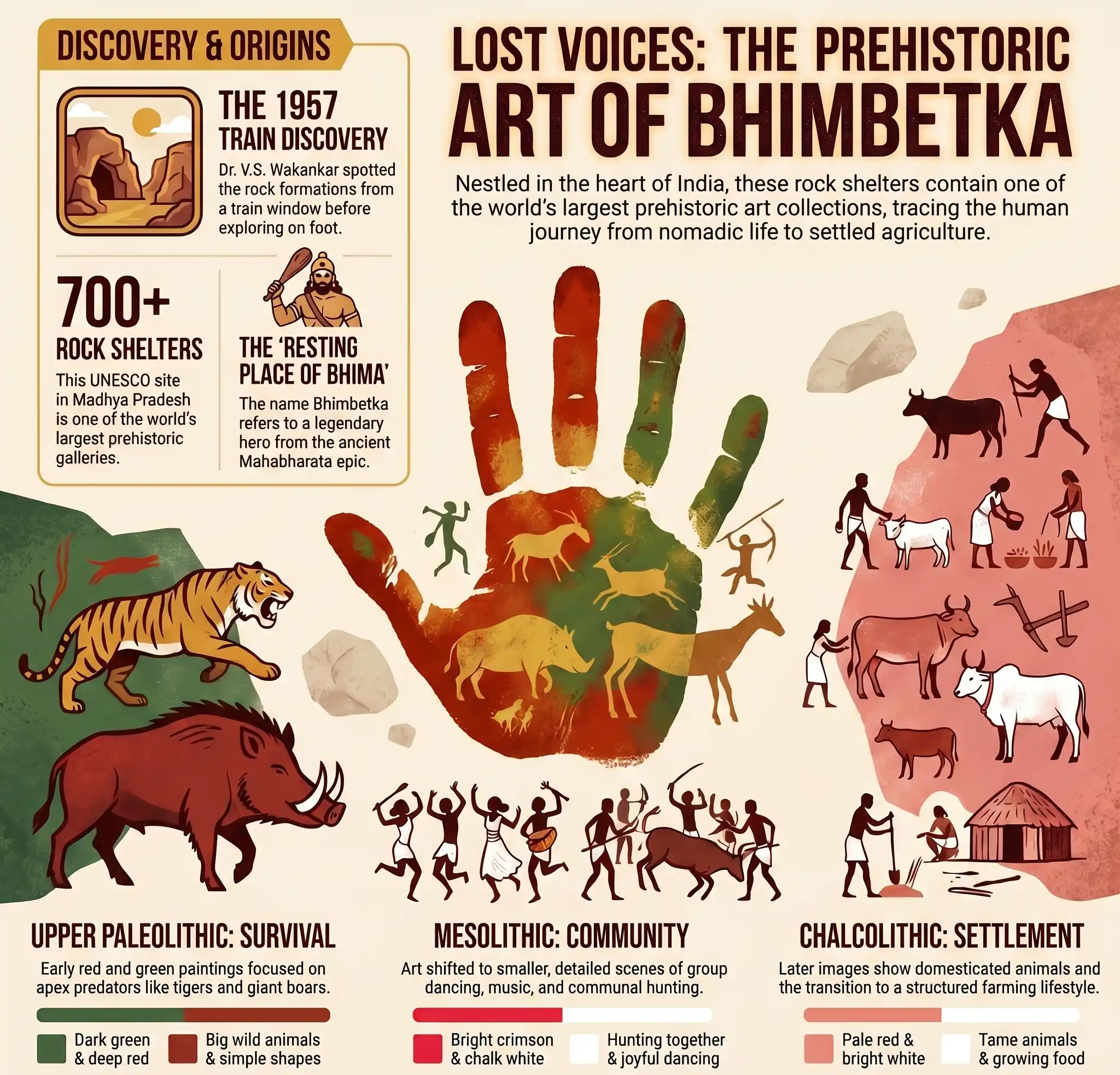
Bhimbetka, central India: for more than a hundred thousand years, people came in out of the sun and rain to the same sandstone hill, and many of them left a mark on the wall
About 45 kilometres south-east of Bhopal, where the Vindhya hills rise out of the plain, there is a ridge of sandstone that looks from a distance like the ruins of a fort.
It is not a fort. Wind and rain have worked on these rocks for a very long time, hollowing out their undersides into overhangs, alcoves and caves. There are more than 750 of them spread over seven hills, in forest that is now part of the Ratapani Wildlife Sanctuary. The best known of the hills is called Bhimbetka.
Each overhang is a roof. It keeps off the sun in May and the rain in July. There was water close by and game in the forest. For people who had no houses, it was a good place to stop.
So people stopped. Then more people came, and more after them, for longer than anyone can quite count.
For people who had no houses, it was a good place to stop.
The first marks
The earliest visitors to Bhimbetka were not people like us. They made heavy stone hand-axes and cleavers of the kind archaeologists call Acheulian, and they dropped them in the floors of the shelters.
The largest shelter is known as the Auditorium Cave. It is shaped roughly like a cross, with its main passage opening to the east. At the entrance stands a big quartzite boulder that archaeologists nicknamed Chief’s Rock, though nobody knows whether a chief ever had anything to do with it. On its face are nine small round hollows, pecked into the stone by hand. They are called cupules.
In 1990 the Australian rock art researcher Robert Bednarik was working in a trench close by. Under layers of debris left by thousands of years of living, on a boulder in an Acheulian layer, he found another cupule with a short wavy line beside it. By later estimates it is at least 125,000 years old, and it may be much older. Bednarik counts it among the oldest known marks made on purpose by human hands anywhere.
Nobody knows what a cupule meant. Each one took a long time to hammer out. Someone thought it was worth the trouble.
Nobody knows what the hollows meant. Someone thought they were worth the trouble.
Diwali: Celebrating the Triumph of Light Over Darkness
The Cosmic Geometry Behind the Sun Temple Wheels of Konark
The painters
Much later, people began to paint.
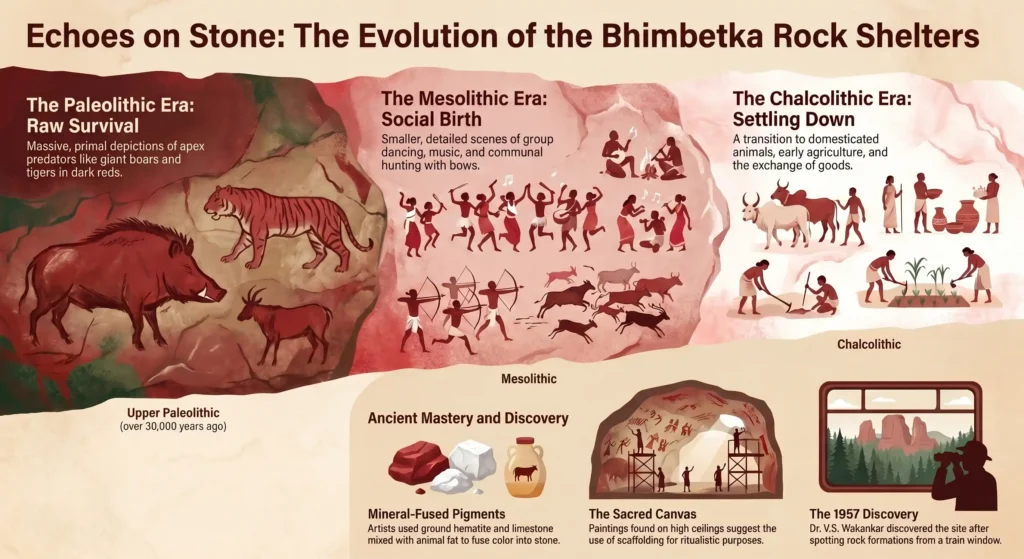
They used what the hill gave them: red from haematite, black from manganese, white, and some green and yellow. The oldest surviving paintings are usually dated to around 10,000 BCE, in the Mesolithic, though the archaeologist V. S. Wakankar believed some were far older. Somewhere between 400 and 500 of the shelters have paintings in them.
The walls are crowded with animals. On one rock, which guides call Zoo Rock, there are elephants, barasingha, bison and deer, painted over one another by different hands in different ages. Elsewhere there are rhinoceros, sloth bears, wolves, antelope, monkeys, fish, turtles, peafowl and a dog.
And there are people. They hunt with barbed spears and bows. They catch fish in nets and drive rats out of their burrows. They dance in lines. There are mothers with children, a man carrying a dead animal home, a burial. In one painting a bison charges a hunter while his two companions stand by, unable to help. In another, a whole group of hunters is running away from a rhinoceros.
These are ordinary days, drawn by the people who lived them.
In one painting a bison charges a hunter while his two companions stand by, unable to help.
New neighbours
The hill did not empty when the Stone Age ended. The painters changed.
Later walls show men on horses and elephants, carrying swords and shields, riding into battle. There are figures that look like gods, and scraps of writing. By then the hill people were trading with the farming villages of the Malwa plains, and farmers’ pottery turns up in the shelters.
Buddhists built small stupas on the nearby hills. In one shelter high on an outcrop, someone cut beds into the rock, much like the places in south India where Jain monks went to fast to death. The same shelter has a short inscription from the Maurya or Shunga period. The Archaeological Survey of India reads the evidence as people living in these shelters, one way or another, from the Stone Age down to the second century BCE.
The name came later still. Bhimbetka is usually explained as Bhima’s seat: in local belief, Bhima of the Mahabharata sat and rested here during the Pandavas’ exile.
Life of Mahavira: From Prince Vardhamana to Great Conqueror
The man on the train
In all that time, the people living around the hill knew the shelters were there. The outside world mostly did not. In 1888 a British official, W. Kincaid, mentioned Bhimbetka in a paper on the old Bhojpur lake. He was going by what adivasis had told him, and he called it a Buddhist site. Nobody followed it up.
In March 1957 Vishnu Shridhar Wakankar was on a train heading south out of Bhopal. The story is told in several versions. In most of them the train was near Obaidullaganj when he looked out of the window and saw the line of rocks on the hills. They reminded him of rock art sites he had seen in Spain and France. He got off and walked up. In his own telling, the very first shelter he went into had paintings on its walls.
Local accounts say he had help from a sadhu who had lived by the caves for years and knew them well. His ashram still stands near the entrance.
Wakankar spent the rest of his working life on rock art, and he came back to Bhimbetka more than once to dig. He received the Padma Shri in 1975. The site came under the Archaeological Survey of India in 1990, and in 2003 UNESCO listed the Rock Shelters of Bhimbetka as a World Heritage Site.
He looked out of a train window and saw a line of rocks that reminded him of Spain.
Still here
The hill had one more trick to play. In 2021 a team of scientists reported a 550-million-year-old fossil of an early animal called Dickinsonia on the roof of the Auditorium Cave. In 2023 another team looked more closely and found it was the decayed remains of a beehive.
The paintings are fading. In at least a hundred shelters they may already have worn away. The sandstone that made such good roofs is the same stone that is slowly letting the colours go.
The people have not left, though. There are 21 villages around the site today, and when UNESCO listed it, it noted how closely their customs resemble what is painted on the rocks.
A roof against the weather and a wall to draw on. That was all Bhimbetka had to offer, and for a hundred thousand years people kept taking it.
Mughal Gardens: Where Geometry Meets Paradise
Mauryan Empire: How Chandragupta and Ashoka United a Subcontinent
If you think you have remembered everything about this topic take this QUIZ
Results


#1. In which administrative district of Madhya Pradesh are the prehistoric Bhimbetka rock shelters located?
#2. Which archaeologist discovered the Bhimbetka shelters in 1957 after noticing the rock formations from a train window?
#3. Which archaeological era is characterized by smaller, detailed paintings of communal hunts, dancing, and music?
#4. What monumental transition in human history is depicted in the later Chalcolithic period paintings at Bhimbetka?
#5. What natural raw material did early humans grind into powder to produce the rich, lasting red colors on the cave walls?
#6. What do modern scholars suggest about the act of painting based on its placement high on cave walls or deep in dark recesses?
#7. According to local legends, the name ‘Bhimbetka’ translates literally to the resting place of which mythological epic hero?
#8. What surprising archaeological fact does the text mention regarding discoveries inside the primary painted caves?
Where are the Bhimbetka rock shelters located?
They are situated in the Raisen District of Madhya Pradesh, nestled peacefully within the foothills of the beautiful Vindhya Mountain range.
Who discovered the ancient caves?
The site was accidentally discovered by the prominent Indian archaeologist Dr V S Wakankar in the year nineteen fifty seven during a train journey.
What kind of colors were used for the cave paintings?
The early artists used natural mineral pigments, primarily iron rich hematite for red and chalky limestone for white, mixed with water or animal fat.
Are the caves open to the public?
Yes, a specific curated cluster of the most prominent and well preserved shelters is completely open for public viewing and tourism throughout the entire year.
Why is this considered a UNESCO World Heritage site?
It holds this highly prestigious global status because it provides a rare, continuous visual record of human evolution and cultural development from the Paleolithic era right through to the medieval period.
Sources & References
Archaeological Survey of India, “Rock Shelters of Bhimbetka” (World Heritage page) — site extent, stone tool sequence, stupas, rock-cut beds and the Maurya/Shunga inscription.
Archaeological Survey of India, Rock Shelters of Bhimbetka: Continuity through Antiquity, Art & Environment (UNESCO nomination dossier, 2003) — Kincaid’s 1888 mention, continuous occupation to the 2nd century BCE, ASI protection in 1990.
UNESCO World Heritage Centre, “Rock Shelters of Bhimbetka” (List no. 925) — the five clusters of shelters and the 21 neighbouring villages whose traditions resemble the paintings.
Robert G. Bednarik, “The cupules on Chief’s Rock, Auditorium Cave, Bhimbetka,” The Artifact 19 (1996) — the Auditorium Cave, Chief’s Rock and its cupules.
Deccan Herald, “Cavemen’s canvas” — the 1990 find of the buried cupule and line, and the dating of the Acheulian layer.
Yashodhar Mathpal, Prehistoric Painting of Bhimbetka (Abhinav Publications, 1984) — dating of the earliest paintings and the animals and scenes depicted.
Live History India, “Bhimbetka: India’s Oldest Art Gallery” — Wakankar’s train journey near Obaidullaganj in March 1957 and the sadhu who helped him.
Bradshaw Foundation, “Dr V. S. Wakankar,” with extracts from K. L. Kamat’s interview — Wakankar’s own account of getting off the train.
G. J. Retallack et al., “Dickinsonia discovered in India and late Ediacaran biogeography,” Gondwana Research 90 (2021); J. G. Meert et al., “Stinging News,” Gondwana Research 117 (2023) — the fossil claim and its correction.