Tuesday, May 19, 2026
28 °c
Moscow
Curious Indian
  • Arts & Culture
  • Festivals of India
  • Indian History
  • Indian Politics
  • Biography
    • Entertainment Personalities
    • Science Personalities
  • Unsolved India
No Result
View All Result
  • Arts & Culture
  • Festivals of India
  • Indian History
  • Indian Politics
  • Biography
    • Entertainment Personalities
    • Science Personalities
  • Unsolved India
No Result
View All Result
Curious Indian
No Result
View All Result
Home Arts & Culture

The Cosmic Geometry Behind the Sun Temple Wheels of Konark

paripurnadatta by paripurnadatta
in Arts & Culture, Indian History, Medieval India, Sculpture
Reading Time: 14 mins read
0 0
A A
Sun Temple wheels of Konark

Sun Temple wheels of Konark

Share on FacebookShare on Twitter

Table of Contents

Toggle
  • The Cosmic Geometry Behind the Sun Temple Wheels of Konark
  • The Temple as a Chariot
  • What the Spokes Are Counting
  • The 24 Wheels and the Lunar Year
  • The Sculpture Between the Spokes
  • The Nata Mandira and the Broader Complex
  • King Narasimhadeva I and the Political Context of the Temple
  • Quick Comparison Table
  • Curious Indian: Fast Facts
  • Conclusion
  • If you think you have remembered everything about this topic take this QUIZ
  • Results
    • #1. Which dynasty ruled Odisha during the construction of the Konark Sun Temple?
    • #2. What is the approximate diameter of each of the 24 carved stone wheels at Konark?
    • #3. What do the seven stone horses pulling the chariot represent besides the seven days of the week?
    • #4. How many total spokes are found on each wheel of the Konark Sun Temple?
    • #5. In the ancient Indian system of time, how long does each “prahar” last?
    • #6. How are the 24 wheels distributed across the sides of the temple platform to represent the Uttarayana and Dakshinayana?
    • #7. What type of stone was primarily used to carve the wheels of the Konark Sun Temple?
    • #8. In which year was the Konark Sun Temple inscribed as a UNESCO World Heritage Site?
    • How do the Konark Sun Temple wheels function as sundials?
    • Why are there exactly 24 wheels at the Konark Sun Temple?
    • Who built the Konark Sun Temple and when?
    • What happened to the main tower of the Konark Sun Temple?
    • Why did UNESCO inscribe the Konark Sun Temple as a World Heritage Site?
The Konark Sun Temple in Odisha was built in the 13th century as a colossal stone chariot for the sun god Surya, pulled by seven horses across the sky of the universe. Its 24 wheels, each nearly ten feet in diameter and carved with extraordinary precision, are far more than architectural ornament. They encode a complete understanding of time, from the hours of the day to the months of the year to the larger cycles of Indian cosmological thought. This piece explores the geometry embedded in those wheels, the civilization that produced them and why a UNESCO World Heritage Site on the coast of Odisha continues to surprise scholars with the depth of its mathematical and astronomical intelligence.
DetailInformation
SubjectSun Temple Wheels of Konark
LocationKonark, Odisha, India
DynastyEastern Ganga dynasty
Built ByKing Narasimhadeva I
Period13th century CE (circa 1250 CE)
Number of Wheels24 carved stone wheels
DiameterApproximately 9.5 feet each
MaterialKhondalite stone
UNESCO StatusWorld Heritage Site since 1984
SignificanceLargest stone chariot in India, cosmic calendar in stone

The Cosmic Geometry Behind the Sun Temple Wheels of Konark

Standing before the Konark Sun Temple on the coast of Odisha, the first thing that registers is scale. The temple complex is enormous, built to communicate the grandeur of the sun god Surya at a time when the Eastern Ganga dynasty was at the height of its political and cultural power. But as you move closer, scale gives way to detail, and it is in the detail that the real intelligence of the monument begins to reveal itself.

The 24 wheels that line the base of the temple’s main platform are each approximately 9.5 feet in diameter. They are carved from khondalite stone with a precision that still draws the attention of engineers and mathematicians. Their spokes, their rims and their hubs are not simply decorative. They are a clock, a calendar and a cosmological diagram, all encoded into a single repeating form placed 24 times around the body of a building conceived as the chariot of the sun. This masterful manifestation of complex science within architectural form shares an intellectual lineage with other massive stone engineering marvels of ancient India, such as the staggeringly large Gommateshwara Statue, which similarly required artisans to achieve perfect mathematical proportions from a single living rock face.

Sun Temple wheels of Konark

The Temple as a Chariot

The architectural concept behind Konark is stated clearly in the design itself. The temple is the chariot of Surya, the Vedic sun god, moving across the sky of the cosmos. Seven horses pull it, represented in carved stone at the temple’s entrance, seven being the number of days in the week and also the number of colors in the spectrum of light. The 24 wheels are the wheels of that chariot.

READ MORE:  Where Is The Lost Wealth Of Mir Osman Ali Khan

This is not a metaphor in the decorative sense. In Indian temple architecture of the medieval period, the relationship between the building and the cosmic reality it represents was understood as literal. The temple did not symbolize the chariot of the sun. It was the chariot of the sun, made present in stone, fixed at a specific location on the earth’s surface so that the sun’s actual movements could be tracked against it.

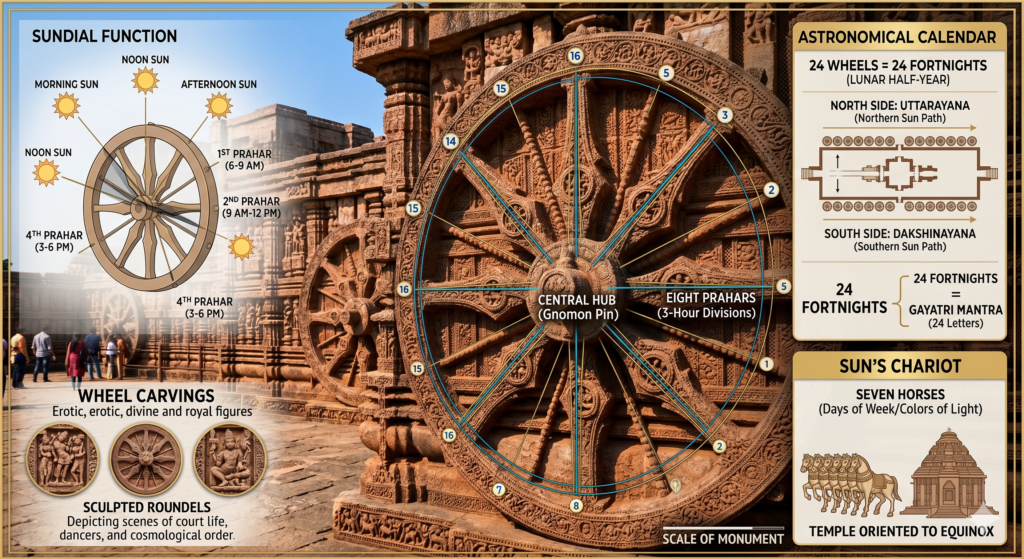
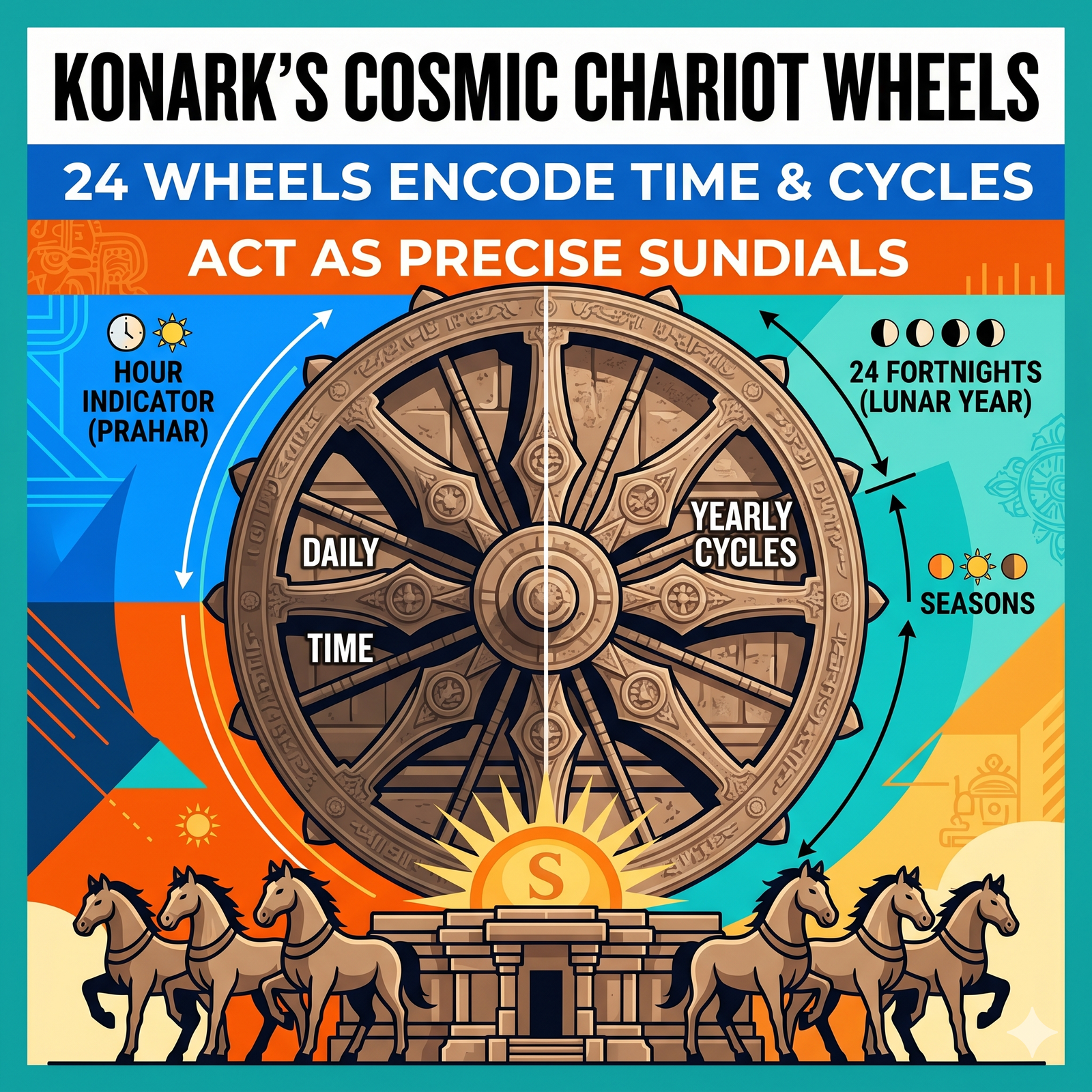
The choice of 24 wheels is itself a statement. There are 24 hours in a day, 24 fortnights in a lunar year and 24 letters in the Gayatri Mantra, the most sacred verse in the Vedic tradition and itself an invocation of the sun. The number was not chosen for convenience. It was chosen because it was already embedded in the deepest layers of the tradition the temple was built to honor.

What the Spokes Are Counting

Each wheel at Konark has eight primary spokes and eight secondary spokes, giving it 16 spokes in total. The eight primary spokes divide the wheel into the eight segments of the day recognized in the ancient Indian system of time: the eight prahars, each lasting approximately three hours, through which the full cycle of a day and night is measured.

This means that each wheel is a sundial. When the sun is at a particular position in the sky, the shadow cast by the primary spokes onto the rim of the wheel indicates which prahar of the day has been reached. The wheels are not simply carved in the right shape for this to work. They are positioned and angled so that the shadow calculations are accurate. The craftsmen of Narasimhadeva I were not decorating their building with clock imagery. They were building a working clock into the surface of their building. To fully appreciate how early civilizations used structural landscape geometry to trace grand astronomical movements, explore our detailed resource on the ancient civilizations and the vedic age at curiousindian.in.

The Nalanda Bronzes and the Buddhist Empire of the Pala Kings

The eight secondary spokes subdivide each prahar further, allowing for more precise time readings. Some scholars studying the astronomical dimensions of the Konark complex, with research documented through the Archaeological Survey of India, have noted that the wheels’ time-keeping function was likely used in practice by the temple’s priests to regulate the timing of daily rituals, which in the Surya tradition were tied precisely to the sun’s position in the sky.

The 24 Wheels and the Lunar Year

Beyond the daily time-keeping function, the 24 wheels collectively encode the structure of the lunar year. The Indian calendar divides the year into 24 fortnights, 12 of the waxing moon and 12 of the waning moon. The 24 wheels of Konark map directly onto this structure, with each wheel representing one fortnight of the year.

Twelve wheels appear on the south side of the temple platform and twelve on the north side. This division corresponds to the two halves of the year as understood in the Indian astronomical tradition: the Uttarayana, the northward journey of the sun from the winter solstice to the summer solstice, and the Dakshinayana, the southward journey from the summer solstice back to the winter solstice. The temple’s orientation is itself calibrated so that the rising sun on the equinoxes aligns with the temple’s principal axis. This structural mastery of celestial patterns reflects the same deep mechanical sophistication that would later emerge in medieval acoustics, such as the marvel of stone engineering seen in the musical pillars of Vitthala temple.

What this means in practice is that the entire building is oriented in relationship to actual solar movement. The architecture is not inspired by astronomy. It is an instrument of astronomy, embedded in the ground at a specific latitude and longitude so that the sun’s real behavior at that location can be read against the building’s geometry.

READ MORE:  Evolution of Jyothika Saravanan as a Modern Cinematic Powerhouse

The Sculpture Between the Spokes

Between the spokes of each Konark wheel, in the spaces created by the radiating stone arms, the sculptors carved decorative roundels showing figures in various attitudes: lovers, musicians, devotees, dancers, scenes of court life and daily activity. These are among the finest examples of Odishan sculptural art from the 13th century, rendered with a delicacy and expressiveness that contrasts sharply with the geometric severity of the wheel’s structural elements.

This contrast is intentional. The wheel’s geometry represents the cosmic order, the impersonal mathematical structure of time that governs all existence. The figures within the spokes represent the human world moving through that structure, the lives of ordinary and extraordinary people caught within the turning of time. Together they make a complete picture: the cosmic mechanism and the human experience of living inside it. This balance of cosmic scale with deeply localized human expression offers a compelling contrast to other monumental open air stone canvases, such as the stylized, enigmatic tribal features preserved in the Unakoti rock cut sculptures.

The imagery carved into the wheels and throughout the Konark complex is documented extensively through the records of the UNESCO World Heritage Centre, which inscribed the temple in 1984 and has supported conservation and documentation work at the site in the decades since.

The Nata Mandira and the Broader Complex

The Sun Temple at Konark consists of more than the main sanctuary. The Nata Mandira, or dance hall, stands in front of the main temple and is itself a significant structure covered in elaborate sculpture. The platform on which both buildings rest is the chariot base, and it is along this platform that the 24 wheels are arranged.

The main sanctuary tower, the deul, collapsed at some point after the temple’s construction, probably due to a combination of structural instability and the weight of the massive superstructure. What remains is the jagamohana, the assembly hall, which still stands to its full height and gives a powerful sense of the temple’s original scale. The Archaeological Survey of India has conducted extensive stabilization work on the surviving structure, and the site requires continuous conservation attention given the coastal environment and the salt-laden sea air that accelerates stone deterioration. This ongoing battle between coastal elements and ancient plaster preservation mirrors the fragile conservation landscape surrounding the exposed painted havelis of the Shekhawati murals.

King Narasimhadeva I and the Political Context of the Temple

The Konark Sun Temple was built by King Narasimhadeva I of the Eastern Ganga dynasty, who ruled Odisha from approximately 1238 to 1264 CE. The temple’s construction coincided with a period of significant military and political achievement for the Eastern Ganga kingdom. Narasimhadeva had successfully resisted Muslim incursions from the northwest and expanded his kingdom’s influence along the eastern coast of India. To see how these shifts in regional power fit into the larger chronological canvas of the subcontinent, you can study our comprehensive guide to historical events and turning points at curiousindian.in.

The temple was therefore not only a religious monument. It was a declaration of power, sovereignty and civilizational confidence. Building the largest stone chariot in India, dedicated to the most ancient and universal of Vedic deities, was a statement about the dynasty’s place in the cosmic order as well as the political one. The scale and ambition of the project communicated something that words in an inscription could not: that this kingdom was serious about its relationship with the divine forces that governed the world. This ancient deployment of pristine geometry to map cosmic order on a monumental scale served as a direct spiritual inspiration for later twentieth-century Indian visionaries, an evolution explored heavily in our study of S.H. Raza and the Bindu at curiousindian.in.

Quick Comparison Table

FeatureKonark Sun TempleBrihadeeswarar TempleKhajuraho TemplesHampi Vitthala Temple
DynastyEastern GangaCholaChandelaVijayanagara
Period13th century CE11th century CE10th to 11th century CE15th to 16th century CE
Primary MaterialKhondalite stoneGraniteSandstoneGranite
Distinctive Feature24 cosmic chariot wheelsTowering vimanaErotic and devotional sculptureMusical pillars, stone chariot
UNESCO StatusWorld Heritage SiteWorld Heritage SiteWorld Heritage SiteWorld Heritage Site
Primary DeitySurya, the Sun GodShivaShiva and VishnuVishnu

Curious Indian: Fast Facts

  • The 24 wheels of Konark correspond to the 24 hours in a day, the 24 fortnights in a lunar year and the 24 letters of the Gayatri Mantra.
  • Each wheel has 16 spokes, eight primary and eight secondary, corresponding to the eight prahars or time divisions of the Indian day.
  • The wheels function as working sundials, with shadows cast by the spokes indicating the time of day when the sun is visible.
  • The temple is oriented so that the rising sun on the equinoxes aligns with the building’s principal axis.
  • Seven horses are depicted pulling the temple chariot, representing the seven days of the week and the seven colors of light.
  • King Narasimhadeva I of the Eastern Ganga dynasty built the temple around 1250 CE.
  • The main sanctuary tower collapsed after the temple’s construction, and what survives is primarily the assembly hall and the chariot platform with its 24 wheels.
  • UNESCO inscribed the Konark Sun Temple as a World Heritage Site in 1984.
READ MORE:  The British East India Company: How a Corporation Conquered India

Conclusion

The wheels of Konark are one of the most concentrated expressions of mathematical and astronomical intelligence in the history of Indian architecture. They are not clocks that happen to be decorative or decorations that happen to tell time. They are instruments designed by people who understood the movements of the sun with sufficient precision to encode those movements into stone at a scale that could be read from a distance and used in daily practice.

What makes them remarkable beyond their technical achievement is the completeness of the vision they represent. The craftsmen of Narasimhadeva I did not simply build a temple and add astronomical features to it. They conceived the entire building as a cosmic instrument, oriented it in relation to actual solar behavior at its specific location on the earth’s surface, and then filled its geometric framework with some of the most expressive figurative sculpture in Indian art history.

The result is a monument that works on every level simultaneously: as a working timekeeper, as a cosmological diagram, as a political declaration and as a place of extraordinary visual beauty. After seven centuries of monsoons, salt air and the slow work of time, it is still doing all of these things. The wheels are still turning, in the only sense that matters for stone. They are still being read.

If you think you have remembered everything about this topic take this QUIZ


Results

Share your score!
Tweet your score!
Tweet your score!
Share to other
QUIZ START

#1. Which dynasty ruled Odisha during the construction of the Konark Sun Temple?

Previous
Next

#2. What is the approximate diameter of each of the 24 carved stone wheels at Konark?

Previous
Next

#3. What do the seven stone horses pulling the chariot represent besides the seven days of the week?

Previous
Next

#4. How many total spokes are found on each wheel of the Konark Sun Temple?

Previous
Next

#5. In the ancient Indian system of time, how long does each “prahar” last?

Previous
Next

#6. How are the 24 wheels distributed across the sides of the temple platform to represent the Uttarayana and Dakshinayana?

Previous
Next

#7. What type of stone was primarily used to carve the wheels of the Konark Sun Temple?

Previous
Next

#8. In which year was the Konark Sun Temple inscribed as a UNESCO World Heritage Site?

Previous
Finish

How do the Konark Sun Temple wheels function as sundials?

Each wheel has eight primary spokes that divide it into eight equal segments corresponding to the eight prahars, the time divisions of the ancient Indian day. When sunlight falls on the wheel, the shadow cast by the spokes onto the rim indicates which prahar has been reached. The wheels are positioned and angled so that this shadow calculation works accurately at the temple’s specific geographic location on the Odisha coast.

Why are there exactly 24 wheels at the Konark Sun Temple?

The number 24 was chosen because it carries multiple layers of meaning simultaneously within the Indian intellectual tradition. There are 24 hours in a day, 24 fortnights in a lunar year and 24 letters in the Gayatri Mantra, the Vedic verse that is itself an invocation of the sun. The number connects the temple’s architecture to time, to the cosmic calendar and to the deepest layer of Vedic solar worship.

Who built the Konark Sun Temple and when?

The temple was built by King Narasimhadeva I of the Eastern Ganga dynasty of Odisha, around 1250 CE. The Eastern Ganga dynasty was at the height of its political and military power during this period, having successfully resisted invasion from the northwest. The temple was both a religious monument and a declaration of dynastic power and civilizational confidence.

What happened to the main tower of the Konark Sun Temple?

The main sanctuary tower, called the deul, collapsed at some point after the temple’s original construction. The exact cause and timing of the collapse are debated, with theories ranging from structural instability in the original design to damage from later military activity. What survives today is primarily the jagamohana or assembly hall, which still stands to its full height, along with the chariot platform and its 24 wheels.

Why did UNESCO inscribe the Konark Sun Temple as a World Heritage Site?

UNESCO inscribed the Konark Sun Temple in 1984 on the basis of its outstanding universal value as an exceptional example of medieval Indian temple architecture, its integration of astronomical and mathematical knowledge into architectural form, and the quality of its sculptural decoration. The temple is recognized as one of the finest surviving examples of the Odishan architectural tradition and as a monument of global significance in the history of human creative achievement.

Tags: Ancient Indian astronomyEastern Ganga dynastyIndian cosmic geometryIndian sundialKhondalite stoneKonark Sun TempleNarasimhadeva IOdisha heritageSun Temple wheelsUNESCO World Heritage India
ShareTweetPin
paripurnadatta

paripurnadatta

Related Posts

Khudiram Bose
Biography

The Final Letters of Khudiram Bose and Soul of Young Bengal

May 19, 2026
Bhikaiji Cama
Biography

How Madam Bhikaiji Cama Unfurled India’s Flag in Germany

May 19, 2026
Matangini Hazra
Biography

Matangini Hazra: The Widow Who Walked Into Gunfire

May 19, 2026
No Result
View All Result

Stay Updated

  • Trending
  • Latest
Life of Mahavira: From Prince Vardhamana to Great Conqueror

Life of Mahavira: From Prince Vardhamana to Great Conqueror

April 11, 2026
Life of Buddha: The Journey to Enlightenment

Life of Buddha: The Journey to Enlightenment

April 11, 2026
Christmas in India

Christmas in India: A Festive Blend of Faith, Flavors, and Tradition

April 11, 2026
From Shimla to Stardom: The Complete Biography of Anupam Kher

From Shimla to Stardom: The Complete Biography of Anupam Kher

April 11, 2026
Khudiram Bose

The Final Letters of Khudiram Bose and Soul of Young Bengal

May 19, 2026
Bhikaiji Cama

How Madam Bhikaiji Cama Unfurled India’s Flag in Germany

May 19, 2026
Matangini Hazra

Matangini Hazra: The Widow Who Walked Into Gunfire

May 19, 2026
Gommateshwara statue

Gommateshwara Statue and the Philosophy of Inner Peace

May 19, 2026

Widget Title

Facebook Twitter Youtube RSS
Curious Indian Logo

Explore the soul of Bharat with Curious Indian. A definitive guide to Indian history, arts, culture, biographies, and the events that defined our future.

Follow us on social media:

Recent News

  • The Final Letters of Khudiram Bose and Soul of Young Bengal
  • How Madam Bhikaiji Cama Unfurled India’s Flag in Germany
  • Matangini Hazra: The Widow Who Walked Into Gunfire

Category

  • Ancient Civilizations & The Vedic Age
  • Architecture
  • Artists & Cultural Icons
  • Arts & Culture
  • Battles of India
  • Biography
  • Business & Industrialists
  • Colonial India
  • Cultural Insights
  • Dance & Music
  • Entertainment Personalities
  • Festivals of India
  • Freedom Fighters
  • Freedom Movement
  • Historical Events & Turning Points
  • Indian History
  • Indian Politics
  • Major Festivals
  • Medieval India
  • North East India
  • Paintings & Visual Arts
  • Political Leaders
  • Post-Independence India
  • Regional Culture
  • Religious & Spiritual Figures
  • Science Personalities
  • Scientific Discoveries
  • Sculpture
  • Social Issues
  • SOCIETY & MYSTERIES
  • Strange & Unknown Stories
  • Textiles & Handicrafts
  • Uncategorized
  • Unsolved India
  • Unsung Heroes

© 2026 Curious Indian- Everything about India

Welcome Back!

Login to your account below

Forgotten Password?

Retrieve your password

Please enter your username or email address to reset your password.

Log In

Add New Playlist

No Result
View All Result
  • Arts & Culture
  • Festivals of India
  • Indian History
  • Indian Politics
  • Biography
    • Entertainment Personalities
    • Science Personalities

© 2026 Curious Indian- Everything about India

This website uses cookies. By continuing to use this website you are giving consent to cookies being used. Visit our Privacy and Cookie Policy.
Are you sure want to unlock this post?
Unlock left : 0
Are you sure want to cancel subscription?
×