Nalanda, 1921: an archaeologist dug a fire-blackened copper plate out of a ruined monastery. It told how a king from across the sea had asked a Pala emperor for help
In 1921 the archaeologist Hirananda Shastri was excavating the ruins of Nalanda, in Bihar, when he found a copper plate in the antechamber of one of the monasteries.
It was crusted with debris, and it had been through a fire. The building around it had burned down at some point, and the plate had lain in the ashes ever since. When it was cleaned, it turned out to be almost complete: a long Sanskrit text, 42 lines on the front and 24 on the back, with a heavy seal fixed to the top.
Related to article: Five Villages · Source: Wikimedia Commons · SpeakingArch · CC BY-SA 4.0
The seal showed a wheel with a deer on either side, the emblem of the Buddha’s first sermon at Sarnath. Below it was a name: Devapala.
The building around it had burned down, and the plate had lain in the ashes ever since.
The emperor
Devapala was the third king of the Pala dynasty, which ruled Bengal and Bihar from the middle of the eighth century. The Palas were Buddhists, and in their time Nalanda was the most famous monastery in Asia. Monks came to it from China, Tibet, Nepal and the islands of Southeast Asia to study, copy books and argue.
The plate is dated in the thirty-ninth year of Devapala’s reign, around the middle of the ninth century. It is a royal order, and it begins with a message that had come a very long way.
The Ethics Of Entomophagy In Northeast India
The Surprising Health Benefits Of Black Rice Of Manipur
The envoy
The message came from Balaputradeva, the Maharaja of Suvarnadvipa, the Golden Island, which historians identify with Sumatra. The plate gives his family in some detail. He was of the Sailendra line, the son of a king of Java, and his mother was a queen named Tara.
Balaputra was a Buddhist, and he wanted a monastery of his own at Nalanda, where monks from his side of the sea could live and study. But a monastery is not just a building. It needs food, lamps, robes and repairs, every year, for as long as it stands. So he sent an envoy to Devapala with a request. Would the emperor help pay for it?
Devapala said yes. He gave the monastery five villages in the country around Rajagriha. From then on, their revenue would go to Nalanda.
A monastery is not just a building. It needs food, lamps, robes and repairs, every year, for as long as it stands.
What the villages paid for
The plate sets out where the money was to go. Some of it paid for worship of the Buddha. Some paid for the monks who lived there, the sangha of the four quarters, and their robes, alms, beds and medicine. Some paid for the copying of books. The rest went on keeping the monastery in repair.
It also lists what came with the villages: their fields, their pasture and grass, their mango and mahua trees, their wet land and dry land. They were freed from the usual royal taxes and levies, and the king’s soldiers and officials were forbidden to trouble them.
The Baffling Mystery Of The MV Jian Seng Ghost Ship
The workshops
A monastery like this was also a place where things were made.
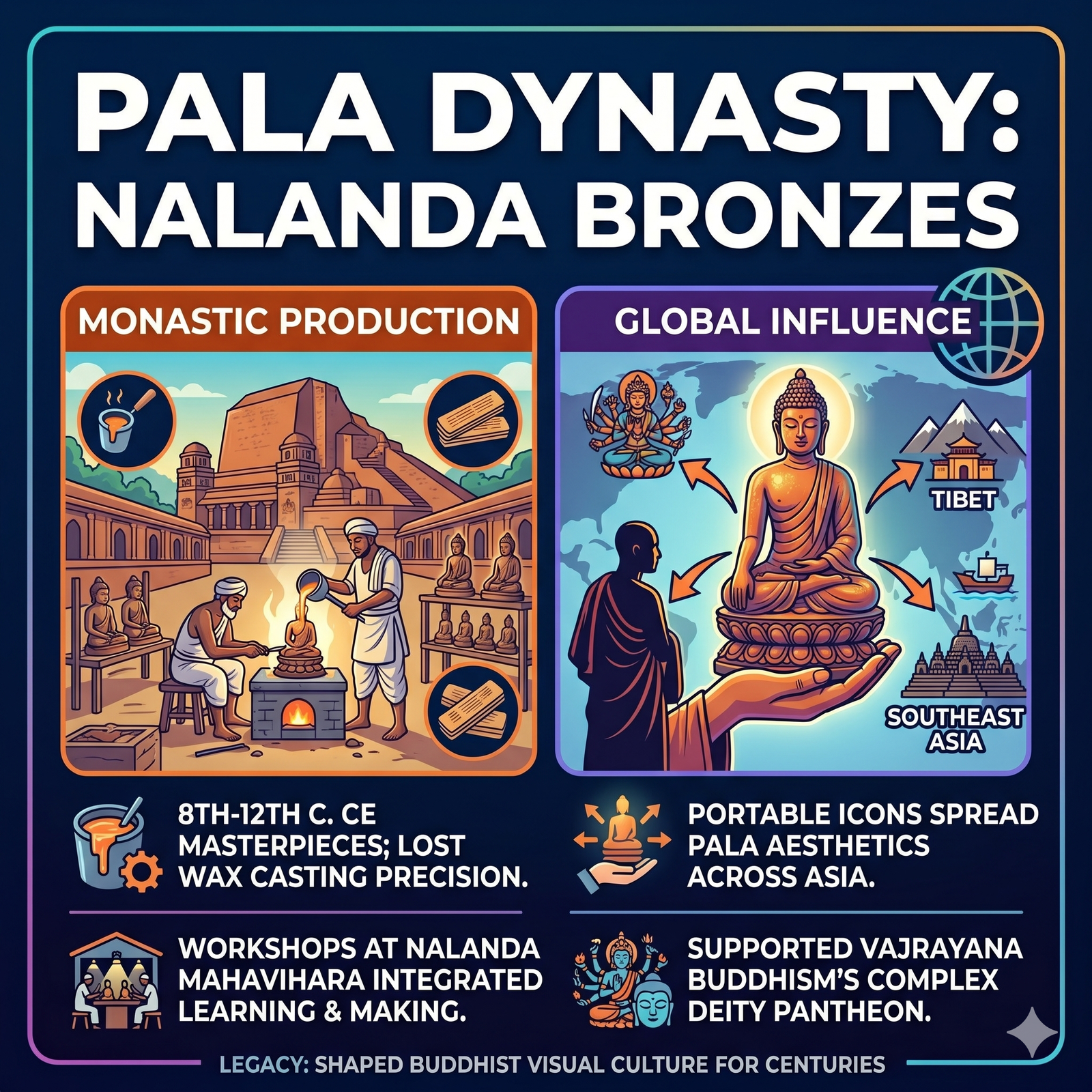
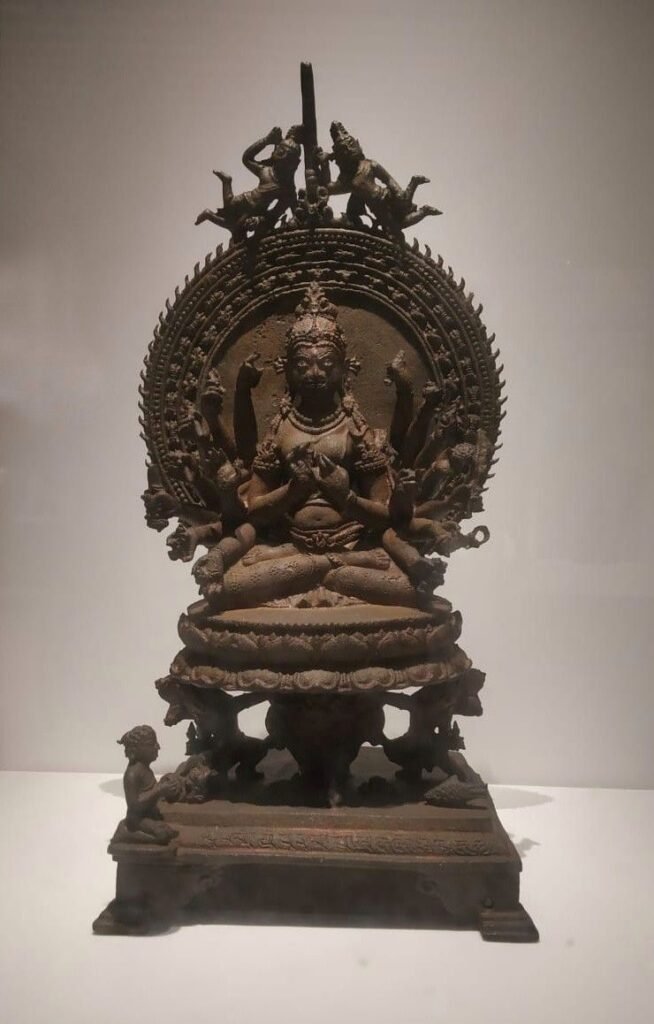
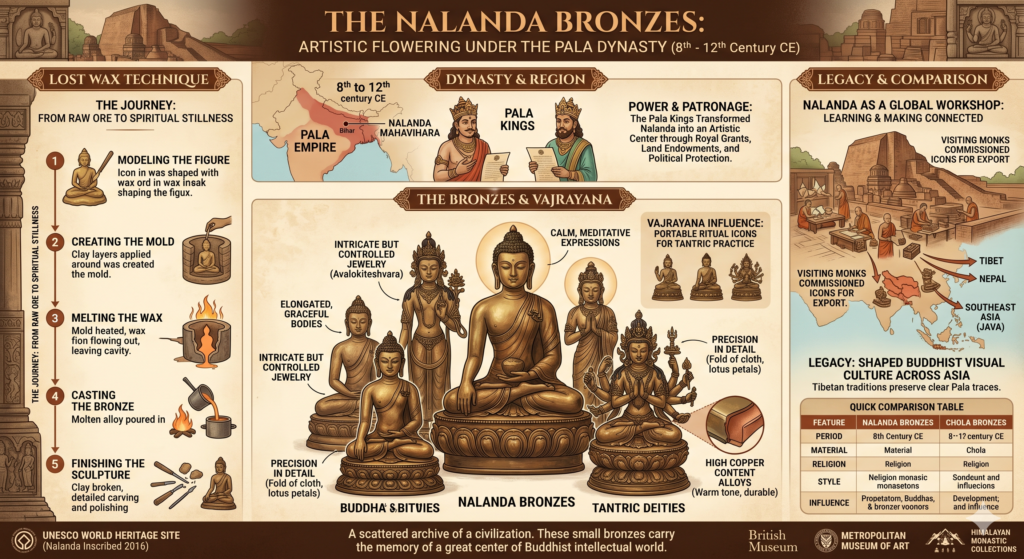
The excavations at Nalanda have turned up more than five hundred bronze images, dating from the centuries after the Guptas through the Pala period. They were cast by the lost-wax method. A figure was modelled in wax over a clay core, covered in more clay and heated. The wax ran out, and molten metal was poured into the space it left behind. Each mould could be used only once.
Most of the Nalanda bronzes are small: Buddhas, bodhisattvas, Tara and other gods, many of them only a few inches high. They were made for private worship, and they were light enough to carry. A monk going home to Sumatra or Java or Tibet could take one with him in his bag.
Many of them did travel. Bronzes from Java of the eighth and ninth centuries are so close to Pala work that it can be hard to tell them apart. The same style shaped Buddhist art in Nepal, Tibet, Burma and Thailand.
The Tibetan historian Taranatha, writing in 1608, named the two men he believed had started it all: a father and son, Dhiman and Bitpalo, who worked in the time of Dharmapala and Devapala. Taranatha was writing some eight hundred years later, and nothing else confirms them. But no other names from those workshops have come down to us.
A monk going home to Sumatra or Java could take one with him in his bag.
Still there
Nalanda was sacked around 1200, and the monks scattered. The monastery where the plate lay had already burned at some point, and the plate lay buried in its ashes for centuries.
Many of the bronzes are now in the Nalanda Museum and in Patna. Their style lived on long after the workshops that made them had gone, in the temple images of East Java and the monasteries of Tibet.
The copper-plate names five villages granted for the support of the monastery, four of them described as lying in the Rajagriha area. Modern attempts to identify the individual villages are not equally secure. For centuries, however, the grant recorded a striking arrangement: revenue from villages in Bihar was assigned to support a monastery built at Nalanda at the request of a ruler from Suvarnadvipa.
Where Is The Lost Wealth Of Mir Osman Ali Khan
Finding Answers To The Disappearance Of The Sarasvati River
If you think you have remembered everything about this topic take this QUIZ
This quiz no longer existsWhat are the Nalanda bronzes and why are they important?
The Nalanda bronzes are Buddhist bronze sculptures produced primarily during the Pala period between the 8th and 12th centuries CE in eastern India. They are important because they represent one of the highest achievements of Indian metal sculpture and had enormous influence on Buddhist art across Tibet, Nepal and Southeast Asia.
Which Pala kings were most responsible for supporting Nalanda?
Dharmapala and Devapala were especially important patrons of Nalanda. They expanded the university, provided land grants and ensured political protection for Buddhist institutions. Their support helped transform Nalanda into both a major intellectual center and a workshop for artistic production.
Where can the Nalanda bronzes be seen today?
Examples of Nalanda bronzes are housed in institutions including the National Museum in New Delhi, the Indian Museum in Kolkata, the British Museum and the Metropolitan Museum of Art. Important examples also survive in monasteries across Tibet and Nepal.
How were the Nalanda bronzes made?
Most Nalanda bronzes were created using the lost wax casting method. Artists first modeled figures in wax, covered them with clay molds and heated the molds until the wax melted away. Molten bronze was then poured into the cavity left behind. After cooling, the clay mold was broken and the sculpture refined through carving and polishing.
Why did Tibetan Buddhist art become influenced by the Pala style?
Monks traveling between Nalanda and Tibet carried manuscripts, rituals and bronze icons with them. After the destruction of Nalanda in the late 12th century, many monks fled to Tibet, bringing artistic traditions with them. As a result, Tibetan Buddhist art absorbed Pala proportion systems, iconography and bronze casting techniques.
Sources & References
Hirananda Shastri, “The Nalanda Copper-plate of Devapaladeva,” Epigraphia Indica vol. 17 (1924), pp. 310–327 — the 1921 find, the burned monastery, the text and its provisions.
Indian Culture portal (Ministry of Culture), “Nalanda Copper Plate Grant” — the five villages near Rajagriha, the upkeep of monks and the copying of manuscripts, and the regnal year 39.
Piprahwa Exhibition, “Nalanda Copperplate Grant” (Exhibit 60) — the dharmachakra and deer seal, and the line counts on each face.
Encyclopaedia Britannica, “Pala art” and “Eastern Indian bronze” — lost-wax casting, small portable images for private worship, Nalanda and Kurkihar as production centres, and their influence on Java, Burma, Thailand, Nepal and Tibet.
Parashuram Pandey, Nalanda Bronzes in Patna Museum (Patna Museum) — more than 500 bronze images from the Nalanda excavations.
Taranatha, History of Buddhism in India (1608), tr. Lama Chimpa and Alaka Chattopadhyaya (Motilal Banarsidass) — Dhiman and Bitpalo.
Hirananda Shastri, “The Nalanda Copper-Plate of Devapaladeva,” Epigraphia Indica XVII (1923–24), and N. G. Majumdar’s re-edition — the five villages granted to support the monastery and their location in the Rajagriha/Gaya region.