How Ilaiyaraaja carried the music of a Theni village into the film orchestra
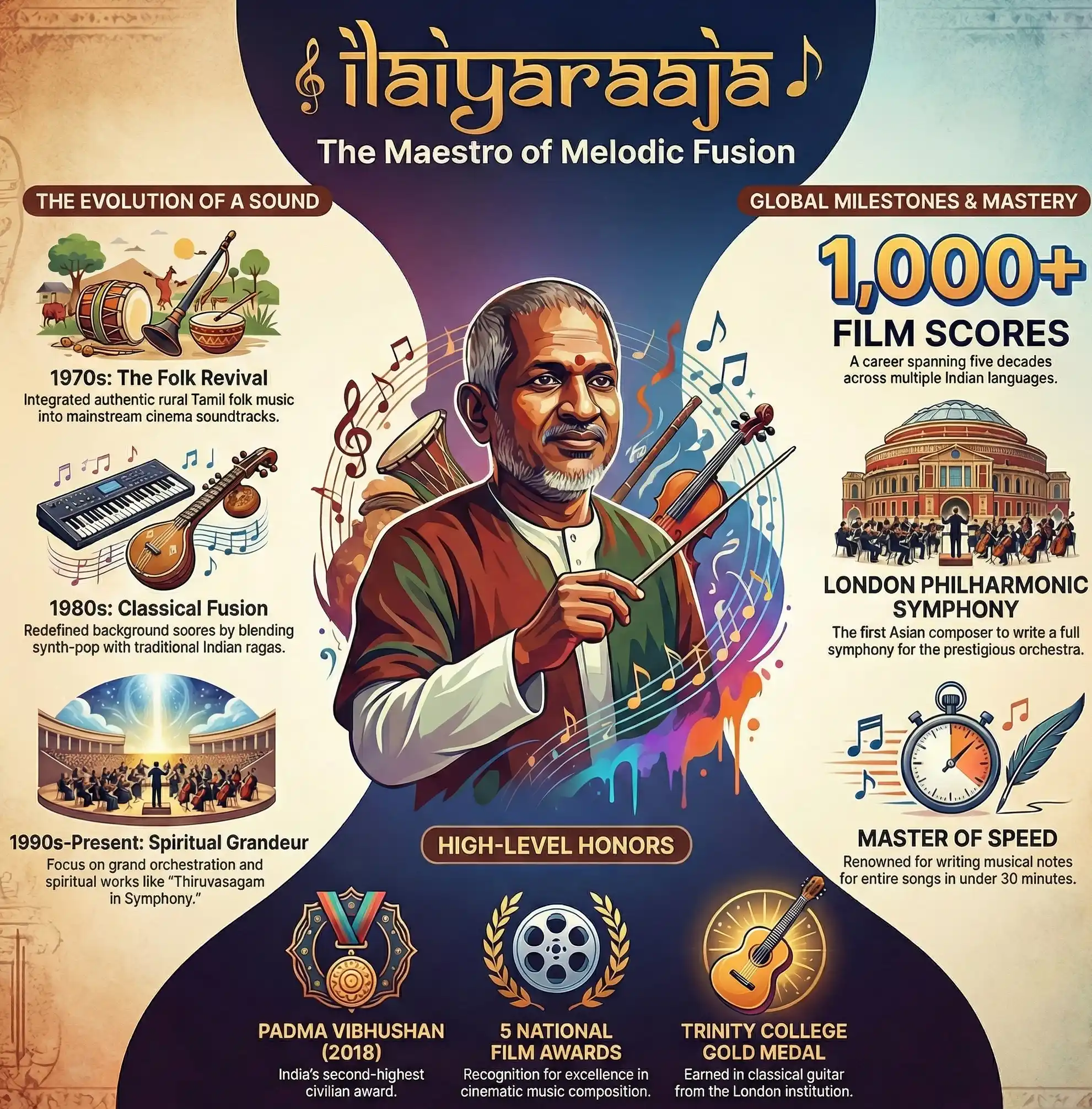
In 2016 Ilaiyaraaja scored his thousandth film. It was called Tharai Thappattai, after two drums played at village funerals and processions in Tamil Nadu, and it was about folk performers who can no longer make a living from them.
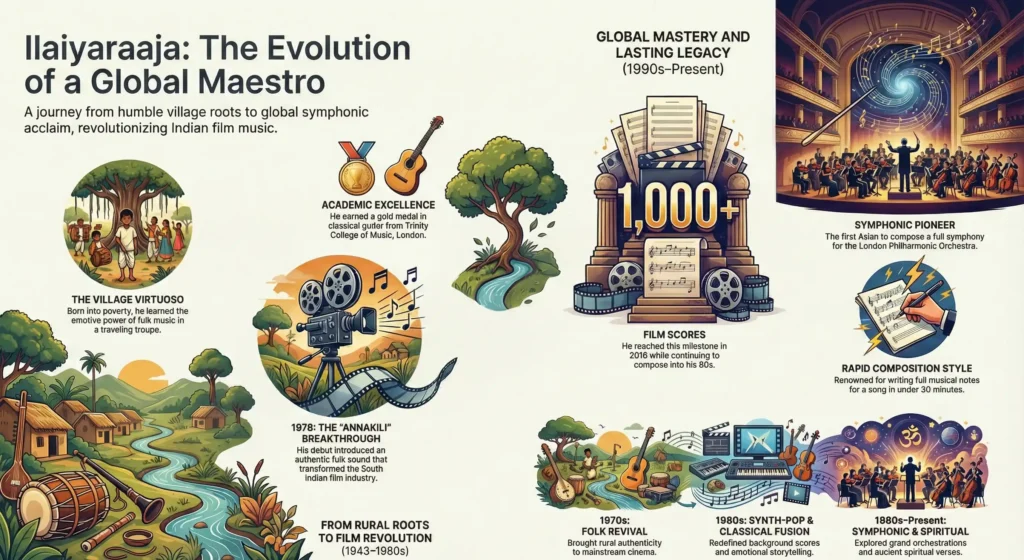
He had been born among those performers. Pannaipuram, in what is now Theni district, June 1943, into a poor Dalit family. His mother, Chinnathayammal, carried a large store of Tamil folk songs in her head, which is how most of that repertoire was held.
The music he grew up inside was the music the film studios treated as background noise from somewhere else.
Fourteen, on the road
At fourteen he joined a travelling troupe run by his eldest brother, the poet Pavalar Varadharajan. The brothers played for theatre companies and village audiences across the south, and he learned the harmonium, the instrument of street performance rather than the concert hall.
That went on for about a decade. By the time he came to film work he had played thousands of stages and knew exactly what a crowd standing in a field responds to.
6 Unfoldings in the Subrahmanyan Chandrasekhar Biography
7 Incredible Facts in the Satyendra Nath Bose Biography
The other training
He then did something that most self-taught folk musicians did not. He went and got the opposition’s education. He studied Western classical music and classical guitar under a teacher known as Dhanraj Master, and took a course from Trinity College of Music in London.
In Madras he worked as a session guitarist, including for Salil Chowdhury, and spent years as assistant to the Kannada film composer G.K. Venkatesh, on around two hundred films. An assistant’s job is orchestration: writing out what each player in the room will actually play. He was being paid to learn the machinery from the inside.
Annakili
His first film as composer was Annakili in 1976. The songs were built on Tamil folk melody and scored for a Western-style orchestra, and audiences in Tamil Nadu had not heard the two things put together like that.
It landed in the middle of a shift. Tamil cinema was moving out of the studio backlot and into real villages, with directors like Bharathiraja shooting rural stories on location, and his sound was what those films had been missing.
The name arrived around then as well. He was born Gnanathesikan, was called Raaja by his teacher, and a producer added the Ilaiya to separate him from an older composer of the same name.
What the drums meant
The part of this that is usually left out is what those instruments carried. The parai and the thappattai are played at funerals and temple processions, and in the caste order of Tamil villages that work belonged to Dalit communities, with the stigma attached to it that such assignments always carry.
Film music had used folk tunes before, generally cleaned up and rearranged through a classical idiom. He used the instruments themselves, in the middle of an orchestra, without apology, and put them in front of an audience of millions.
Some of what he wrote travelled further than the films. Songs of his have been sung at Left and Dalit gatherings in Tamil Nadu for forty years, which is not something a composer can arrange for.
The drums did not get let into the concert hall. They arrived in every cinema in the state instead.
8 Fascinating Facts in the Homi Jehangir Bhabha Biography
A thousand films
The output is difficult to take in. More than seven thousand songs and scores for over a thousand films in Tamil, Telugu, Malayalam, Kannada and Hindi, across five decades. He wrote the parts out by hand for the whole orchestra and recorded them live, often finishing in one or two takes, which is a working method that belongs to his years of playing on stage rather than to the studio.
He was also the first Indian composer to record a soundtrack using a computer, on Vikram in 1986, and the background scores he wrote for Nayakan and Thalapathi are studied as film music in their own right. Five National Film Awards followed, then the Padma Bhushan in 2010 and the Padma Vibhushan in 2018, and a nomination to the Rajya Sabha in 2022.
London
In 1993 he recorded a full symphony with the Royal Philharmonic Orchestra in London, the first South Asian composer to do it, and the orchestra gave him the title Maestro. In 2006 he set the Thiruvasagam, a body of ninth-century Tamil devotional verse, as an oratorio recorded with the Budapest Symphony Orchestra.
Both projects get cited as the summit of his career, usually by people who mean that a village musician had finally been validated by European institutions. That is the wrong way round.
He did not take the orchestra to the village. He took the village into the orchestra, and kept it there for a thousand films.
8 Remarkable Secrets in the Jagadish Chandra Bose Biography
If you think you have remembered everything about this topic take this QUIZ
Results


#1. What was Ilaiyaraaja’s debut film in 1976 that introduced a fresh folk sound to Tamil cinema?
#2. Ilaiyaraaja holds a gold medal from Trinity College of Music, London, in which instrument?
#3. Who gave Ilaiyaraaja the prefix “Ilaiya” (Younger) to distinguish him from another composer?
#4. Ilaiyaraaja was the first Asian to compose a full symphony performed by which prestigious orchestra?
#5. What is the name of the new Carnatic raga invented by Ilaiyaraaja?
#6. Which film marked Ilaiyaraaja’s 1000th film score?
#7. Ilaiyaraaja composed “Thiruvasagam in Symphony,” an oratorio of ancient verses in which language?
#8. In 2018, Ilaiyaraaja was honored with which high civilian award by the Government of India?
What is Ilaiyaraaja’s real name?
His birth name is R. Gnanathesikan. He was renamed Ilaiyaraaja for his debut film.
How many films has Ilaiyaraaja composed for?
He has composed music for over 1,000 feature films in various languages.
What is unique about Ilaiyaraaja’s music?
He is celebrated for fusing Western classical orchestration with traditional Indian folk and Carnatic music, creating a unique, rich soundscape.
Has Ilaiyaraaja won international awards?
While primarily recognized in India, his composition Thiruvasagam in Symphony is globally acclaimed, and he was the first Asian to score for the London Philharmonic Orchestra.
Who are Ilaiyaraaja’s children?
His children are music composers Karthik Raja and Yuvan Shankar Raja, and the late playback singer Bhavatharini.
Read More: https://curiousindian.in/a-r-rahman-january-1967-present/
Sources & References
The News Minute (“Understanding Ilaiyaraaja: his music, politics and impact”) — the use of parai and thappattai in his scores and the caste context of those instruments.
Padma Awards portal, Government of India — the Padma Bhushan of 2010 and the Padma Vibhushan of 2018.
Directorate of Film Festivals, National Film Awards archive — his National Film Awards for best music direction.
The Hindu — the 1993 symphony recorded with the Royal Philharmonic Orchestra and the Maestro title.
Author


Exploring the Soul of Bharat through History, Science, Culture, and its Diversity
Our Mission
Curious Indian is a definitive knowledge portal dedicated to chronicling the events, personalities, and cultural shifts that defined the Indian subcontinent. From the ancient Vedic Period to the complexities of 21st-century politics, our goal is to provide deep-dive analysis that inspires.
Editorial Standards & E-E-A-T
Every article published under our brand undergoes a rigorous fact-checking process. We prioritize primary historical records, academic citations, and credible archives to ensure our readers receive accurate, high-authority information.
Historical Integrity Directly sourcing from ASI archives and academic journals.Topical Authority Comprehensive clustering of Indian Science, Biographies, and Wars.Managed by Paripurna Datta and TEAM | Dedicated to the Knowledge of India.