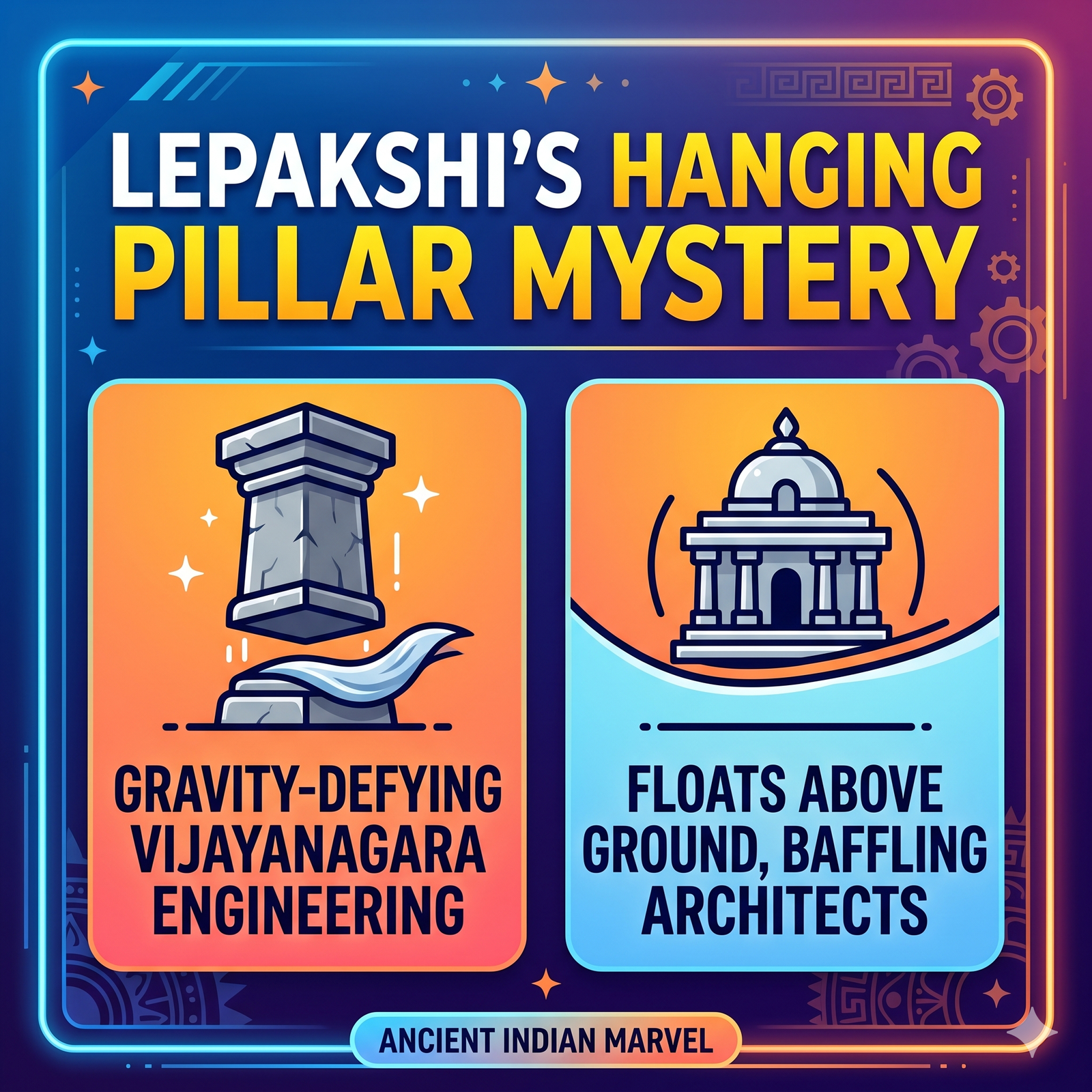
In the quiet town of Lepakshi in Andhra Pradesh stands a magnificent 16th-century temple that completely challenges the laws of physics. The Veerabhadra Temple is a breathtaking showcase of the Vijayanagara empire, featuring incredibly detailed stone carvings and ancient paintings. However, out of the seventy heavy stone pillars supporting the main dance hall, there is one that leaves every single visitor totally speechless. It is the famous Hanging Pillar of Lepakshi, a massive block of intricately carved granite that does not touch the ground. Tourists from all over the world come here just to slide a piece of cloth or paper under its base, proving that ancient Indian architects possessed engineering secrets that modern science is still struggling to understand.| Feature | Details |
| Location | Lepakshi, Andhra Pradesh |
| Temple Complex | Veerabhadra Temple |
| Empire | Vijayanagara Empire (16th Century) |
| Main Mystery | A massive stone pillar that floats above the ground |
| Key Test | Passing a thin cloth entirely underneath the base |
When we think of ancient architecture, we usually picture massive, heavy stones planted firmly into the earth. Building a large stone temple requires perfect balance and a deeply solid foundation. But if you visit the dry, rocky landscape of the Anantapur district in Andhra Pradesh, you will find a temple that throws these basic rules completely out the window. The Veerabhadra Temple at Lepakshi is an absolute masterpiece of ancient art, but it is hiding a secret that has frustrated and amazed structural engineers for hundreds of years.
Walking through the cool, dark corridors of this massive temple, you are surrounded by the brilliant history of the Vijayanagara empire. The ceilings are covered in natural color frescoes, and the walls are carved with dancing gods and fierce warriors. But the main attraction stands quietly in the center of the grand dance hall. It is a pillar that hangs from the ceiling rather than resting on the floor.
Devika Rani Biography: The Architect of Bollywood’s Golden Era
The Masterpiece of the Vijayanagara Empire
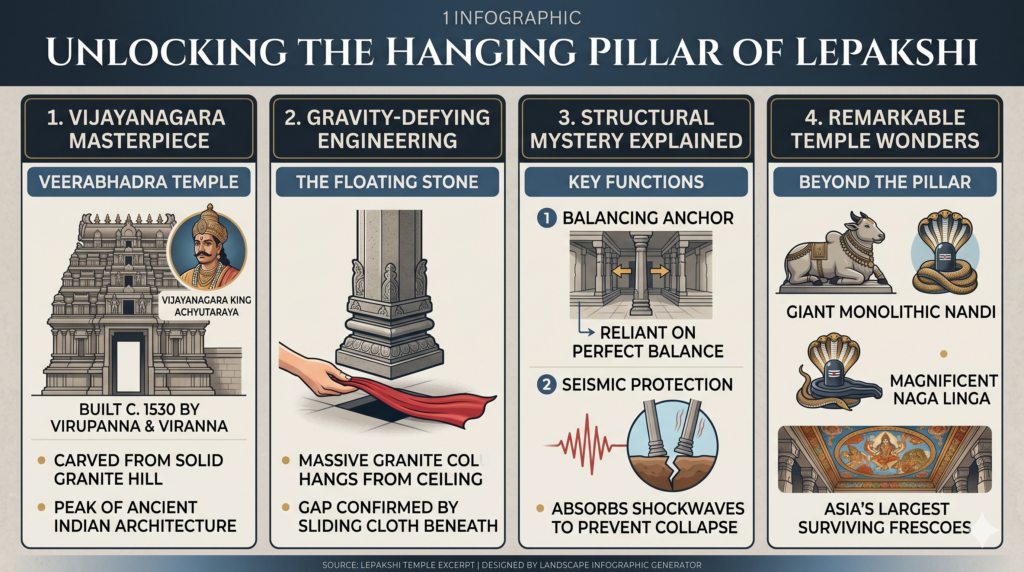
To understand how this was built, we have to look back to the year fifteen thirty. The temple was constructed by two brothers, Virupanna and Viranna, who were important governors under the mighty Vijayanagara King Achyutaraya. The Vijayanagara builders were famous across the entire world for their highly advanced stone carving skills. They did not just build temples to pray in; they built them to show off the absolute peak of human engineering and artistic wealth.
The temple is carved directly out of a massive hill of solid granite, which is incredibly difficult stone to cut and shape. The brothers employed the absolute best sculptors in the kingdom to create seventy intricately designed pillars for the main hall, known as the Natya Mandapam. Each pillar tells a different mythological story, but the builders decided to leave one very special pillar to completely show off their structural genius.
The Mystery of the Floating Stone
When you first look at the hanging pillar, it looks completely normal. It is covered in the same beautiful carvings as the other sixty nine pillars in the hall. However, if you look closely at the very bottom, you will notice a tiny, dark gap between the base of the stone and the temple floor.
Every single day, curious tourists kneel down on the cold stone floor and perform a famous test. They take a thin piece of cloth, a newspaper, or a flat twig, and they slide it completely under the massive stone pillar from one side to the other. The cloth passes through easily without getting stuck. The pillar is literally hanging from the heavy stone ceiling above it, supporting its own massive weight completely in mid-air.
The Relentless Pursuit of Excellence by Legendary Filmmaker K. Asif
The British Engineer Who Tried to Move It
During the British colonial era, the mysterious pillar deeply annoyed the British engineers. They could not understand how a heavy stone roof could be supported if one of its main pillars was not touching the floor. A famous story details how a British engineer decided he was going to uncover the trick.
He brought heavy iron crowbars and modern tools, determined to push the hanging pillar to the side and see what was holding it up. But the moment he forcefully moved the hanging pillar just a tiny bit, he heard a terrifying sound. The entire massive stone roof of the temple, along with the surrounding pillars, suddenly shifted and threatened to collapse entirely. He quickly realized that the hanging pillar was not just a magic trick; it was actually the central balancing anchor for the entire hall. He immediately stopped his experiment, leaving the ancient masterpiece intact but slightly crooked, which you can still see today.
Brilliant Engineering or Earthquakes?
Today, modern scientists and architects constantly debate how the pillar ended up this way. Some structural experts believe that the pillar was originally built touching the ground, but over hundreds of years, the earth below it naturally settled and sank, leaving the pillar hanging from the perfectly interlocked ceiling.
However, many historical architects strongly disagree. They believe the Vijayanagara builders intentionally designed the hanging pillar as a highly advanced form of earthquake proofing. By leaving one central pillar completely free-hanging, they allowed the massive stone ceiling to slightly sway and absorb the heavy shockwaves of an earthquake without cracking the rigid stone joints. If this is true, it means the 16th-century Indian builders were hundreds of years ahead of modern seismic engineering.
Secrets Behind Kamal Haasan’s Cinematic Journey
The Magnificent Veerabhadra Temple
While the floating pillar is the absolute superstar, the entire temple complex is filled with mind-blowing wonders. Just a short walk from the main temple sits one of the largest monolithic Nandi statues in all of India. This massive bull is carved flawlessly out of a single, giant boulder and looks perfectly smooth and incredibly lifelike.
Inside the temple, you can also find the magnificent Naga Linga, a massive stone sculpture of a multi-headed snake shielding a Shiva Linga, carved entirely out of a natural granite boulder. The Archaeological Survey of India works very hard to protect these delicate carvings and the breathtaking roof paintings, ensuring that the brilliant colors and sharp details survive for another five hundred years. Know more at Indian National Trust for Art and Cultural Heritage.
Quick Comparison Table
| Feature | Standard Stone Pillar | The Lepakshi Pillar |
| Base | Rests firmly on the ground | Hangs slightly above the floor |
| Primary Function | Supports the heavy ceiling directly | Acts as a central balancing counterweight |
| Structural Impact | Rigid and unmoving | Allows the roof to absorb seismic shock |
| Tourist Interaction | Admired for its visual carvings | Tested by passing cloth underneath it |
Mapping the Global Reach of the D Ramanaidu Movie Legacy
Curious Indian Fast Facts
- The name Lepakshi translates to “Rise, oh bird” in Telugu, referencing the mythological bird Jatayu from the Ramayana epic.
- The temple ceiling contains Asia’s largest surviving fresco painting, measuring a massive twenty-four feet by fourteen feet.
- The giant Nandi bull statue facing the temple is perfectly positioned so that it looks directly at the central Shiva Linga inside the complex.
- The hanging pillar is slightly dislodged from its original perfect center due to the aggressive testing done by the British engineer.
- The entire temple is built on a low, rocky hill called Kurmasaila, which is uniquely shaped exactly like a giant tortoise.
Conclusion
The Hanging Pillar of Lepakshi is a beautiful reminder that our ancestors possessed knowledge that we are still trying to catch up with today. The Vijayanagara architects did not have modern computers, digital blueprints, or giant steel cranes. Yet, they managed to balance a massive granite roof using a floating piece of stone, creating an architectural magic trick that has survived centuries of harsh weather and attempted sabotage.
When you slide a piece of cloth under that massive stone base, you are interacting directly with history. You are touching the absolute genius of ancient Indian engineering. The Veerabhadra Temple stands proudly not just as a place of deep spiritual worship, but as a permanent, gravity-defying museum of human brilliance.
Inside the Bhushan Kumar T-Series Success Journey
If you think you have remembered everything about this topic take this QUIZ
Results


#1. In which Indian state is the Veerabhadra Temple located?
#2. During which empire was the Lepakshi temple constructed?
#3. Who were the two brothers responsible for building the temple in 1530?
#4. How many total pillars support the main dance hall (Natya Mandapam) of the temple?
#5. What happened when a British engineer tried to move the hanging pillar with iron crowbars?
#6. According to some historical architects, what was the likely purpose of the hanging pillar design?
#7. What is unique about the hill called Kurmasaila on which the temple is built?
#8. Which mythological event does the name “Lepakshi” refer to?
Why does the pillar at Lepakshi hang in the air?
While some believe it is due to the natural sinking of the ground over centuries, many experts argue it was intentionally designed as a floating counterweight to protect the massive stone temple from earthquakes.
Can you actually pass a cloth under the pillar?
Yes, the gap between the bottom of the pillar and the floor is large enough for visitors to easily slide a piece of paper, a twig, or a thin piece of cloth completely underneath it.
Who built the Veerabhadra Temple?
It was built in the sixteenth century by two brothers, Virupanna and Viranna, who were governors under the powerful Vijayanagara King Achyutaraya.
What happened when the British tried to move it?
A British engineer attempted to forcefully dislodge the pillar to study its secret, but he had to stop immediately when the entire stone ceiling and surrounding pillars began to shift and threatened to collapse.
What else is famous at the Lepakshi temple?
Besides the hanging pillar, the temple is incredibly famous for having one of the largest monolithic Nandi bull statues in India, a massive carved Naga Linga, and beautiful natural fresco paintings.