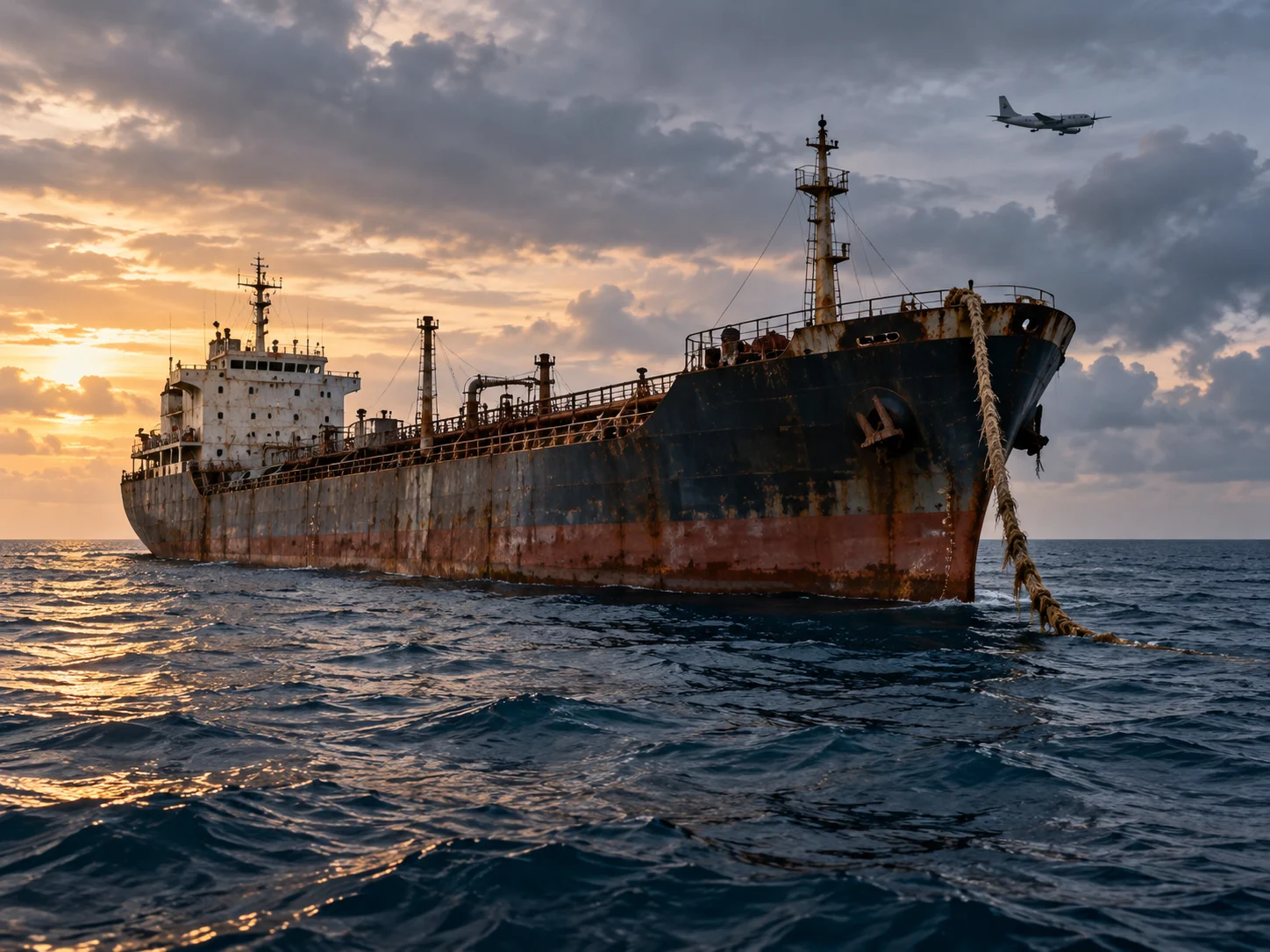
Gulf of Carpentaria, March 2006: an Australian patrol plane found an eighty-metre tanker drifting with nobody aboard. The most important clue was a broken tow rope hanging from its bow
In the first week of March 2006, an Australian Coastwatch aircraft on patrol over the Gulf of Carpentaria spotted a ship where no ship should have been.
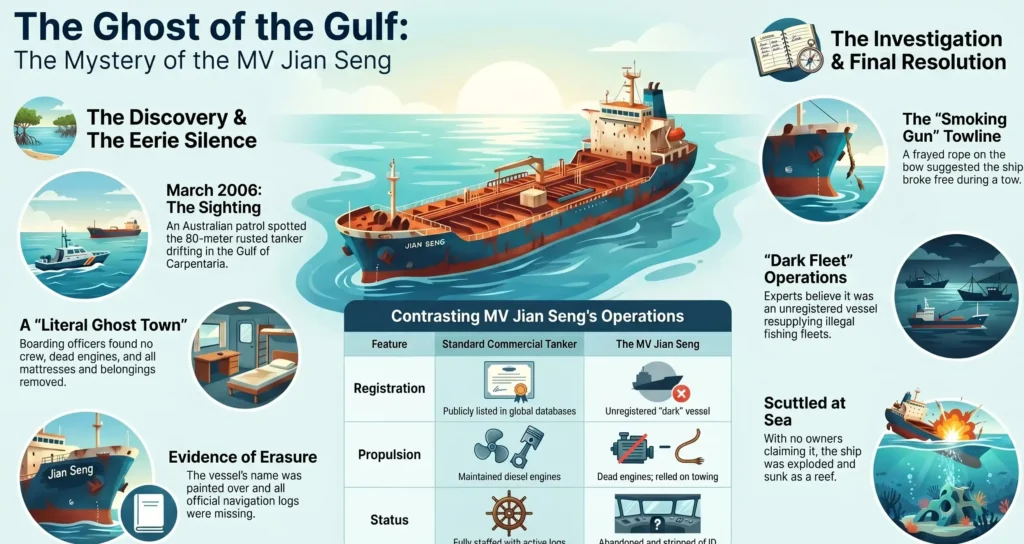
It was a tanker, about eighty metres long, drifting roughly 180 kilometres south-west of Weipa in Queensland, just inside Australian waters. Its engines were silent. There was no movement on deck. The pilots circled and photographed it, and noticed one detail that would matter more than any other: a torn tow rope hanging from the bow.
The photographs went to the Australian Customs Service, which sent the patrol boat Storm Bay. It reached the drifting tanker at night and waited for daylight before putting a boarding party into a small boat.
The pilots noticed one detail that would matter more than any other: a torn tow rope hanging from the bow.
The engines did not work. There was no flag, no port of registry, no ship’s papers, no logbook, nothing to say who owned the vessel or where it had come from. The only name anywhere was Jian Seng, painted on the ship and marked on a ladder.
In the holds were sacks of rice.
And that was the strangest part. There were no signs of violence. There were no signs that anyone had left in a hurry. In fact, Customs officials said there were no signs of anyone having been on board recently at all. No half-finished meals, no scattered belongings, no distress call. Nothing to suggest people smuggling either.
There were no signs of violence, and no signs that anyone had left in a hurry.
The Storm Bay watched the tanker for several days as it drifted south, a hazard to shipping and, not far away, to the Great Barrier Reef.
The Australian Maritime Safety Authority arranged a salvage tug, which had to come a long way. It reached the tanker and towed it into Weipa on 27 March. The operation produced an oil slick, which had to be cleaned up under the supervision of Maritime Safety Queensland.
The Jian Seng sat at Weipa for nearly a month while Australian authorities made inquiries around the world, checking international shipping registries for the name, the dimensions, anything.
Nobody came forward. No owner, no operator, no insurer, no government. Not one.
On 21 April 2006, having found no one to hand it back to, the authorities towed the Jian Seng into deep water and sank it.
Even the basic dates are muddled in the accounts that survive. Different reports put the first sighting on different days in early March, and the boarding a day or two after that. For a story that produced photographs, patrol boats and a government salvage operation, the record is surprisingly loose.
Ghost ship stories usually turn on a vanished crew. This one probably does not.
The boarding team’s own conclusion was simple and undramatic: the vessel had been under tow when the rope parted, and had then been abandoned and left to drift into Australian waters. That fits everything they found. A ship whose engines no longer work does not sail anywhere. It gets towed.
Where it was being towed to, and by whom, is the part nobody has answered. Australian officials speculated that it might have been supporting fishing operations far out at sea, which would explain the rice. Others have suggested it was being taken to a shipbreaking yard. Both are guesses.
What is documented is narrower, and in its way more interesting: an eighty-metre steel ship, big enough to see from an aeroplane, can exist without a single paper trace. Somebody built it. Somebody sailed it. Somebody was towing it when the rope snapped. And when it turned up in Australian waters and was advertised to the world, not one of those people said a word.
It is less surprising than it sounds. Ships can be registered under flags of convenience, sold on through layers of companies, renamed and re-registered, and eventually drop off the books altogether while still floating. A vessel like that has no reason to be missed and no one obliged to report it.
The Jian Seng is still there, on the seabed off the Queensland coast, quietly becoming a home for fish.
There is no crew to look for, as far as anyone can tell, and probably no crime scene either. What sank with it was something smaller and harder to accept: the answer to an ordinary question. Whose ship was that?
If you think you have remembered everything about this topic take this QUIZ
Results
QUIZ START
#1. In which year was the MV Jian Seng discovered?
Previous
Next
#2. Where was the ghost ship spotted?
Previous
Next
#3. What did customs officials find when they finally boarded the vessel?
Previous
Next
#4. What clue on the front bow indicated the ship had not been sailing under its own power?
Previous
Next
#5. Investigators suspected the ship was being dragged to which type of facility before it broke free?
Previous
Next
#6. What was found scattered in the cargo holds, hinting at the ship’s possible use as a resupply vessel?
Previous
Next
#7. Why did the Australian government decide to scuttle and sink the MV Jian Seng in April 2006?
Previous
Next
#8. According to the text, what percentage of the world’s retired commercial vessels find their final resting place in South Asian shipbreaking yards?
Previous
Finish
What exactly is the MV Jian Seng?
The MV Jian Seng is the name of a massive, eighty-meter ghost ship that was found drifting completely empty and abandoned off the coast of Australia in 2006.
Its origin was never established. Investigators found a broken tow rope, suggesting the vessel had broken free while being towed, but who was towing it and from where remain unknown.
Why was there no crew on board the ship?
Investigators found no signs of violence or a hurried evacuation. The most likely explanation was that the non-operational vessel had been under tow and was abandoned after the towline broke.
Did the authorities ever find the owners of the Jian Seng?
No. Despite a massive international search broadcasted across global maritime networks, absolutely no one stepped forward to claim the illegal, unregistered vessel.
What finally happened to the abandoned tanker?
After being salvaged and held at Weipa while authorities tried unsuccessfully to identify an owner, the Jian Seng was towed into deep water and deliberately sunk on 21 April 2006. to create an artificial reef.
Sources & References
Yacht, “Ghost ships: Jian Seng, tanker without crew, without trace, sunk” (2026) — the Coastwatch sighting, the Storm Bay’s boarding, the salvage tow to Weipa on 27 March, the oil slick, and the scuttling on 21 April 2006.
Contemporary Australian press reports of the Customs Service statement (March 2006) — the broken tow rope, the absence of recent activity on board, and the boarding team’s conclusion that the vessel had broken free while under tow.
ABC News (Australia), 25 March 2006, reporting Australian Customs officials — the approximately 80-metre vessel, its disabled condition, uncertain registry and the investigation into the abandoned Jian Seng.
Australian Parliament, Questions on Notice concerning the abandoned vessel Jian Seng (2006) — official follow-up on the vessel, its identity, investigation and disposal.
Paripurna Datta is the founder and editor of Curious Indian, an independent editorial publication focused on Indian history, culture, science, society, and the stories behind them. He oversees research, editorial standards, and the publication's long-term direction.
Paripurna Datta is the founder and editor of Curious Indian, an independent editorial publication focused on Indian history, culture, science, society, and the stories behind them. He oversees research, editorial standards, and the publication's long-term direction.