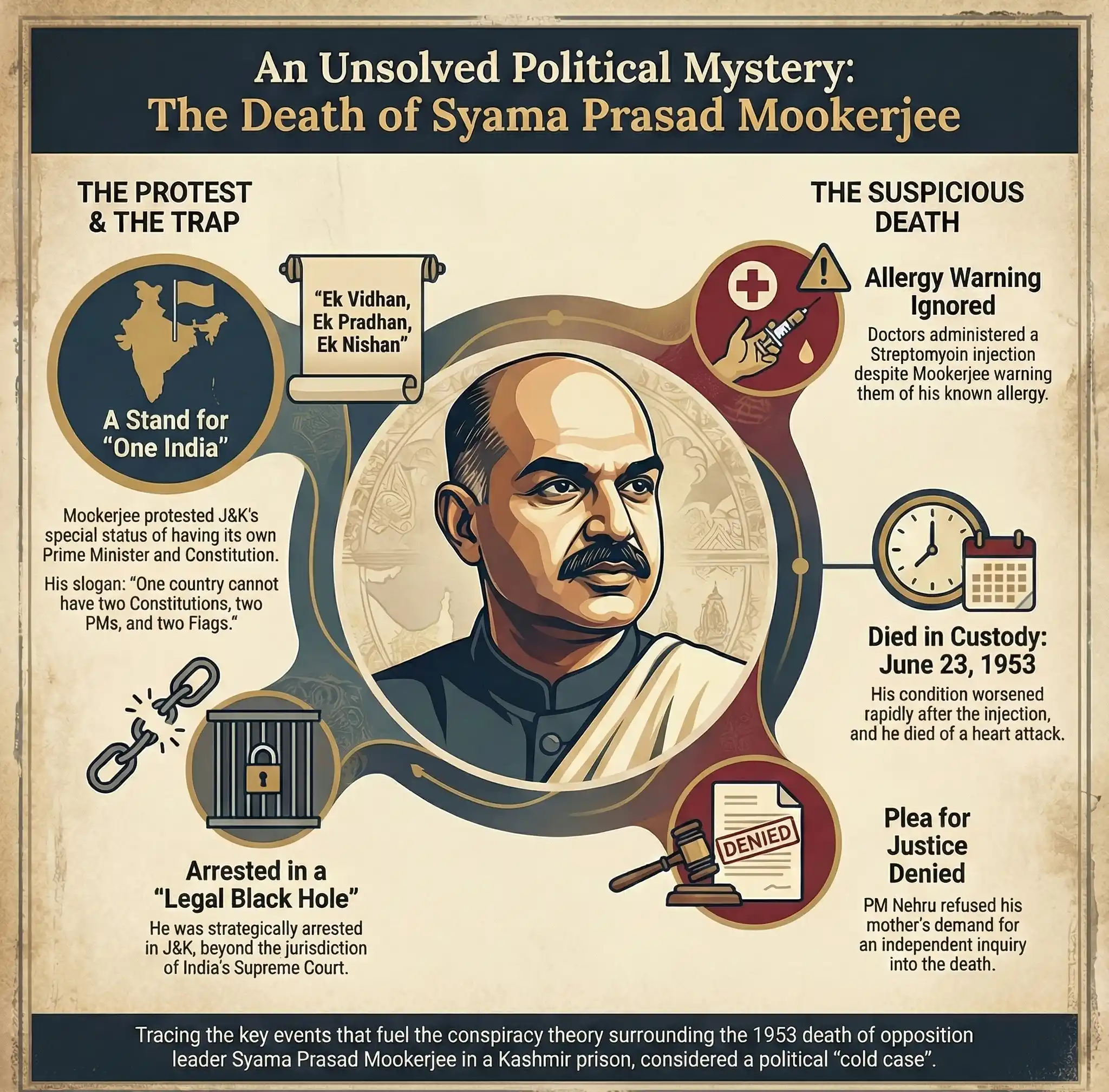
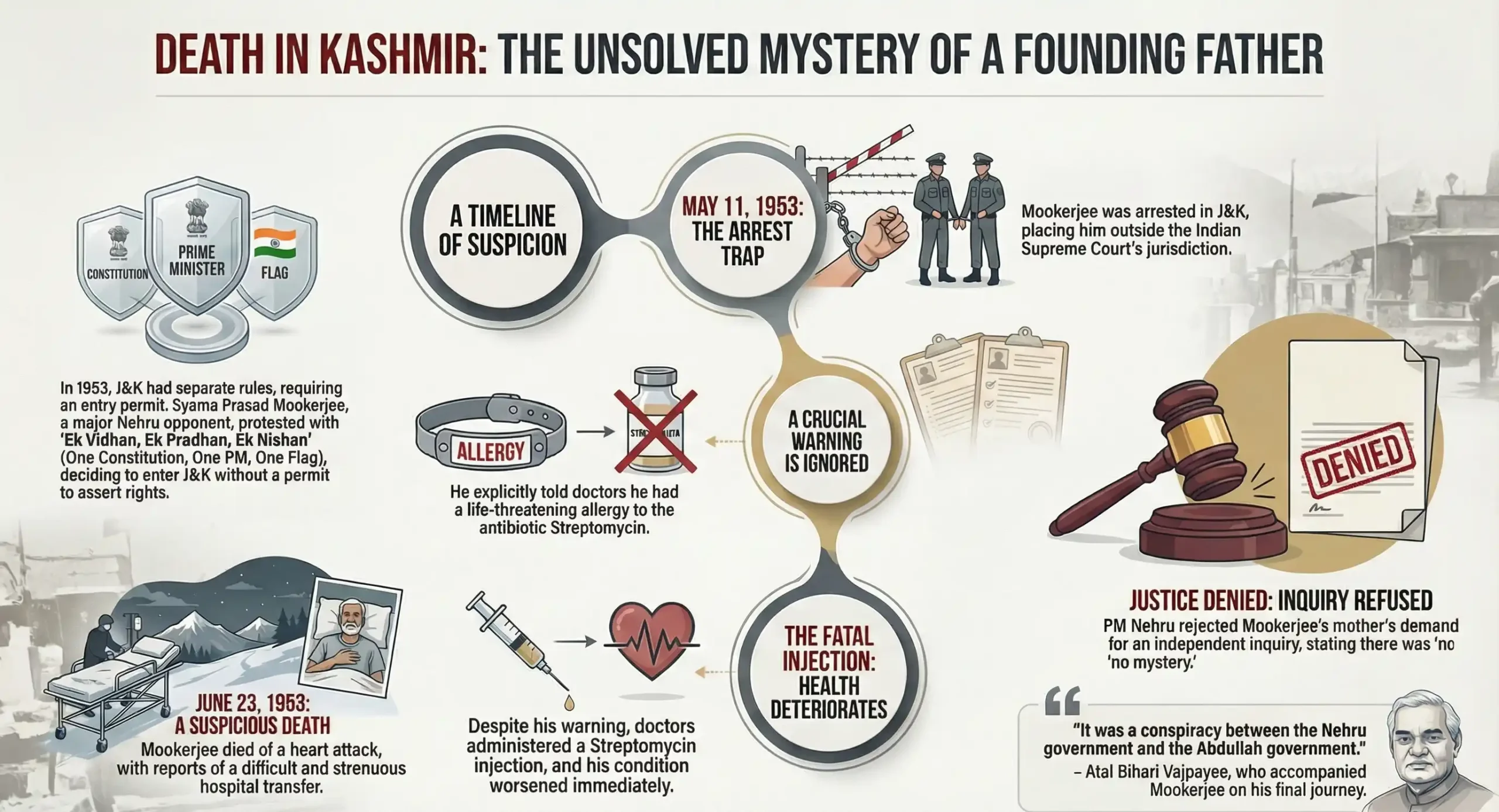
Investigating the Syama Prasad Mookerjee death mystery. Did the founder of the Jana Sangh die of a heart attack in Kashmir, or was it a "medical murder" orchestrated to silence his opposition? We analyze the facts.
Syama Prasad Mookerjee was arrested entering Kashmir in May 1953 and died in detention six weeks later. His mother learned both from the same message
On 11 May 1953 Syama Prasad Mookerjee crossed into Jammu and Kashmir at Lakhanpur, on the bank of the Ravi, and was arrested by the state’s police the moment he did.
He had expected to be. He was fifty-one, a Member of Parliament, a former minister in Nehru’s first cabinet, and the founder, two years earlier, of the Bharatiya Jana Sangh. Indians then needed a permit to enter the state, and Mookerjee had been campaigning against the permit and against the state’s separate status. His slogan was that one country could not have two constitutions, two prime ministers and two flags. He entered without one on purpose, as a protest.
He was taken to the Central Jail in Srinagar with two companions arrested alongside him, and then moved to a cottage outside the city. He was held there without trial. Because he was held under the laws of Jammu and Kashmir, the writ of India’s Supreme Court did not reach him.
He went to Kashmir to be arrested. He did not go there to die.
Six weeks
He was held there for more than five weeks. Then, on the night of 19 June, he developed pain in his back and a high fever. The doctor diagnosed dry pleurisy, an illness he had had twice before, in 1937 and 1944.
The doctor prescribed streptomycin. Mookerjee told him that his own family physician had said the drug did not suit him. The doctor answered that there was new information about streptomycin and that he would be fine. The injections were given.
On 22 June he felt pain around his heart, broke into a sweat and felt he was about to faint. He was moved to a hospital, where a heart attack was provisionally diagnosed. He died there in the early hours of 23 June 1953.
The message
In Calcutta his mother, Jogamaya Devi, had heard nothing from the government that held him. The first news she received from Jammu and Kashmir about her son, in six weeks of his detention, was that he was dead.
She was not the only one kept in the dark. Atulya Ghosh, president of the West Bengal Congress, Nehru’s own party, said it was amazing that no word had been sent to the family or to Mookerjee’s physician, Dr B.C. Roy, who was then Chief Minister of West Bengal. He called the Kashmir government’s handling of it callous.
Nehru was abroad when it happened. On 30 June he wrote to her with his condolences, and spoke of his affection for her son.
She answered on 4 July. “My son died in detention, detention without trial,” she wrote. Nehru had visited Kashmir while her son was held there, she reminded him, and she asked what had stopped him from going to see him, and satisfying himself about his health and the conditions he was kept in. She asked for an impartial inquiry.
My son died in detention, detention without trial.
No inquiry
Nehru replied that he had asked a number of people who knew the facts, and that there was no mystery about the death. Jogamaya Devi did not accept that. She asked again for an independent inquiry. None was set up. In November 1953 a resolution in the West Bengal Legislative Assembly asked for an inquiry by a commission under a Supreme Court judge. That did not happen either.
Without an inquiry, the questions stayed where they were. Why was he let across the border only to be arrested on the other side? Why was he given a drug he had said did not agree with him? Why was his family told nothing until he was dead? His supporters have called it a conspiracy ever since. The government of the day said it was an illness and a heart attack, and that it had looked into it.
No commission ever tested either account. That is the whole of the mystery, and it has never been closed.
The mother
Jogamaya Devi had been widowed since 1924, when her husband, Sir Ashutosh Mookerjee, died. She had now outlived her son. What she asked the Prime Minister for was not punishment. It was an account of how her son had died in the care of a government, one she could believe.
If you think you have rememberd everything about this topic take this QUIZ
Results
QUIZ START
#1. What was the primary legal consequence of Syama Prasad Mookerjee being arrested in Jammu & Kashmir territory instead of in Punjab?
Previous
Next
#2. The slogan ‘Ek Vidhan, Ek Pradhan, Ek Nishan’ was coined by Syama Prasad Mookerjee to protest what specific situation in Jammu & Kashmir?
Previous
Next
#3. What is the central claim of the ‘medical murder’ theory regarding Syama Prasad Mookerjee’s death?
Previous
Next
#4. How did Prime Minister Jawaharlal Nehru respond to the request from Mookerjee’s mother, Jogamaya Devi, for an inquiry into his death?
Previous
Next
#5. According to the source material, where was Syama Prasad Mookerjee held in detention?
Previous
Next
#6. What was the eventual fate of the ‘Permit System’ that Syama Prasad Mookerjee died protesting against?
Previous
Next
#7. Who does the text quote as having said Mookerjee’s death was a ‘conspiracy between the Nehru government and the Abdullah government’?
Previous
Next
#8. Besides the controversial injection, what other detail concerning Mookerjee’s final moments raises suspicion?
Previous
Finish
Why was Syama Prasad Mookerjee arrested?
He was arrested for entering Jammu & Kashmir without a “permit.” At that time, J&K had special autonomous status, and Indian citizens needed a permit (like a visa) to enter. Mookerjee violated this rule as an act of protest.
It is alleged that he was given Streptomycin, an antibiotic to which he was allergic. He had reportedly informed the doctors of this allergy, but it was administered anyway to treat his pleurisy.
Did the government investigate his death?
No. Despite repeated demands from his mother, Jogamaya Devi, and political leaders, Prime Minister Jawaharlal Nehru refused to order an official inquiry commission, stating he saw no mystery in the death.
What was the “Nehru-Abdullah Conspiracy” theory?
The theory, supported by leaders like Atal Bihari Vajpayee, suggests that the Indian government deliberately allowed Mookerjee to cross into J&K so he could be arrested by Sheikh Abdullah’s police, putting him out of the jurisdiction of the Indian Supreme Court and ensuring he could not be easily bailed out.
Sources & References
Uma Prasad Mookerjee (ed.), Syama Prasad Mookerjee: His Death in Detention (1953) — the documents of his arrest and detention, and the correspondence between Jogamaya Devi and Nehru.
Deccan Herald / PTI (23 June 2025) — his arrest for entering the state without a permit and his opposition to the permit system.
West Bengal Legislative Assembly proceedings, 27 November 1953 — the resolution seeking a judicial inquiry into his death.
VSK Telangana, “Dr Syama Prasad Mookerjee Death Anniversary” (23 June 2025) — Atulya Ghosh’s criticism of how the news was conveyed; a partisan source, so check the quotation against the 1953 press before publishing.
Wikipedia, “Syama Prasad Mookerjee” — the medical sequence from 19 to 23 June and Nehru’s reply; to be replaced with a primary or scholarly source before publishing.
Exploring the Soul of Bharat through History, Science, Culture, and its Diversity
Our Mission
Curious Indian is a definitive knowledge portal dedicated to chronicling the events, personalities, and cultural shifts that defined the Indian subcontinent. From the ancient Vedic Period to the complexities of 21st-century politics, our goal is to provide deep-dive analysis that inspires.
Editorial Standards & E-E-A-T
Every article published under our brand undergoes a rigorous fact-checking process. We prioritize primary historical records, academic citations, and credible archives to ensure our readers receive accurate, high-authority information.
Historical IntegrityDirectly sourcing from ASI archives and academic journals.
Topical AuthorityComprehensive clustering of Indian Science, Biographies, and Wars.
Managed by Paripurna Datta and TEAM | Dedicated to the Knowledge of India.