The roots of the Naga National Council do not begin in the hills. They begin in France, in 1917, where two thousand Naga men went to work behind the lines of a European war
In 1917, the British authorities in the Naga Hills asked for men.
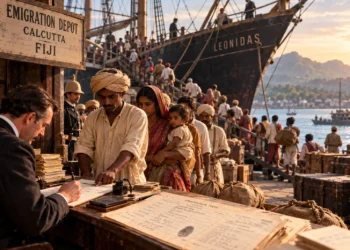
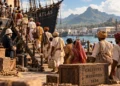
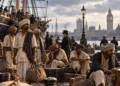
The First World War was grinding through its fourth year, and Britain needed labour behind its lines in France: men to dig, carry, build and clear. Around two thousand Nagas, from different tribes, went. They were enrolled in a labour corps and shipped to Europe.
They worked there through the war. Some died. The survivors came home in 1918.
They worked there through the war. Some died. The survivors came home in 1918.
They brought back something the hills had never had.
Until then, a Naga’s world was his village and his tribe. Angami, Ao, Sema, Lotha and the rest had their own languages, their own customs, and long histories of rivalry with one another. In France, thrown together in the same corps, far from home, they discovered that to everyone around them they were simply one people. Nagas.
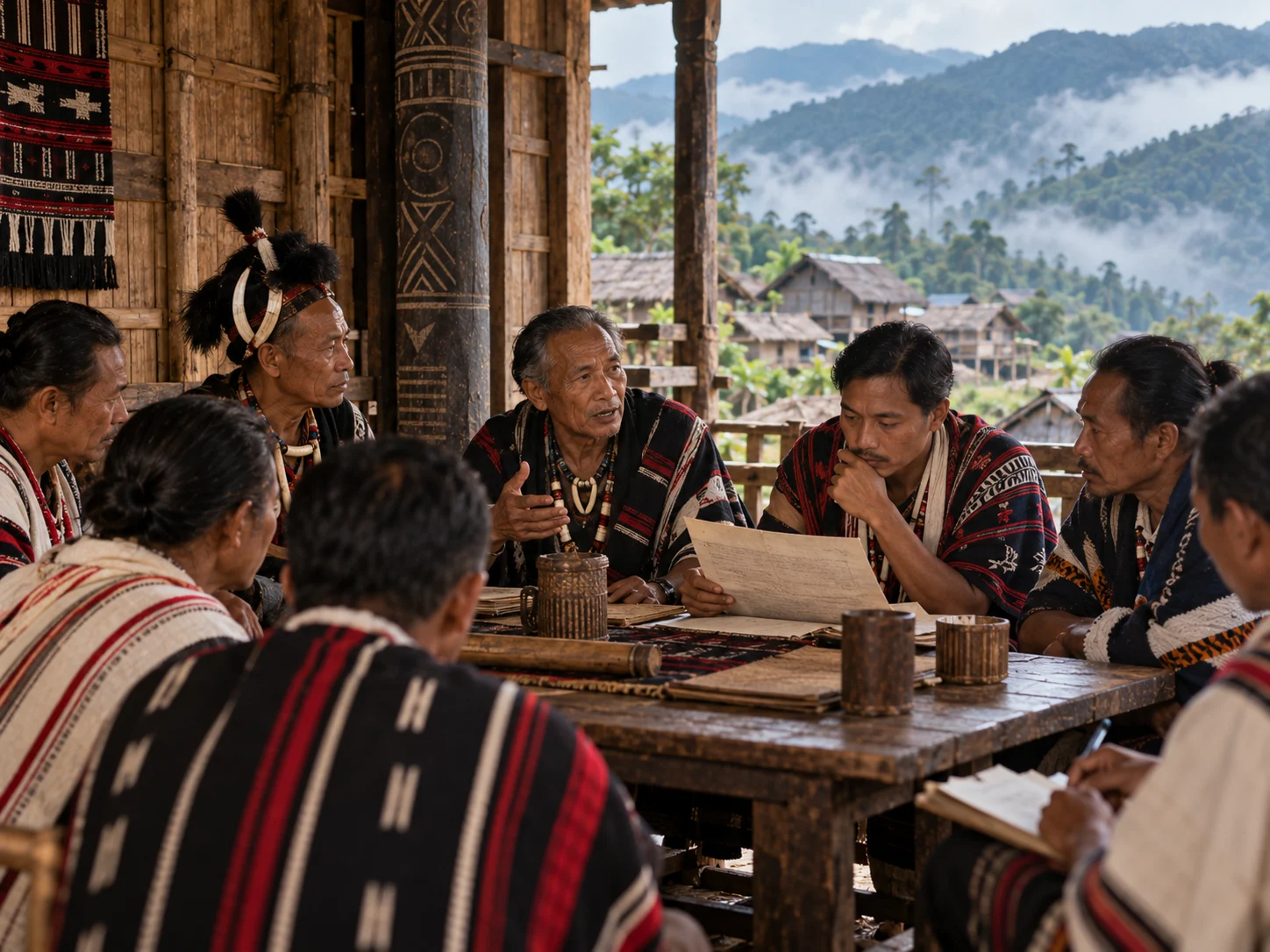
Back home, some of these returned men, together with village headmen, interpreters, teachers, government clerks and pastors, and with a few British officials, formed the Naga Club in 1918. It had two branches, at Kohima and Mokokchung. It was the first organisation of its kind: not of one village or one tribe, but of Nagas.
The Deputy Commissioner of the Naga Hills, J.H. Hutton, told some of its members that a commission from the British Parliament, led by Sir John Simon, would be visiting Kohima to hear views on India’s constitutional future. The club decided to speak. It asked a teacher, Rüzhükhrie Angami, to draft a memorandum.
On 10 January 1929, twenty members of the Naga Club handed that memorandum to the Simon Commission at Kohima.
It said the Nagas had never been conquered by anyone before the British came. It asked that the Naga Hills be kept out of the reformed scheme of Indian government, which they had never been asked about, and placed under British protection. It set out the Nagas’ fear of heavy taxation and of losing their land if they were absorbed into India. And if the British were determined to leave altogether, it made one request, in words that Nagas have quoted ever since. They should not be handed over, it said, to people who had never conquered them.
If the British left, the memorandum asked, “leave us alone to determine for ourselves as in ancient times.”
The British response was partial. Under the Government of India Act of 1935, the Naga Hills were classified as an Excluded Area, kept outside the normal administration of the province and placed under the special powers of the Governor of Assam.
The Second World War then came to the Naga Hills themselves, when Japanese and British forces fought through Kohima in 1944.
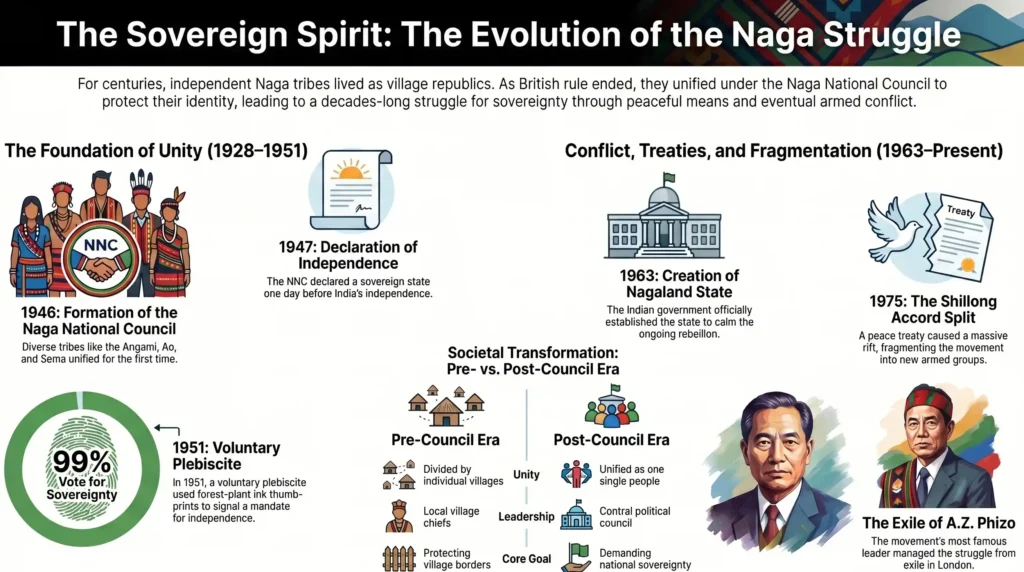
Two years later, in February 1946, Naga leaders met at Wokha and formed the Naga National Council. It grew directly out of the Naga Club, and out of the same idea: that the Nagas were one people who should decide their own future. Its most famous leader was Angami Zapu Phizo.
On 14 August 1947, one day before India’s independence, a section of Naga delegates issued a declaration of independence after breaking away from an NNC meeting the previous day. Later accounts often attributed the declaration to the NNC as a whole, but recent scholarship distinguishes the two. In May 1951 the NNC organised a plebiscite and announced overwhelming support for sovereignty. The Indian government did not accept the declaration or the plebiscite, and the NNC later boycotted India’s first general elections.
From there the road led into decades of armed conflict, negotiations, accords, splits and talks that continue to this day. That long story is not for one article.
What matters, for understanding where it came from, is how early it began, and how quietly.
The Naga demand was not invented after Indian independence. It was written down in 1929, eighteen years before India became a country, by a group of men whose political education had begun in a labour corps in France. Their claim was never that they wished to break away from India. It was that they had never joined it.
Whatever one makes of that claim, the sentence they wrote at Kohima has outlived them all. Leave us alone to determine for ourselves, as in ancient times.
If you think you have remembered everything about this topic take this QUIZ
Results
QUIZ START
#1. In which year was the Naga National Council (NNC) officially formed to provide a unified voice for the tribes?
Previous
Next
#2. Who was the charismatic leader who traveled from village to village and led the council during its most active years?
Previous
Next
#3. On what date did the council officially declare an independent Naga state, just one day before India’s independence?
Previous
Next
#4. What was the historic 1951 event where over 99% of the people allegedly voted for independence using thumbprints?
Previous
Next
#5. To which commission did the Naga leaders submit a famous memorandum in 1928 asking to be left “free and independent”?
Previous
Next
#6. What was the name of the 1975 peace treaty that caused a major split within the Naga movement?
Previous
Next
#7. In which year was the state of Nagaland officially created by the Indian government to address the rebellion?
Previous
Next
#8. According to the text, where did A.Z. Phizo eventually live in exile while managing the movement?
Previous
Finish
What was the main reason the council was formed?
It was originally formed by educated tribal leaders to unite the divided villages and protect their unique land and culture from being absorbed by the newly forming Indian government.
Who was the most famous leader of this political movement?
Angami Zapu Phizo was the most prominent and fiery leader who heavily popularized the demand for total independence and organized the famous village plebiscite.
What exactly happened during the nineteen fifty one plebiscite?
The council organized a massive voluntary vote where they collected thumbprints from tribal adults across the hills to prove that the vast majority wanted complete sovereignty.
Did the movement always use violent armed conflict?
No it originally started with peaceful political memorandums boycotts and voting. The tragic armed conflict only began after the national military was deployed to the region.
What was the Shillong Accord of nineteen seventy five?
It was a controversial peace agreement where some underground leaders agreed to surrender their weapons which ultimately caused the original movement to split into deeply divided factions.
Sources & References
The Naga Republic, “Naga Club recalls representation to Simon Commission on Jan 10 1929” (14 January 2018) — the 2,000 Nagas of the Labour Corps, their return in 1918, Hutton’s information about the Simon Commission, and Rüzhükhrie Angami’s drafting of the memorandum.
Outlook, “Naga Agitation: How One of India’s Oldest Insurgencies Started” (2021) — the twenty-member Naga Club delegation, the text of the memorandum’s central plea, and Phizo’s meeting with Nehru.
Eastern Mirror, “Naga Club: a Fountain of Naga Political Consciousness” — the founding of the club in 1918, the memorandum’s arguments, and the Excluded Area status under the 1935 Act.
“Destiny rests upon our shoulders: early Naga visions of their political future,” Contemporary South Asia 33(3) (2025), with archival Naga records — the NNC’s pre-independence negotiations and the distinction between the NNC meeting of 13 August 1947 and the declaration issued by a breakaway section on 14 August.
Paripurna Datta is the founder and editor of Curious Indian, an independent editorial publication focused on Indian history, culture, science, society, and the stories behind them. He oversees research, editorial standards, and the publication's long-term direction.
Paripurna Datta is the founder and editor of Curious Indian, an independent editorial publication focused on Indian history, culture, science, society, and the stories behind them. He oversees research, editorial standards, and the publication's long-term direction.