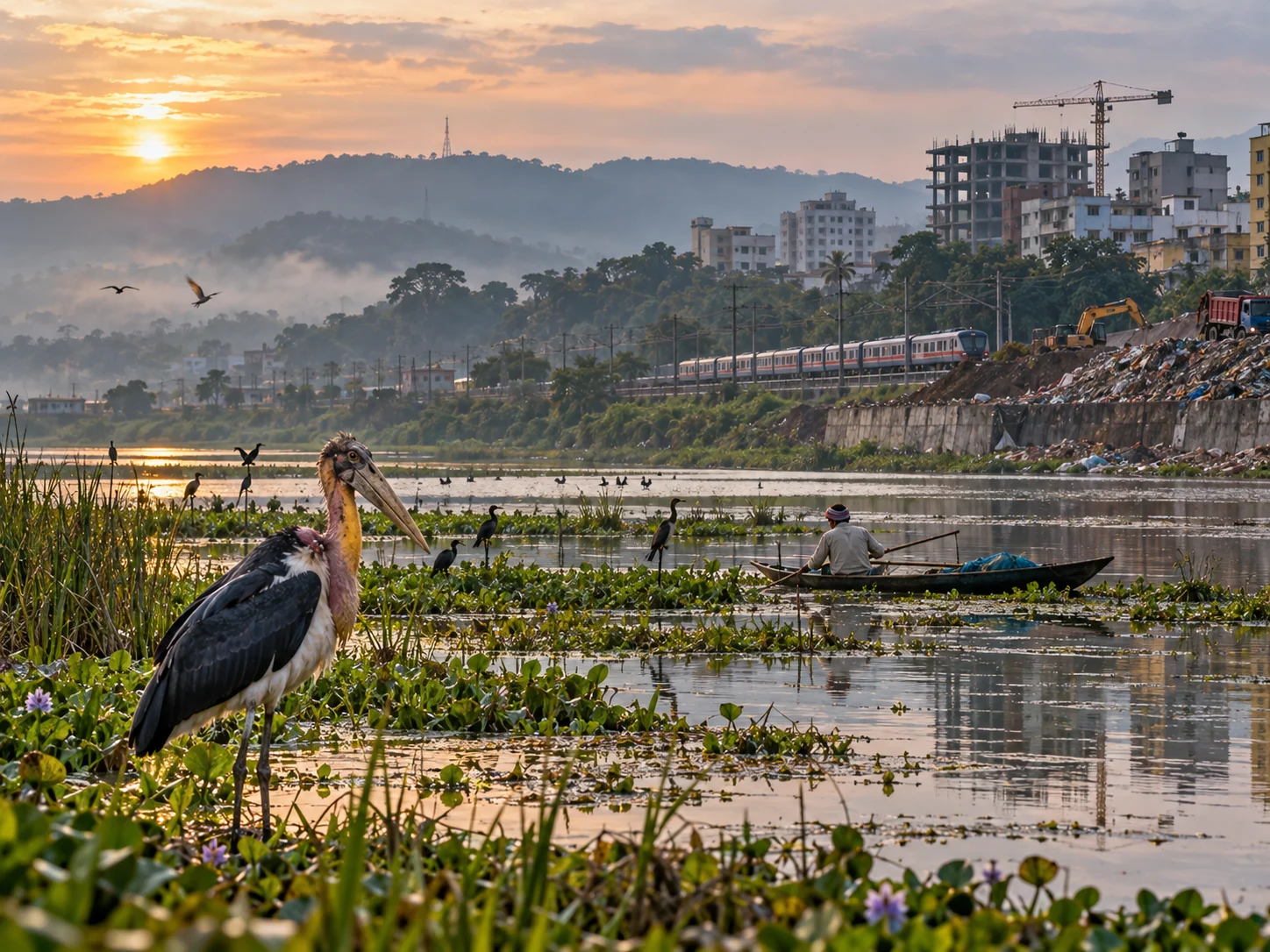
Guwahati: on the city’s south-western edge lies a wetland whose name is said to mean the lake of elephants. The elephants still come. They have to cross a railway line to reach it
The name Deepor Beel is often translated as the lake of elephants.
For a very long time, the name made sense. To the south of the lake rise the forested hills of Rani and Garbhanga, home to wild Asian elephants. For generations the elephants came down out of those hills to drink and feed at the water’s edge, as naturally as the rain ran down into the lake.
They still come. But between the hills and the water there is now a railway line.
They still come. But between the hills and the water there is now a railway line.
Deepor Beel is a large, permanent freshwater wetland on the south-western edge of Guwahati, the biggest city in the north-east. In Assamese, a beel is a lake-like wetland. Rivers flow into it from the hills, and a single outlet carries its water away to the Brahmaputra.
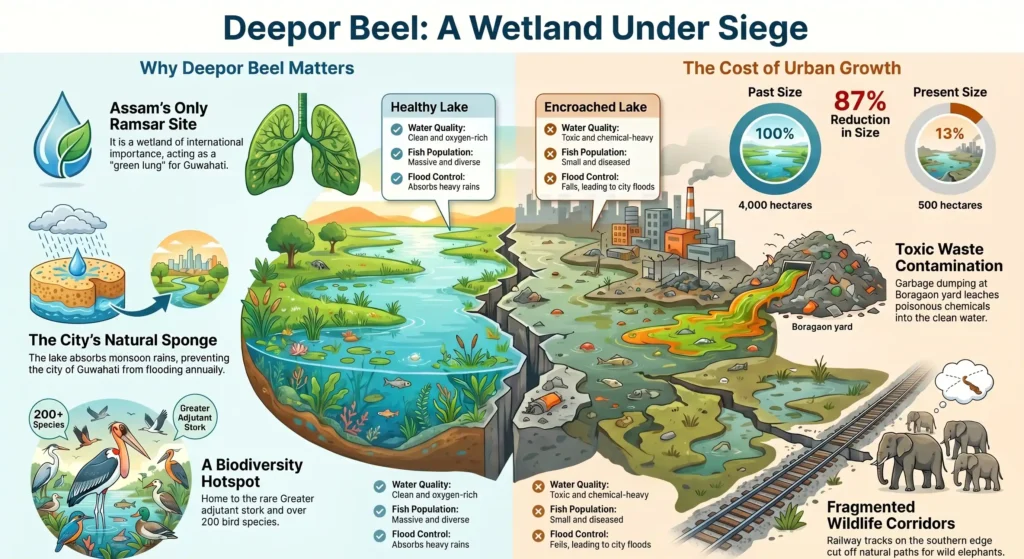
It is a rich place. Every winter, migratory birds arrive in their thousands. Fish breed in its shallows. In 1989, the Assam government declared part of it a bird sanctuary, and in 2002 Deepor Beel was listed as a Ramsar site, a wetland of international importance. For years it was the only one in Assam.
People depend on it too. Around its edges are villages of fishing families, whose living has always come from the beel.
The fisherman
Hema Malini: From Cinema’s Darling to Mathura’s MP
Golak Das lives in Keotpara, a small fishing village on the edge of the beel. He is in his fifties, and he has become one of the lake’s defenders.
He is not against development. But he has watched the lake change around him for years, and he has a warning for the government: it should put conservation first, he told ThePrint, and not rush into haphazard development.
To understand why he worries, you only need to walk around the edge of the beel.
What the city brought
First, the railway. A line was built along the southern edge of the lake, cutting between the Rani-Garbhanga forests and the water. Elephants crossing it at night to reach the beel have been hit by trains. Over the years, many have died.
Then, the rubbish. In 2005, three years after Deepor Beel became a Ramsar site, a municipal garbage dump was opened at Boragaon, on the lake’s eastern side. Guwahati’s waste was piled there for years. Birds and animals came to feed on it. The greater adjutant stork, one of India’s most endangered birds, gathered on the mounds of refuse. In 2017, twenty-six greater adjutants were found dead at the dump. The site was officially closed around 2021, but villagers say dumping has not fully stopped, and the old waste still seeps into the wetland.
And all the while, the buildings. Houses, warehouses and factories have crept onto the wetland’s edges, some of them illegally. Activists say the lake has never been properly demarcated, which makes it hard to protect. One study estimated that the beel had shrunk by around a third since 1991.
In 2017, twenty-six greater adjutant storks were found dead at the dump.
It is easy to think of a wetland as empty land waiting to be used. It is not.
A wetland like Deepor Beel acts like a sponge. In the monsoon, it soaks up rainwater that would otherwise flood the city. It feeds fish, and the families who catch them. It shelters birds from half a continent away. It gives elephants water in the dry season. When a wetland shrinks, the city around it floods more easily, the fish decline, the birds find somewhere else, and the elephants take greater risks to reach what is left.
The government has plans for eco-tourism at Deepor Beel, and some people hope that will bring money and attention to protect it. Others, like the fishing families of Keotpara, fear that more construction, even in the name of nature, will do more harm.
Nobody on any side wants the beel to disappear. The question is whether Guwahati can keep growing without swallowing the lake at its edge.
At night, the elephants still come down from the hills. They wait at the edge of the forest, then cross the railway line, and walk down to the water, as their ancestors did long before the tracks were laid. Whether the lake of elephants keeps its name will depend on what the city decides to leave for them.
If you think you have remembered everything about this topic take this QUIZ
What is the main problem facing the lake today?
The biggest problem is rapid city expansion where people are illegally dumping dirt into the water to build concrete houses and large commercial buildings.
How does the garbage dump hurt the local wildlife?
The giant city garbage dump leaks toxic chemicals and heavy plastics directly into the fresh water which poisons the fish and the birds that eat them.
Why is this specific water body so important for Guwahati?
It acts as a giant natural sponge that absorbs millions of gallons of extra rainwater during the heavy monsoons preventing the city streets from completely flooding.
Yes tourists can visit the area safely to enjoy peaceful boat rides and amazing bird watching as long as they do not leave any plastic trash behind.
What is the main cause of Deepor Beel urban encroachment?
The primary cause is the rapid and often unregulated expansion of Guwahati city. As land becomes scarce, builders fill the wetland with dirt to create dry ground for houses, schools, and commercial buildings, while city authorities have historically used the area for large-scale garbage dumping.
Sources & References
ThePrint, “Assam govt has eco-tourism plans for Deepor Beel, a Ramsar site. But residents fear ecological cost” (28 February 2025) — the meaning of the name, Golak Das of Keotpara, the landfill’s closure, and the lack of demarcation.
Down To Earth, “How Assam’s Deepor Beel is perishing from concretisation, waste dumping” (7 September 2021) — the shrinking of the beel since 1991, the Boragaon dump, the 2017 stork deaths, and the railway.
The Diplomat, “Destruction of a Lake – a Ramsar Site – in India’s Northeast” (23 February 2026) — elephants killed by trains and the dependence of Rani-Garbhanga wildlife on the beel.
Land Conflict Watch, “Encroachment of Deepor Beel threatens livelihood of 1,200 families in Assam” (2025) — the 1989 bird sanctuary and the 2002 Ramsar listing.
Paripurna Datta is the founder and editor of Curious Indian, an independent editorial publication focused on Indian history, culture, science, society, and the stories behind them. He oversees research, editorial standards, and the publication's long-term direction.
Paripurna Datta is the founder and editor of Curious Indian, an independent editorial publication focused on Indian history, culture, science, society, and the stories behind them. He oversees research, editorial standards, and the publication's long-term direction.