He won best actor for Bobby at twenty-one, and forty-four years later wrote that he had paid to get it
In his memoir, published in 2017, Rishi Kapoor wrote that the best actor award he won for Bobby was bought. A publicist named Taraknath Gandhi told him thirty thousand rupees would secure it, and he handed over the money without thinking about it.
He was twenty-one at the time and, by his own description, a brat. He also suspected it was why Amitabh Bachchan, who had Zanjeer out the same year and no award for it, did not speak to him through the shooting of Kabhi Kabhie.
Asked afterwards to name the award, he would not, saying only that it was one of them. The best actor prize he took that year was Filmfare’s.
Nobody had asked him. He was sixty-four, he was a Kapoor, and he put it in print himself.
Born inside
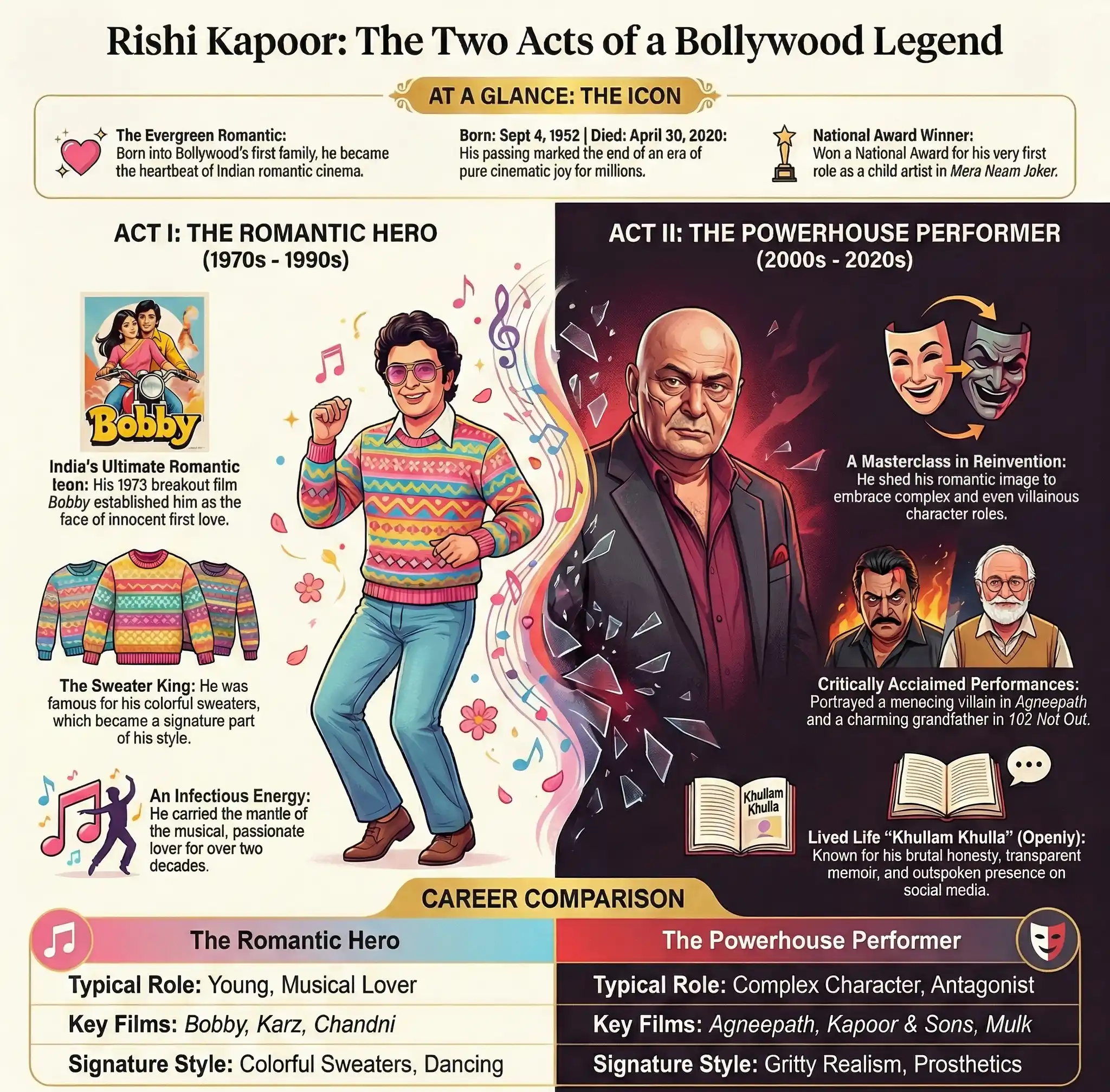
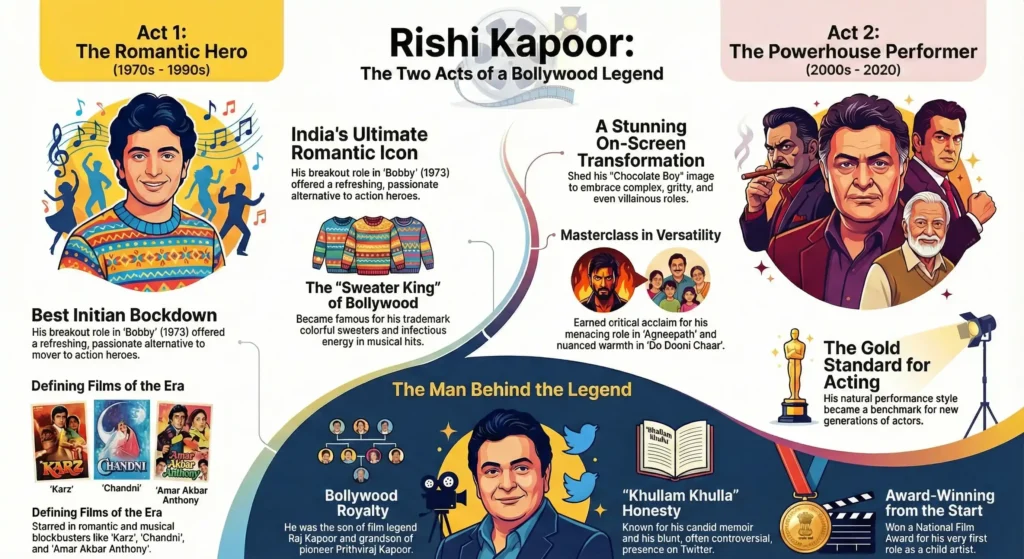
There was no version of his life that happened outside a film studio. Raj Kapoor was his father and Prithviraj Kapoor his grandfather, and he first appeared on screen in Mera Naam Joker in 1970, playing his father’s character as a boy, which won him the National Award for a child artist.
Mera Naam Joker then failed so completely that it nearly took the family company with it. Bobby, in 1973, was made to get the money back. It worked, enormously, and it made his son a star at twenty-one.
The Powerful Meira Paibis Legacy In Northeast India
The wrong decade
Zanjeer came out that same year, and the next fifteen years belonged to it. The mode was a man with a grievance against the system, and audiences wanted him tall, furious and quiet.
Rishi Kapoor was the other thing. He sang, he wore the sweaters, he fell in love and looked delighted about it. He worked without a break through Amar Akbar Anthony, Karz, Chandni and ninety-odd films as the lead, and he was almost never the biggest star in the room.
The unusual part is that he said so, repeatedly and without self-pity, and he had a precise sense of what he was good for.
He also had the good luck to be the last man standing from a kind of film that stopped being made. The romantic Hindi musical of the seventies and early eighties is his, more than anybody else’s, and when it went out of fashion he did not spend a decade insisting it would come back.
The book
The memoir is the least protective thing any member of a Hindi film dynasty has written. He describes his father’s drinking and his affairs. He describes going into a depression after the films that followed Bobby failed, and taking it out on Neetu Singh while she was pregnant, and says she deserves a medal for staying.
He describes meeting Dawood Ibrahim before the 1993 blasts. He describes turning down both male leads in Darr and handing Shah Rukh Khan a career. He settles scores, some of them small, and he does not pretend the settling is anything nobler than that.
The industry’s convention is to publish a memoir that protects the family. He wrote one that starts with his own worst moment.
The Act East Policy India And Northeast Connections
Sixty
The second career is the one that changed how he was assessed. From around 2007 he stopped playing the lead and took the parts that came with a face like his: Do Dooni Chaar, the ninety-year-old under prosthetics in Kapoor and Sons, the Muslim patriarch on trial in Mulk.
Agneepath in 2012 is the demonstration. He plays Rauf Lala, a trafficker of women, without a shred of the charm he had spent forty years on, and the performance is genuinely hard to watch.
It is the rarest move available to an ageing star, and it requires giving up the thing that made you money: the audience’s affection for your face. He gave it up without visible reluctance.
He was better at sixty than at thirty, and he said that too.
2020
He was diagnosed with leukaemia in 2018 and spent nearly a year being treated in New York, posting from there, quarrelling on Twitter, apologising, quarrelling again. He came home in September 2019.
He died in a Mumbai hospital on 30 April 2020, at sixty-seven, the day after Irrfan Khan. His family’s statement said he had kept the doctors and the staff entertained to the last, which sounds like a line families write and in his case probably was not.
A man born at the top of Hindi cinema spent his last years describing what it is actually like up there, beginning with thirty thousand rupees he wishes he had not paid.
8 Remarkable Secrets in the Jagadish Chandra Bose Biography
If you think you have remembered everything about this topic take this QUIZ
Results


#1. In which film did Rishi Kapoor make his debut as a child artist, winning a National Award for his performance?
#2. Which specific fashion item became a famous trademark of Rishi Kapoor’s romantic hero image during the 70s and 80s?
#3. What was the name of Rishi Kapoor’s brutally honest memoir released in 2017?
#4. In his later career, which character did he play to showcase a menacing, dark side that contrasted with his earlier romantic image?
#5. How many films did Rishi Kapoor star in with his wife, Neetu Singh, before they got married in 1980?
#6. According to the ‘Quick Comparison’ table, what defined his ‘Impact’ during the first phase of his career (1970s-90s)?
#7. In addition to India, in which country did the Kapoor family have a massive following, leading to Rishi receiving a lifetime achievement award there?
#8. Rishi Kapoor was famously known by which pet name among family and fans?
The Inner Line Permit System And Indigenous Tribes
What was Rishi Kapoor’s first movie?
His first appearance was as a child artist in the song “Pyar Hua Ikrar Hua” in Shree 420, but his full acting debut was in Mera Naam Joker.
What is the focus of the Rishi Kapoor legacy?
It focuses on his transition from a romantic musical star to one of India’s most versatile character actors, alongside his candid and honest personality.
Did Rishi Kapoor win a National Award?
Yes, he won the National Film Award for Best Child Artist for his role in Mera Naam Joker.
Who are Rishi Kapoor’s children?
He has two children: the famous actor Ranbir Kapoor and fashion designer Riddhima Kapoor Sahni.
10 Remarkable Facts About Meghnad Saha Life and Achievements
Read More: https://curiousindian.in/rajinikanth-december-1950-present/
Sources & References
Gulf News (2017) — his account of paying for the award, and his refusal afterwards to name which award it was.
Film Companion — a reading of Khullam Khulla and the disclosures in it about his father, his marriage and his career.
Al Jazeera (30 April 2020) — his death, the two-year treatment for leukaemia and the family’s statement.
Directorate of Film Festivals, Government of India — the National Film Award for his performance as a child artist in Mera Naam Joker.
Author


Exploring the Soul of Bharat through History, Science, Culture, and its Diversity
Our Mission
Curious Indian is a definitive knowledge portal dedicated to chronicling the events, personalities, and cultural shifts that defined the Indian subcontinent. From the ancient Vedic Period to the complexities of 21st-century politics, our goal is to provide deep-dive analysis that inspires.
Editorial Standards & E-E-A-T
Every article published under our brand undergoes a rigorous fact-checking process. We prioritize primary historical records, academic citations, and credible archives to ensure our readers receive accurate, high-authority information.
Historical Integrity Directly sourcing from ASI archives and academic journals.Topical Authority Comprehensive clustering of Indian Science, Biographies, and Wars.Managed by Paripurna Datta and TEAM | Dedicated to the Knowledge of India.