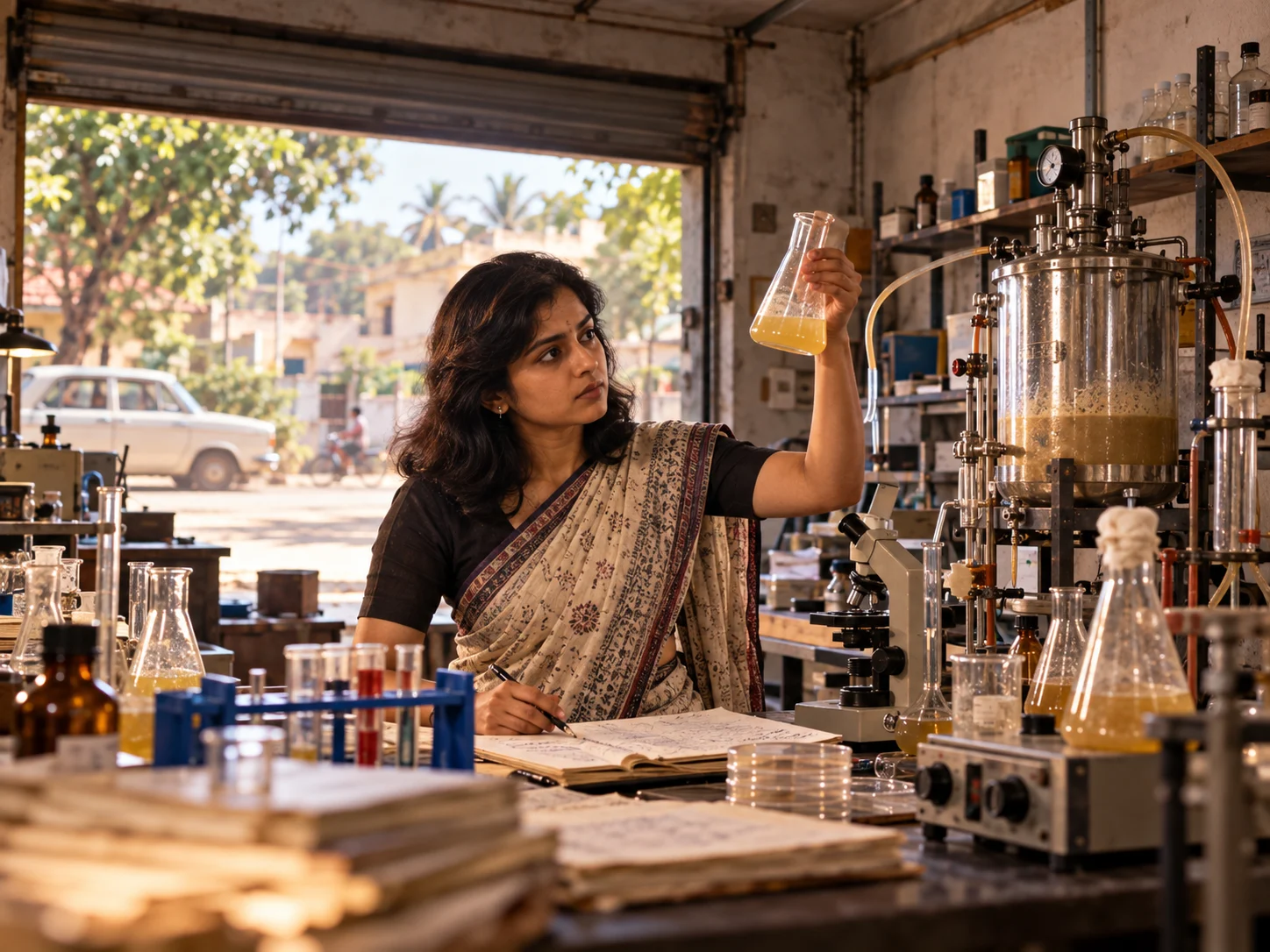
Kiran Mazumdar Shaw founded Biocon Limited in 1978 in a rented garage in Bengaluru with minimal capital, no laboratory infrastructure and in the face of consistent skepticism from banks, investors and a scientific establishment that was not accustomed to taking a young Indian woman seriously as an entrepreneur. Over four decades she built it into Asia's largest biopharmaceutical company, pioneering affordable insulin and cancer biologics that have reached millions of patients across the developing world. Her story is one of the most significant in Indian business history and one of the least sentimentally told.| Detail | Information |
| Subject | Kiran Mazumdar Shaw and Biocon |
| Born | 23 March 1953, Bengaluru, Karnataka, India |
| Company Founded | Biocon Limited, 1978 |
| Founded At | A garage in Bengaluru |
| Initial Capital | Approximately 10,000 rupees |
| Industry | Biotechnology, pharmaceuticals |
| Current Status | Asia’s largest biopharmaceutical company |
| Awards | Padma Shri 1989, Padma Bhushan 2005 |
The Woman Biotechnology Needed
Kiran Mazumdar Shaw founded Biocon Limited in 1978 in a rented garage in Bengaluru with minimal capital, no laboratory infrastructure and in the face of consistent skepticism from banks, investors and a scientific establishment that was not accustomed to taking a young Indian woman seriously as an entrepreneur. Over four decades she built it into Asia’s largest biopharmaceutical company, pioneering affordable insulin and cancer biologics that have reached millions of patients across the developing world. She was born on 23 March 1953 in Bengaluru. Her story is one of the most significant in Indian business history and one of the least sentimentally told.
The Brewing Degree and Institutional Doors
Kiran Mazumdar Shaw had a degree in malting and brewing from Ballarat College in Australia and spent the year after her return discovering that Indian brewing companies did not hire women as brewmasters regardless of qualifications. She had come back to India with international training that the Indian industry she had trained for did not want to use. She was twenty-five years old and trying to figure out what to do next.
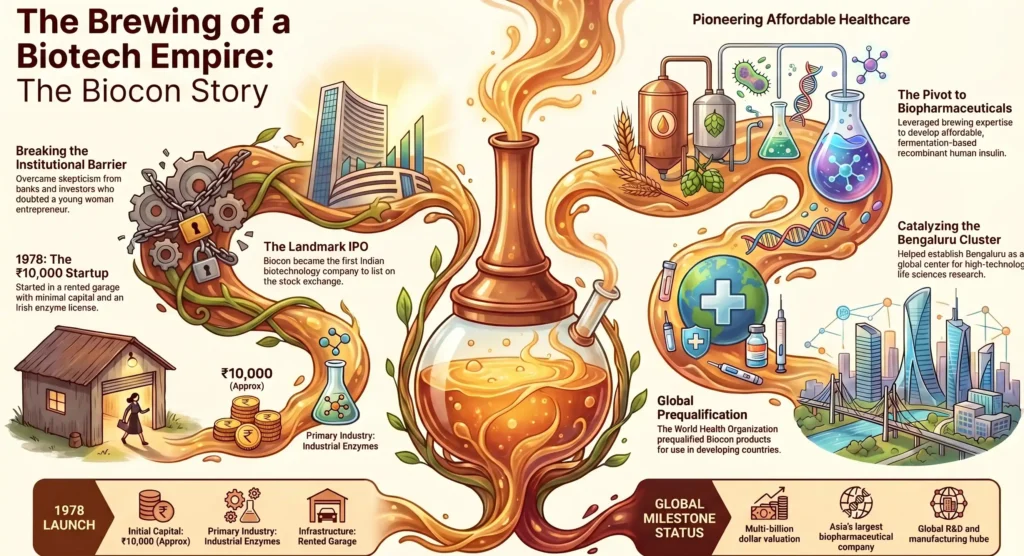
What she did next was start a biotechnology company in a country that did not yet have a biotechnology industry, with ten thousand rupees, a license from an Irish firm and a conviction that India needed what she was proposing to build.
Her father was a brewmaster at United Breweries in Bengaluru, and her initial career aspiration followed naturally from growing up in a household where brewing was a serious technical profession. She completed her science degree in Bengaluru and then pursued post-graduate training in malting and brewing at Ballarat College in Australia, where she was the only woman and one of very few international students.
She returned to India with qualifications that were internationally recognized and practically relevant to a brewing industry that was growing. The industry was not interested. The rejection she received from Indian brewing companies was not based on her qualifications, which were excellent, but on her gender. Brewmasters were men. The equipment was heavy. The working environment was not considered appropriate for women. These were the explanations offered without apparent embarrassment by companies that needed qualified people.
The experience of being systematically excluded from the industry she had trained for shaped everything that followed. It produced in her a specific kind of clarity about institutions, about what they are actually doing when they appear to be making rational decisions and about the relationship between individual capability and institutional permission. She had the capability. The institutions were refusing the permission. The logical response was to build an institution that did not require anyone else’s permission.
The Irish Connection and the Enzyme License
The opportunity that made Biocon possible came through Leslie Auchincloss, the founder of Biocon Biochemicals in Ireland, who was looking for an Indian partner to manufacture enzymes for industrial use. Enzymes were the foundation of the biotechnology industry that was beginning to emerge globally in the late 1970s, used in food processing, brewing, textile manufacturing and an expanding range of industrial applications.
Auchincloss contacted Kiran through a mutual connection and proposed a joint venture in which Biocon India would manufacture enzymes under license from the Irish parent company. The proposal was straightforward in its commercial logic. India had lower manufacturing costs, a growing industrial base and access to raw materials relevant to enzyme production. What it needed was someone who understood the science and could build the manufacturing capability.
Kiran understood the science. Building the manufacturing capability in a rented garage in Bengaluru with ten thousand rupees required something beyond scientific understanding, but she had that too. The garage operation was unconventional by any standard. The initial workforce included contract workers and a part-time secretary. The laboratory equipment was minimal. The production processes were adapted to the resources available. What the operation had was the enzyme license, Kiran’s technical knowledge and her absolute refusal to allow the gap between what she had and what she needed to become a reason to stop.
The Banks and the Bias
The early years of Biocon were defined largely by the experience of trying to raise capital from Indian banks and financial institutions that were constitutionally unable to take seriously the idea that a young woman was building a biotechnology company.
The obstacles were not always stated explicitly in terms of gender. They were expressed through the language of risk assessment, through requirements for collateral that a twenty-five-year-old starting from a garage could not provide, through evaluation of the business model as insufficiently proven and through general skepticism of lending institutions toward businesses in sectors they did not understand.
But the gender dimension was real and was felt. Kiran has spoken about this period directly in interviews and in her own accounts of the company’s founding. She was taken less seriously than a man with equivalent qualifications and equivalent proposals would have been. The meetings were harder to get. The decisions took longer. The skepticism was more automatic and less penetrable by evidence.
She raised the capital she needed through a combination of retained earnings from the enzyme business, personal persistence with financial institutions and the eventual involvement of investors who could see what she was building before it was fully built.
Double Ikat Patola of Patan and Why It Takes a Year to Weave
The Pivot to Pharmaceuticals
The enzyme business that Biocon built in its early years was commercially viable but was not the company’s ultimate direction. The pivot toward pharmaceuticals and biopharmaceuticals came gradually through the 1980s and 1990s as Kiran identified the opportunity that would eventually define Biocon’s global significance: the production of affordable versions of complex biological drugs for patients in developing countries who could not access the expensive branded versions produced by multinational pharmaceutical companies.
The most important of these drugs was insulin. Insulin-dependent diabetes is a condition that affects hundreds of millions of people globally, with a disproportionate burden in developing countries including India. The insulin produced by multinational pharmaceutical companies was expensive, a cost that placed it beyond the reach of large populations in low and middle-income countries.
Biocon developed and manufactured recombinant human insulin using fermentation-based processes that Kiran’s background in brewing had made her unusually well-equipped to understand. The technical approach was sophisticated. The commercial objective was straightforward: produce insulin that worked as well as the multinational versions but cost a fraction of the price.
The insulin program brought Biocon to international attention and established the model that the company would extend across its broader biopharmaceuticals portfolio. The research and development investment required for this work was significant, and Kiran’s decision to invest heavily in research rather than simply manufacturing distinguished Biocon from many Indian pharmaceutical companies that focused on generic manufacturing without original research capability. The research partnerships that Biocon developed during this period helped establish Bengaluru as a center of serious biotechnology research rather than simply a location for pharmaceutical manufacturing.
The Stock Market Listing
In 2004, Biocon became the first Indian biotechnology company to list on the stock exchange, raising significant capital and establishing a market valuation that made Kiran Mazumdar Shaw one of the wealthiest self-made women in India. The IPO was not simply a financial event. It was a validation of the biotechnology sector as a serious investment destination in India and a demonstration that a company founded by a woman in a garage twenty-six years earlier could achieve the scale and credibility that stock market listing requires.
The listing was covered extensively in the Indian financial press and attracted international attention as an example of Indian entrepreneurship in a high-technology sector. Forbes and other international business publications included Kiran in their rankings of significant global business figures, bringing the Biocon story to an audience that extended well beyond India.
The listing made it considerably easier for subsequent Indian biotechnology companies to raise capital because it had demonstrated that the sector could produce returns that institutional investors recognized.
Birth of Shivaji Maharaj: The Dawn of Swarajya at Shivneri
The Bengaluru Biotech Ecosystem
One of the less-discussed dimensions of Kiran Mazumdar Shaw’s achievement is the role that Biocon played in building Bengaluru into a center of biotechnology research and manufacturing. The city had already established itself as India’s technology hub through its software industry. Biocon’s growth demonstrated that the city’s talent base and infrastructure could support high-technology life sciences as well as information technology.
Kiran has been directly involved in advocacy for the development of Bengaluru’s biotechnology ecosystem through organizations including the Biotechnology Industry Research Assistance Council, which provides funding and support for biotechnology research and startups in India. Her engagement with these institutional frameworks has gone well beyond Biocon’s own interests to encompass a broader investment in the conditions that allow biotechnology entrepreneurship to flourish.
The Bengaluru biotechnology cluster that has developed over the past two decades, hosting research institutions, biotechnology startups and manufacturing facilities, owes something of its character and its ambition to the example that Biocon set and to the advocacy that Kiran pursued at both the state and national level.
Indian National Congress (1885): Safety Valve Became a Freedom Engine
The Affordable Medicine Commitment
The thread that runs through Biocon’s development from its earliest pharmaceutical work to its current portfolio is the commitment to affordable medicine. Kiran has articulated this commitment consistently and has made it the organizing principle of Biocon’s research and development strategy rather than simply a marketing position.
The cancer biologics that Biocon has developed and manufactures are among the most significant expressions of this commitment. Cancer treatment in India and across the developing world is frequently inaccessible not because the treatments do not exist but because the branded versions of those treatments are priced beyond the reach of most patients. Biocon’s biosimilar versions of cancer biologics, developed through years of investment in research capability, have the potential to extend access to effective cancer treatment to populations that currently cannot afford it.
This work has been recognized by the World Health Organization, which has prequalified several Biocon products for use in developing countries as part of its effort to expand access to essential medicines globally. In 1989, Kiran received the Padma Shri for her contribution to Indian biotechnology. In 2005, she received the Padma Bhushan.
The Disputed and Fascinating Origins of Kashmiri Pashmina
Quick Comparison Table
| Feature | Kiran Mazumdar Shaw | Sulochana Mody | Ekta Kapoor | Falguni Nayar |
| Industry | Biotechnology | Textiles | Entertainment | Beauty retail |
| Company | Biocon | ModiLuft, textile ventures | Balaji Telefilms | Nykaa |
| Founded | 1978 | 1970s | 1994 | 2012 |
| Primary Challenge | Male dominated science industry, capital | Male dominated business | Male dominated entertainment | Male dominated retail investment |
| Recognition | Padma Bhushan, global recognition | Limited national recognition | National awards | Forbes billionaire |
Curious Indian: Fast Facts
- Biocon was founded in 1978 in a rented garage in Bengaluru with an initial capital of approximately ten thousand rupees.
- Kiran Mazumdar Shaw was rejected by Indian brewing companies because she was a woman, despite holding internationally recognized qualifications in malting and brewing.
- The license that made Biocon possible came from Leslie Auchincloss of Biocon Biochemicals in Ireland, who was looking for an Indian manufacturing partner.
- Biocon became the first Indian biotechnology company to list on the stock exchange in 2004.
- The company’s recombinant human insulin program brought Biocon to international attention and established its model of affordable biopharmaceuticals for developing country markets.
- Kiran received the Padma Shri in 1989 and the Padma Bhushan in 2005 for her contribution to Indian biotechnology.
- The World Health Organization has prequalified several Biocon products for use in developing countries.
- Bengaluru’s biotechnology cluster, which Kiran helped build through advocacy and example, now hosts research institutions, startups and manufacturing facilities that extend well beyond Biocon itself.
The Argument Made in Balance Sheets
Kiran Mazumdar Shaw started with a garage, a license and ten thousand rupees in a country that did not have a biotechnology industry and in a professional world that did not believe a young woman could build one. The gap between that starting point and what Biocon became is one of the largest distances traveled by any Indian entrepreneur of her generation, and it was traveled without the advantages of family wealth, established networks in the relevant industry or the institutional backing that smooths the path for so many large enterprises.
What she had was the science, the stubbornness and the clarity of vision that comes from having been excluded from the institutions you were qualified to enter. That exclusion, painful as it was, produced something useful: the absolute certainty that institutional permission is not the same thing as capability, and that the absence of one does not require the absence of the other.
Biocon is not simply a successful company. It is an argument, made in the language of balance sheets and drug approvals and stock market listings, that Indian biotechnology is real, that affordable medicine for developing country populations is achievable and that a woman from Bengaluru with a brewing degree and ten thousand rupees could build something that matters to millions of people she will never meet. The garage is long gone. The company it produced is still here.
How Azim Premji Turned Cooking Oil Into a Technology Empire
If you think you have remembered everything about this topic take this QUIZ
Results


#1. In which year did Kiran Mazumdar Shaw start Biocon in a rented garage in Bengaluru?
#2. From which international college did Kiran Mazumdar Shaw receive her degree in malting and brewing?
#3. Who was the founder of Ireland’s Biocon Biochemicals that partnered with Kiran Mazumdar Shaw to establish the Indian joint venture?
#4. What industrial product did Biocon India initially focus on manufacturing under its original Irish license?
#5. What major technological pivot did Biocon undertake in the 1980s and 1990s to distinguish itself from standard generic manufacturing firms?
#6. Which complex biological drug program first brought Biocon international attention for its breakthrough fermentation-based production processes?
#7. In which year did Biocon make history by becoming the first Indian biotechnology company to list on the stock exchange?
#8. Which high-profile national honor did Kiran Mazumdar Shaw receive from the Government of India in the year 2005?
How did Kiran Mazumdar Shaw come to found Biocon in 1978?
Kiran founded Biocon after being rejected by Indian brewing companies despite holding internationally recognized qualifications in malting and brewing from Ballarat College in Australia. She was approached by Leslie Auchincloss of Biocon Biochemicals in Ireland, who was looking for an Indian partner to manufacture enzymes under license. She took the license, rented a garage in Bengaluru and began operations with approximately ten thousand rupees in initial capital.
What was the significance of Biocon’s insulin program?
Biocon’s development of recombinant human insulin using fermentation-based processes was significant for two reasons. First, it demonstrated that an Indian company could develop and manufacture complex biological drugs using original research rather than simply copying existing formulations. Second, it established Biocon’s model of producing effective biopharmaceuticals at a cost that made them accessible to patients in developing countries who could not afford branded multinational versions.
What obstacles did Kiran Mazumdar Shaw face in the early years of Biocon?
The primary obstacles were access to capital and institutional skepticism rooted partly in gender bias. Indian banks and financial institutions were reluctant to lend to a young woman building a company in a sector they did not understand. The collateral requirements could not be met by someone starting from a garage. The business model was considered unproven. These obstacles were navigated through retained earnings, personal persistence and the eventual involvement of investors who could see the company’s potential.
Why is Biocon’s 2004 stock exchange listing considered significant?
The 2004 IPO made Biocon the first Indian biotechnology company to list on the stock exchange. Its significance extended beyond Biocon itself because it demonstrated that an Indian biotechnology company could achieve the scale and credibility required for public listing, making it considerably easier for subsequent Indian biotechnology companies to raise capital by establishing that the sector could produce returns that institutional investors recognized.
What is Kiran Mazumdar Shaw’s broader contribution to Indian biotechnology beyond Biocon?
Beyond building Biocon, Kiran has been directly involved in developing Bengaluru’s biotechnology ecosystem through advocacy and institutional engagement including with the Biotechnology Industry Research Assistance Council. She has worked at both state and national levels to create conditions that support biotechnology entrepreneurship in India. The Bengaluru biotechnology cluster that now hosts research institutions, startups and manufacturing facilities owes something of its character to the example Biocon set and the advocacy she pursued.