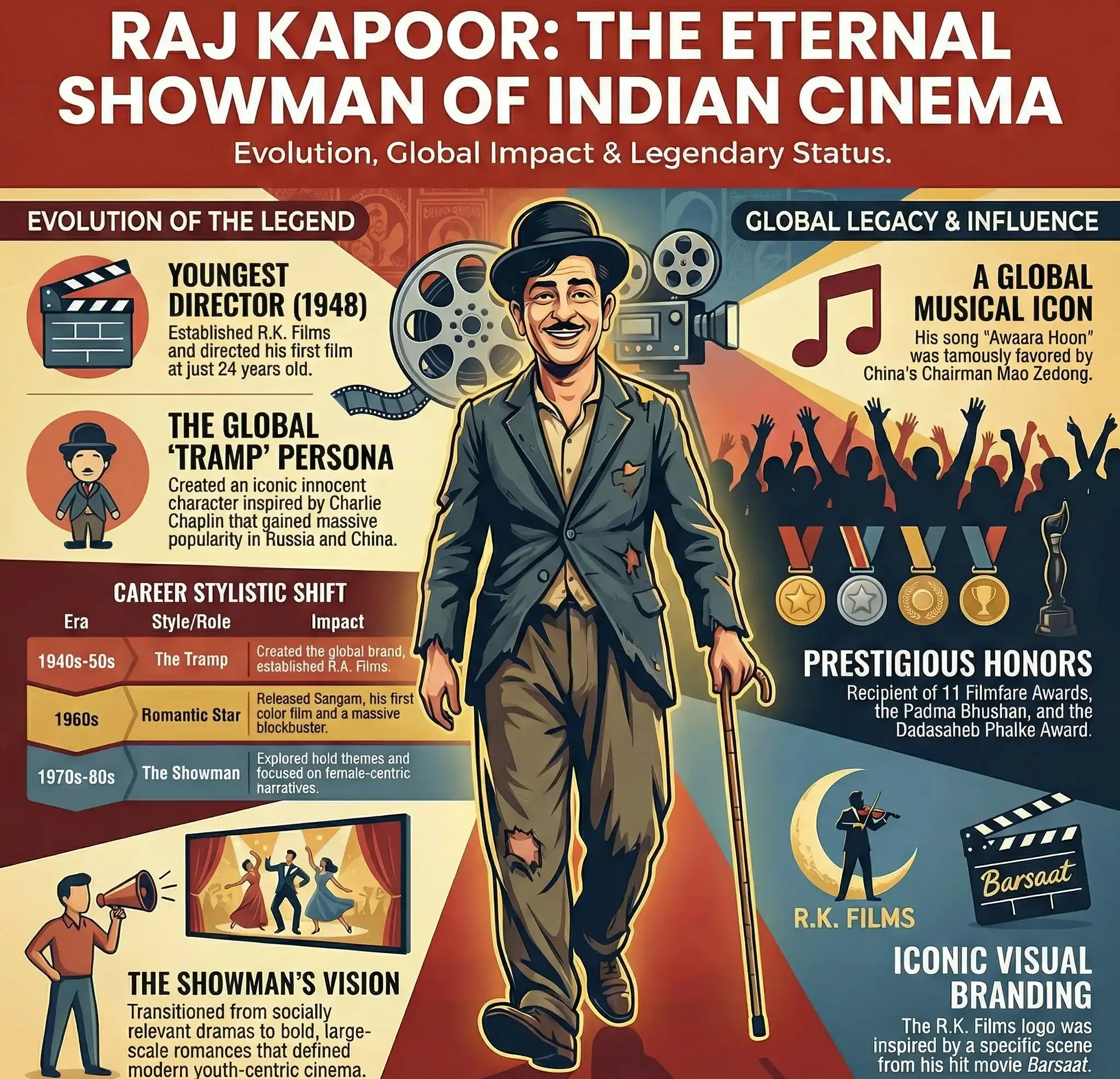
Raj Kapoor put a picture of Nargis on everything he made, and kept it there long after she had gone
For forty years every film that came out of R.K. Films opened with the same picture.
A man stands holding a violin in one hand. A woman is bent back over his other arm, her hair falling, her face turned up towards his. It is not a drawing of nobody in particular. It is a still from Barsaat, released in 1949, and the two people in it are Raj Kapoor and Nargis.
She ended it in the mid-1950s. He kept the picture on everything he made for the rest of his life.
Satyajit Ray (1921–1992): The Auteur Who Redefined Indian Cinema
The film that saved the company
He had needed the hit badly.
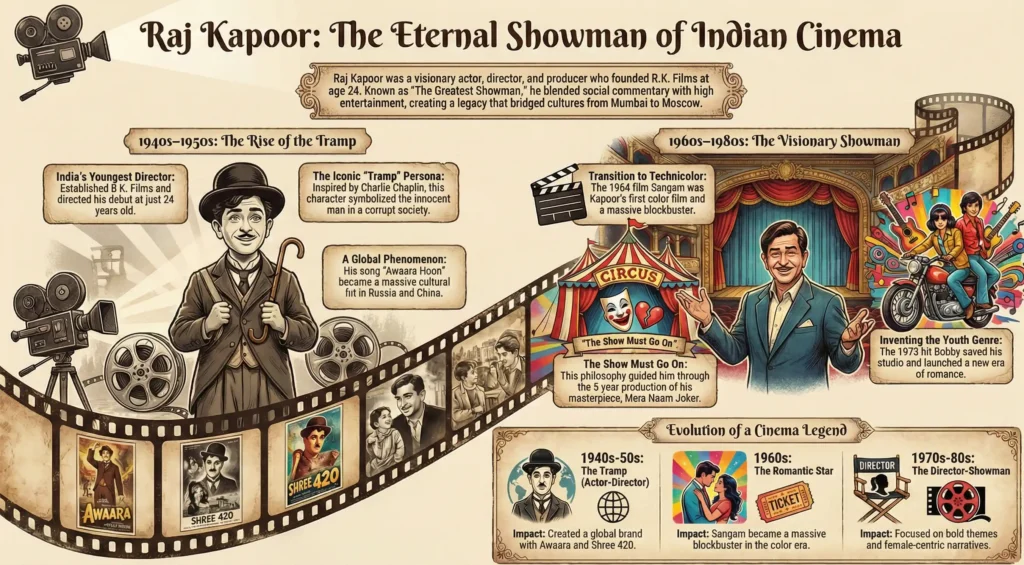
R.K. Films was founded in 1948, when Kapoor was twenty-four and by some distance the youngest man directing films in India. Its first release, Aag, did nothing at all. Barsaat came the following year and did everything, and when the company wanted a mark of its own it lifted the pose straight off the Barsaat poster. The design has been claimed for Bal Thackeray, who drew cartoons before he did anything else, and it may owe something to a European painting of a violinist. The pose in it was theirs.
Most company logos are abstractions. His was a photograph of the two of them.
Asha Bhosle Biography : Beyond the Melody
Nine years
For most of the following decade they worked almost entirely with each other.
Awaara, in 1951, made them famous a very long way from Bombay. Awaara Hoon was sung in the Soviet Union, in China, across the Middle East, by enormous numbers of people who could not follow a word of it. For a while Raj Kapoor was arguably the best-known living Indian who was not a politician, and the tramp he played, borrowed openly from Chaplin, was the face India showed the world.
None of this was hidden and none of it was tidy. He had married Krishna Malhotra in 1946 and stayed married to her until he died. Nargis was, for nine years, the other half of his working life and never the other half of his household. Around 1956 she ended the arrangement. In 1958 she married Sunil Dutt, and she went on to Mother India, to the Rajya Sabha and to a life that had nothing to do with him, until her death in 1981.
He never changed it
What he did after she left is the part nobody puts in the summary.
He did not retire the logo. Jis Desh Mein Ganga Behti Hai, Sangam, Mera Naam Joker, Bobby, Satyam Shivam Sundaram, Prem Rog, Ram Teri Ganga Maili. Every one of them opens with her. The pose was set in relief at the entrance to the studio in Chembur, so that everybody arriving for work walked under it.
The logo was simplified over the years into something closer to an outline, but the shape never altered: the man, the violin, and the woman falling back across his arm.
He ran a company for another thirty years under a picture of the woman who had gone.
From Pancham to Legend: The Complete Biography of R.D. Burman
The joker
He also kept telling on himself, in public, at enormous expense.
Mera Naam Joker took six years to make, came out in 1970 and failed so completely it nearly took the studio down. It is about a clown who loses the women he loves and keeps performing anyway. Bobby, three years later, paid the bills and saved the company, and everyone agreed the old man had bounced back.
In May 1988 he went to Delhi to collect the Dadasaheb Phalke Award. He was asthmatic and badly unwell, and he collapsed in front of the President and the whole hall. He died a month later, aged sixty-three.
16 September 2017
The studio outlived him by twenty-nine years.
That afternoon a fire broke out during the shoot of a television dance show and gutted Stage One, the floor where Awaara had been made. What burned was not only a building. The costumes of the studio’s leading ladies went, Nargis’s among them, and so did the mask Raj Kapoor had worn as the joker.
The family said they could not rebuild it. In 2019 they sold the two and a bit acres in Chembur to Godrej Properties, which is putting apartments and a retail plaza on the ground. The developer kept the logo.
Everything in that picture is gone now except the picture.
Amitabh Bachchan : The Shahenshah Who Conquered Hearts
If you think you have remembered everything about this topic take this QUIZ
Results


#1. Raj Kapoor founded his own production banner, R.K. Films, at the young age of:
#2. Which film marked Raj Kapoor’s directorial debut in 1948?
#3. Raj Kapoor’s iconic “Tramp” persona was inspired by which Hollywood legend?
#4. The famous R.K. Films logo is inspired by a scene from which movie?
#5. Which Raj Kapoor song became a sensation in Russia and was reportedly favored by Chairman Mao Zedong?
#6. Which ambitious film took six years to make and was a commercial failure upon release, but is now considered his masterpiece?
#7. Raj Kapoor suffered a collapse in 1988 while receiving which prestigious award?
#8. Which film was left incomplete due to Raj Kapoor’s death and was later finished by his sons?
Why is Raj Kapoor called the Greatest Showman?
He earned this title due to the grandeur, visual storytelling, and musical richness of his films, coupled with his larger-than-life persona.
Which Raj Kapoor film failed initially but is now a classic?
Mera Naam Joker (1970) was a major commercial failure upon release but is now considered his magnum opus and a classic of world cinema.
Who was Raj Kapoor’s wife?
He was married to Krishna Kapoor from 1946 until his death.
Did Raj Kapoor win the Dadasaheb Phalke Award?
Yes, he was honored with the Dadasaheb Phalke Award in 1987, India’s highest award in cinema.
What was Raj Kapoor’s first film as a lead actor?
His first film as a lead actor was Neel Kamal (1947), opposite Madhubala.
Sources & References
Encyclopaedia Britannica (“Raj Kapoor”) — R.K. Films, the tramp persona and the reach of Awaara.
Encyclopaedia Britannica (“Nargis”) — her work with Kapoor, her marriage to Sunil Dutt and her later public life.
Directorate of Film Festivals, Government of India — the Dadasaheb Phalke Award of 1987.
Godrej Properties, statement on the acquisition of the R.K. Studios site, Chembur (2019) — the sale and the fate of the land.
Author


Exploring the Soul of Bharat through History, Science, Culture, and its Diversity
Our Mission
Curious Indian is a definitive knowledge portal dedicated to chronicling the events, personalities, and cultural shifts that defined the Indian subcontinent. From the ancient Vedic Period to the complexities of 21st-century politics, our goal is to provide deep-dive analysis that inspires.
Editorial Standards & E-E-A-T
Every article published under our brand undergoes a rigorous fact-checking process. We prioritize primary historical records, academic citations, and credible archives to ensure our readers receive accurate, high-authority information.
Historical Integrity Directly sourcing from ASI archives and academic journals.Topical Authority Comprehensive clustering of Indian Science, Biographies, and Wars.Managed by Paripurna Datta and TEAM | Dedicated to the Knowledge of India.