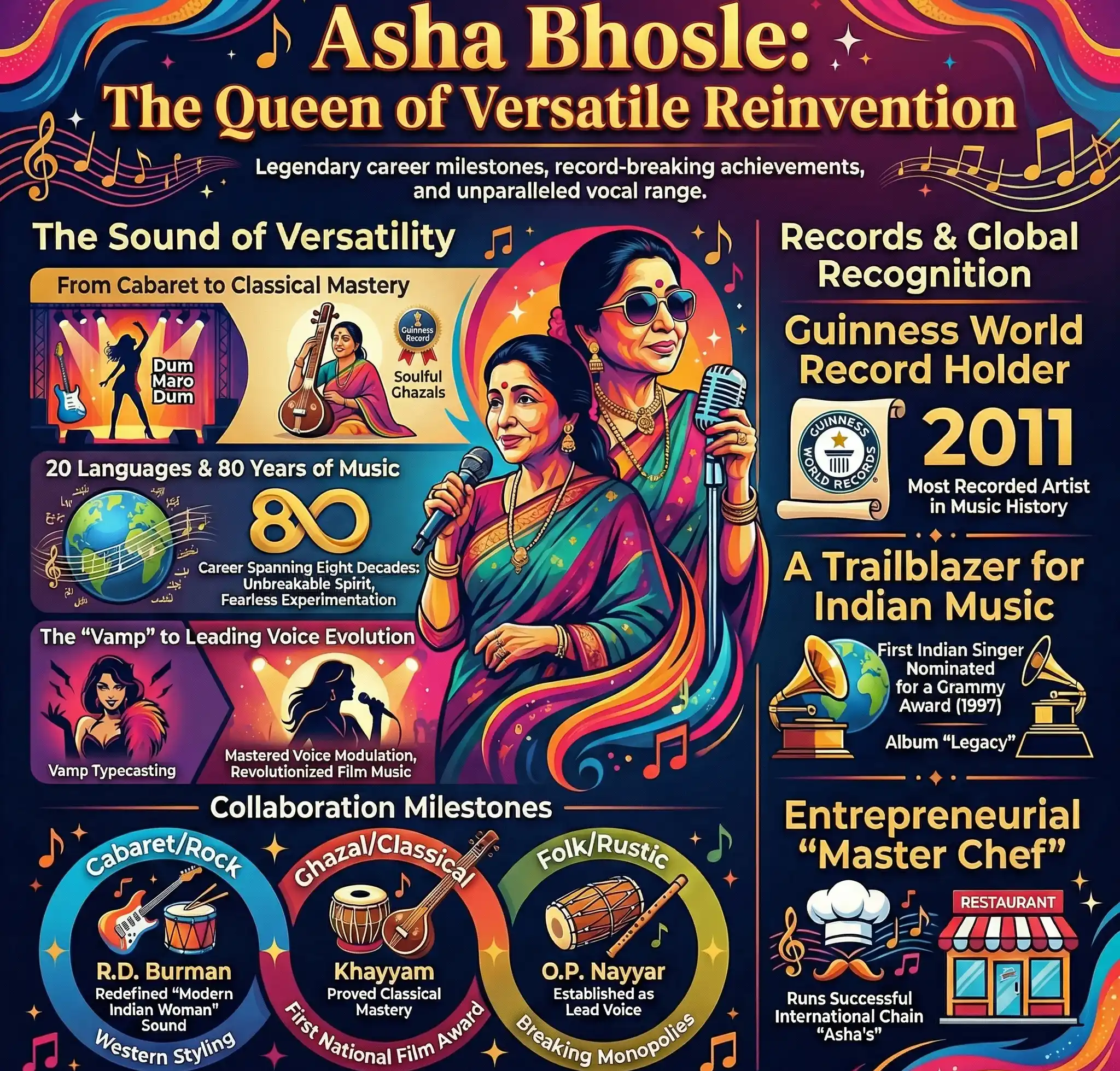
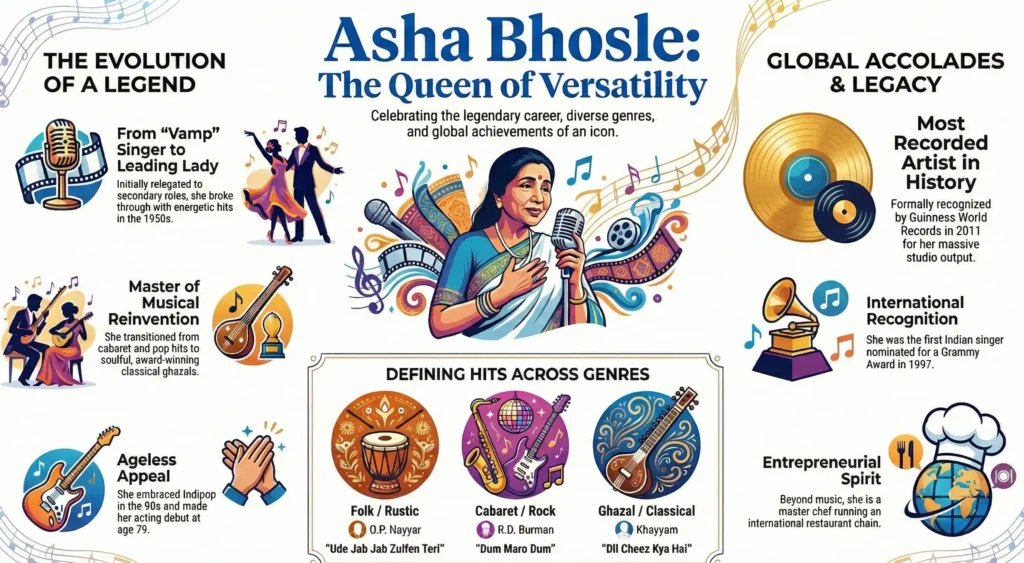
Asha Bhosle spent twenty years being handed the disreputable end of Indian film music, and made it the interesting end
In 2026 a Gorillaz album came out with an Asha Bhosle vocal on it. She was ninety-two, and she died that April.
She had been recording since 1943. The list of people she worked with by the end runs from O.P. Nayyar to Boy George, from R.D. Burman to the Kronos Quartet, and it is tempting to file that under charming eccentricity in old age.
It was not. She was saying yes at ninety-two for the same reason she said yes at twenty-two, which is that early on the only work available to her was the work nobody else would take.
She eloped at sixteen with Ganpatrao Bhosle, a man much older and employed by her own family. Her family opposed it and the marriage broke down, and she came back to Bombay with three children and no money. She was not building a career. She was feeding people.
So she took what was going. The songs for the heroine went to singers with more standing. What was left were the B-films, the second heroine, the vamp, the cabaret number, the drunk song and the seduction. For roughly two decades that was the shape of her working life.
The disreputable end of a catalogue is usually also the experimental end, and nobody had noticed.
Nobody was watching those songs closely, which meant they could be strange. Working with O.P. Nayyar and then with R.D. Burman, she put things into Hindi film music that had no business being there: audible breath, laughter mid-phrase, improvisation around the beat, rhythm borrowed from wherever it was going.
She had the training for it, which is the part that gets forgotten. She studied classical music seriously, and the looseness in those records is a trained singer deciding to break things, not an untrained one getting away with it.
Piya Tu Ab To Aaja and Dum Maro Dum are the obvious examples and they are genuinely radical records. The songs India thought were beneath serious attention are where its film music actually became modern.
By her late forties the industry had settled on a label for her, and it was cabaret singer.
Then Muzaffar Ali made Umrao Jaan, and Khayyam, composing it, wanted the exact opposite of everything she was known for. He is said to have told her plainly that he did not want Asha in the songs. He lowered her pitch by about half a note and asked for stillness instead of play.
It was a serious risk for both of them. The reference point for that kind of film was Pakeezah, and the reference point for the Hindi film ghazal was her own sister, so the comparison was going to be made whatever happened.
She was forty-eight, and she said afterwards that she had surprised herself. Dil Cheez Kya Hai, In Aankhon Ki Masti, Yeh Kya Jagah Hai Doston. It won her the first National Award of her career, and she took a second one in 1987 for Mera Kuchh Saamaan from Ijaazat.
The habit of taking the odd job never left her, and it aged extremely well.
She sang with Boy George. She recorded with the boy band Code Red at sixty-four. The Kronos Quartet built an album around her singing R.D. Burman in 2005, the same year the Black Eyed Peas sampled her. Cornershop had already written a song about her records in 1997. She opened restaurants in Dubai and Britain and was nominated for two Grammys.
By the end there were more than twelve thousand recordings across eight decades, in a great many languages, and the Dadasaheb Phalke Award and the Padma Vibhushan on the shelf.
12 April 2026
She died at Breach Candy Hospital in Mumbai, where she had been admitted with a chest infection and exhaustion.
Her son announced it that Sunday, and the last rites were held at Shivaji Park. The tributes all reached for the same word, versatility, which is accurate and slightly misses the point.
Versatility suggests a singer choosing to demonstrate range. What actually happened is that a young woman with three children and no bargaining power took whatever was offered, and then spent seventy years proving that the material India had decided was not respectable was the material worth having.
Exploring the Soul of Bharat through History, Science, Culture, and its Diversity
Our Mission
Curious Indian is a definitive knowledge portal dedicated to chronicling the events, personalities, and cultural shifts that defined the Indian subcontinent. From the ancient Vedic Period to the complexities of 21st-century politics, our goal is to provide deep-dive analysis that inspires.
Editorial Standards & E-E-A-T
Every article published under our brand undergoes a rigorous fact-checking process. We prioritize primary historical records, academic citations, and credible archives to ensure our readers receive accurate, high-authority information.
Historical IntegrityDirectly sourcing from ASI archives and academic journals.
Topical AuthorityComprehensive clustering of Indian Science, Biographies, and Wars.
Managed by Paripurna Datta and TEAM | Dedicated to the Knowledge of India.