Dima Hasao, Assam: the Dimasa say their rice wine was discovered by a farmer who hung his lunch on the wrong tree. It is a good way into the brews of the north-east, and the women who make them
Long ago, the Dimasa say, a farmer walked up to his hill field carrying his lunch: a packet of sticky rice, wrapped in a leaf. He hung it on the branch of a tree, and went to work.
He worked all afternoon. When at last he came back for his food, the packet smelled wonderful. The rice was dripping with a sweet liquid. He ate it, and felt a joy he had never known before, and danced all around his field.
The tree, the story goes, was a thembra. Its bark has gone into the Dimasa rice wine, judima, ever since.
He ate it, and felt a joy he had never known before, and danced all around his field.
What is in the glass
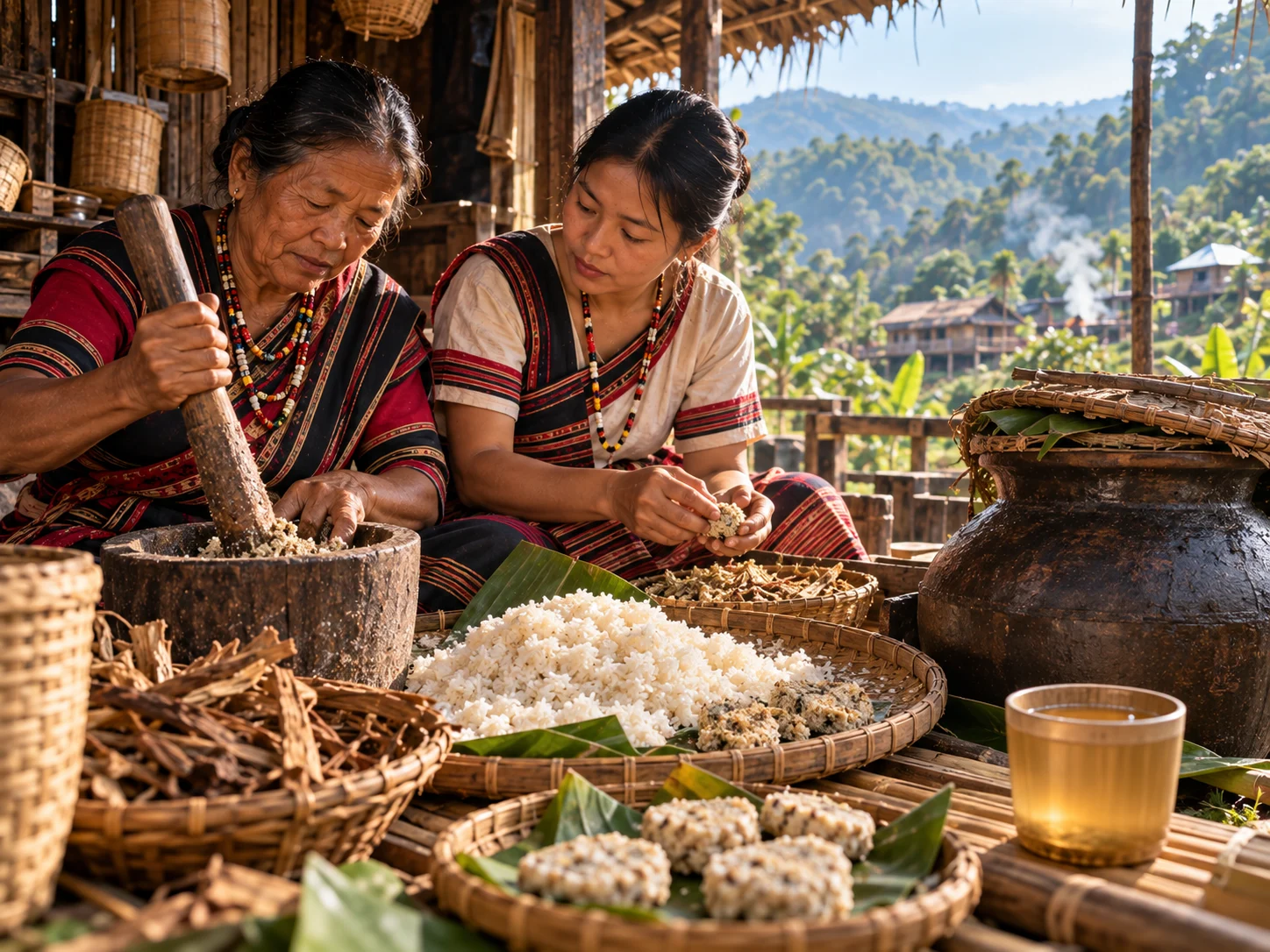
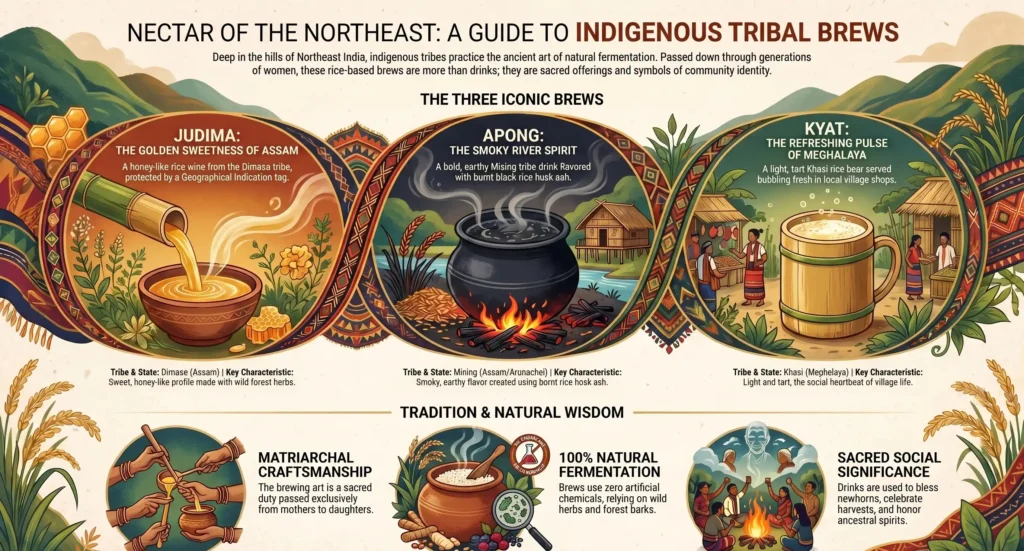
Judima is made by the Dimasa people of Dima Hasao, the hill district of Assam. Traditionally it is the women who make it, and daughters learn from their mothers and grandmothers.
It begins with two things. The first is sticky rice; the Dimasa say the maiju variety makes the best judima. The second is thembra, the bark of a thorny forest climber, Acacia pennata. The bark is cut, dried in the sun, and pounded together with rice to make humao, small cakes that act as the starter. When the cooked rice is mixed with the starter and left, the fermentation begins.
The result is pale yellow or reddish, and sweet. Distilled, it becomes a stronger spirit, juharo.
Nargis Dutt (1929–1981): The Graceful Soul of Indian Cinema
More than a drink
For the Dimasa, judima is not simply something to drink. It is offered to guests as a sign of welcome. It is served at weddings and harvest festivals, and used in rituals for the ancestors.
When a family sets out to ask for a bride, the groom’s party carries judima with them, as a sign of their intention. And when a Dimasa child is born, a drop of judima is dabbed on the baby’s lips, to keep bad luck away.
In other words, it marks a life from its first day, through its courtship, to its memory.
It marks a life from its first day, through its courtship, to its memory.
A region of brews
Judima is one brew among many. Almost every community in the north-east has its own rice beer or rice wine, and its own way of making it. The Nagas brew zutho. Across Assam and Arunachal Pradesh, other rice beers go by other names. What changes from place to place is the rice, the herbs, the leaves and barks in the starter cake, and the rituals the drink belongs to.
Researchers have begun to notice how much knowledge sits inside these recipes. The plants used in the starters are a record of what people have learned, over generations, about the forests around them. And across the region, the people who hold that knowledge are very often women.
Meena Kumari (1933–1972): Sorrow and Stardom of the Tragedy Queen
The tag
In 2018 a Dimasa women’s group, Dimajik Hasao, applied for a Geographical Indication for judima, to protect its name and link it legally to the Dimasa and their way of making it. The application failed. The next year they tried again, this time with the help of Assam Agricultural University and a local nonprofit, YADEM, carefully documenting the drink’s history, ingredients and method.
In 2021, judima received its GI tag. It was the first traditional brew from anywhere in the north-east to be given one.
Today some judima is bottled and sold through a cooperative, whose members say it is still prepared by Dimasa women, and only batches that meet their standards make it into a bottle. Since 2016 the district has held a judima festival. Elsewhere in the region, entrepreneurs have begun making premium rice wines, fruit wines and even tea wines.
The tree
None of this has changed the heart of the thing. Judima still depends on sticky rice grown in hill fields, on bark gathered from the forest, and on women who know exactly how long to let it rest.
Somewhere in Dima Hasao this evening, a pot of rice and humao is quietly doing what that farmer’s lunch did on a thembra branch long ago. For a curious Indian, it is a reminder that the drinks of the north-east are not just drinks. They are stories about land, forests, and the women who have kept them, one batch at a time.
Lata Mangeshkar (1929–2022): The Voice of the Millennium
If you think you have remembered everything about this topic take this QUIZ
Results


#1. What is the name of the sweet rice wine from the Dimasa tribe that has a Geographical Indication (GI) tag?
#2. What unique ingredient gives Apong its characteristic smoky flavor and dark color?
#3. In which state is the bubbling rice beer called Kyat primarily found?
#4. What are the small wooden local shops in Meghalaya called where people gather to socialize and drink Kyat?
#5. Who is traditionally responsible for the sacred duty of brewing these indigenous drinks?
#6. According to the text, what is used to serve these local brews that adds a subtle earthy flavor?
#7. What is done with the leftover fermented rice mash after the drink is separated?
#8. Which organization studies these traditional techniques to understand safe fermentation without chemicals?
What makes these local drinks different from factory made alcohol?
They are made entirely by hand using purely natural ingredients like local rice and wild forest herbs without any artificial chemicals or preservatives.
Can travelers easily taste these drinks?
Yes many rural homestays and local village festivals happily offer these traditional drinks to visitors as a gesture of warm hospitality.
Are these drinks very strong?
Most of these traditional brews are very mild and light because they are naturally fermented for a short time unlike strong distilled spirits.
Who usually makes these beverages in the village?
The brewing process is highly respected and is almost exclusively done by the elder women of the community who hold the secret family recipes.
Can tourists try Kyat in Meghalaya safely?
Yes, the Meghalaya Department of Tourism encourages responsible cultural exchange. Many local villages have designated shops or homestays where Kyat is brewed fresh daily. It is best enjoyed in moderation while engaging with local stories
Sources & References
The Locavore, Dejna Daulagupu and Dolly Kikon, “Following Judima in Dima Hasao: A Rice Wine Story” (23 May 2023) — the legend of the farmer and the thembra, and the making of humao.
India Food Network, “Judima: The GI Tagged Rice Wine of Assam’s Dimasa Tribe” (14 July 2026) — the ingredients, the drink’s social role, and the GI applications of 2018 and 2019.
Open Magazine, “Brewing Heritage” (12 July 2024) — the newborn ritual and the Judima Traditional Brewers’ Industrial Co-operative Society.
Wikipedia, “Judima”, citing The Hindu (21 September 2021) — the GI tag, thembra, and the distilled juharo.