Nargis came out of a world respectable India was busy disowning, and it made her the symbol of its virtue
In 1957 Mehboob Khan released Mother India, and the country decided it had found its mother.
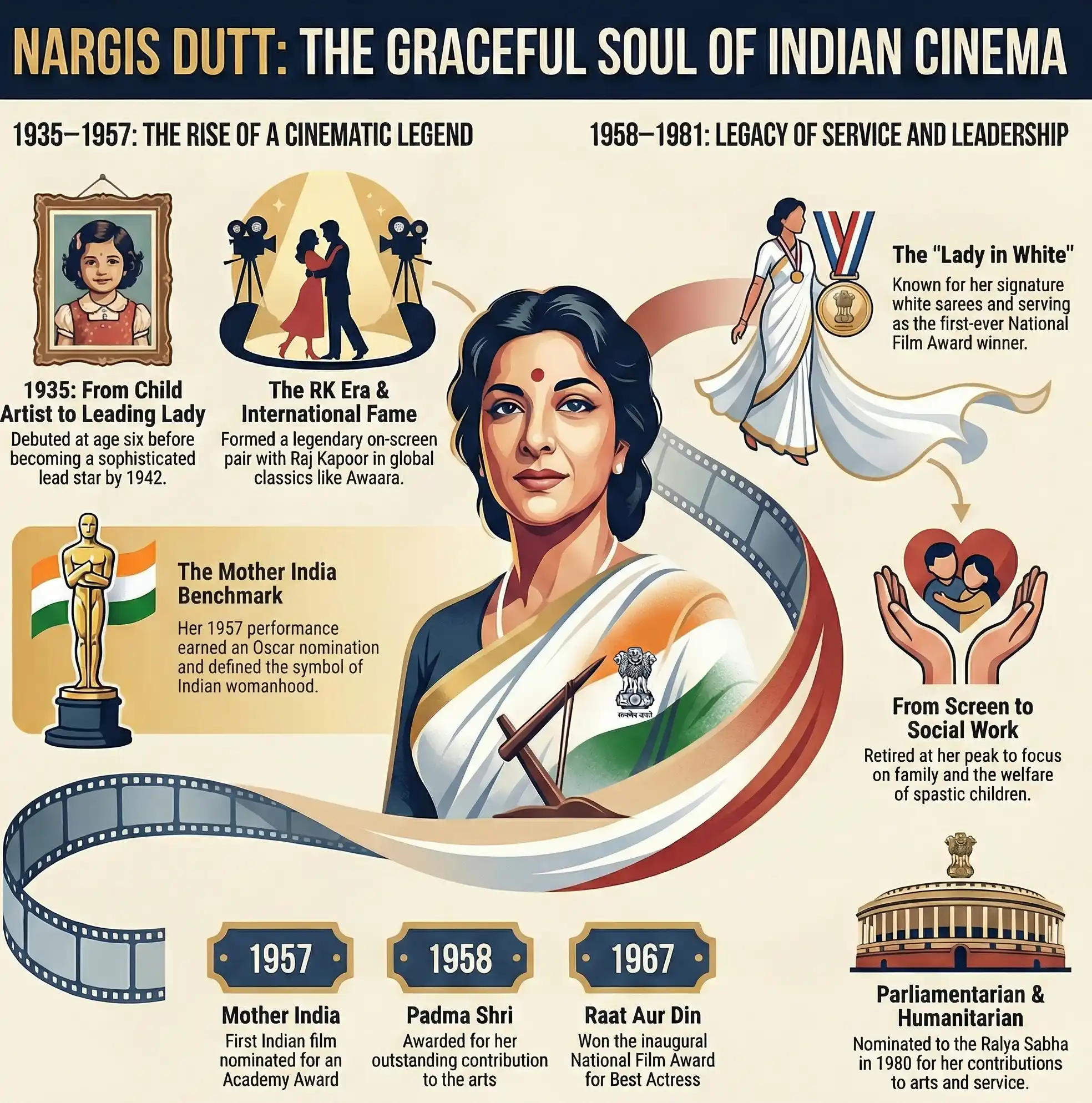
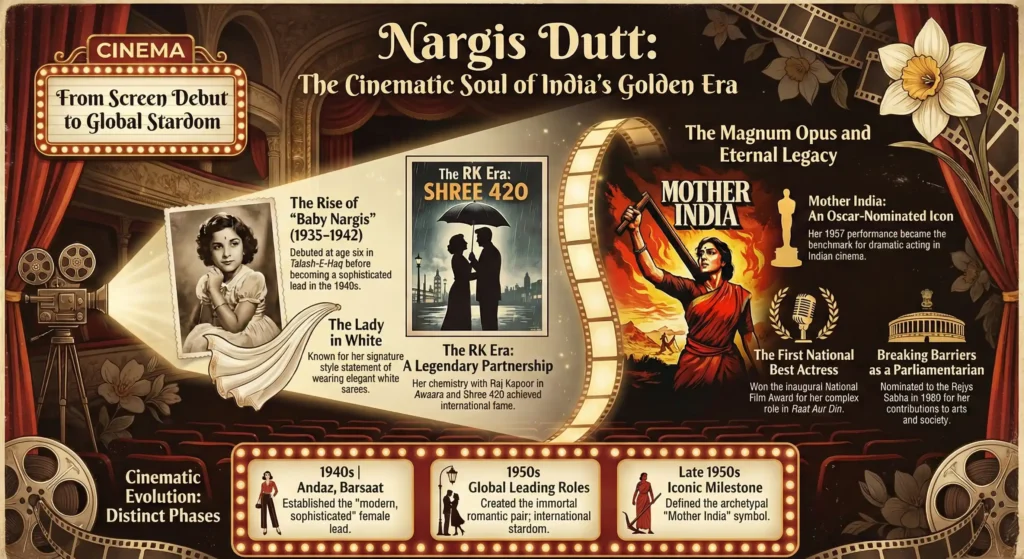
Nargis played Radha, the peasant woman who holds a family together through flood and debt and finally shoots her own son. She was twenty-eight. Sunil Dutt, who played that son, was born the same year she was. The film went to the Academy Awards, the first Indian film nominated for the foreign language prize, and for the rest of her life and long after it she was the image India used when it wanted to picture its own virtue.
The interesting part is where the woman in that picture had come from.
7 Secrets of Padmanabhaswamy Temple Treasure
Jaddanbai
Her mother was one of the most formidable people in early Indian cinema, and almost nobody outside the industry knew it.
Jaddanbai was born around 1892 in Benares, the daughter of Daleepabai, a well-known tawaif of Allahabad. She trained seriously in classical music, in thumri, under teachers of the first rank, and became a bigger name than her mother had been. When the talkies arrived she moved into them. By the mid-1930s she had her own company, Sangeet Movietone, and was producing, directing, writing and scoring her own films, which made her one of the first women to compose music for Indian cinema.
Her subjects were not incidental. Talash-e-Haq, which she wrote, scored and starred in, is about a woman of the streets trying to redeem herself. She made films about the people the respectable world had written off, because she knew them.
The tawaif tradition she came from was a trained artistic culture, and it was also the exact thing respectable India had spent forty years trying to stamp out.
6 Unfoldings in the Subrahmanyan Chandrasekhar Biography
Fourteen
The company did not survive.
Film production got expensive as the star system took hold, and the small houses founded by women in the 1930s were pushed out one by one. Jaddanbai’s went with them. She had put her daughter into an elite Bombay school; she now took her out of it and put her into Mehboob Khan’s Taqdeer in 1943, at fourteen, as a lead.
It worked. The film succeeded, the family’s finances recovered, and Fatima Rashid did not go back to school. Everything she knew afterwards she had learned on sets.
What she was, before she was a symbol
For the next fifteen years she was simply one of the best actors in the country.
She did screwball comedy and literary drama and everything between, worked constantly through the great decade of Hindi cinema, and was among the highest paid actresses in India. Andaz, Awaara, Shree 420. She was not a saintly presence in any of them. She played modern, sharp, independent women, which was closer to what she actually was.
Then Mehboob Khan cast her as Radha, fourteen years after he had cast her as a girl, and the range stopped mattering. On the set a fire got out of control and Sunil Dutt pulled her out of it. They married in 1958, the year she received the Padma Shri, and she effectively stopped.
The argument she picked
She was not content to be a statue, which is the part people leave out.
She was nominated to the Rajya Sabha in April 1980, and she used the position. Her most famous intervention was an attack on Satyajit Ray, then the most admired Indian director alive, for showing the West nothing but Indian poverty. Pather Panchali, she said, “is not a correct image of India.” She wanted a modern country on the screen instead.
People still have that argument, and she was on the losing side of the critical verdict. It is worth noticing what it took to make it. The woman who had played the poorest woman in India was arguing about who gets to decide how India is shown, and she had a right to an opinion that most of her critics did not.
3 May 1981
She died of pancreatic cancer at fifty-one, still a sitting member of the Rajya Sabha.
Four days later Rocky opened, the first film of her son Sanjay. By her husband’s account her seat at the premiere was left empty.
India took a woman whose mother it would not have admitted through the front door, and made her its idea of motherhood. It never quite got around to noticing what it had done.
Dr. A.P.J. Abdul Kalam: (1931-2015)
If you think you have remembered everything about this topic take this QUIZ
Results


#1. What was Nargis Dutt’s real birth name?
#2. Which film starring Nargis earned an Academy Award (Oscar) nomination for Best Foreign Language Film?
#3. Who saved Nargis from a fire on the sets of Mother India, later becoming her husband?
#4. Nargis won the inaugural National Film Award for Best Actress for which film where she played a character with a split personality?
#5. What does the screen name “Nargis” mean in Urdu?
#6. After retiring from films, Nargis became the first patron of which social organization?
#7. Who was Nargis’s mother, a pioneering classical singer and filmmaker?
#8. In 1980, Nargis was nominated to which parliamentary body for her contribution to arts and social service?
What was Nargis Dutt’s first movie?
Her debut as a child artist was Talash-E-Haq (1935), and her first lead role was in Tamanna (1942).
Did Nargis Dutt win an Oscar?
No, but her film Mother India was the first Indian film to be nominated for the Academy Award for Best Foreign Language Film.
Who was Nargis Dutt’s husband?
She was married to actor and politician Sunil Dutt.
What is the Nargis Dutt Award?
It is a National Film Award for Best Feature Film on National Integration, instituted in her honor.
How did Nargis Dutt die?
She passed away due to pancreatic cancer on May 3, 1981.
Sources & References
Encyclopaedia Britannica (“Nargis”) — her career, Mother India and the Academy Award nomination.
Women on Record, “Jaddanbai” — her mother’s musical training, Sangeet Movietone, and the decision to put Nargis into films at fourteen.
Rajya Sabha, Government of India — her nomination to the House in April 1980 and her term, which ended with her death.
Cambridge University Press, The Slumdog Phenomenon (2013) — her public argument with Satyajit Ray over the export of Indian poverty.
Author


Exploring the Soul of Bharat through History, Science, Culture, and its Diversity
Our Mission
Curious Indian is a definitive knowledge portal dedicated to chronicling the events, personalities, and cultural shifts that defined the Indian subcontinent. From the ancient Vedic Period to the complexities of 21st-century politics, our goal is to provide deep-dive analysis that inspires.
Editorial Standards & E-E-A-T
Every article published under our brand undergoes a rigorous fact-checking process. We prioritize primary historical records, academic citations, and credible archives to ensure our readers receive accurate, high-authority information.
Historical Integrity Directly sourcing from ASI archives and academic journals.Topical Authority Comprehensive clustering of Indian Science, Biographies, and Wars.Managed by Paripurna Datta and TEAM | Dedicated to the Knowledge of India.