In 1975 the lightest figure in the Hindi film industry turned out to be the one with a spine
In the summer of 1975 the Information and Broadcasting Ministry began telephoning film stars.
The Emergency had been declared in June. Doordarshan and All India Radio had been turned into instruments of the government, and the ministry under V.C. Shukla wanted the industry visible on its side: singers at Youth Congress rallies, actors endorsing the twenty-point programme, everyone publicly grateful for the new discipline. Most of the people who were asked found a way to say yes.
The man who said no was the one nobody would have picked. The scarf, the puff of hair, the tilted walk, the fastest and lightest talker in Indian cinema.
What he was supposed to be
Dev Anand had spent nearly thirty years being the charming one.
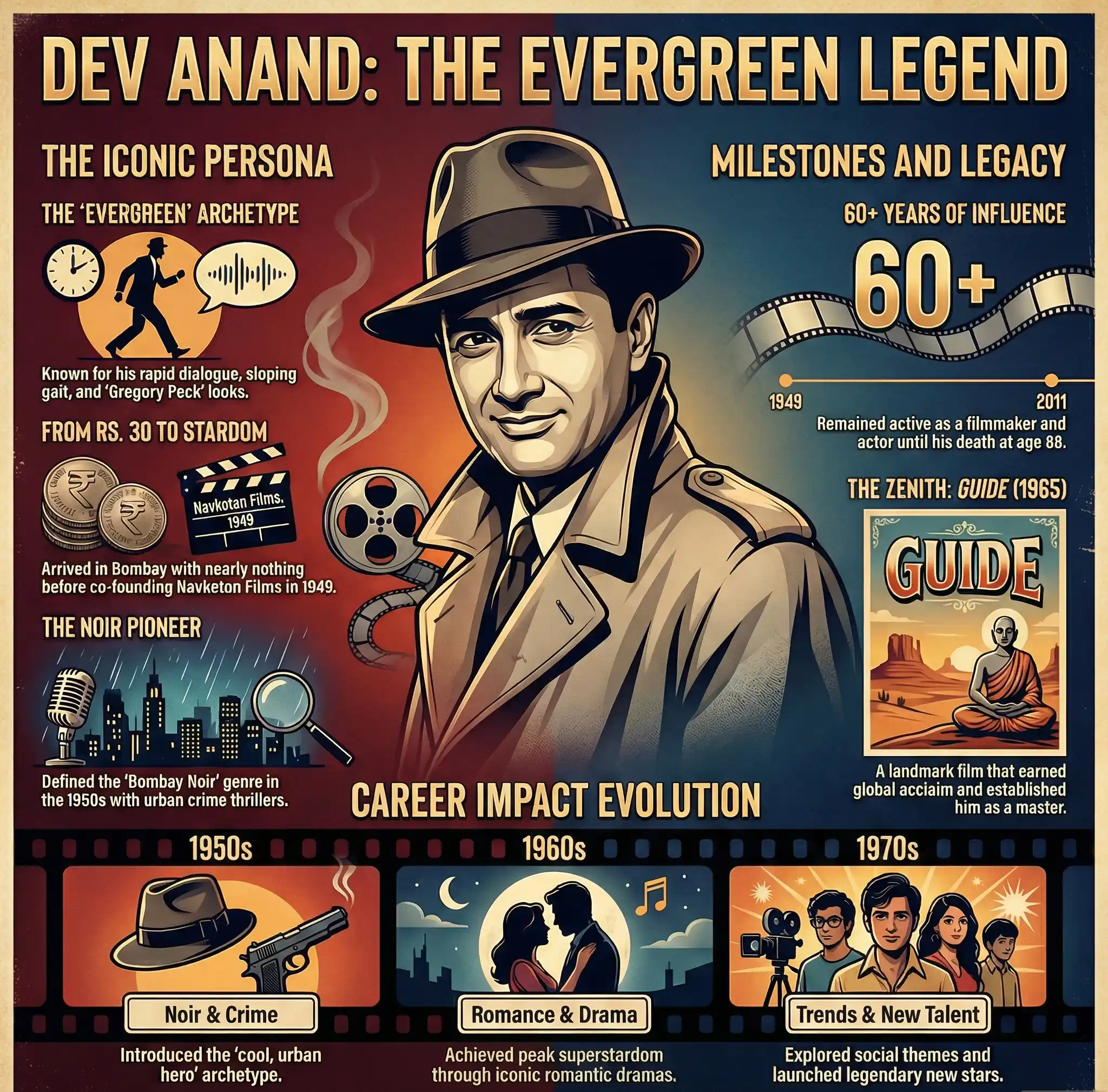
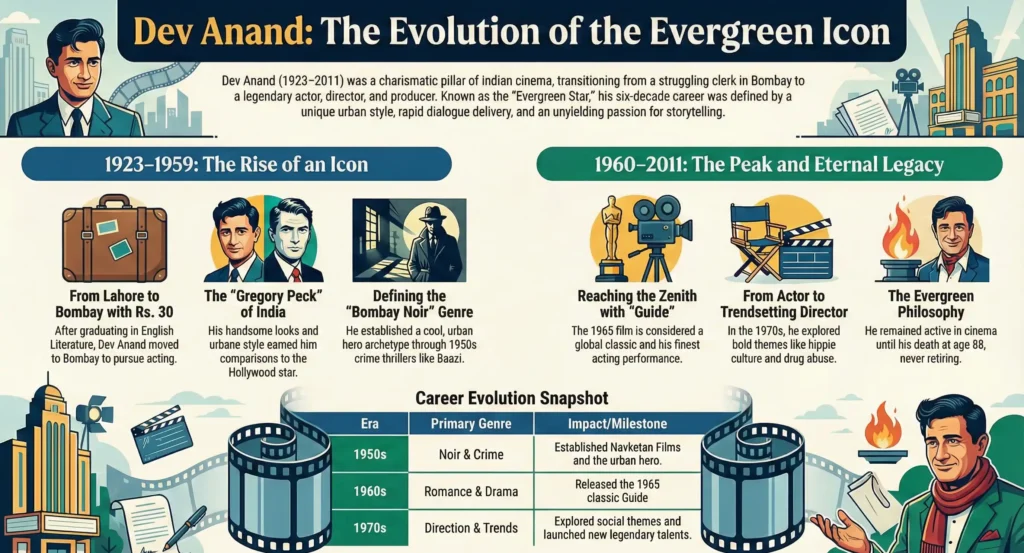
Ziddi made him a star in 1948, and the comparisons to Gregory Peck started almost immediately. He set up Navketan Films the following year and made the run of city thrillers, Baazi and C.I.D. and Kala Bazar, that gave Bombay its own version of noir. Guide, in 1965, was the film that proved he could act as well as glide.
The most repeated story about him was that the police had asked him to stop wearing black in public, because women were said to throw themselves off buildings at the sight of him. He spent years pointing out that this had not happened. It is the kind of legend that only attaches to people nobody takes seriously.
He was the industry’s style, not its conscience. The serious Anands were his brothers. Chetan had made Neecha Nagar, which went to Cannes. Vijay directed Guide.
What was actually being asked
Dr. A.P.J. Abdul Kalam: (1931-2015)
The requests looked like invitations and were not.
Refusal was expensive in a specific way. Kishore Kumar turned down a rally and a set of promotional songs, and from May to October 1976 his voice was simply removed from government radio and television. Dev Anand’s films stopped being broadcast on Doordarshan. Shatrughan Sinha was reportedly warned he could be tied to a criminal case if he did not campaign.
The pressure did not stop at the airwaves. Actors who would not cooperate found their shoots interrupted and their clearances slow, which in an industry running on borrowed money is its own kind of sentence.
An actor whose work is not shown does not stay an actor for long, and everybody in the room understood that.
Then he did the harder thing
Refusing quietly would have been enough for most people.
Instead he went to a public meeting on Juhu Beach, with his brothers Chetan and Vijay, and spoke against the government by name, using the word dictators about the Prime Minister and her son. This was at a point when more than a hundred thousand people were in jail and the newspapers were being censored.
He wrote about it afterwards in his memoir with no triumphalism at all. The Emergency, he allowed, had imposed a certain order and some of it had done the country good. But the soul of the people, he wrote, was “smouldering, their spirit stifled by an iron hand.”
8 Defining Chapters in the Vikram Sarabhai Biography
The party
What he did next did not work.
The Emergency ended in March 1977. The Janata government that followed came apart by August 1979, and a month later Dev Anand launched a party of his own in Bombay, the National Party of India. It lasted months. He dissolved it before the 1980 election.
He was not the only one who had gone into politics. Much of the film industry had swung behind the Janata Party at the 1977 election, once it had become safe and popular to do so. He was simply late, and on his own.
His explanation, given at a literature festival nearly thirty years later, was that they “could not find right candidates to contest the polls.” He sounded relieved rather than bitter. He had the nerve for the moment and no machinery for the aftermath, which is a common enough combination and rarely admitted so plainly.
What the scarf was hiding
He went back to making films and never stopped making them.
He directed and financed one after another into his eighties, most of them unsuccessful, and showed no interest at all in his own back catalogue. He died in London in December 2011, at eighty-eight, with another script in progress.
Evergreen was always a compliment about his hair and his energy. It is the wrong thing to remember him for. In a year when a great many serious people found sensible reasons to stay quiet, the frivolous one stood up on a beach and said so out loud.
10 Remarkable Facts About Meghnad Saha Life and Achievements
If you think you have remembered everything about this topic take this QUIZ
Results


#1. What was Dev Anand’s real birth name before he became a star?
#2. Dev Anand co-founded which famous production house in 1949?
#3. Which 1965 film, based on R.K. Narayan’s novel, is considered one of Dev Anand’s finest performances and a landmark in Indian cinema?
#4. Dev Anand was famously compared to which Hollywood actor due to his looks and style?
#5. Which film directed by Dev Anand tackled the theme of hippie culture and introduced Zeenat Aman?
#6. Before becoming an actor, what job did Dev Anand hold in Bombay for a salary of Rs. 165?
#7. Dev Anand had a passionate but unfulfilled romance with which famous singer-actress?
#8. Dev Anand actively opposed the Emergency (1975–77) and formed a short-lived political party called:
Why was Dev Anand called the Evergreen Star?
He was called “Evergreen” because of his youthful energy, zest for life, and his refusal to retire or play “old” roles even as he aged.
Who was Dev Anand’s first love?
His first love was the famous actress-singer Suraiya. Their relationship is one of Bollywood’s most tragic love stories.
Did Dev Anand win the Dadasaheb Phalke Award?
Yes, he was honored with the Dadasaheb Phalke Award, India’s highest award for cinema, in 2002.
Which was Dev Anand’s most acclaimed film?
Guide (1965) is widely considered his masterpiece, winning him the Filmfare Best Actor award and international acclaim.
Who are Dev Anand’s brothers?
His brothers were Chetan Anand (a renowned director) and Vijay Anand (also a celebrated filmmaker who directed Guide and Jewel Thief).
Sources & References
Dev Anand, Romancing With Life (2007) — his own account of the Emergency years and the decision to speak against the government.
Encyclopaedia Britannica (“Dev Anand”) — Navketan Films, the noir cycle and Guide.
Encyclopaedia Britannica (“Indira Gandhi”) — the Emergency of 1975 to 1977, the censorship of the press and the scale of the detentions.
Directorate of Film Festivals, Government of India — the Dadasaheb Phalke Award of 2002.
Author


Exploring the Soul of Bharat through History, Science, Culture, and its Diversity
Our Mission
Curious Indian is a definitive knowledge portal dedicated to chronicling the events, personalities, and cultural shifts that defined the Indian subcontinent. From the ancient Vedic Period to the complexities of 21st-century politics, our goal is to provide deep-dive analysis that inspires.
Editorial Standards & E-E-A-T
Every article published under our brand undergoes a rigorous fact-checking process. We prioritize primary historical records, academic citations, and credible archives to ensure our readers receive accurate, high-authority information.
Historical Integrity Directly sourcing from ASI archives and academic journals.Topical Authority Comprehensive clustering of Indian Science, Biographies, and Wars.Managed by Paripurna Datta and TEAM | Dedicated to the Knowledge of India.